Transcendent Textures: Marine Atlan’s Unique Approach to Foudre
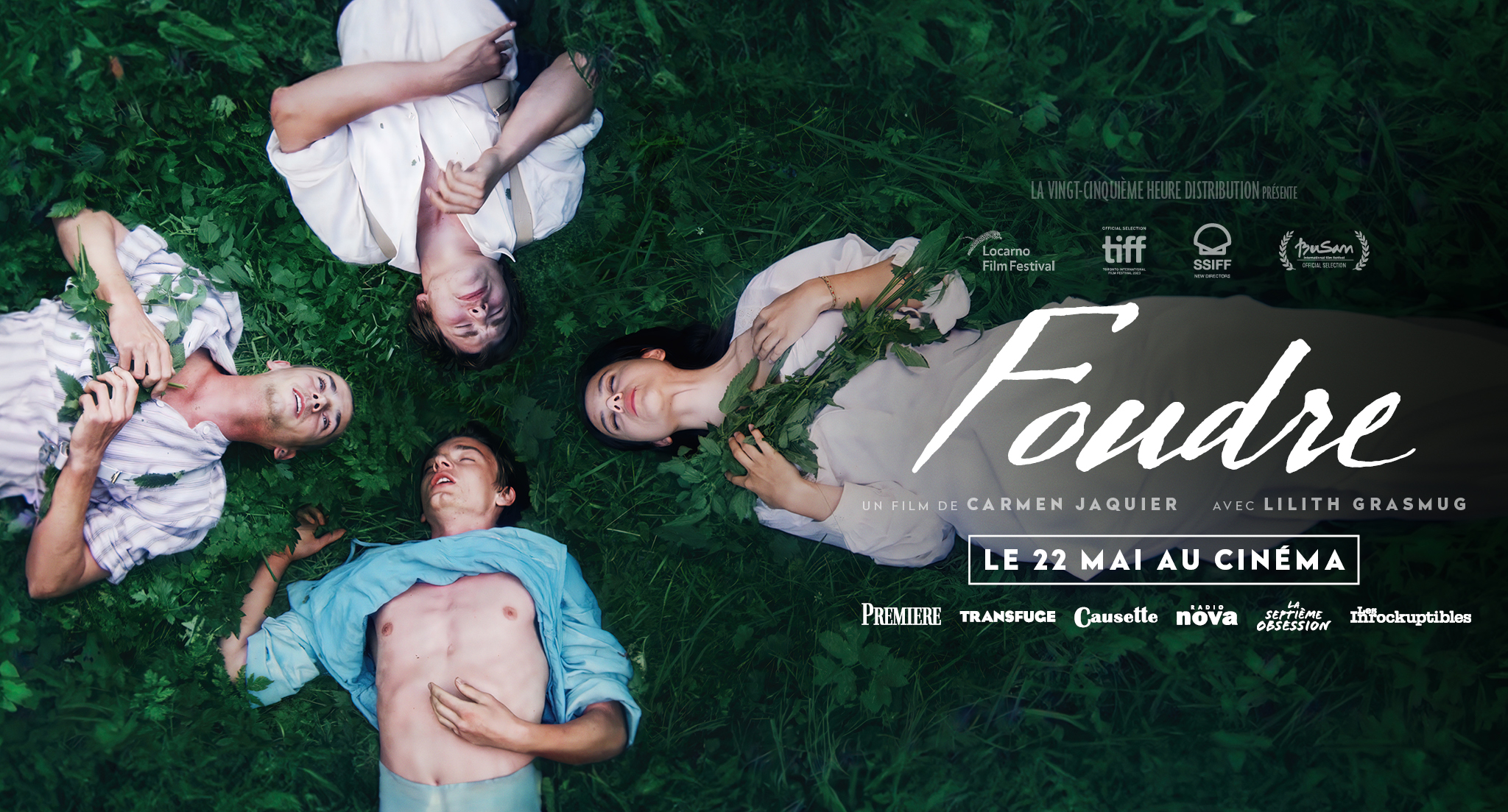
On the occasion of the release in France on May 22 of Foudre by Carmen Jaquier (which captivated us at the Chef Op’ en Lumière Festival), we sit down with its cinematographer, Marine Atlan.
You studied at La Fémis. What was your journey before enrolling there?
I was already in the Cinema track in high school. I studied for two years at the BTS Audiovisuel Jacques Prévert in Boulogne, then attended university for a year before taking the entrance exam for La Fémis. What stands out is that I came to filmmaking through photography, as I started shooting on film when I was 12 or 13 years old. The idea of making movies emerged for me from the blend of photography and a love for cinema.
How did you meet Carmen Jaquier, the Swiss director of Foudre?
In quite an unexpected way! I was teaching at HEAD in Geneva, and one of my students happened to be Carmen’s brother. During my classes, I showed some of my work as a cinematographer and also as a director. After seeing my films and my work, he thought of mentioning me to his sister. Carmen then watched Jessica Forever (the first feature I shot as a cinematographer), and my two short films (Daniel fait face and Les Amours vertes), and she reached out to me.
We arranged a first meeting after that call. When we discussed the visual style of the film, something clicked between us around two or three strong ideas.
How would you pitch the film?
It’s a tough one… I’d say it’s the story of a young woman who, while trying to solve the mystery of her sister’s death, faces the awakening of her own desires.
Did you understand the film in this way from the first read? Is this how Carmen presented it to you?
I actually remember the script being quite fragmented, filled with strong intuitions and impressions. The writing was very sensual and sensitive. The theme of emancipation emerged through conversations with Carmen, which helped me grasp the film’s more political dimension.
What were the references or the artistic direction?
She sent me the script and her previous films, which gave me some insight into the rhythm and aesthetics. They had a very unique musicality. When I read the script, I instinctively thought of the American photographer Sally Mann, who captures her family and children with a somewhat spectral, almost morbid, aesthetic. This was also a reference for Carmen. Later, during prep, we exchanged a lot about films.
Soon enough, the question of how to represent 1900 came up.
Indeed, Foudre is a historical film, but it is shot in the moment. The costumes, for instance, are not weathered. How did you approach the question of modernity?
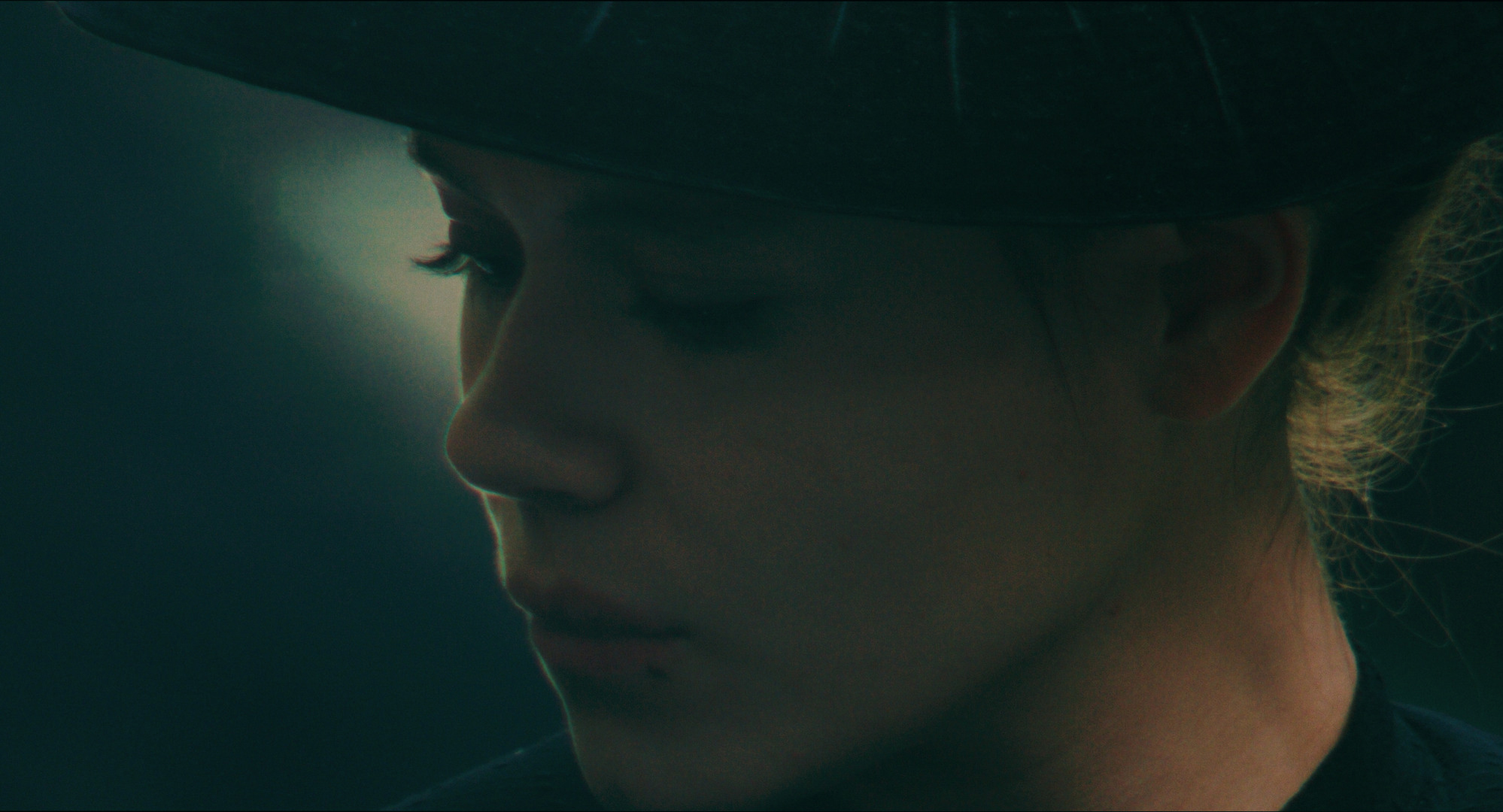
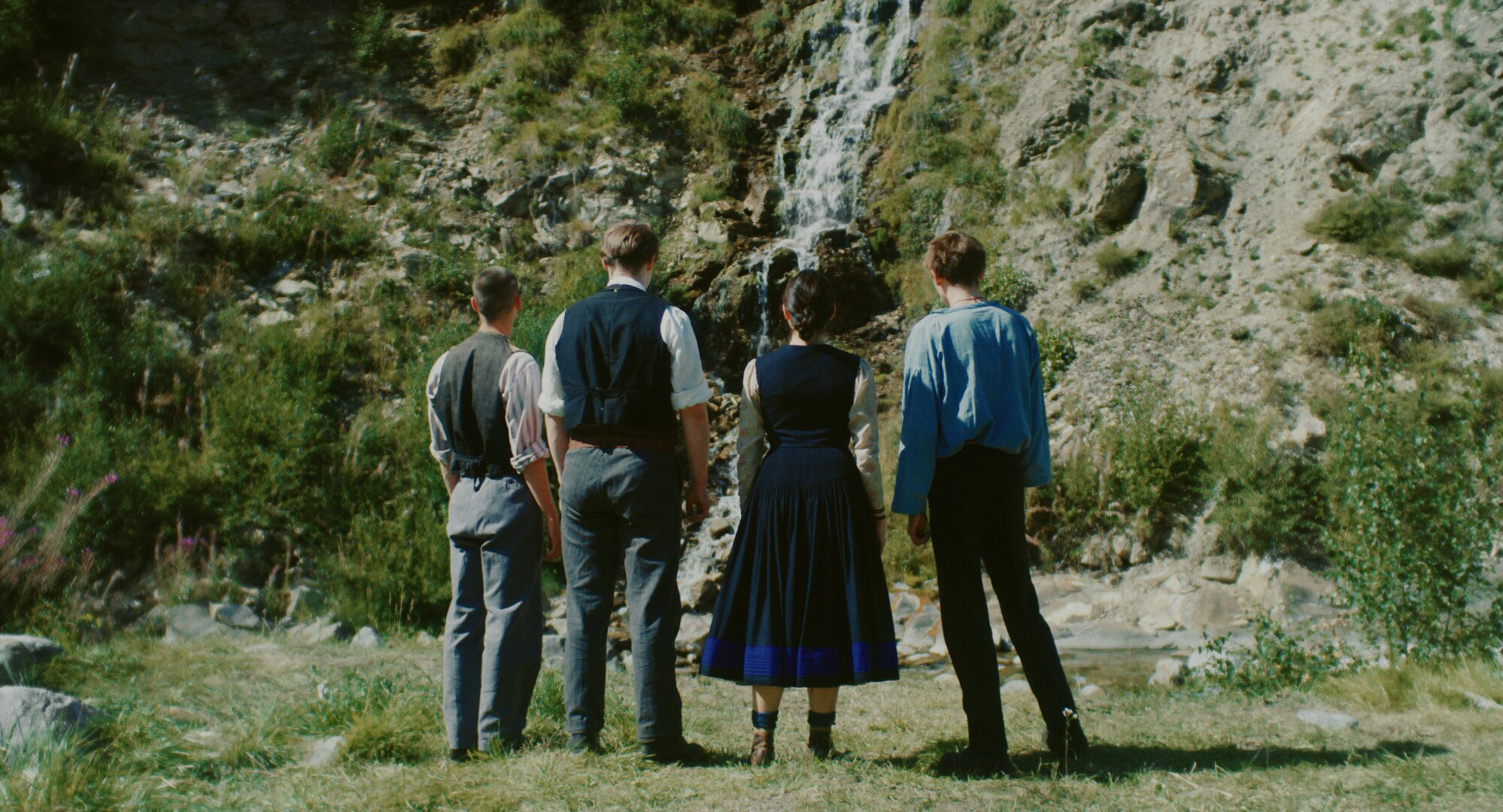
It’s funny because I just finished shooting another period film (L’Engloutie by Louise Hémon) set around the same time, but with a completely different approach. With Carmen, it was about not sanctifying things. We definitely did not want to be stuck in a period representation. She wasn’t afraid of anachronism and wanted to inject the present into this film set in 1900. Even so, she did a lot of research, and we did extensive archival image research. I became interested in the work of Roberto Donetta, who photographed Swiss peasants in the Valais. We also studied autochromes. Essentially, what we were looking for was to understand what we could take from this study for the film, rather than trying to stick to the archives. We wanted nothing rigid, nothing in the realm of reproduction, and we wanted the film to embrace modernity, seek contemporary colors, and exist through images that could transcend time. We even talked about DV, a punk image, more pop colors. It was a long process. For example, the appearance of chromatic aberrations in the film references very modern colors.
When the idea of mixing archival imagery, autochromes, and pop colors and videos came up, did you conduct tests?
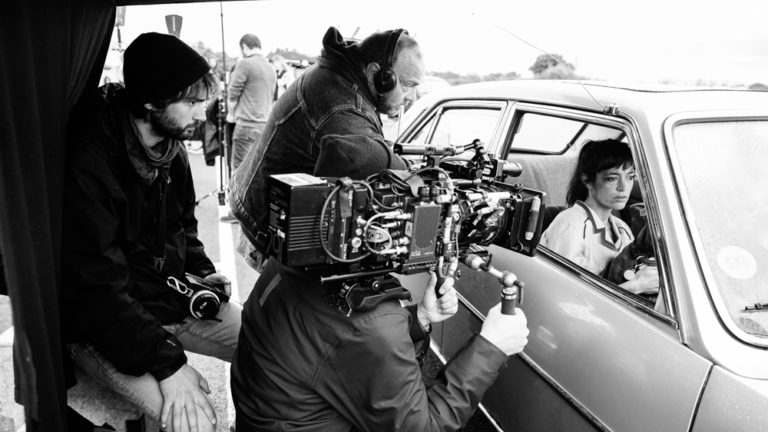
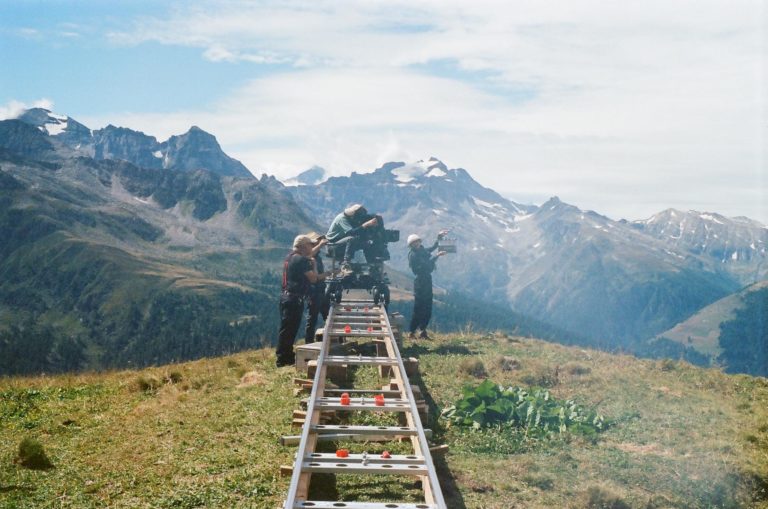
We quickly started doing tests. One thing to note is that we had more prep time because it took place during the COVID period. We began with optical tests. I tested a wide range of options and showed them to Carmen. I also experimented with stockings, Vaseline, prisms… I rented the camera gear and the RED camera in Switzerland (Visuals Switzerland), but the lenses from Panavision-Alga, who agreed to support the project. I used a Cooke MKII zoom, planning to work with long focal lengths in the film’s cinematography, so I added a doubler to this zoom. When I showed Carmen tests at 500 mm, strong contrasts revealed chromatic aberrations that she loved. For her, this captured the vibration and introduced very contemporary colors into our chromatic palette.
Interestingly, if you look at the Lumière brothers’ autochromes from that period, you can see those colors (pink and green) also exist in those photos.
This led us to explore material and color further.
So with the film’s colorist, Pierre Mazoyer, we conducted grading research. I also did tests with underexposure and overexposure. I gave everything to Pierre, along with reference images, and remotely, she explored things on DaVinci Resolve, pushing the material to find over-saturations, and also playing with contrast.
In Foudre, I recall one of the very first shots of the film, which announces the death of her sister, where the texture is transparent. The texture changes afterward. It’s not constant throughout the film (which is one reason I wanted to do this interview).
The texture results from many things. There is the quest for “vibration.” The autochromes evoked “colorful glitter” to Carmen. There’s a relationship to the image, almost a mystical cosmology. There’s also the idea of chronology. For Carmen, the character Elisabeth gradually reconnects with this sensitive relationship to the world, to nature, to others, and therefore to sexuality. There is an evolution linked to her perspective and discovery.
There’s also an element of chance. At that time, this was my second feature (it’s releasing in May in France, but the film has been finished for three years) and it was a formal exploration. I was at the beginning of an artistic exploration and sometimes let myself be surprised. But since Carmen gave me that freedom, trusted it, and wasn’t afraid of it, it opened up this field of exploration. Finally, one last layer on the subject of discontinuous texture… the re-editing of the film meant that some sequences, or certain shots, were not edited in the intended order. It resulted in a kaleidoscope of textures.
Isn’t it a bit daunting for a cinematographer, when working with a chronology, to realize in editing that it’s disrupted?
Yes, it’s like a new phase of experimentation. Our chronology is subjected to another one, the power of narration and new meaning. But I believe it establishes a new logic.
The principle of fragments was already present in the writing. The beginning of the film uses chiaroscuro, working with daylight entry in a fairly classical manner, inspired by the great masters (Caravaggio…), and gradually the light emancipates. It seeks overexposure and less classical structures. The film gradually frees itself from warm colors (tungsten, candlelight).
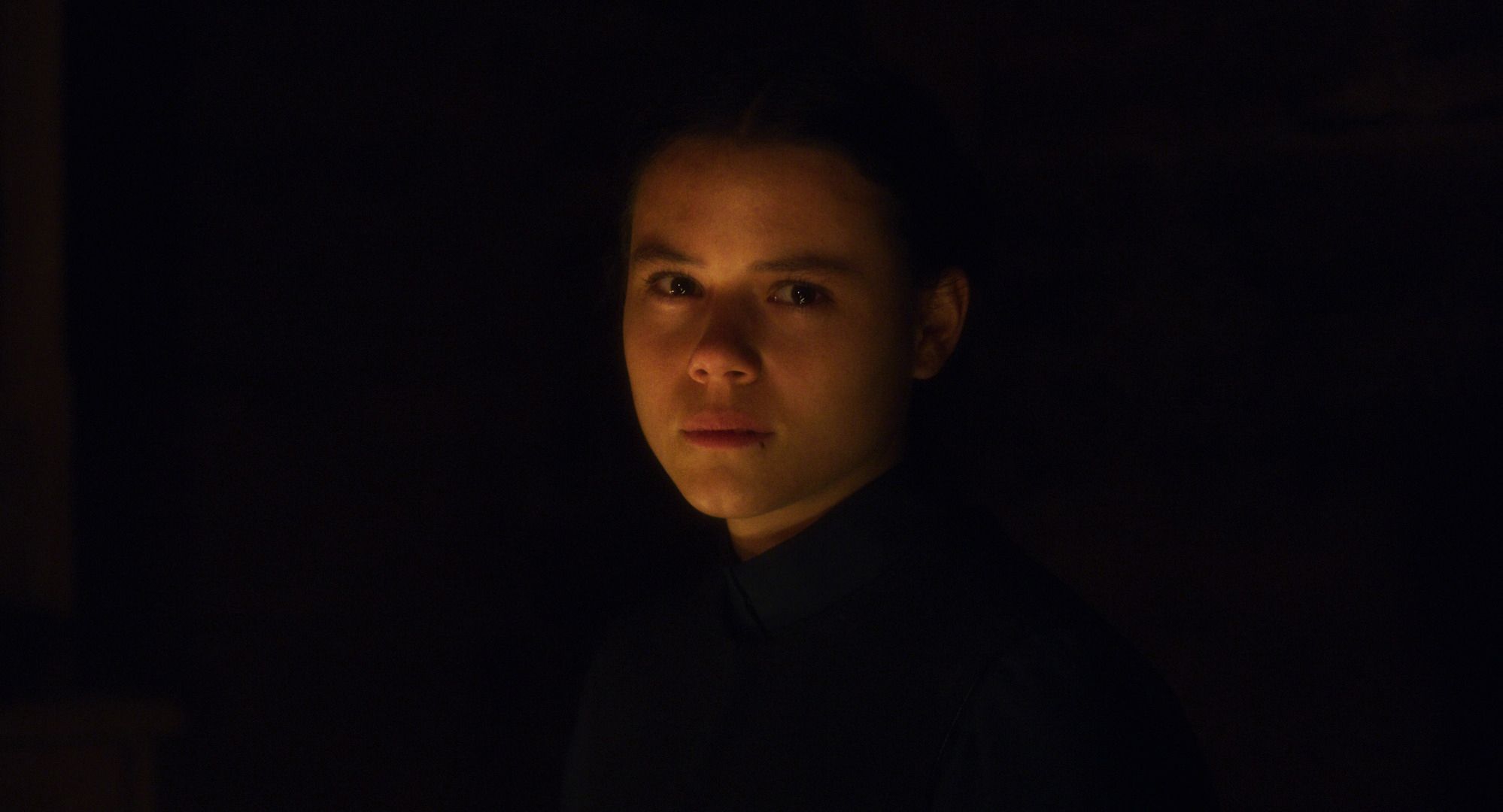
There’s a scene lit by candlelight with a very strong diffusion.
Yes, the stocking behind the lens stayed on for the night scenes. It had been tested and approved by Carmen for what it did to the definition of the skin, and she loved the halos it created. This also came from the photos and films she loves; it was a way to evoke them.
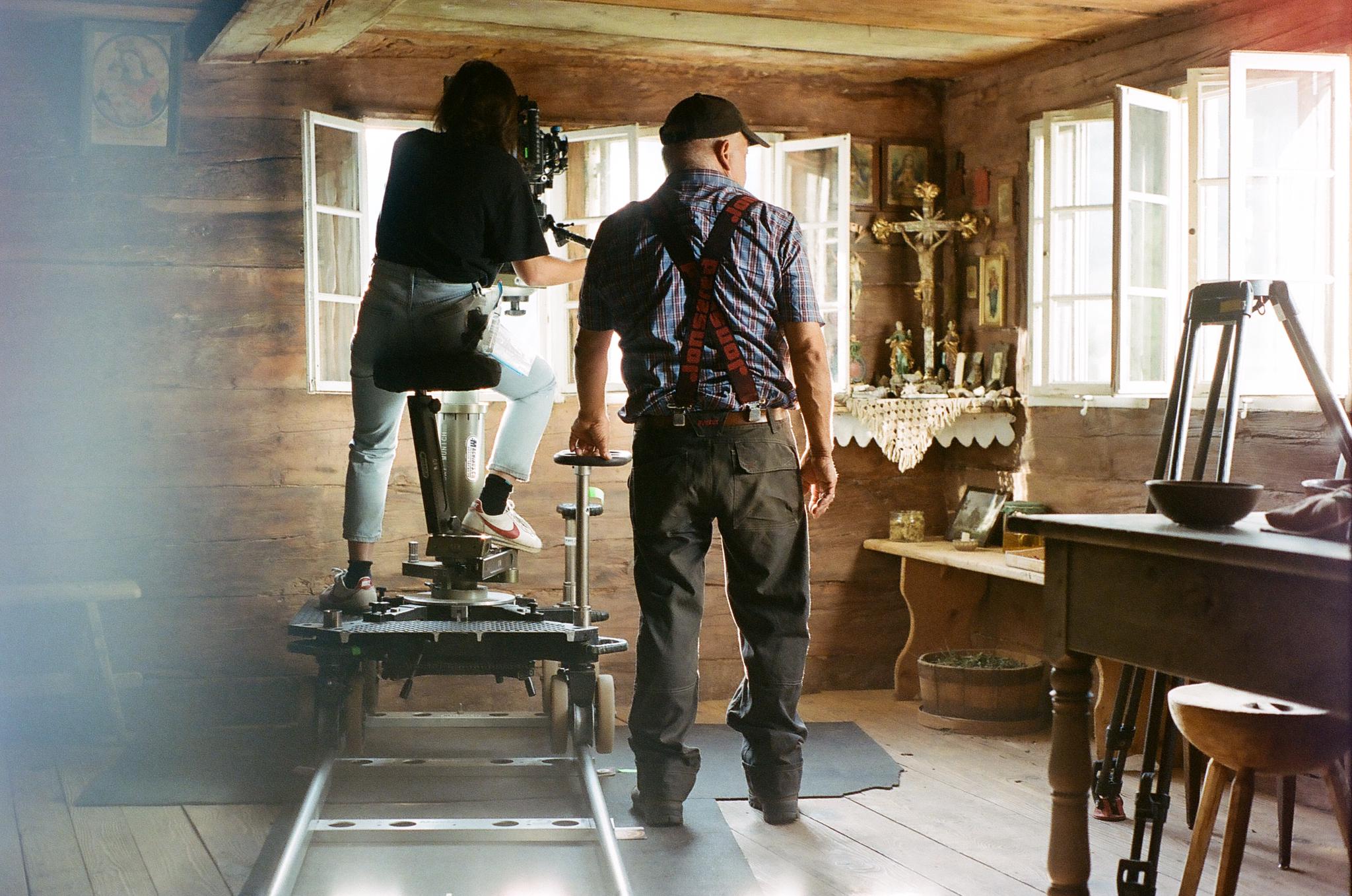
Ultimately, COVID provided valuable prep and development time for the film. (Perhaps it’s worth reconsidering: the experience that post-COVID films have been more serene and free because they had more preparation time and a stronger fusion between directing and cinematography). For this project, you had a director who wanted to test, provoke, and invoke, but you also had the time to try things and show her. Without this, are there effects you wouldn’t have been able to propose during filming?
Yes, it would have been too risky. Boldness comes with experience using the tools. I was still afraid of going too far sometimes, but at least I knew the direction I was heading. And indeed, the dialogue time built trust between us. There’s always the first week, which remains a meeting on set. But the film exchanges, the storyboarding, this shared cinephilia were very important.
There’s a forest sequence where the effects are very pronounced, with changed shutter speed and very video-like colors. Can you tell us about it?
It’s the part where Elisabeth reads her sister’s journal. She discovers her sister’s voice. This is where we pushed the material the most. Carmen talked to me about miniDV cameras and 90s music videos. We went very far on set and even further in grading. There are noise increases, very strong saturations, something acidic. Carmen told me this moment should be raw, not romantic at all. The words she reads express a direct sexuality that is not filmed but read. We closed the shutter and worked with very long focal lengths, up to 500 mm. It was one of those rare days on set where the goal was to capture material very freely, with the scene’s intention as the only constraint.
Carmen loves this oversaturated ear. And I love it too. I really enjoy saturation. For me, it’s expressive; even moments that are technically on the edge between error and choice have meaning. When she falls to the ground, I see this ear and it conveys her emotion. For Foudre, I never went to places I didn’t want to go. Everything we did, we did together, including with Pierre in grading. There was a lot of dialogue between all of us.
I worked with Lilith Grasmug on another film, and I remember a conversation with her. Lilith is an actress very committed to her performance, who doesn’t hold back when she acts, and she remembered you on Foudre as a cinematographer who could end a take in tears, and if what was happening in front of the camera moved you, you expressed it. Do you remember the same?
It’s true, I do get emotional while filming. I think it also depends on the films (not just their subject matter but also the set). We were on a set with mostly women in key roles, women for whom this was their first feature film, and Carmen allowed, through her working method and sensitivity, a relationship I find healthy, where it was possible to be moved and express emotions while working. We were very focused, but this emotional openness was there.
There’s something transversely connecting the film and its creation. Notably, we did something that’s rare nowadays: a dailies screening. Midway through filming, we set up a 4×4 frame to project, one night, on the set, a selection of dailies that Carmen had edited. This created a permeability between the film and the crew, between what we were making and what we were experiencing. It made it easier to be emotionally open than on other films.
When I talk to students about framing, I tell them the best way to frame well is to be with the actors, to be focused and fully immersed in what you’re filming. I see myself as a spectator on set.
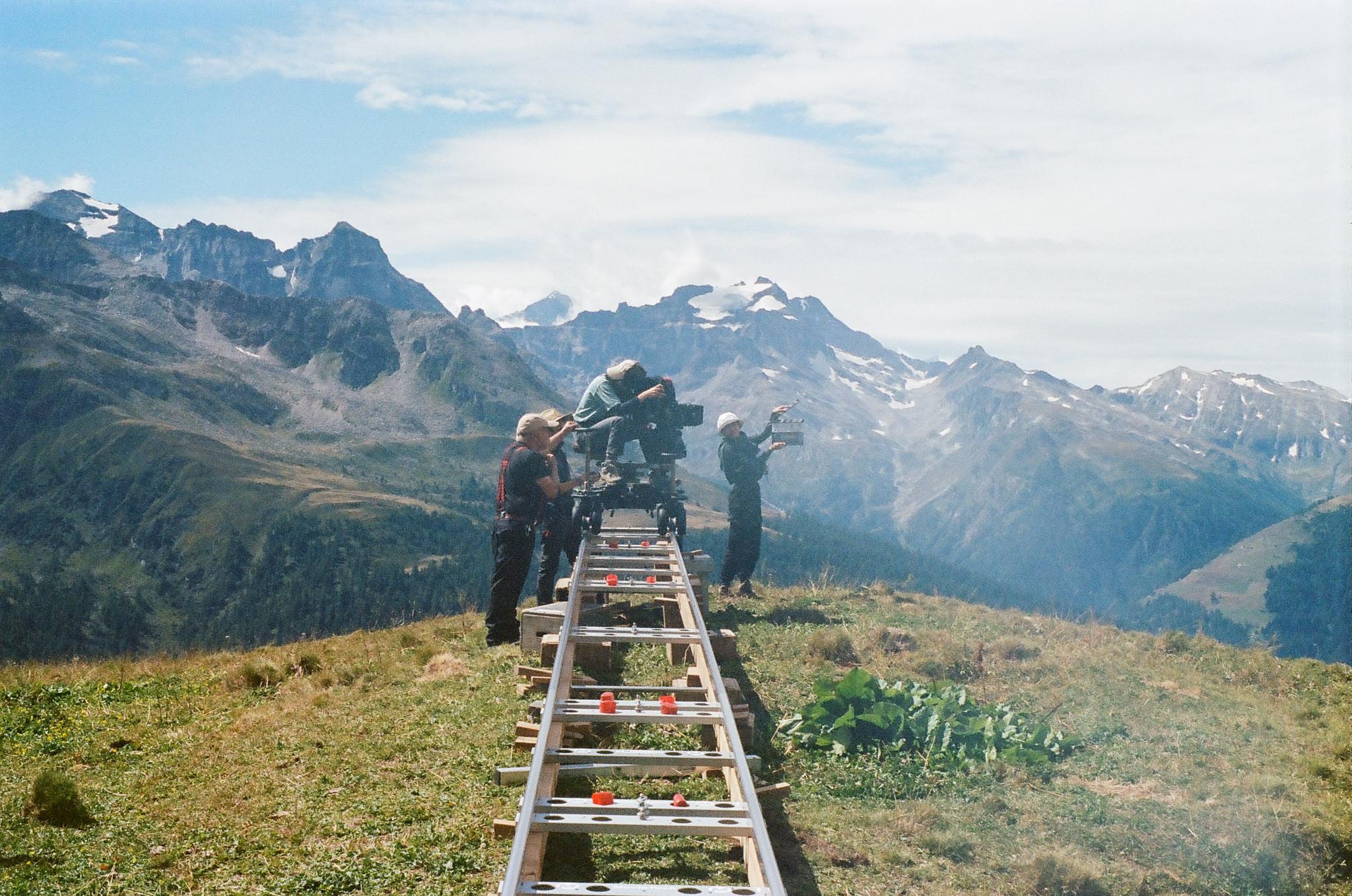
(This makes me want to share an interview I did at Camerimage with Sturla Brandth Grovlen, who even asks for an actor’s input when framing).
Additionally, as a female cinematographer, I’ve sometimes wondered about my tendency to try to embody the role of the cinematographer. Saying that the cinematographer is just another spectator, and that the more immersed they are in what they’re doing, the more they convey emotions, hadn’t been expressed much until now.
Indeed, not performing your role is crucial. We are there to observe. These are long conversations, but yes, there is the idea of freeing oneself from the technical aspects to fully see what you’re participating in. I find it fascinating to explore a face for eight weeks.
What I find difficult, though, is that there’s a specific monitor I love and find reliable (the SmallHD 303) and I can’t get that image in my viewfinder! This forces me to frame using this monitor when I focus on lighting. I’d love to have a very good eyepiece.
Can you tell us about the nettles scene?
It was a somewhat unique setup: the actors chose the experience they wanted to have, either with prepared nettles that no longer stung or with stinging nettles. It was a top-shot setup and a ritualized performance of about ten minutes for each actor. They reached a state quite close to trance. For this scene, we aimed for a very realistic skin tone. We wanted to see the textures and colors of the skin in as much detail as possible.
It was quite an intense experience, but within a controlled environment and timeframe. Carmen was very attentive to everyone’s needs.
Ultimately, in the film, this sequence is fabulous, extremely sensual and original, and it contributes to the film’s modernity and uniqueness: a film about sexual awakening and emancipation, where you never see a bare breast.
Yes, Carmen also spoke about sexuality without penetration, a sexuality that exists elsewhere. Besides the collaboration with the actors, there was also a choreographer present, someone to communicate with about the body (we didn’t talk about intimacy coordinators back then). There are many ways to approach it. The film is extremely erotic.
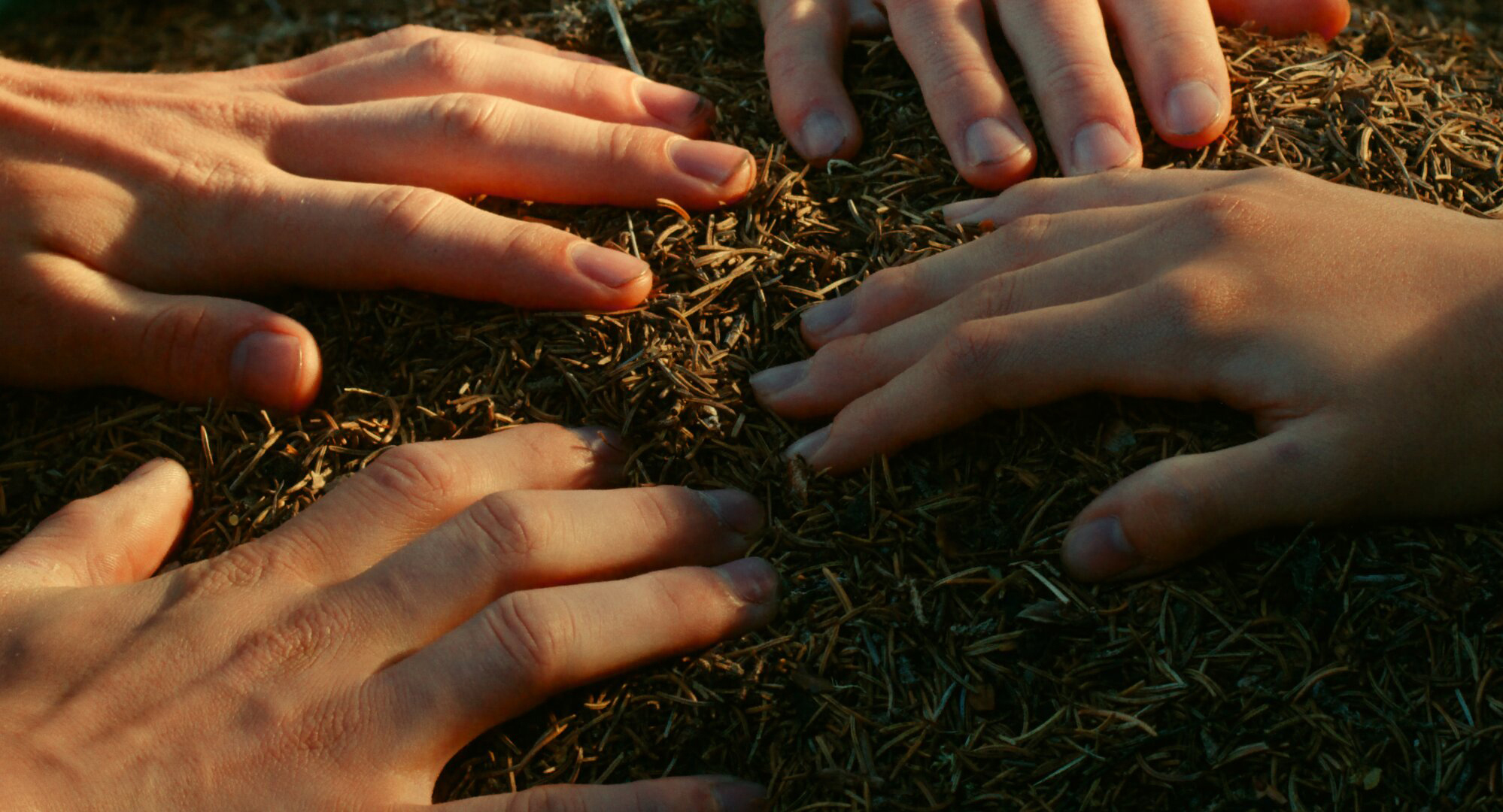
The film also brings sexuality closer to spirituality rather than violence.
This is Carmen’s primary cinematic gesture.
One last question: you are also a director and pursue both careers simultaneously. Your two short films have been widely viewed and awarded. You received CNC funding for your first feature. How is this transition for a cinematographer?
This process has been ongoing for a long time. I’ve made my films alongside my work as a cinematographer. Filmmakers who reach out to me are aware of this and often have seen my films. For this first feature as a director, with the experience of my seven feature films as a cinematographer, I appreciate the workload involved in directing a feature. Until now, I’ve handled the cinematography for my short films with Benoît Bouthors, who is also a director and a gaffer (notably for Claire Mathon on Saint-Omer). This time, I decided to collaborate with Pierre (with whom I’ve been working for a while in post-production) and co-sign the cinematography with her. I know I’ll sometimes need to operate the camera, but I’ll also have about fifteen actors to direct (the film is about a school group on an excursion to Pompeii). After grading Alexis (Langlois’s Les Reines du drame), I’m heading into pre-production.
Preparing for a first feature is quite an adventure!