On Thursday, November 12, Camerimage screened Manhunt, a fiction feature directed by Wayne Wapeemukwa and shot by Jon Glendon. The film was competing in both the Cinematographers’ Debuts and the Directors’ Debuts competitions.
Synopsis: Two young men, Joey and Kit, set off on a road trip across the vast expanses of Canada’s Far North and are gradually drawn into a spiral that leads them to the gates of hell.
During the Q&A, which brought together no fewer than five members of the Canadian crew (thank you to them!), director Wayne Wapeemukwa and his cinematographer Jon Glendon looked back on the aesthetic and technical choices that shaped the film. From a palette that slowly drains of color to the use of an infrared camera, with a camera team kept to a bare minimum, they built a visual experience that follows the drift of their two young protagonists. A plunge into a contemporary hell, where the transformation of the image mirrors that of the characters.
Infrared: picturing the descent into hell
From their very first discussions about the script, Jon Glendon asked Wayne Wapeemukwa about the two protagonists’ descent into hell and how to convey it on screen. The director’s vision for these scenes ran counter to traditional depictions: hell first had to appear seductive, colorful, almost wondrous. An aesthetic that reflects the illusion of freedom the two protagonists believe they feel when they finally let loose the violence seething inside them.
“For these incels, hell is colorful and it’s pretty awesome, at least for a while.” Wayne Wapeemukwa
This idea gave rise to the desire to experiment with infrared imaging, which the cinematographer suggested in their very first conversation.
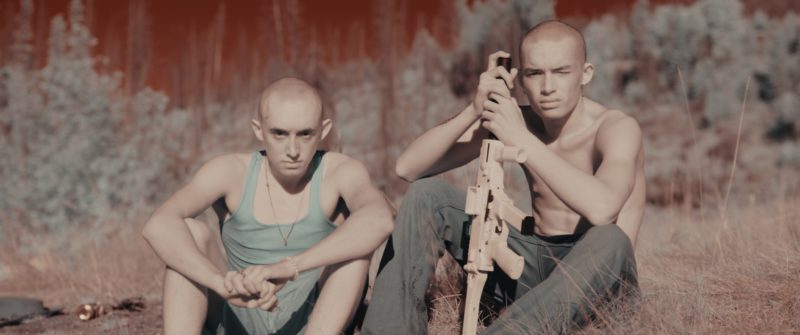
To bring this vision to life, the team developed an unconventional camera setup. The shoot relied on three cameras, and as many image styles: an Arriflex 416 Super 16 fitted with a Canon 9.5–64 mm zoom for the prologue and epilogue, an Alexa Mini, and a second Alexa Mini converted to full spectrum, its sensor modified to make it sensitive to infrared and record a wider range of the light spectrum. This full-spectrum camera was paired with infrared filters from Kolari Vision, used to select the wavelengths being captured.
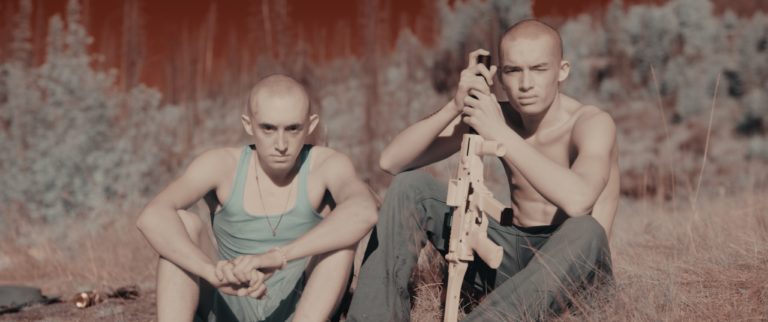
The principle is to capture part of the infrared spectrum, then combine it with information from the visible spectrum to produce images in unusual colors. Foliage in particular is transformed, taking on orange, pink, or red hues. A way of gradually tipping the landscape into a reality that no longer quite belongs to the visible world.
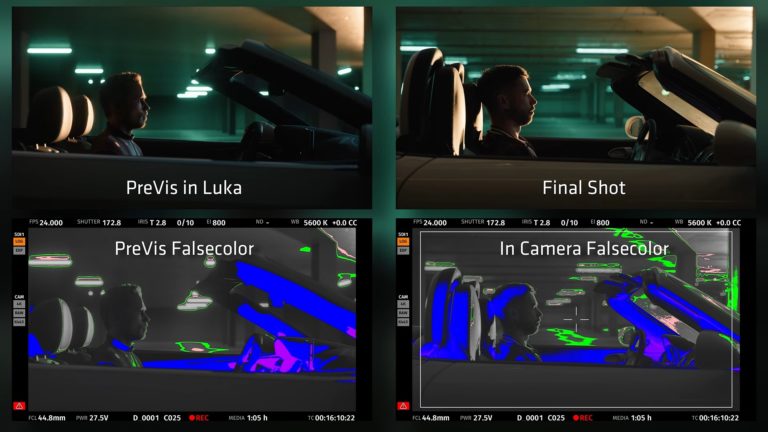
But the experiment was not without its difficulties. Jon Glendon explains that infrared overturns many of the camera team’s usual reference points. Focus doesn’t fall on the same plane as in visible light, exposure readings become unreliable, and the image on the monitor reveals information the eye cannot see directly. They had to feel their way forward, relying more on instinct and experimentation, in as organic an approach as possible.
Manhunt, by Wayne Wapeemukwa. © Aspect Ratio Films
Alex Nunes, the first assistant camera, had to get to grips with the physics of infrared and the filters being used. Pulling focus required constant adjustment, as some of the usual tools became useless. The team discovered, among other things, that an infrared flashlight could throw out of focus an area that was perfectly sharp in visible light.
The experimentation also extended to lighting. For some scenes, gaffer Aidan Johnson used infrared lamps, invisible to the naked eye, whose aim had to be constantly checked on the monitors. Above all, though, the team discovered the potential of fire. In infrared, fire gives off a considerable amount of light that the human eye cannot see. Small embers could thus appear on the monitor as an extremely powerful light source.
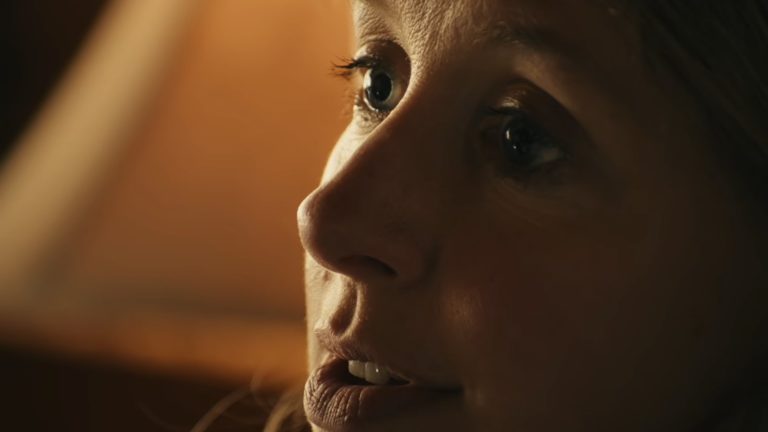
This property was put to use in the campfire scenes in particular. The red light envelops the protagonists’ faces and gives them an almost reptilian look that goes hand in hand with their transformation.
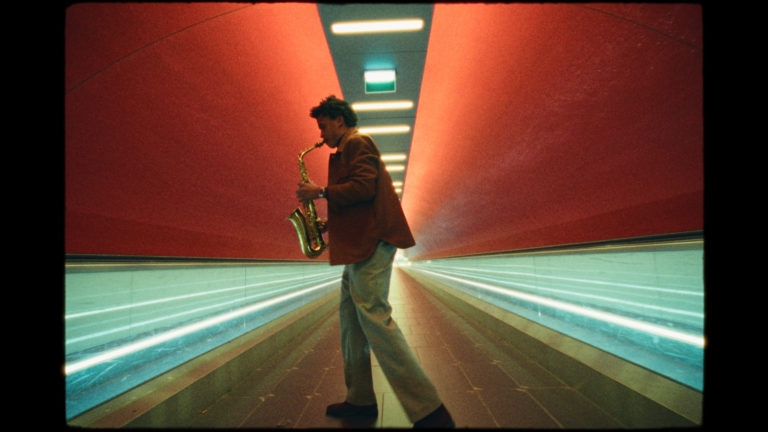
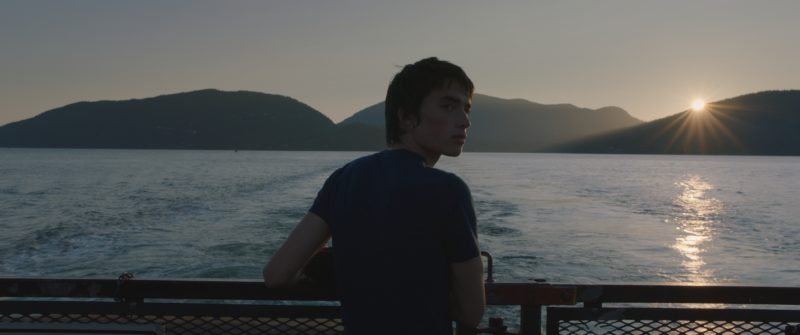
Yet infrared is not just an aesthetic effect reserved for the final act. The transformation of the image begins well before infrared appears. Jon Glendon explains that he devised, with Wayne Wapeemukwa and colorist David Tomiak, a gradual desaturation of the whole film. Scene after scene, the colors imperceptibly lose their intensity, until the world is almost entirely drained of color.
To build this sensation, Glendon cites Breaking the Waves, shot by Robby Müller and directed by Lars von Trier. He points to the way that film gradually lets a brown cast into the image, until the audience stops consciously noticing it while still feeling its effects.
Manhunt, by Wayne Wapeemukwa. © Aspect Ratio Films
David Tomiak’s grading work consisted of supporting this progression without ever making it too obvious. For the infrared images, his main concern was to preserve the distinctive quality of the image captured in camera, without tipping into a look that would have resembled a digital effect.
Restraint becomes a guiding principle here. Even when the image seems to break free of the natural laws of color, it retains a kind of materiality. The final sequences play on successive variations: pink trees, a purple sky, black-and-white infrared images, then intense red. For Glendon, this instability conveys the characters’ gradual loss of touch with reality. We no longer simply see their surroundings: we see them the way the characters perceive them.
At first there is a kind of softness in these images. Under infrared, the skin becomes almost translucent, sometimes revealing the veins. The faces take on a childlike look, almost that of newborns. Jon Glendon and David Tomiak talk about this idea of rebirth, of a physical and symbolic transformation. But this softness gradually turns unsettling. The characters’ eyes, and particularly their irises, turn black and give them a demonic look. Wayne Wapeemukwa adds that he also wanted to show the characters as child soldiers.
Building to a reversal
The visual transformation of Manhunt also rests on a very precise plan for camera movement and shot sizes. From the start of the shoot, Wayne Wapeemukwa and Jon Glendon set distinct rules for each of the three acts.
In the first two, the camera stays handheld as much as possible. Glendon favors shots from behind and three-quarter framings, which show the world in front of the characters without ever fully meeting them. The audience travels with them but keeps a certain distance.
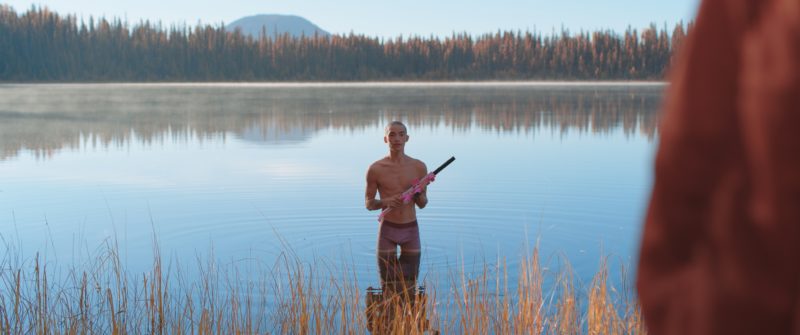
The third act radically reverses this principle. The camera locks off and the frames gradually widen. The characters, fairly prominent in the image at first, grow smaller and smaller until they seem swallowed by the landscape. The cinematographer sums it up: “We wanted nature to engulf them.”
This change of approach reflects a kind of reversal. At first, the two boys seem to move through a world they think they can control, where other people and nature appear as resources at their disposal. According to Wayne Wapeemukwa, this stance echoes a logic of domination inherited from the colonial imagination: that of a world the white man could appropriate and bend to his will. As the story progresses, the framing strips them of this illusion of power. Nature reclaims its place, while the characters gradually lose their hold on space. They are no longer at the center of the world they pass through: in the end, it absorbs them.
Manhunt, by Wayne Wapeemukwa. © Aspect Ratio Films
The editing contributes to this construction too. Coline Debray, the film’s editor, explains that a rule was set from the outset: don’t cut when there is no reason to. But working with non-professional actors and a great deal of improvisation meant that complete scenes were not always available. Wayne Wapeemukwa therefore encouraged the use of jump cuts, not as a mere break in continuity but as a genuine element of film language.
Ellipses and gaps thus become part of the storytelling. They express what the characters lack: relationships, emotional anchors and, notably, Joey’s mother, conspicuously absent from the film. The editing does not try to fill these gaps but to give them shape. This absence finds a counterpoint in the brief appearance of Kit’s parents, just as the two teenagers are about to set off on their road trip. In a single shot, the film sketches a home that seems stable, a middle-class family with no apparent dysfunction. At first glance, Kit does not seem to carry the same wounds as Joey. And yet he is the first to lose his footing and slip past the point of no return. This contrast keeps the boys’ trajectory from being reduced to a purely family or individual explanation. The evil the film depicts seems rooted in something larger: a social, political, and historical legacy that goes beyond personal stories.
“Misogyny is revealed here not only as destructive to women, but also as a slow self-destruction of men: a portrait of despair taking hold in a world that has forgotten how to look at itself.” Wayne Wapeemukwa, in his director’s statement
A shoot rooted in reality
This formal exploration took shape under particularly tight production conditions. Jon Glendon came on board about 6 weeks before principal photography, after the original cinematographer dropped out. The main shoot lasted 24 days, plus 5 days of pickups shot a year later.
The crew was deliberately small: Aidan Johnson doubled as gaffer and key grip, with occasional backup from grip Francis Rogers, while Alex Nunes was the only camera assistant. This setup demanded a great deal of versatility, especially since the last two weeks were spent camping in remote parts of Canada, hours away from anywhere.
A film conceived as medicine
Beyond its aesthetic choices, Manhunt lays claim to a political and cultural dimension. Wayne Wapeemukwa considers the prologue and epilogue, in which an Innu couple appears, to be the soul of the film. Drawing in particular on conversations with his Indigenous Elders, the director set out to anchor the story in Canada’s colonial history. These sequences give historical depth to the uprootedness of the two teenagers, deprived as they are of community and a sense of belonging.
The smudging ritual that closes the film then takes on its full meaning. Presented by Wapeemukwa as a form of medicine, it seems addressed as much to the characters as to the audience. When the smoke is directed toward the camera, the gesture symbolically crosses the boundary of the screen and invites us to question our own relationship to violence. We too are heirs to a history marked by colonialism and patriarchal power relations, whose traces continue to shape our societies. Purification then becomes an invitation to acknowledge this legacy in order to try to break free of it.
From its desaturated brown to the unreal colors of infrared, Manhunt reveals a world in metamorphosis, one that becomes almost seductive before revealing its monstrousness. The camera follows this drift all the way to the final reversal: the world the two boys thought they could dominate ends up swallowing them.
A radical visual proposition, grounded in experimentation as much as in restraint, that makes cinematography far more than an accompaniment to the story: its true language.
Try it yourself
A quick note if you’d like to cook up some infrared yourself:
RVZ rents full-spectrum OLPFs (optical low-pass filters) for RED cameras in the DSMC2 range.
Add to that a kit of Kolari Vision filters:
Pro Cinema 4×5.65 infrared filters from Kolari Vision
About the IRChrome filter, developped by Frenchman Yann Philippe, here is some further reading:
The story of the IRChrome filter
And to go back to the roots of color infrared, read our earlier article on color infrared photography.
Then, let the experiments begin!