Myriam Bakir’s documentary (63′) addresses the tragic issue of single mothers in Morocco. To mark the film’s selection at IDFA, one of Europe’s most renowned documentary festivals, held in Amsterdam, I asked Gertrude Baillot, the film’s cinematographer, to share her experience on this project.
Due to health restrictions, this year’s festival runs from 18 November to 6 December, mainly online, although Dutch audiences can attend screenings at reduced capacity.
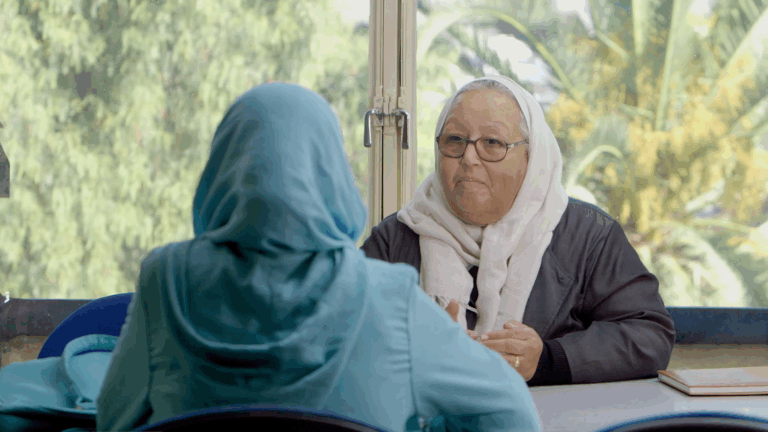
Through the portrait of Mahjouba Edbouche and her organisation, Oum El Banine, in Agadir, Mères depicts the painful situation of single Moroccan women who, pregnant out of wedlock, risk imprisonment and social disgrace, for themselves and their child. Most of the time, they don’t dare tell their families about their situation, for fear of being rejected and excluded, or even suffering violence…
The organisation takes these women under its wing, providing shelter, legal assistance, and preparing them for motherhood. It also seeks ways to restore relations with their parents as early as possible.
By bearing witness to Mahjouba and her team’s feminism in action, the documentary questions the social and family straitjacket at work in Morocco.
How did you end up on this film?
I was contacted by Cécile Vacheret, the film’s producer, who called me through a sound engineer friend. The film was co-produced by Morocco and France, and the producer was looking for a woman cinematographer, given the film’s subject matter and its shooting conditions.
When I met the director, Myriam Bakir, she quickly told me about the crucial visual challenge: ensuring the anonymity of the women we would be filming. Reframed as a question, this became: how do you make a film without showing the main characters’ faces?
To feed our thinking, I brought up Pork and Milk (DP Céline Bozon) to imagine how one might film someone from behind or in backlight. We also talked about the wearing of the veil, which would be part of the equation…
Under these conditions, I wondered how we could still tell a story.
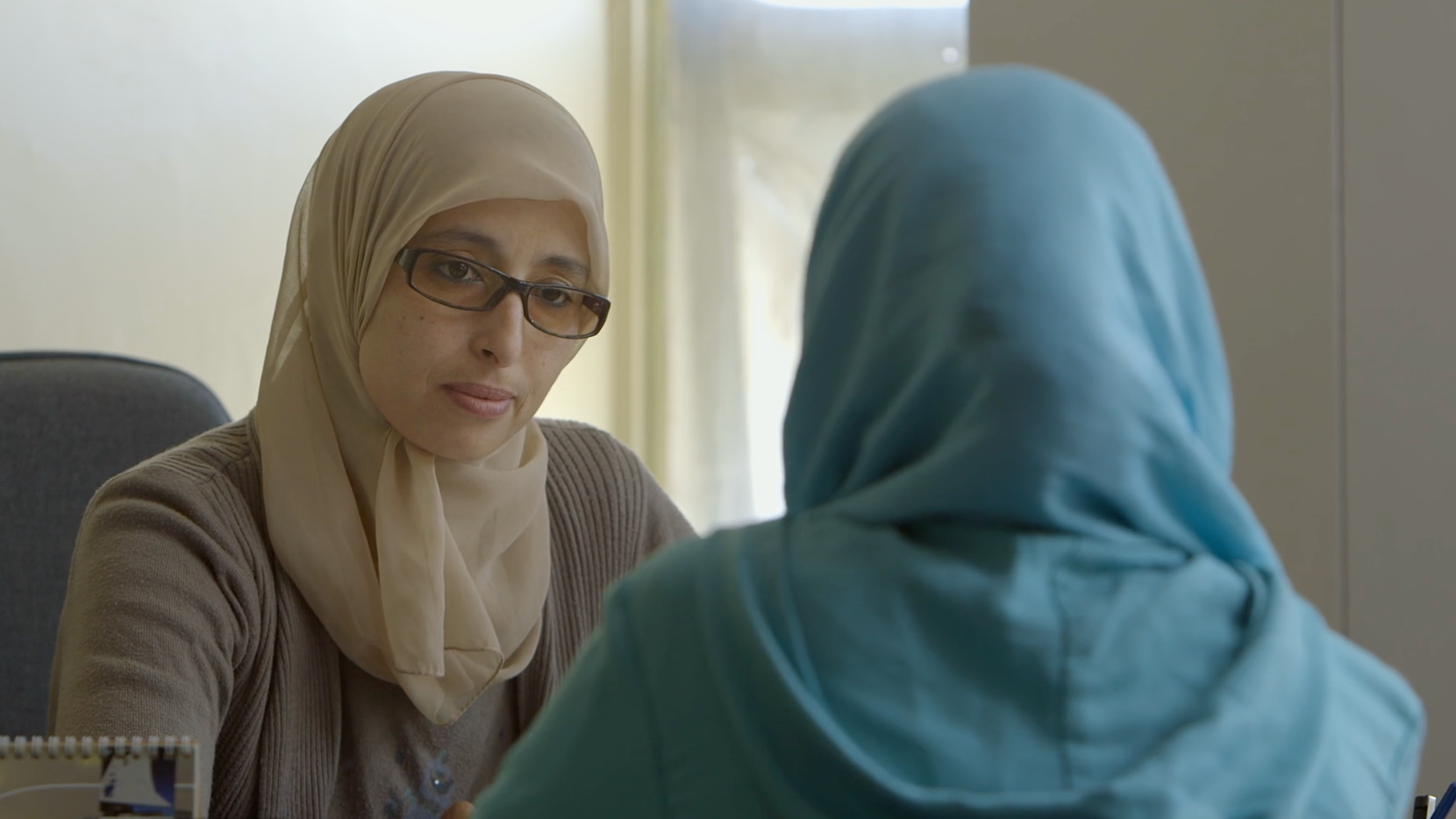
The film is shot entirely in Moroccan Arabic and Berber. What direction did the director give you, and how did you approach the framing?
Shooting alone in China a few years earlier for another project, I had been faced with not understanding what was being said. But since I had no choice, I decided it wasn’t a problem. And it isn’t necessarily. To me, a good documentary cinematographer works by ear — they listen and cut according to what’s being said, in sync or off-camera, what repeats, the rhythm of the sentences. It’s hard when you don’t understand the language and you’re still trying to work out what’s being said, but you also work to the rhythm of breathing, gestures, glances — you manage to sense it, and most of the time, it works.
In the case of Mères, Myriam had very precise ideas about the framing; she didn’t want us to reframe during takes, for instance. It was a little frustrating, because in documentary we’re used to shooting coverage to allow options in the edit and to follow what’s happening or being said, but in this case I had no choice — and I have to say Myriam was right.
What’s more, Myriam explained everything to me: what was going to happen, what was at stake, what was said off-camera, and what we had shot. As I said, not understanding what’s being said isn’t a problem — above all, you’re filming the story you want to tell.
Funny story: we were shooting in Berber, and even my assistant, who is Moroccan, didn’t understand what was being said!
What requirements or constraints guided your equipment choices?
The film was shot on a relatively small budget, with a C300 that had been lent to us on location, fitted with several Canon L lenses. I knew this camera well, and had my habits with it — I had brought my Canon 100mm macro, a very basic and practical “donut” ring and shoulder rig.
Mères is Myriam’s first documentary; she comes from fiction. On set, she would work out the staging of the sequence we were about to shoot, adjusting the setting as needed. So we had time to set up, and to work on the lighting.
I always had a 575 HMI and some Mandarines on hand, bounced indirectly, as well as a Chinese lantern, tungsten. All rented in Agadir. Finally, I had a small LED torch permanently mounted on the camera, switched on or off depending on the situation, and diffused to a greater or lesser degree.
When the sunlight was really too strong, we sometimes had to neutral-density the windows — typically in Mahjouba’s office!
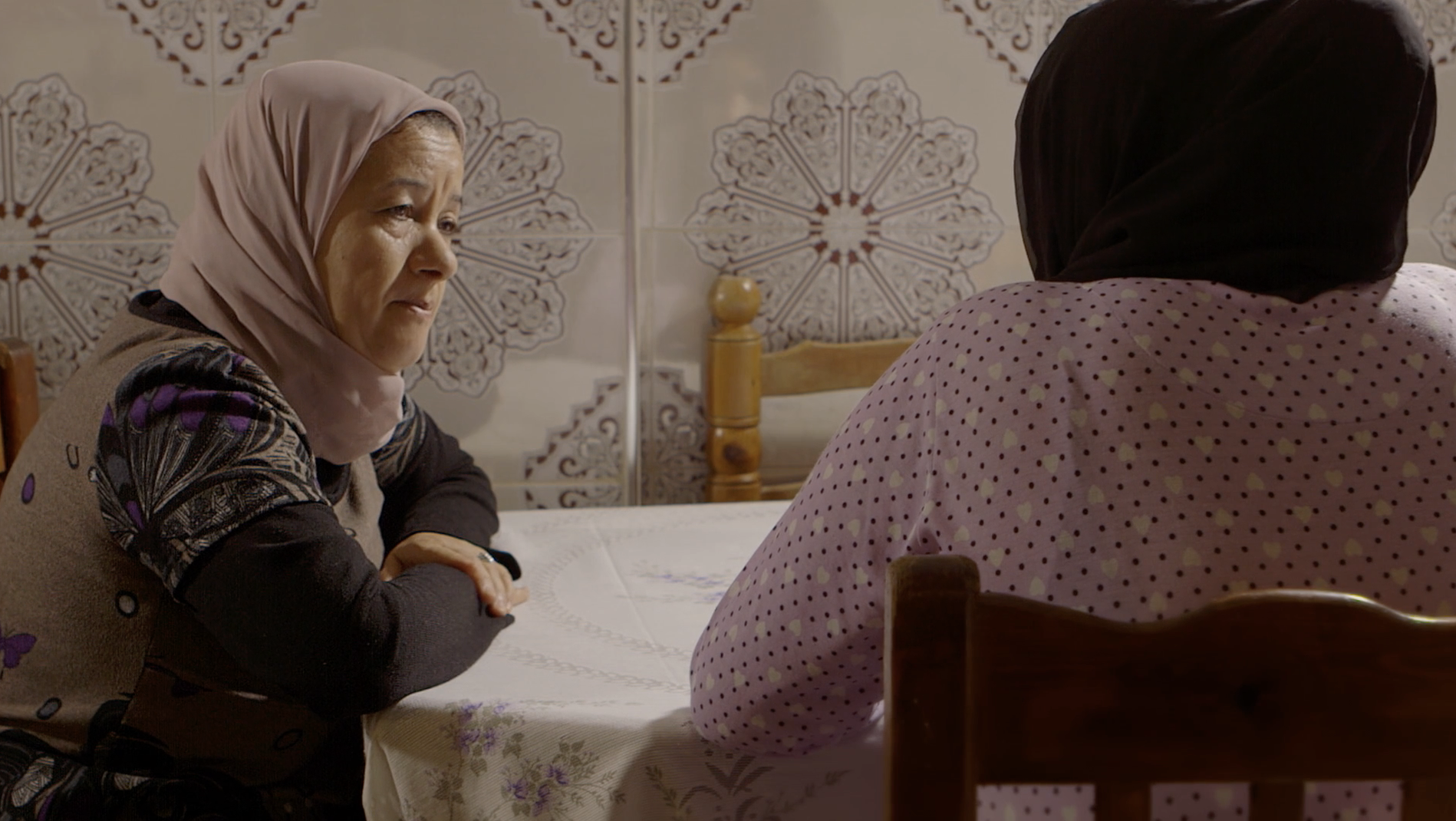
How do you film the scene with Fatima and her parents, a confrontation scene whose outcome is uncertain?
One of my priority missions on this film was that the characters shouldn’t be recognisable, and since we were living in an essentially clandestine world — these women being at risk under the law — it was something of an obsession for me. For example, when Fatima embraced her father, and I risked seeing their faces, I naturally sought out Mahjouba’s reaction instead, whose face I could film, and which also expressed an important emotion: compassion. Then, seeing that they were embracing so tightly that their faces were no longer visible, I was able to keep filming Fatima and her parents.
The camera lets you experience things with a certain emotional distance — behind the eyepiece, at a remove, in the end… Empathy doesn’t travel through the same channels.
To come back to the question of anonymity, I’d say the veils, with their multitude of patterns and colours, helped me a great deal throughout the whole film!
As a daughter, a woman and a mother, how did you experience witnessing these women’s lives being upended, living through moments of extreme existential fragility?
When you’re immersed in a human world, as is often the case on a documentary shoot, it’s very intense and very rich. People accept you as a human being, and holding the camera generally gives you an aura of respect and admiration — as a result, people protect you, and the director protects you a great deal too.
I’ve worked a lot with women, so I know what it’s like to be surrounded only by women.
At the Oum El Banine Foundation, I felt as though I were in a cocoon; with these Moroccan women I felt something stronger, a very emotional bond, a trust…
Thanks to them and to the crew, I discovered what it means to be a woman in Morocco — a very beautiful relationship between father and daughter, in particular, but the relationship with men is entirely distorted by the way society is structured, the rise of religious radicalism, the fear of what people will say, social pressures…
You have to really grasp that these women find themselves outside the law simply for being pregnant out of wedlock, bearing alone the weight of a terrible guilt…
Despite the warm atmosphere at the Foundation, and the fact that among women they could remove their veils, having to hide the fact of being a woman is a great violence, day after day. After two weeks, I couldn’t take it any more, filming nothing but veils in place of faces — I almost wanted to go out naked in the street!
How did you approach the grade?
Éric Salleron graded the film at Avidia, in their new large suite, on DaVinci Resolve. Éric and I have worked together for ten years; we know each other well.
Since Myriam couldn’t be there in person, we prepared the finishing touches over a long WhatsApp conversation, and then, during the grade, I sent her a few sequences where there was potential for discussion.
In the end, we stayed quite close to the rushes — there are very few power windows in the final grade. With the C300, I generally shoot with a Canon Log gamma, standard matrix, which avoids a loss of information in low light, something that’s usually detrimental to skin tones.
My great pride is that, watching the film, you forget that — apart from the members of Mahjouba’s Foundation — we never see the faces of these women living in hiding.
I’m also proud to have taken part in a sensitive, committed film, which has been seen by 3 million viewers on Moroccan television (Maroc 2M) and is now beginning its journey at a major international festival — a rather promising sign.