In competition during this 29th edition of the festival, with the TV show Germinal, produced by David Hourrègue, Xavier Dolléans AFC, Union des Chefs Opérateurs reflects on the means implemented to create a period TV show, and how a flawless collaboration between departments allows coherent and controlled work, from preparation to post production.
At the beginning of 2020, Xavier is focused on creating with the director a moodboard that will allow his early research to get solid groundwork in the cinematic construct of the TV show. When the main set is a coal mine and the actors are covered in black, the quest for perfect contrast and deep blacks is a major issue. His research centers around Pierre Soulages’ work and Sebastião Salgado’s photographs. He discovered that the latter was using Kodak Tri X film which gave his photographs a particularly proper contrast. Unfortunately, in the 2000s, Kodak changed this film’s chemistry. With the new Tri X, the photographer does not retrieve this so liked contrast of his, which will lead him to resort to digital. Xavier undertakes to find this old Tri X film in order to perform comparative contrast tests with the chosen camera for this project, the Sony Venice.
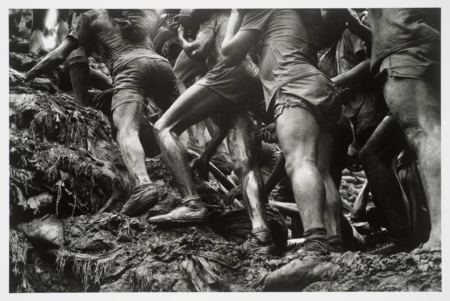
Mining, Brazil 1986 ©Sebastião Salgado
From these reference pictures, colorist Karim El Katari and color scientist Florine Bel associate with Xavier on creating a look that would allow them to figure out this film contrast’s characteristics and apply it onto the camera signal. Two LUTs are therefore created, on one same basis. The first one is designed for daytime sequences and the second one, less contrasted, is meant to be used both for nighttime and for the coal mine, in order to reduce the need for level in the shadows. For Xavier, prepping a project is a very important step, especially on a TV show where shooting days are reduced. Creating a stable and advanced look allows him full control on his image in all lighting conditions.
In order to best reproduce the shadows, which are one of the crucial issues of Germinal’s image, the Sony Venice and its high ISO quality had established itself as the most suited camera for the project’s needs. With the Rialto extension unit system, it takes up very little space and fits perfectly for the sometimes confined filming conditions (narrow mine galleries, diving chamber). Then, the matter of optics arises as they wish to shoot with both prime and anamorphic lenses, alas traditional series are heavy and expensive. After a variety of tests, Xavier chooses the ATLAS ORION series wherewith he will not feel the need to filter since their rendering is already suited to the one he is looking for.
One of the major stages of the preparation work is setting up lighting tests on the set with the actors, with their make-up and dressed in their acting costume. These tests also allow the whole crew to understand what the visual challenges of the TV show will be so they can adapt the employed materials and working method for the project. Xavier recalls “many discussions upstream about the costumes. The costume designer, Thierry Delettre, has in fact understood the interest brought by the chosen LUT and oriented his choice of materials and textures to aim at the desired renderings, from prep to color grading.” This dialogue was also discussed with the key makeup artist, Shirley Dray, about skin color and their patina. There is a true desire in achieving deep blacks on the actor’s skins and a reflection about waterproof makeup parts and, on the other hand, the parts that would leak with water contact.
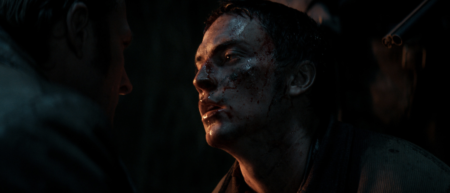
Germinal ©Banijay Studio
Beyond the staging, heads of department thus become the principal speakers to the director of photography, during this preparation period that extended until September 2020. It is crucial to be well surrounded to raise a project of such magnitude, it was a true requirement for the director and for the production. This constant interchange between the departments and this common investment logically leads to a controlled and successful result. Xavier attests that “what really is very pleasant it’s that when you get on set, all you see is in a certain way what you chose, the decoration is not imposed to you, nor are the textures or the costumes, and it is again something that is only possible if you work in harmony with the other departments.”
To make this concrete, the research for the locations has been a long process and raised major issues involving a work for visual and artistic preparation, feasibility and spatialization. A first selection of locations was made on the basis of photographs, then scouting sessions were set up to determine if the locations corresponded to the period, if they were practical for the lighting setups and what adjustments were needed in terms of decoration and props. For example, the team searched for middle-class homes in which there would be very little preparation (they initially wished for period floors and walls) but only found homes that were too abandoned or that had been remodelled. These homes were unexpectedly among the most difficult locations to find and the scenes had to be rescheduled later in the film production.
“Not everything that seemed obvious turned out to be.” The search for corons, the miners’ houses, was also a complex case. Orientated towards the known sites in the north of France, the team went to scout on site but quickly realized that everything had evolved with modernity and that these houses were now surrounded by parking lots, satellite dishes and heavy traffic. Moreover, construction seemed impossible. Finally, the right set was found in a military fort. However, the perspectives were not adequate and fake roofs had to be built in the Fort de Seclin to recreate the right perspectives. This set also allowed us to shoot interiors and exteriors within the same shot, in an effort to spatialize the characters’ movements.
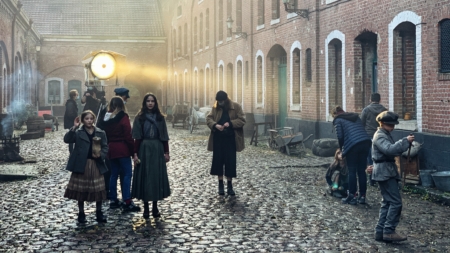
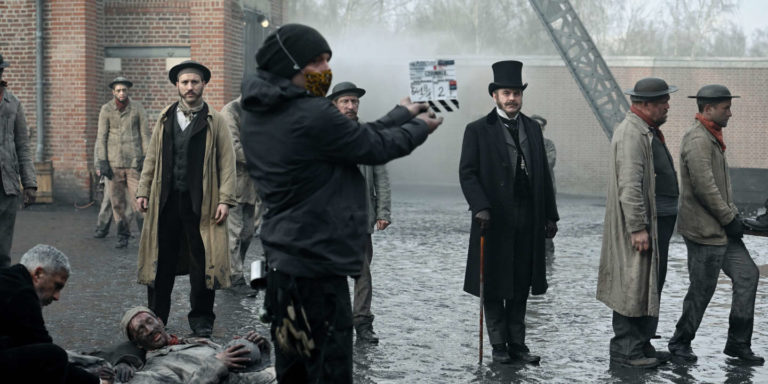
BTS Germinal ©Xavier Dolléans
During the preparation of the project, the team drew a giant map in order to visualize the spatialization of the TV show and to organize the sets between them to establish the characters’ evolution inside of these spaces and to determine what would be visible in the background of each location. What is interesting about this is that Emile Zola himself had drawn a map of his story. In addition to spatialization, accessibility and safety were key issues.
In light of these concerns, the issue of mine construction became a priority since it is very difficult to go and shoot in old mines, which are now often inaccessible and are nothing comparable to 19th century galleries. “We needed a large 19th century mine. We thus had to bring ourselves to build a 500m² mine. We were also lucky enough to come across Claude Berri’s set from 1993 which had been partially preserved in the Arenberg mining center. This mining center, now transformed into an audiovisual center turned out to be a fabulous base camp for us. On top of Berri’s mine presence, the exterior buildings were usable as such and some of the interior spaces were converted into studios : a godsend for us, allowing the construction of the mine sets in situ. Isabelle Quillart, our set decorator and her team did an incredible reconstruction job.”
Unfortunately, it was very dangerous to shoot inside Berri’s film mine because everything was extremely flammable due to the coal dust on the location. “We rationalized everything on shooting times for all the sequences and realized that we would have to shoot a day and half in Berri’s mine and the rest on our set because we needed to create variety.” This mine, preserved as a museum by a miners’ association, offered only limited accessibility and was very difficult to light, especially since it required the presence of a fireman at all times to check the electrical installations and avoid any fire outbreak.
“There was a lot of discussion around wall colors, shades, materials, patinas, which helped give a consistency to the project’s aesthetic. There was excellent smoke management, which is ultimately a very great team effort. Having a director who is aware of the importance of waiting for the smoke to be optimal was a great help in keeping it consistent. The prop master sometimes came in to ask for a hand and the grips helped control that smoke, there was a very good team effort. Everyone was working towards the same direction, and the set design team was even more into the love of work. At one point, we needed a window that the set design team had forgotten to put in, and the construction manager said “okay, we will figure it out”. They ended up re-drilling a window for us because they knew we were asking for things that we were actually going to use, and it was that gained trust between departments that allowed the best possible collaboration.”
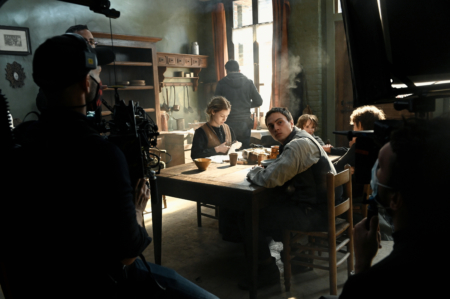
BTS Germinal, Louis Peres and Rose-Marie Perreault ©Sarah Alcalay – FTV – Banijay
Regarding the light, which in the literary narrative is mostly due to flames (candles, lanterns), the concern of the technical feasibility of such lighting quickly arose. Although the Sony Venice is excellent in low light, it was nevertheless essential for Xavier to carry out tests. He therefore bought a miner’s lamp right away to do some tests and quickly concluded that the flame alone would not be enough because the actors would not always carry the lamps at face height. The light therefore had to be supplemented, with LED, for compactness and practicality.
After having first found a Litegear dimmer reproducing flame effects, Xavier took a spectrometer and looked for the best way to reproduce this very particular light, then obtained the final result with 2700°K LED strips combined with ¼ CTO gels. All the practical lights were therefore equipped with this LED system. “This solution, however, meant that we had to use a lot of 9V batteries, so much that an electrician was assigned to only change the minor’s lamps.” The light heads and practical lights also had to be waterproof in order to shoot the mine flood scenes. “The benefit of working on a project of such a magnitude is that this big job on the lights was made possible by a whole team of people working together to get the desired result.”
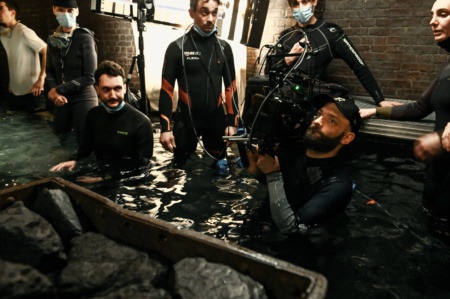
BTS Germinal, Xavier Dolléans, Guillaume Quilichini, Thomas Gros ©Sarah Alcalay – FTV – Banijay
Overall, the lighting setup was chosen during scouting and Xavier drew up basic ground plans for each set, in order to anticipate the technical, electrical and logistical constraints as much as possible. “For the daytime sequences, I often planned to film an establishing shot and make sure with David that the setup would not interfere with him. On the other hand, for the night sequences, I would ask for a shot list as soon as possible, in order to be able to set up the heaviest means and logistics. The night shots were really prepared based on the shot list, whereas there was more flexibility for the daytime, as we knew the main shot list patterns.”
In an effort to meet the restrictions of the TV show format, Xavier had prepared lighting setups that were easily evolutive, through remote control, LED sources, additional light heads, spare gels, reflectors, etc, thus making it possible to easily switch from morning to evening or change year seasons without losing time. He also chose to shoot at ISO 2500 with an internal ND 0.3, which allowed to quickly switch to 50fps or even 100fps and ISO 5000. Xavier knew that the director would regularly ask him to make these speed changes, and they were possible to make rapidly by removing the ND 0.3 or switching to ISO 5000 without affecting light or contrast.
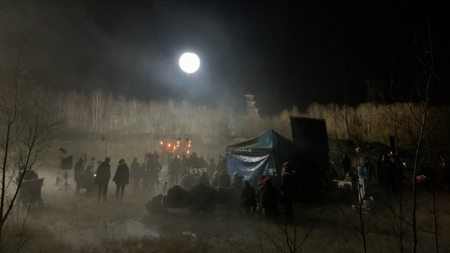
BTS Germinal, Plan des Dames ©Xavier Dolléans
Though constant dialogue, the cinematographer and the director also made decisions together to pull the project towards the most efficient and appropriate solutions, sometimes providing technical resources according to the budget (removing an Airstar balloon – budget requirement – on one night’s shooting to be able to use it two weeks later on a scene with more at stake, etc). Compromise is often a way to succeed in staying within the budget, whether it is about human or technical management, crew fatigue…
“With 70 shooting days, it was very important to be focused on time management constantly. Thankfully, the producers Alban Etienne and Carole Della Valle trusted us and were on the same page about the artistic vision, so things were done in a reasoned way. It really is a global vision management, along with the director of course (sometimes David would tell me to take my time) and it is a huge privilege to have a director who values your work and who is prone to collaboration with you.”