This 29th edition of the festival was the occasion to highlight the collaborative work between the production designers and the cinematographers in the construction of the world of the film. A considerable work that aims to create a rich universe that emotionally supports the stakes of the film.
This article offers a synthesis and a reflection based on two conferences presented at Camerimage: “Creating Worlds on Screen: Production Design and Cinematography” and “Rosco Seminar: How to build a World, Cinematography and Production Design on The Colony”.
The Search for the Perfect Place
Each project is unique and redefines its own rules in terms of preparation. The genesis is created according to the needs of the story and the relationships between the different people involved in this construction. But what appears to be universal in this preparatory work is the exchange of visions and expertise of each person in order to create a credible and emotional world.
Kalina Ivanov, the production designer of George Clooney’s The Tender Bar, shares her experience on this movie that immerses us in the life of journalist J. R. Moehringer and his search for a father figure. For her, it was essential to tell the story of a family through the walls of their home. She wanted them to bear the marks of the past years. By exposing her research and her worksheets, she takes us into a very detailed universe and gives life to each of the sets she builds. This work is done in close collaboration with the cinematographer Martin Ruhe ASC and the director because she builds her sets to serve the camera. It is not a question of creating the most beautiful or exceptional set, but rather of setting it up around the subject and the cinematographic choices.
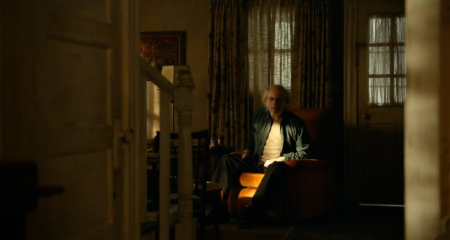
The Tender Bar ©Amazon Prime Video
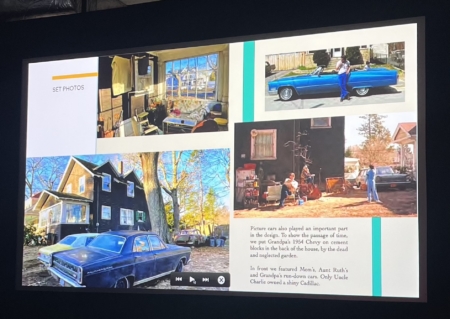
The elements proposed by the designer of The Tender Bar fit with the stories of the characters in the film
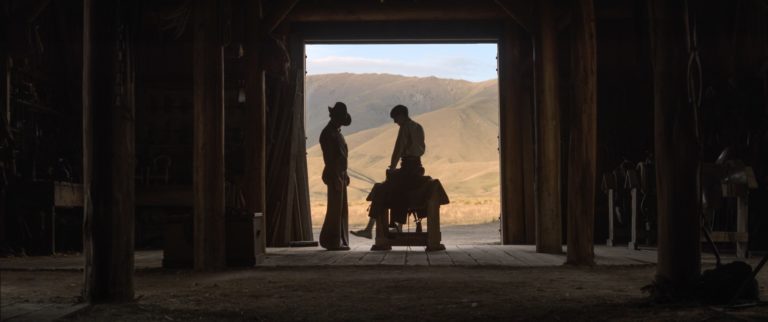
The cinematographer on Jane Campion’s The Power of the Dog, Ari Wegner ACS expresses the same opinion on the work of the production designer Grant Major. The house in the movie is built according to the shooting angles, in order to increase the emotion through the space. The direction then relies on its sets to control and influence the characters’ ability to move. But in this twilight western, the endlessness of the wilderness is at the heart of the direction. With such an important place given to the locations, the film crew had to ask themselves this essential question: “Where do we want the movie to take place? Through this classical question, they had to find the soul of the set in the real world, and then build the universe of the movie around it. So they start a journey of “several days, several weeks […] to find the best place to create this world and build the house on this land”
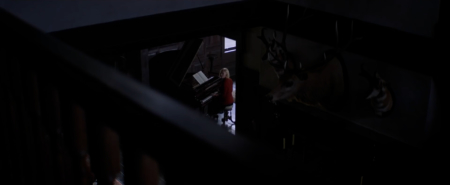
The Power of the Dog ©Netflix
Creating a world is not just a search for the perfect location or setting, it’s also, and more importantly, thinking about “what makes that world authentic.” In addressing this question, Nelson Coates, production designer of John M Chu’s film, In the Heights, leads us to think about the history of the place where the action of the movie will take place. Here, a New York City neighborhood. More particularly, the film takes place around a store on the corner of two streets. It was very important to them that this main setting will be the place of convergence of all the spaces in the movie. The space of this musical is then mapped around this intersection towards which the choreographies lead. It is therefore natural that this set is the first to be found. But the production designer insists on the need to dive deeply into the history of the neighborhood in order to recreate a credible and rich universe. For him, “you find your film through location scouting. It’s a journey to find your world. The details of the real world become powerful narrative elements. He remembers the incessant flickering of the faulty subway lights he took in the neighborhood on one of those location scouting days. This fickle light, they decide, with cinematographer Alice Brooks ASC, to make it an important element in the visual identity of a dream scene of one of the characters. Letting the irregularities of reality feed into the emotional markers of the plot seems essential in building a powerful universe.
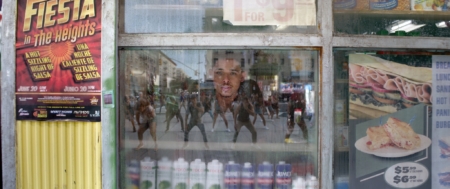
In The Heights ©Warner Bros.
Sometimes the cinematographer is involved before the production designer in this search for the film’s location. This is the case of Markus Förderer ASC BVK who explains that he was the first to work on the movie The Colony because he had previously collaborated with the director Tim Fehlbaum on his movie Hell. Together they did a lot of test shooting on the natural setting of the German Wadden Sea, which is the ideal setting for the representation of a post-apocalyptic world. But making this setting spectacular would mean shooting during the magic hour and would limit it to four hours a day, which was economically unrealistic. So Julian Wagner, production designer, was given the complex task of recreating this setting in a studio. The wide shots could be shot on location in order to capture the immensity of this sand and water desert, while the close-up shots were set up in the studio using an ingenious combination of natural elements and Rosco’s Softdrop technology.
Adapting the set to the needs of the movie: The Tender Bar the set design as a character
It is essential to adapt the chosen location to the needs of the movie and the story, so it is often necessary to rebuild it so the shooting possibilities are not limited to the real space of the location. The bar and the house of J. R. Moehringer’s uncle in The Tender Bar are reconstructed and adapted in a studio. With an interior 10 times larger than the original size, the set allows the camera to move around more easily and to connect the spaces between them in order to make the camera moves more narrative and more expressive. For example, Kalina Ivanov gives the illusion of height to a set located on the floor of a house by having this set built on a platform. It is a matter of recreating a space in phase with the direction and the impression that the spectator should feel.
The concept of the first floor of the house by Kalina Ivanov:
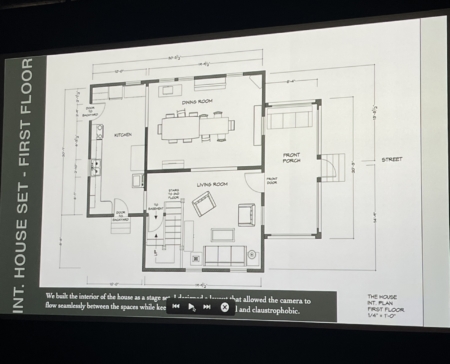
Concept of the second floor of the house by Kalina Ivanov
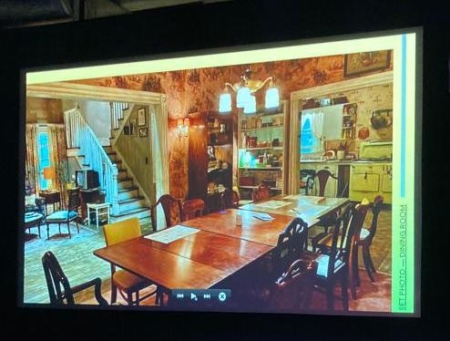
Photography of the final set built
The rebuilding in the studio also allows adapting the technical spaces necessary to the installation of the machinery and the lighting. Here, all the ceilings are removable, facilitating the installation of the practical lights or the projectors. This offers almost infinite freedom of creation, at the service of the plot and the narrative stakes of the movie. The goal of the set designer is to create sets that define the characters who inhabit them. They serve as a temporal marker for the story and help guide the audience through the evolution of the protagonists. They grow up, age, but the sets go through time and are marked by the memories of what they were. It is the immense amount of research done beforehand on the colors, textures, and patterns that adorn the walls that allows the set to come to life. Kalina believes that “you always have to go deeper into the material so that the camera can transcribe it in an accurate and sensitive way. But always stopping before the effect is noticeable and becomes theatrical”. The light on a set, for example, can exist long before the cinematographer arrives. That’s why she likes to talk upfront about the colors and shapes of the practical lights “It’s important that everyone is open to each other’s ideas. »
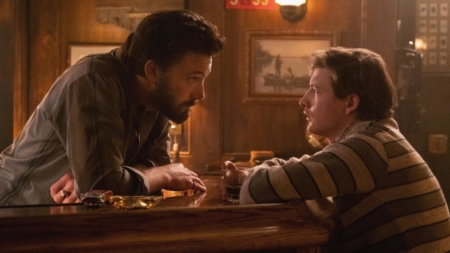
The Tender Bar ©Amazon Prime Video
The world on stage, turning the stage into a dance floor: In the Heights
Successfully putting a musical on screen involves creating a space thought around the choreography and how it will be shot. This fully determines the construction of the set, which will have to be adaptable in order to follow the movement of the dance through the set design. To prepare In the Heights, the crew maps out each song and builds a common language for all the technical departments by determining what role each will play in creating the film’s universe. They then coordinate their expertise to build a hybrid world between the physical set, cinematography and visual effects.
Whenever possible, the team shoots exterior shots directly on the streets they have chosen. They adapt the environment of these streets by building new facades or changing details to create the rest of their world within the real world. Nelson Coates explains that sometimes there is a legal aspect to shooting in real locations. For example, they have to cover up a brick wall with graffiti because the rights belong to the street artist who did it. But the idea of keeping a graffiti on this wall seemed to be the ideal to stick to the natural environment of their set, they decided to design their own artwork by giving it a symbolic aspect in connection with the story.
Unfortunately, the store’s interiors do not allow a film crew to operate there. In this case, it is therefore essential to completely rebuild the interior set design in order to preserve the soul of the film. But then one of the essential questions in this choreography of spaces is “how to erase the gap between the interior and the exterior? To do this, it is important to create connections between these two worlds and sometimes it is needed to partially reconstruct the exteriors in the studio. In this way, it will be possible to navigate from an interior to an exterior setting in the same shot and to link these two spaces through the staging. For this purpose, part of the intersection of In the Heights is reconstructed by the crew, which requires an extremely precise work of light connection from the cinematographer Alice Brooks ASC.
But the big challenge of the movie is a dreamlike sequence between two protagonists who start to dance on New York stairs and end up floating on the walls of a building, defying gravity. This surreal effect becomes possible through the construction of a platform similar to the building’s facade in a green screen studio, which will allow the addition of visual effects in post-production. The ingenious detail is that a part of this platform is mechanized in such a way that it can be raised at 90°. It is therefore through a play of light, camera movement, and mechanism of the set that the airy impression is given. In order to achieve a credible and emotionally strong result, a precise dialogue between the construction of the set, the cinematography and VFX must be established from the preparation to the finalization of the scene.
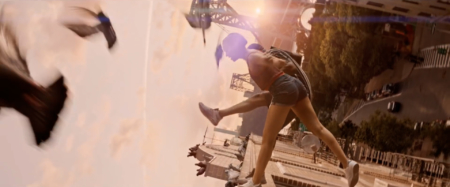
Final result: In The Heights ©Warner Bros.
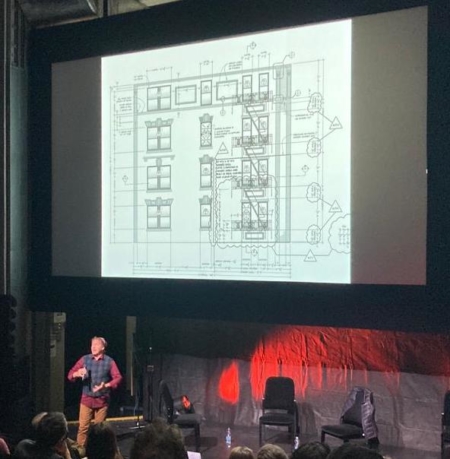
Nelson Coates presents his dynamic facade concept that lowers from 90 to 0 degrees in 5 Seconds
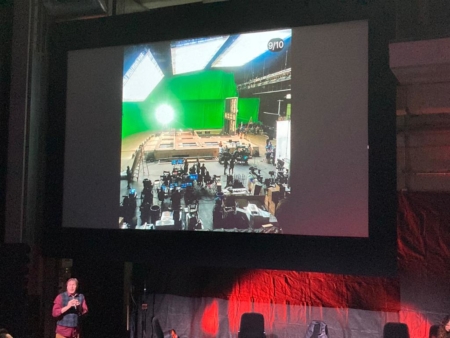
When the facade mechanism is triggered, the camera, lights, actors, and VFX environment must follow the same movement, creating an impressive time-lapse sequence. In this kind of setup, it is of primary importance that the actors are secured to cables by the stunt department. The VFX team is responsible for creating the background that will replace the green screen. They must match the dynamic change of the landscape and the sun to the movement of the camera and the facade. Alice Brooks and her lighting and machinery teams designed the installation of three large softboxes on the ceiling to simulate ambient skylight, as well as a powerful tungsten source to create the sun in the studio. This source is mounted on a large crane on Dolly to make it perform a complex and credible movement that accompanies the movement of the dynamic facade. The intensity and colorimetry of the softboxes are programmed to evolve in this time-lapse and to match the dynamic change of the background. This precise orchestration between departments allows for a remarkable result that creates one of those important moments where cinema becomes magic.
Expanding horizons: The Power of the Dog and Focus on The Colony, or how to recover the immensity of the sea
Ari Wegner ACS and Grant Major devoted a large part of their work on Jane Campion’s film to the question of how to link exteriors and interiors and to determine what is visible in the background. For budgetary reasons, it is essential that they avoid having every shot that takes place in an interior setting with a view become a VFX shot. But they also wanted to avoid being restricted by the use of curtains, which significantly reduced the film’s space to simple interiors. They desire the immensity of the natural space outside to be felt through the windows and doors of the sets. They, therefore, turned to the design of ‘backdrops’ that the set designer had already used on his previous projects. As the plot spans several seasons, they designed backdrops for each period, at different times of the day, in order to make the environment around their set evolve with the rhythm of the movie.
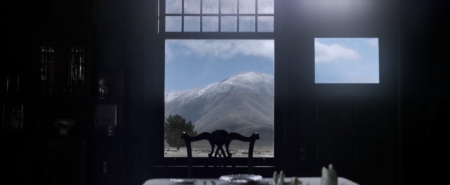
The Power of the Dog ©Netflix
This is the same technology that the crew of The Colony uses to make its seascapes believable, although they are reconstituted in the studio. For this, it is essential to conceive the set in a hybrid way. First, it is organized around a huge platform on which the beach is recreated, built in the Bavaria Studios (considered the largest in Europe). This floor is the result of intensive research on the textures of sand and water, but also on the interaction between these two natural elements. It is the reflection of the sky in the puddles created on the ground that gives the setting its power. It is clear to Markus Förderer and Julian Wagner that the use of Rosco Softdrops is the best alternative to backgrounds to shoot the movie in a more authentic and sensitive way because unlike a green screen set, this type of process allows the use of a wider range of materials in the production designs and costumes. The effects of transparency and reflection, particularly complex to master on a green screen, become possible again because of the organic character of this type of set. This last point also contributes to plunging the whole team into the heart of a more immersive and thus much more tangible experience.
The platform is surrounded by a 9m high and 90m long background, created from 8K plates of the original set that are combined to recreate the immensity of the Wadden Sea sky. In order to vary the background of the different sequences shot on this same backdrop, they develop a technique that allows them to have a first sky effect printed on the front and a second printed on the back. Thus, by adapting the front and back lighting, it becomes possible to create a wider range of lighting moods on the same set. During the preparation of the movie, Markus did a series of tests on miniature sets to determine the different lighting techniques they would need to implement on the set to make this technique a success.
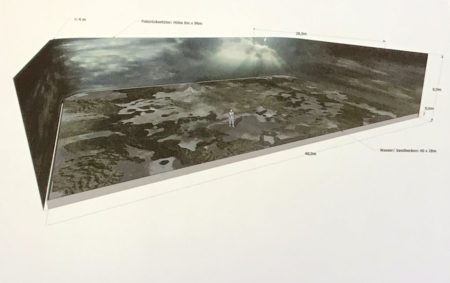
3D representation of the set of The Colony ©Julian Wagner – Markus Förderer – Berghaus Woebke Filmproduktion
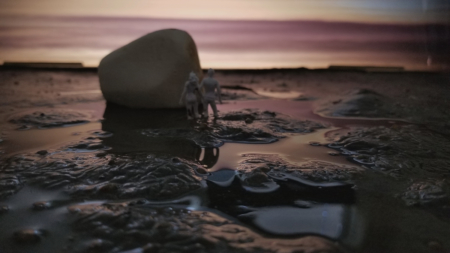
Model of the set of The Colony ©Julian Wagner – Markus Förderer – Berghaus Woebke Filmproduktion
Based on this research and assisted by his gaffer Uwe Greiner, the cinematographer conceived the installation of a hundred Skypanels, placed on the ground behind the Softdrop, in order to create this impression of light coming from the horizon, specific to sunsets and sunrises. In addition, there is a line of ETC projectors at the front of the background and a uniform Skysoft to raise the level on the platform. Since all the lights are programmable, the variation of the lighting between each sequence is extremely simple and adapted to both night and daylight scenes. This saves them a lot of time. For some scenes, they add to this basic principle an ARRIMAX 18kg backlight, behind the Softdrop to simulate the sun’s rays breaking through the clouds.
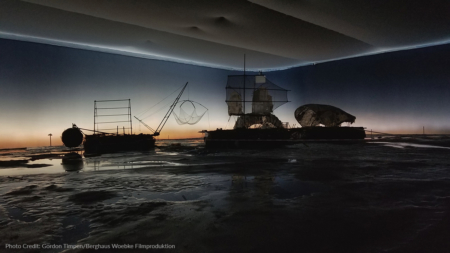
The Colony set ©Gordon Timpen – Berghaus Woebke Filmproduktion
In this way, this ingenious combination reconstitutes the environment of the movie in a believable way. But it remains an essential element to the feeling of reality in this setting. Indeed, the rendering of the space and its vastness in natural conditions is a real challenge so the reconstitution in the studio does not seem limited. To achieve the illusion, the difficulty is to succeed in recreating a horizon line further away than it really is. A fluid line between the sky and the earth where the infinite merges. All this is accomplished through the controlled use of an essential element: smoke. The installation of several fog machines on set, beyond creating an atmosphere conducive to the plot, allows to link the whole and to reinforce the feeling of immensity. The result is an image where it becomes difficult to perceive the demarcation between the platform and the Softdrop, avoiding the feeling of a reduced studio space.
Considering the small budget of the film, the work done is impressive and demonstrates the importance of cooperation between the different department heads in order to find the right solution to the challenges of the film. These different experiences help to turn a set design into a tangible and complex universe.
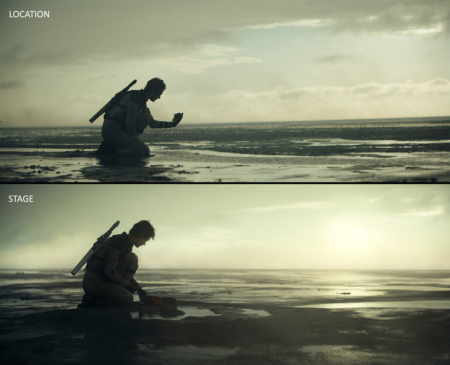
Comparison between natural setting and studio reconstruction, The Colony ©Berghaus Woebke Filmproduktion
Opening the field of possibilities through VFX
The good collaboration between these different experts answers to the artistic needs, specific to each movie, but is also a guarantee of control of the costs essential to carry out a project. However, it is sometimes essential to expand the film’s universe through the possibilities offered by VFX work. Without talking about the sets entirely created in post-production, which represent another type of work and techniques, it is necessary to be interested in how the digital additions come “to enlarge the reality”.
This coordination between real sets and visual effects is also the result of a close collaboration between the film crew and the VFX team, which often involves the presence of the VFX supervisor on the set. According to Kalina Ivanov, “the set designer physically recreates the world of the movie, and then VFX comes to finalize the idea of this world”. This is where the “common language” that Nelson Coates insists on becomes essential. The speakers all share the same opinion on the question: this language must be established from the conception of the preparatory drawings elaborated by the set designer. Indeed, at this point in the process, there is a reflection on the work-sharing between each department in the elaboration of visual elements: on the one hand, the elements that must be built and thought for the real world – “how much do we have to build this world physically?”, and on the other hand, the elements that will be processed in post-production. All these elements must be coordinated in a precise way in order to make the world of the movie believable.
Filmography
The Tender Bar
Director : George Clooney
Cinematographer : Martin Ruhe ASC
Production designer : Kalina Ivanov
In The Heights
Director : Jon M. Chu
Cinematographer : Alice Brooks ASC
Production designer : Nelson Coates
The Power of the Dog
Director : Jane Campion
Cinematographer : Ari Wegner ACS
Production designer : Grant Major
The Colony
Director : Tim Fehlbaum
Cinematographer : Markus Förderer ASC BVK
Production designer : Julian Wagner