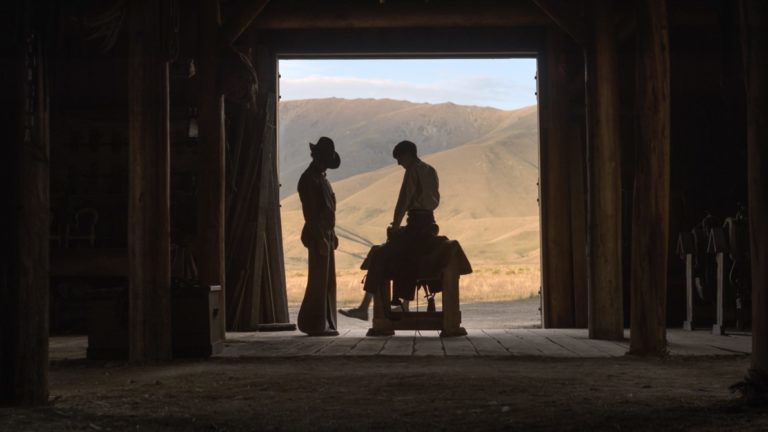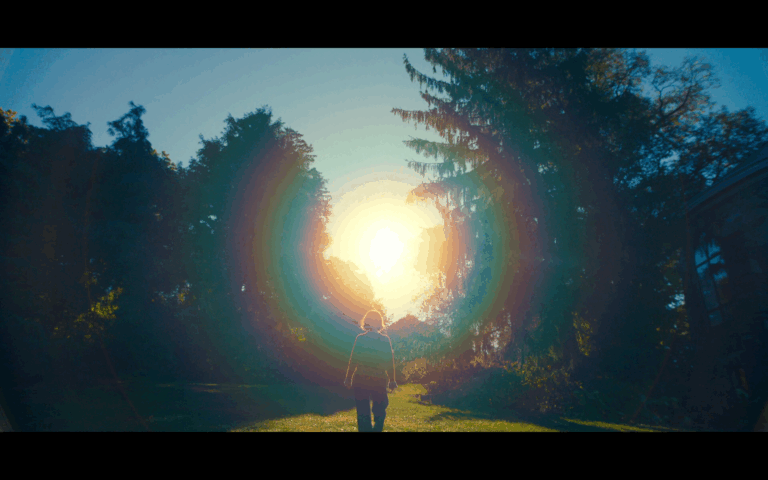
“The colorist is the DOP’s secret weapon,” said Eric Weidt at the FilmLight Colour Awards ceremony, the first of its kind to exclusively reward the best graded films this year (*). And he knows what he’s talking about, as he won the first prize in the feature film category with Mank. He was quick to point out, along with his colleagues, that he can only exercise his talent in the wake of the cinematographer, on whom he depends and whose work he supports, protects and extends.
“It is very important for me to be able to rely on the talent of others,” said cinematographer Elen Lotman ESC in the opening remarks of the IMAGO round table on color grading. “I like that everyone on my team is more knowledgeable than I am in their own area of expertise. This is true on set as well as in the color-grading suite.”
No specific training yet
The moderator, Dirk Meier BVK, then asked the right questions and opened up some interesting perspectives, notably the one concerning the lack of concrete professional training for colorists.
Among the speakers, all more illustrious than the others, Philippe Rousselot AFC ASC admitted not to care too much about the ultra-complex arcana of the “Science of Color”. “The basics are quite simple,” he confided, “and they remain so: the combination of the three primary colors, a scale of contrasts, animated masks, I don’t need much more to exchange with the colorist.”
He adds that he doesn’t like to operate by reference to previous works, except to point out what he doesn’t want. “Proceeding by elimination rather than by accumulating references, it pushes you to look for something original and authentic, off the beaten path, rather than trying to approach what has already been done.”
All the panelists agreed on one thing: “post production” seems to mean “after the fact,” and colorists are still far from being considered in proportion to the role they play in the image creation chain. The first step towards a solution would be to involve them early on in the creative process, so that they can understand the issues and iron out obstacles long before they arise.
Dizzying fades
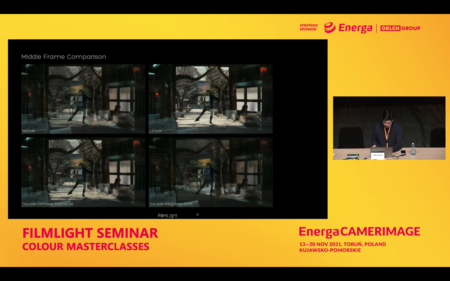
Third event at Camerimage, by far the most “geeky”: the seminar dedicated to the difference between luminance and luminosity.
Daniele Siragusano, FilmLight Image Engineer, showed us that luminosity is an illusion, born from our erroneous perceptions, and very relative to the spatial or temporal context.
Andy Minuth, FilmLight Colourist, took us on a fascinating exploration of fades (to black, to white and crossfades).
The conclusion? It turns out that fades should always be left to the colorist. A comparative screening of fades in editing and fades in color grading left no doubt.
—
(*) FilmLights, the organizer of this award, has established itself as the leader in professional color grading systems with Baselight. However, the FilmLight Colour Award accepts films graded on all platforms. It was a wise decision to work together and draw attention to a growing discipline.
This year, more than 300 films, commercials and series competed for the four awards:
Commercial / Music Video
Tim Masick (Company 3)
DIOR – Spring Summer 2021 Collection
https://youtu.be/PL9BqUaQQgM
Theatrical Feature
Eric Weidt
Mank
TV Series / Episodic
ex-aequo
Tony D’Amore (Picture Shop)
FARGO East-West
et
Damien Vandercruyssen (Harbor)
LISEY’S STORY
Innovative Use of Baselight
Gilles Granier, Fabien Napoli & Arnaud Caréo (Le Labo Paris)
MISS