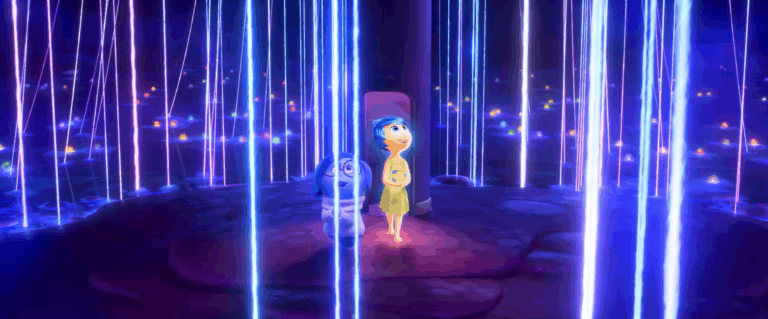
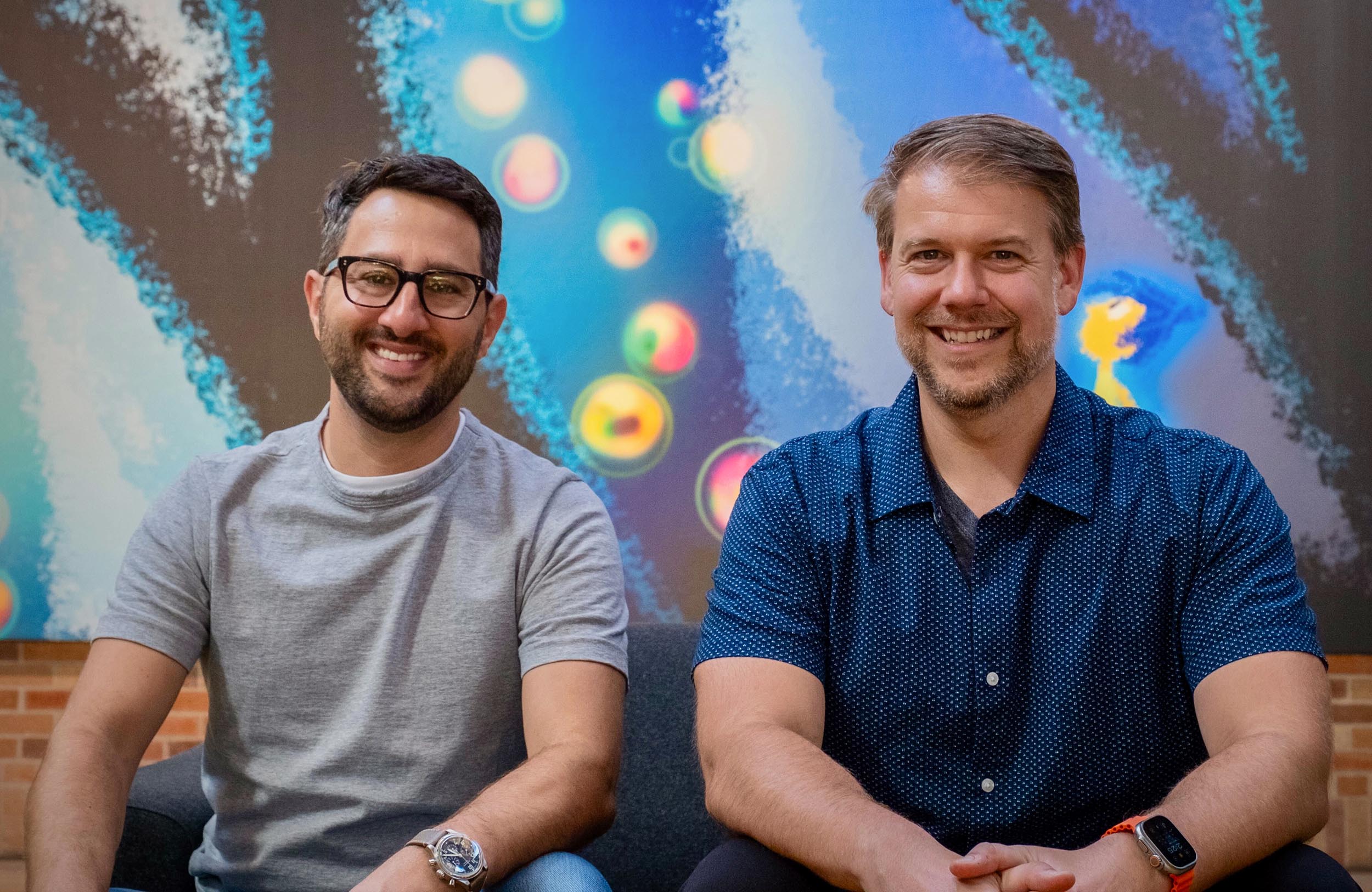
UCO talked with Jonathan Pytko and Adam Habib, the two Directors of Photography of “Inside Out 2.”
Both handled the cinematography of the Pixar film since in 3D animation, it’s a two-headed position:
Adam for camera and staging, and Jonathan for lighting.
JB: Adam, regarding shot composition, in France and other countries, we have two main approaches to breaking down a film:
either the director knows exactly what they need and builds the shots with the cinematographer, or they trust the cinematographer’s ideas to break down the film according to its vision.
What was your approach on “Inside Out 2?”
Adam: Kelsey (Mann) defined his intentions in some ways with the storyboards, so we were sure to represent and honor them, but then we diversified and tried other ideas that we tested with the editorial team.
For example, the “Brainstorm” sequence deviated quite significantly from the written action. As we progressed through production and worked on the third act, we often found ourselves working without storyboards at all, often from script pages or sometimes just from a verbal pitch.
So in those cases, it’s much closer to the second approach (the director trusting us to present good options).
For every shot in the film, we tried 3-4 alternative versions.
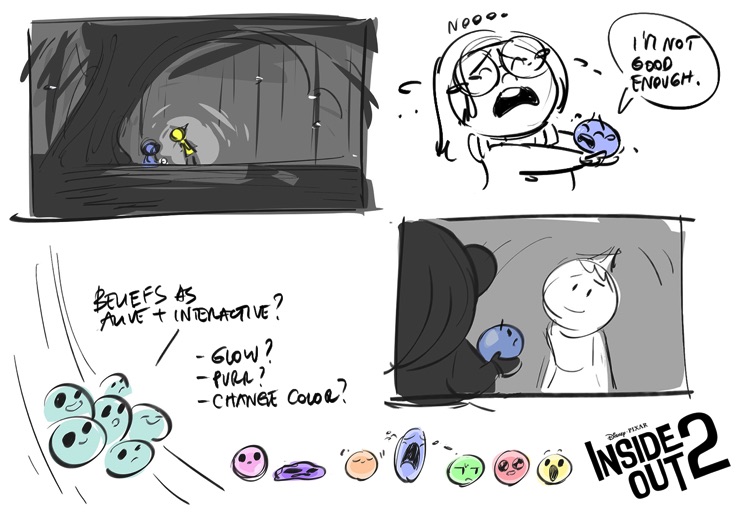
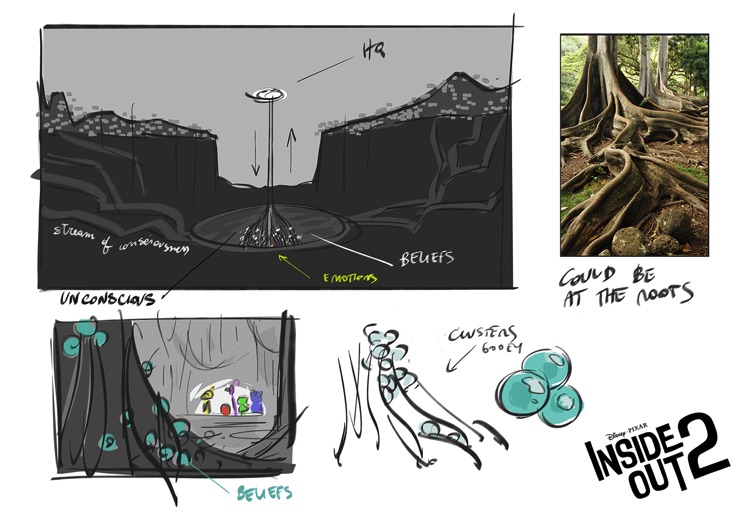
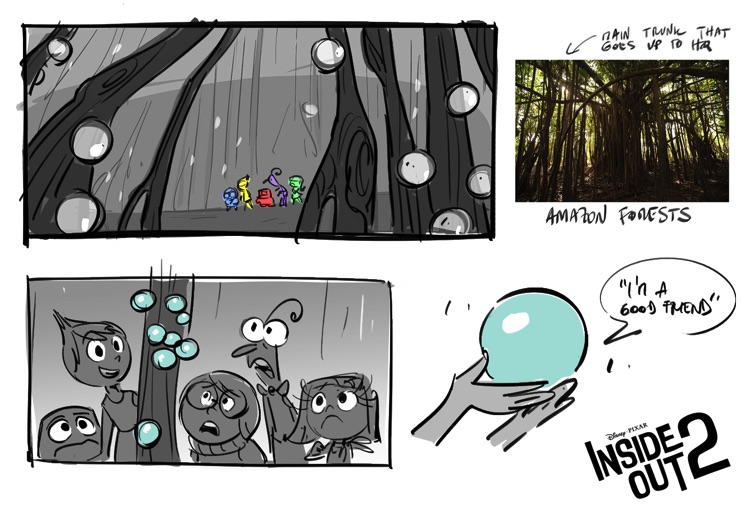 Storyboards by Alessandra Sorrentino (www.alessandrasorrentino.com)
JB: Given that you’ve previously worked as a cinematographer on live-action films, when you’re breaking down a scene, do you think in terms of fixed focal lengths (like a defined set of lenses), or do you work instinctively by setting the desired field of view without worrying about numbers (like a zoom lens)?
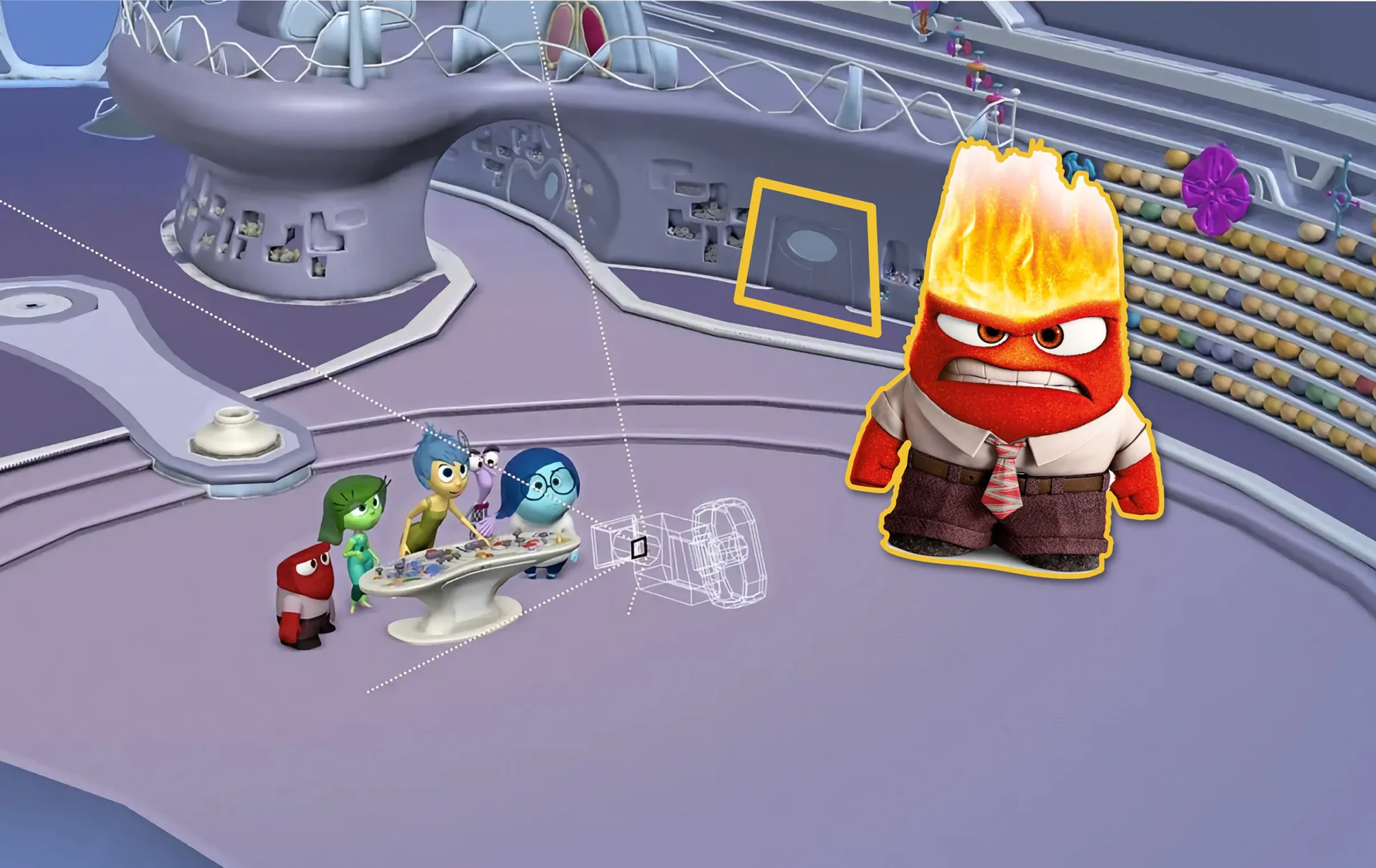
Adam: Always primes. We make up a set of set of focal lengths based on a typical lens package, mainly to ensure consistency among the team of nearly twenty artists.
We also learn which focal lengths work for each character – for instance, “Joy” and the other emotions worked with wider focal lengths than one might expect. A group shot or a full shot was typically shot with a 25mm, and a close-up could be shot with a 32 or more rarely a 50. Almost never longer (in Super35 format).
Of course, inventing a new focal length isn’t an issue, but it was quite rare.
JB: Given that you don’t have issues with actor availability or crew transportation, etc., did you work in continuity, or are there still constraints that force you to work on sequences out of order?
Adam: It’s funny you mention that because this film was shot in almost perfect continuity.
We built and rebuilt Act 1 until everything worked well. Then we built and rebuilt Act 2, then Act 3, and finally, of course, we did the last pass on the entire film to continue refining things until we ran out of time.
The main consideration for starting a scene is whether the story is ready or not. After that, you have to consider asset preparation – for example, early in production, it would typically be difficult to do a crowd scene because many of these characters aren’t ready yet.
That said, on this film, we started with the hockey opening sequence, and somehow all these incredible characters had their models ready!

JB: Adam, Jonathan, I’m curious about what kind of schedule 3D animation cinematographers have.
Could you briefly describe it in a standard production context?
Since we’re talking about months or even years, do you have breaks during production, for example waiting for a set to be built, or is it non-stop?
Adam: The entire production of Inside Out 2 took about four years.
The first two years are usually dedicated to story development and screenplay writing, and the last two years to production.
That’s when I get involved as cinematographer. From that point on, it’s practically non-stop until the end of shooting! And of course, even then you’re not done: there are press presentations to support the release and interviews! By the end, you’re definitely ready for a long break!
It’s a different type of stress from live-action production, which might be more intense but often shorter.
Animation is a marathon, and you have to pace yourself and your team, sometimes reminding them not to spend all their energy too early fine-tuning a shot at the beginning of production when there’s a good chance the story might still change!
Jonathan: I come in at the beginning of production, collaborating with Adam and the set team.
In fact, we literally have to build the world before we can shoot the film in it!
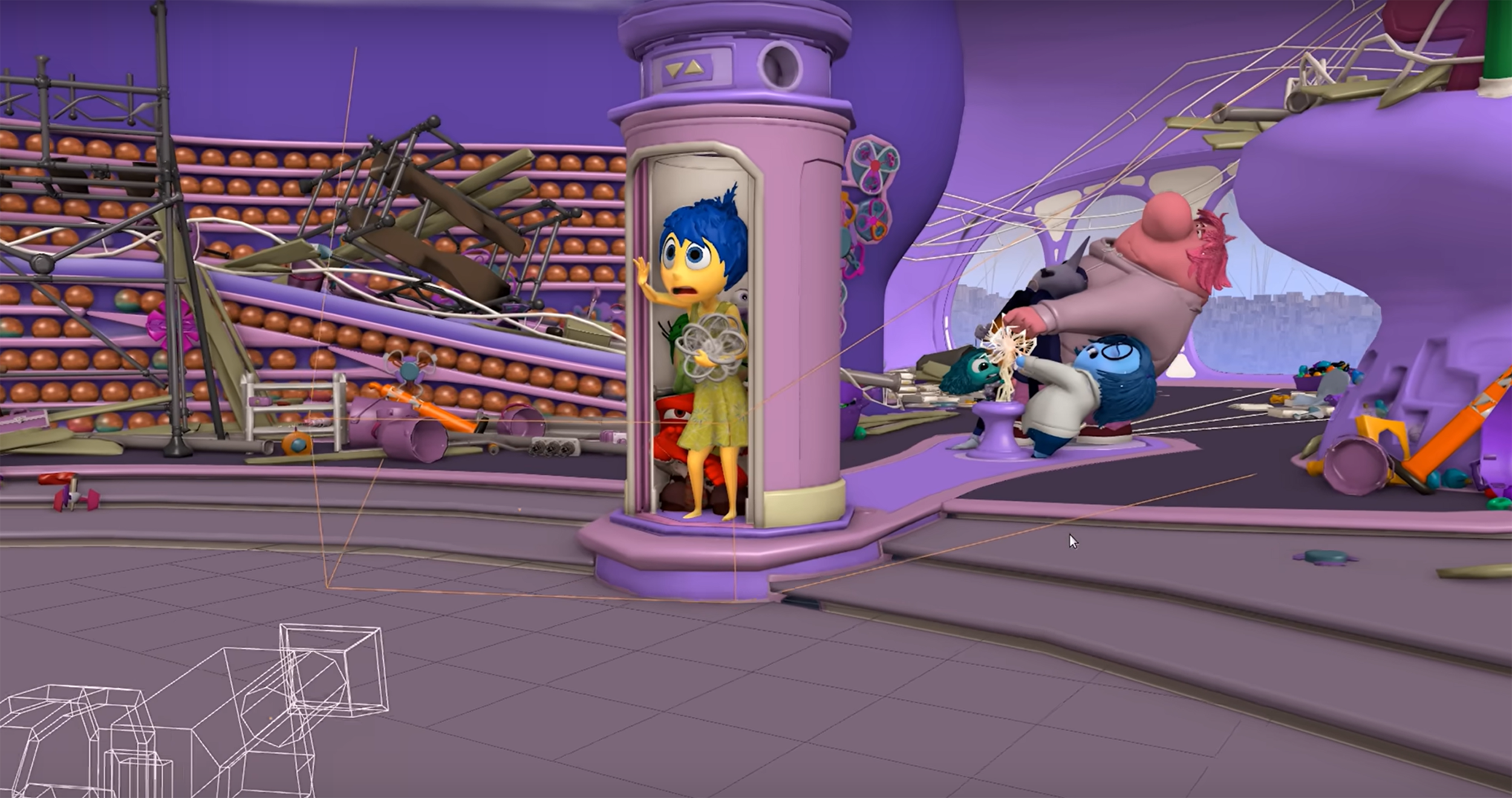
We break down the script to identify the major set pieces to build. Once a set is built, Adam starts scouting these different locations. On my end, I think about the quality of light and times of day for each set. At this stage, we’re not rendering many images; we’re still in a very rough state.
But once we have these sets, we can place our virtual cameras and Adam can do preliminary scouts. We also do basic lighting tests to see where to place the sun, where shadows fall, and what we can utilize in each set.
JB: So you get involved upstream with the set builders?
Jonathan: Yes, we have an entire set team. There’s the team that builds the sets themselves, then the set dressers who add all the small elements and props shot by shot to give texture to the world. That’s when we start shooting in this universe.
JB: How do you conceive the color scheme of the film?
To what extent do you dictate these choices to other collaborators like costume designers or set decorators?
Jonathan: We start the color scheme very early.
As soon as I join the film, I work with the production designer, the art department, and Adam. It’s generally a collaboration; I can’t take all the credit!
I’m more involved in choosing colors for the sets, while the production designers are very aware of the characters, particularly the emotional characters who each have a distinct color!
I intervene according to the sequences, suggesting for example putting orange in the seats or for the hockey players’ jerseys.
We all discuss together the visual themes we want to see in the film. We developed the idea of connecting the emotional colors of the human world with what’s happening in the mental world.
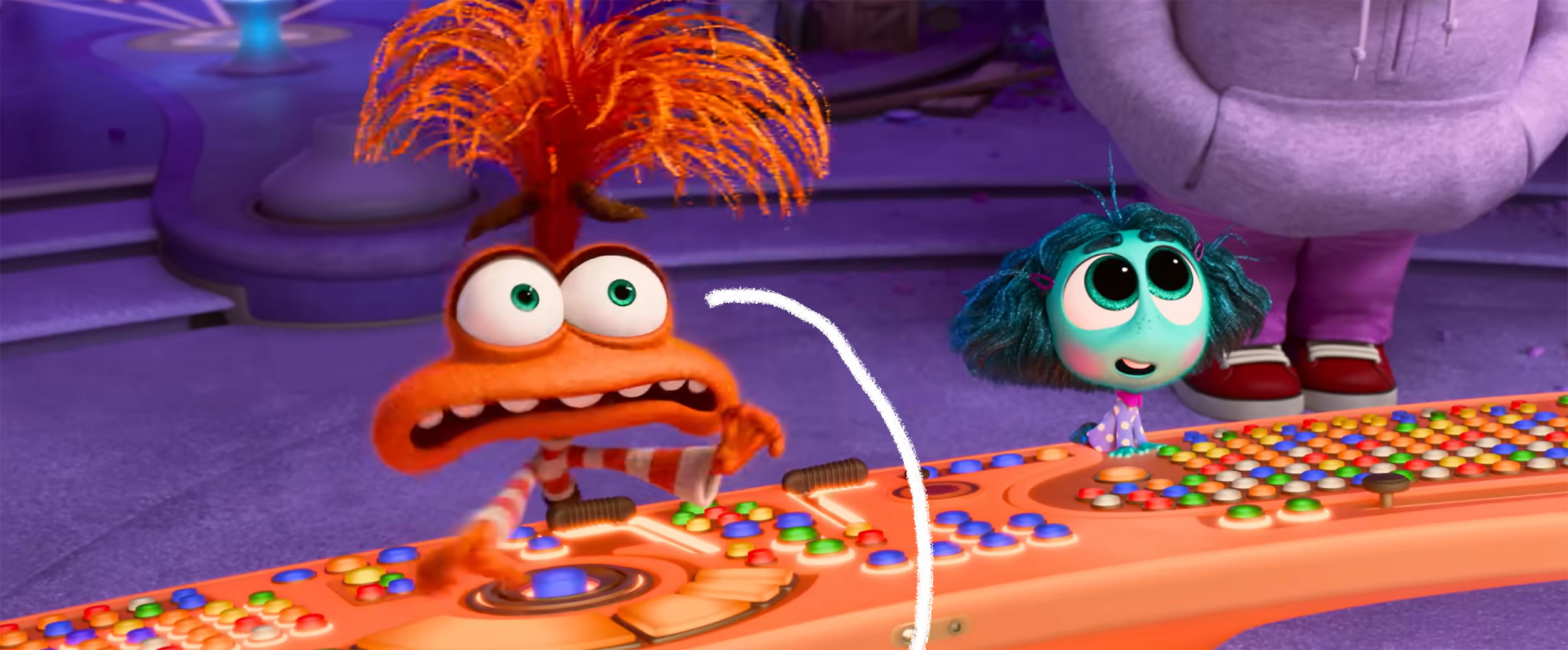
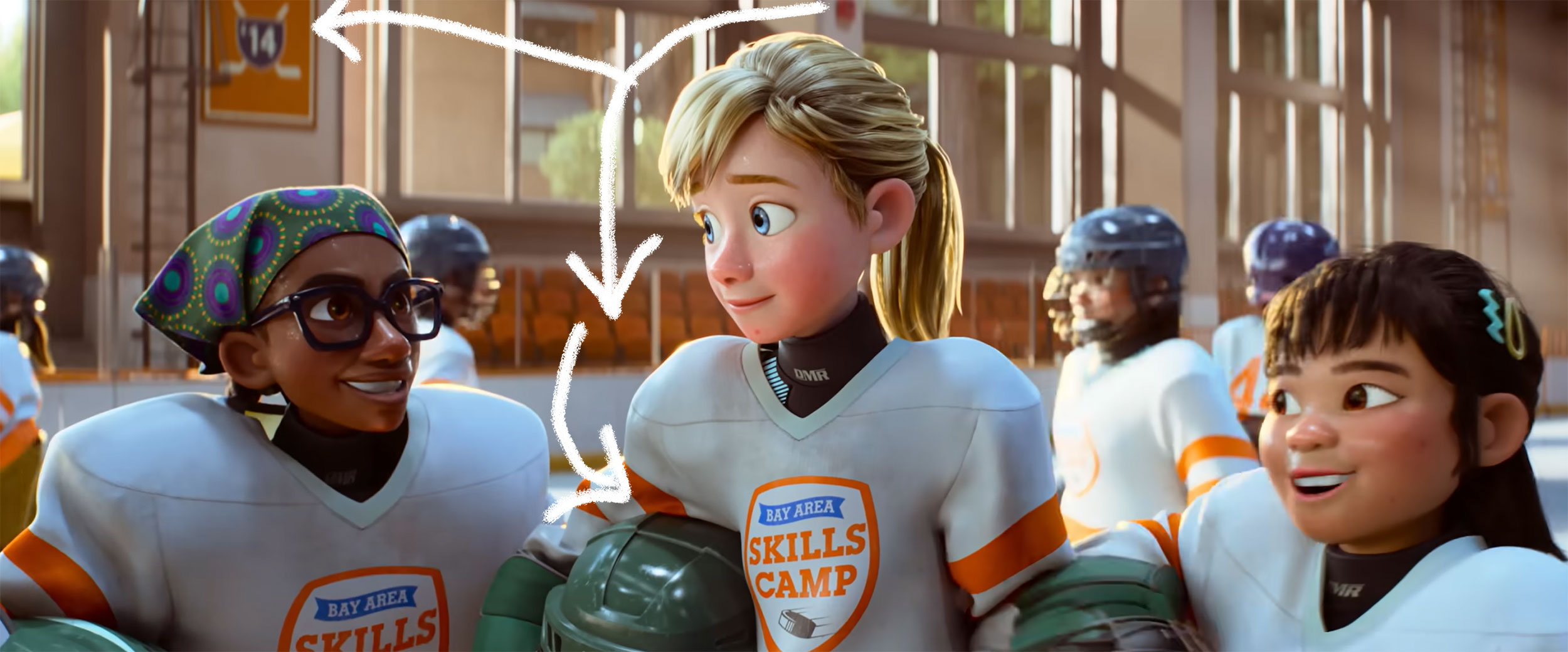
JB: Regarding your desire to experiment with effects like background shakes or anamorphic looks, do you encounter limitations with the software? Are the tools powerful enough for these “outside the box” creative effects?
Jonathan: The software tools allow us to do an enormous amount of things, almost too much sometimes!
Actually, we have to impose constraints on ourselves to keep it realistic and anchored in some physicality.
For me, animation is better when it tries to keep a human side. While live-action films seek to create something unreal by putting characters in crazy situations, in animation, we want to stay grounded in a certain reality.
Our cameras can do practically anything and we can make the background shake however we want, but we always try to reference something real that serves as a basis for the effects we want to create.
JB: Given that traditional cinematographers sometimes see 3D cinematographers as “aliens,” can you explain if adjusting virtual light sources is different from adjusting physical lights in terms of direction, power, beam parameters, etc.?
Jonathan: It’s sometimes similar; we have many of these physical properties on our lights, we can use gobos, gels, flags, and bounce cards in the scene. So we can light a scene very similarly to a real film set. However, since we’re working with animated characters, the eyes are always enormous, so we have special treatments to make them look good.
Normal human eyes are very small. And for non-human characters, like the emotions, they’re completely out of norm. They’re treated almost more like a painting. We light them, but it’s not conventional physical lighting, and they’re lit separately from the rest of the set.
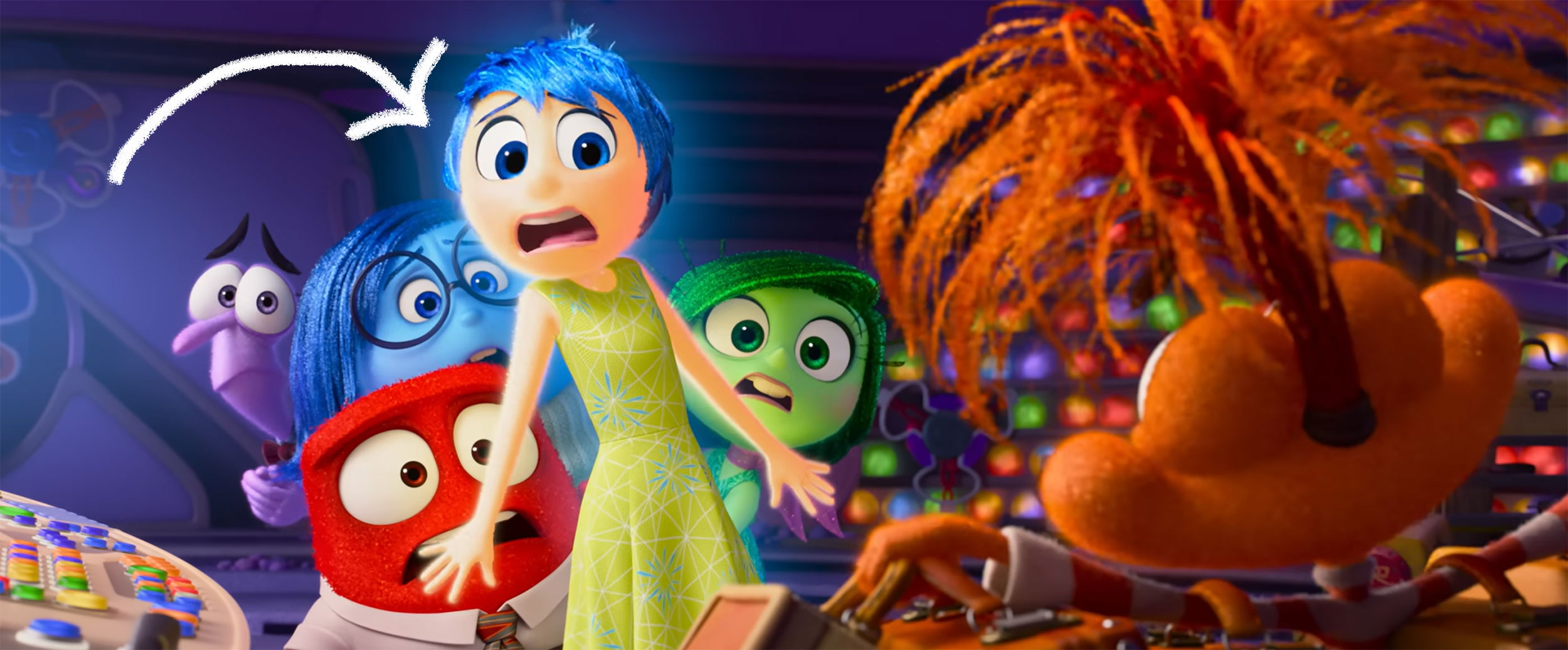 JB: You’re talking about the glow of the main characters?
Jonathan: Yes, and also their shape. We have specific lights on them to model them well, as they have really unusual shapes. The lighting that happens on the set is actually separate from what happens on the characters. They’re like two distinct entities. So, we do both according to the needs of the scene. The human world is very inspired by live-action, while the mental world completely breaks these rules.
JB: You mentioned that checking a render is computationally expensive, sometimes more than 100 hours for a single frame, can you explain what’s the best way to see a final result without using these costly renders?
Jonathan: Generally, we use what we call low-quality renders. They’re rougher, noisier, but still allow us to judge the lighting. Then, we render the first, last, and a middle frame of the shot in almost final quality to see what the final quality will look like. But typically, we work with low-resolution and noisy renders until we do checkpoints with final quality material. And of course, what ends up in the film is our highest quality render.
JB: How often do you do these renders?
Jonathan: It depends on where we are in production.
At the beginning, we calculate these still frames every few days, depending on the weeks, to see the evolution, but when we’re finalizing shots, we typically calculate a version each night.
JB: Regarding Riley’s world and the realism you wanted to achieve, you mentioned basing it on a camera that reacts like a real one and physical lights.
How do you technically achieve this realism knowing that in a 3D environment, there are no constraints, no floor, walls, or ceiling to hang a source?
Jonathan: We have the set with the characters, and we take advantage of light coming from windows and the environment. We set up our natural lighting, like the time of day. Then our flags and our lights. We have default gobo textures to have some modeling; it’s not just a flat card. We add flags to cut certain lights, bounce cards to reflect others. We set all this up and see what it gives us.
If we need to start breaking rules to make the eyes look good, then we start doing non-physical things like adding specific reflections on the eyes, or darkening them, or modeling them differently. The set lighting is a good starting point on which we then build for the shot.
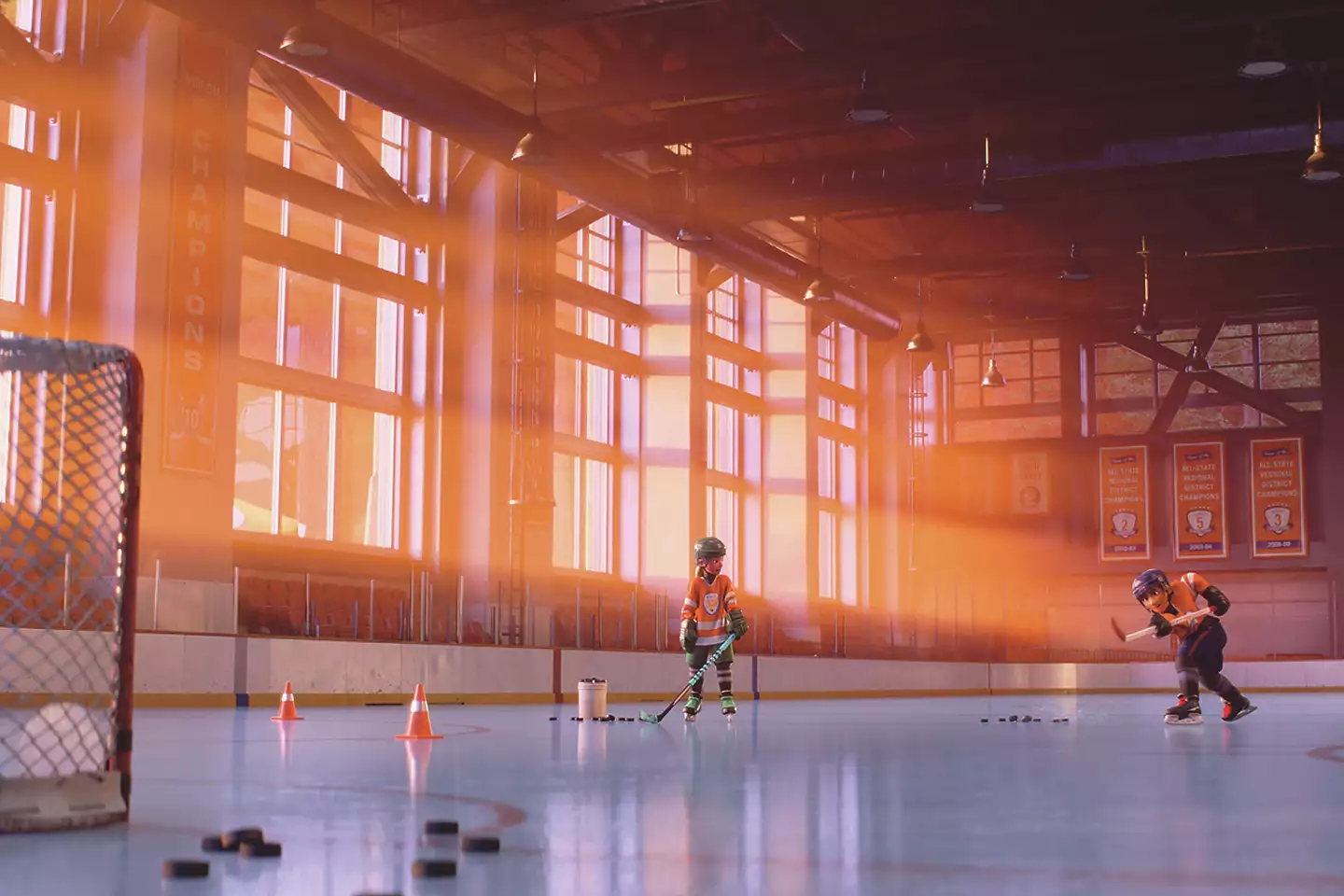
JB: There are a lot of camera movements, do the sources move too?
Jonathan: They can. Generally, we start by blocking everything statically. But if necessary, we can constrain lights to cameras or animate light movement. We can also have textures, cookies (cucoloris). For example, we have a water pattern, like caustic light, that we can project on walls and animate. We have a library of different textures that help us model like physical light.
JB: One last personal question: if you had to imagine your mental world during the film’s production, what emotion or feeling would characterize it?
Jonathan: Bliss. When it was finished, bliss.
Adam: At the end of the first film, on which I was the camera lead, I asked exactly the same question to the cinematographer of that project, Patrick Lin. I expected him to answer “Anger” (because I have a strong sense of fairness, like him!), but he looked at me as if it was an obvious question and said: “Of course you’re Joy!” So, I try to be a bit more like Joy – most of the time!
In addition to this article, you can also read the two Master Classes with directors of photography Adam Habib and Jonathan Pytko on two Pixar productions written by Margot Cavret for the AFC.