_ _ _ _
Camerimage 2021 : The “night” onscreen – darkness, between naturalism and fantasy
Night sequences often challenge the cinematographer in many ways, both technically and artistically, and are the subject of both narrative and more prosaic issues related to the tastes of directors and broadcasters. Several cinematographers had the opportunity to address the question of how to film at night during this 2021 edition of Camerimage. Here is a look back at the seminar that Philippe Rousselot AFC, ASC dedicated to this subject, supplemented with the comments of Xavier Dolléans AFC, Union des Chefs Opérateurs during his intervention about Germinal TV series, as well as some personal thoughts on the subject.
The importance of conventions
Cinema relies partly on conventions linked to our culture and collective mental representations. Moreover, as these representations evolve over time, the spectator does not perceive images and their sequence in the same way depending on the time and cultural environment in which he or she evolves. Our understanding of a movie (and of images in general) also depends on our personal visual culture, from which our tastes are also forged, as well as on technical evolutions and the new possibilities they bring. The treatment of the night is also influenced by these issues.
Rousselot begins with an historical return to the origins of cinema. In the first movies, in black and white, the night was not at all treated in a realistic way. It must be said that the film stock back then were not very sensitive, it was often necessary to add artificial lights even during the day; it was difficult to get nuances in the dark areas. However, this did not prevent the audience from clearly understanding whether a sequence took place during daytime or at night, even though the images often appeared lighter than in reality. It is true that sometimes night scenes were tinted in blue to distinguish them from day scenes, but on one hand this was not so often the case and on the other hand the turn was often more of an expressive choice. The indication was coming more from the actions from the characters – for example turning on the light, or the insertion of a moon shot.
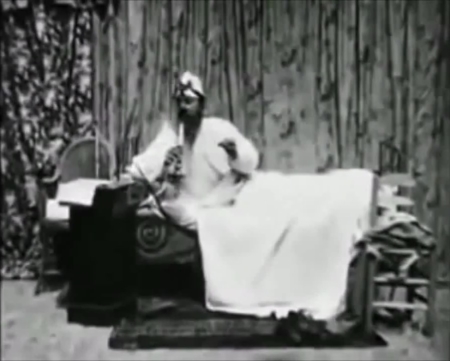
A Terrible Night by Georges Méliès – The light does not dim when the man blows out the candle
If nowadays the visual culture of the audience makes us turn towards more naturalistic effects, even now we must not neglect the conventional dimension that any representation carries.
“Day for night”, or how to create night with day
A significant example that illustrates this importance of conventions and their evolution is the French term “nuit americaine”, widely used in the past due to the lack of sensitivity of film stock, and still used today whenever it is difficult, or even impossible, to light correctly at night (with a setting that is way too large or barley accessible). Rousselot takes advantage of this to point out that in the script, the question of the possibility or the difficulty of shooting certain sequences, for example a night scene on a horseback in the rain, is not often asked.
In day for night, you underexpose and you generally try to put the camera against the light in order to silhouette the characters so that they stand out from the background and remain visible. Whether it’s sunny or cloudy, the choice remains a question of taste and suitability for the scenario. Although underexposed, the image in general and the faces in particular remain much more legible than they would be in reality. A more or less pronounced blue tint is also often used to recall the moonlight.
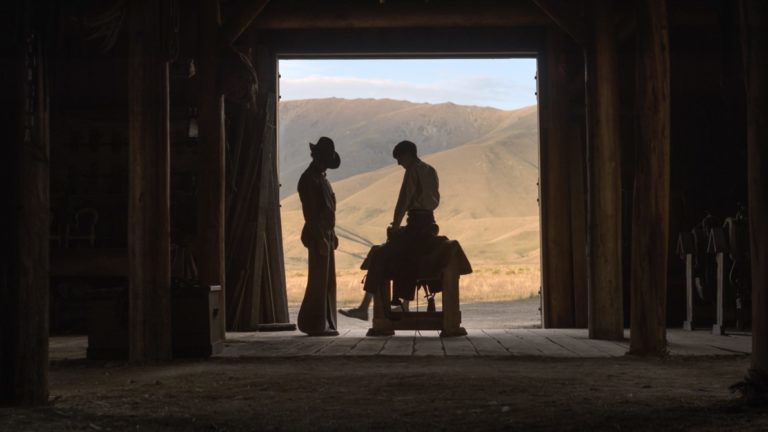
Rousselot thus evokes the sequence of A river runs through it where the two brothers sail on the river at night. The journey stretches over a long distance, and anyway the very situation of a boat sailing on the water makes it very expensive and complex – not to say impossible – to set up a lighting system for a night shoot. Then it soon became obvious that it was necessary to resort to “day for night”. Rousselot thinks, even more so today, that this effect does not work. Yet the audience does not notice this lack of realism, because they are above all caught up in the story.
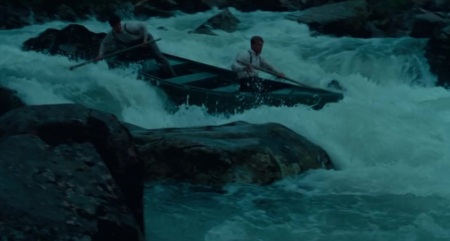
A river runs through it by Robert Redford – Night sequence on the lake shot in day for night
The question of realism
This higher than normal brightness/readability is also linked to our desire as spectators to see the action and the expressions of the actors, a desire that also contributes to our tolerance of the lack of realism. On the whole, in a film, we accept many more things than in real life, in terms of image but also, of course, in terms of storytelling. It is also one of the pleasures of cinema to transport us into a different world, where we can dream, for example, by believing in the possibility of improbable coincidences… I believe that we are reaching here the magical dimension of cinema: the audience agrees to let itself be taken into a universe that is not quite governed by the same rules as reality; the desire for magic makes magic possible.
The idea of conventions implies that we are not in a totally realistic representation. It should be noted that the day for night can sometimes be used precisely to derealize night sequences. The night, and the cinematographic image, not to say the cinema, are never purely realistic anyway, it is necessarily an interpretation of reality. Even realism is a construction.
Playing with conventions by distancing oneself from them allows one to be creative, to tell something other than a simple transcription of reality. While night is often represented by a bluish coloring of the light, choosing like Darius Khondji AFC,ASC in Delicatessen or Jordan Cronenweth ASC in Blade Runner to create orange or even coppery outdoor night atmospheres gives them a richer meaning than simply informing that “it’s night”: a polluted night for the Los Angeles of Ridley Scott’s film, a strange and timeless night for the village in Jean-Pierre Jeunet’s. Moving away from conventions leads the story to a world detached from reality : a place far from the cities, a distant future, even an undefined and uncertain space-time, outside the world and outside time. It is difficult to determine whether certain sequences of these two films take place at night or during the day, which contributes to the feeling of strangeness.
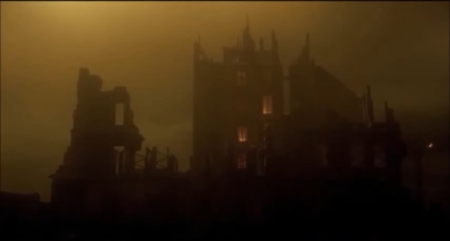
The warm nights of Delicatessen by Jean-Pierre Jeunet
The contributions of technological progress : towards more realism ?
Technical and technological progress has offered new possibilities for filming. Digital color grading allows for more precise adjustments, for example to work on skies that are often too clear on day for night. This was notably the case for Tim Burton’s Big Fish : the night scenes around the lake, shot in day for night, were reworked during digital color grading, notably to lower the luminosity of the skies, in order to obtain a more “natural” rendering ; a result that Rousselot judges to be relatively successful, even if he considers that today, thanks to technological progress, it could have been even better.
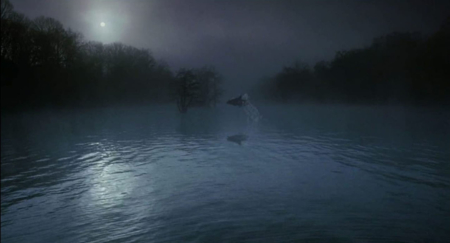
Big Fish by Tim Burton
When shooting in digital, the use of LUTs or even pre-grading on set allows to have a more precise idea of the final rendering and therefore to make finer adjustments in the light settings during the shooting.
On the other hand, some recent digital cameras, with a much higher sensitivity than film stock, have changed the way of approaching night shoots, and contributed to pull cinematographic nights towards denser images, since we can capture more shades in the low lights. Xavier Dolléans did not hesitate to push the Venice, chosen precisely for its sensitivity, to ISO 3200 or more. The representation of the night is moving towards more and more naturalism, and more subtle effects, which also modifies our perception as spectators when it comes to the cursor of realism and acceptability. The audience is more and more demanding on the credibility of light in historical films, especially when they depict periods before the appearance of electricity and light bulbs.
Germinal often takes place at night, at a time and in places where private and public lighting remained very weak, and moreover in the coal mine environment, therefore in settings where coal is everywhere. Blacks therefore plays an essential narrative and visual role. The director of photography was very interested in the reproduction of blacks in all their nuances and textures, inspired in particular by the research of painter Pierre Soulages.
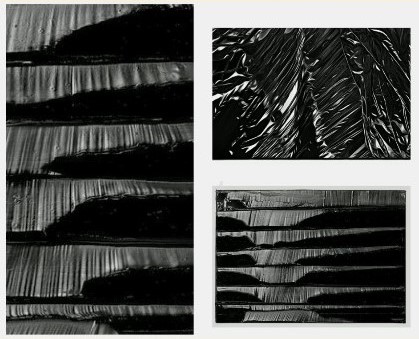
Works of Pierre Soulages used as a reference by Xavier Dolléans for Germinal
However, it is not because there is less need to light a set to see something at night that there is no need to light it. A picture is never a simple, supposedly neutral recording of reality : even a “naturalistic” light is never “natural”, one always chooses a camera angle, an incidence of light in relation to the axis, one adjusts the hardness/softness and the color of the sources, one reworks the contrasts between the different zones. Naturalism is a feeling, not a reality.
On the other hand, the progress of digital color grading also enable multiple new creative possibilities, for example by working on the colors selectively according to the luminosity. Dolléans and his colorist Karim el Katari were thus able to add yellow in the highlights of Germinal, without touching the shadows.
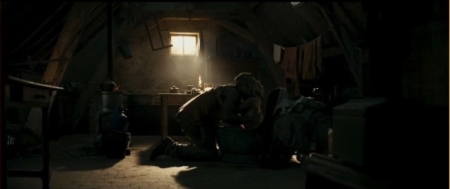
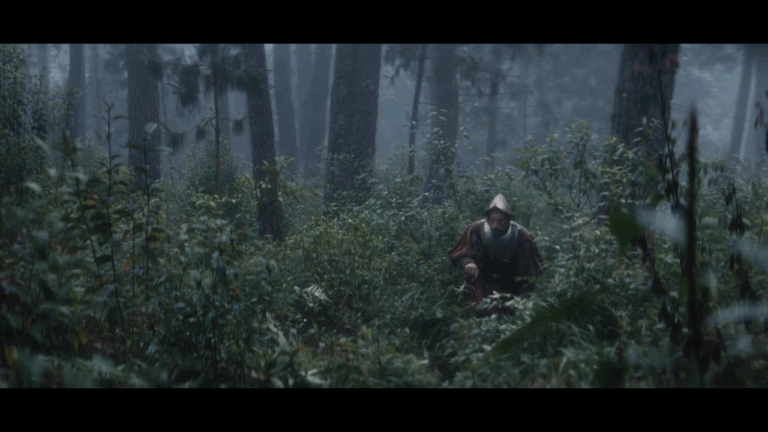
A photogram from Germinal
The justification of light sources
In night exteriors in particular, but also in interiors where no practicable light is visible, the director of photography is often confronted with the question of the justification of light sources. How can one see something when there is no light source in reality? It is not always obvious on stage to determine if the direction of a source placed by the cinematographer but without any visible justification in the image and in the set will raise questions in the viewer’s mind, or if it will not even cross his mind because the rendering corresponds to his mental representations, and that he is otherwise taken by the story. This brings us back to the idea of convention : it can be useful to show the supposed source of light at the beginning of a sequence, if its presence is not obvious to the viewer (depending on the frames, the editing, for example, even if the viewer is also often able to guess spontaneously) : for example the moon, or a street light, or in a dark room the light coming from another lit room. It sometimes happened to me while watching a movie that I was confused by a light, especially a colored one (therefore all the more surprising), whose diegetic origin I couldn’t understand. This tends to bring me out of the film a little bit, discovering later that it was coming from a neon light, for example, which had been out of the picture until then. Even during the day, the fact of having shown the presence of diegetic light sources in the set makes it easier for the spectator to accept that the actors and the locations are lit, even if they are not really lit by these elements and could not be (because of the nature of the light source or the direction of their beams). For example, if in a shot where we are facing a character, we can see a light in the background on the right side of the image, we immediately accept that this character is illuminated from his left side, despite the fact that the light in question is too far back to have a really lateral direction or even 3/4 face on the actor’s face. However, it is another light source, out of the field, positioned by the director of photography, that actually lights the actor’s face.
This example shows that realism is not a simple copy and paste of reality : it is a question of making an effect credible, and reproducing a sensation, which can have different facets (the night can convey a subdued and warm atmosphere as well as a disturbing atmosphere for example).
The question of the justification of light sources is even more complex when the diegesis does not present any practicable light, especially if it is precisely about telling a deep darkness. This was the situation that Xavier Dolléans was confronted with in Germinal, for night exteriors in a place and time when there was no public lighting. How then to make credible the presence of a minimum of light to make a minimum visible the characters and the elements of the decor essential to the narrative ? It’s all a question of direction and hardness/softness of the light directions, and the dosage of contrasts.
Darkness, a place of fantasy
More fundamentally, the choice to set a sequence in “night” is never trivial from a narrative point of view. It is an artistic choice and not simply a factual one.
The lighting atmosphere influences the actors’ performance. Rousselot points out that it is interesting to do rehearsals with just the practicable lights on, as this enable the actors to be in the real light environment and to be able to act in a way that is accurate in relation to what the characters can or cannot see, for example they may want to get closer to better distinguish something.
The origin of our representation of the night goes back notably to the romantic period. The night conveys an imaginary of the hidden, the mysterious, the unknown; as well as of a time apart, that it refers to the dream and thus to the possibility of inventing worlds, as to freedom, to the transgression of the prohibited, to the universes and underground cultures (one can think of the famous “world of the night” : the most delirious parties could not take place in full day, the traffics rarely take place in full light).
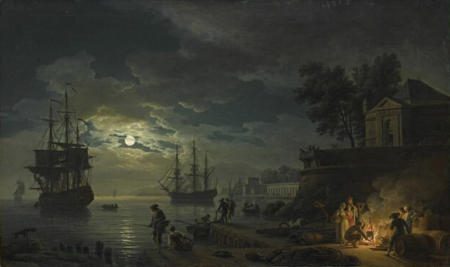
Claude-Joseph Vernet, “A Seaport in the Moonlight” (1771)
Rousselot quotes an anecdote related to Proust: in one of the salons of the late 19th century, one of the first incandescent light bulbs was on display, producing a much brighter light than the candles and oil lamps used until then. The writer then complains about the “end of the dark corners” : if everything becomes visible, there is no more unknown, no more mystery, therefore no more possible projection. The night leaves place to a certain ” licentiousness”, one dares more if less afraid to be seen; and what one does not see, one can fantasize it.
Darkness also often proves to be frightening : thrillers, horror, monster or suspense movie play largely on darkness, as well as on the off-screen, on everything that cannot be seen and therefore feeds our interrogations and our fantasies, and therefore our active involvement in the viewing of the film. Sight is our main sense, being deprived of it easily confuses us and we wonder what is hidden in the dark.
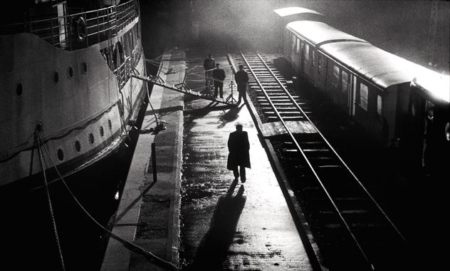
Béla Tarr’s The Man from London – A nocturnal atmosphere for a suspicious encounter
A question of contrasts : the highlights, allies of the dark areas
Darkness exists only in contrast to light.
One might think that representing nights in a realistic way would mean trying to reproduce the characteristics of human night vision: low contrast, little color or even chromatic aberrations, lack of definition, sensation of slight blur, noisy/grainy texture. However, if we apply strictly and only these principles, we obtain an unattractive and uninteresting image. Moreover, after a while, the eye gets used to the lack of luminosity: the noise comes out all the more and the black does not seem so black anymore. As human eyesight relies heavily on comparison rather than on an absolute evaluation, it is important to keep contrast in night images: the presence of intense light zones allows the low lights to appear even darker by contrast, and especially to remain dark over time by preventing the viewer’s eye from switching to “night vision” mode.
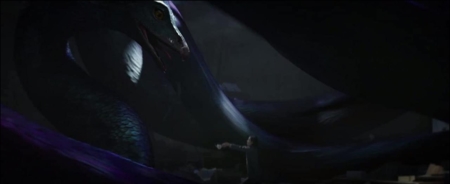
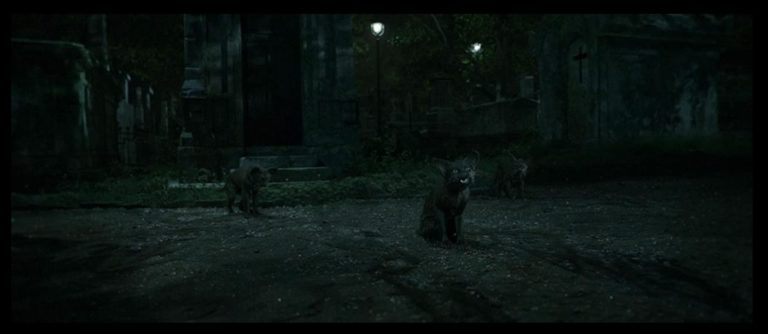
David Yates’ The Fantastic Beasts – The light that makes the darkness deeper
What we see, and what we don’t see, that’s the question… That everyone has to agree on !
The desire to see often leads directors and producers to push the night sequences towards images that are clearer than reality but also beyond the desires of the director of photography. It is therefore important to discuss the question of the level of darkness and of what will be visible or not, and at what point, from the preparation phase and with all the decision-makers: the director but also often the broadcasters. This helps the cinematographer avoid disappointment when discovering the final result, and to justify his or her ideas and choices, to defend them, and have them respected in terms of contrast and specifically the level of blacks, especially with television channels or streaming platforms, which are often cautious about bold and strong visual choices.
For example, for Germinal, Xavier Dolléans wanted to obtain a look that was both dense and metallic, with deep blacks, which was not easy to get the broadcaster to accept. But thanks to a lot of research and dialogue before the shooting, he succeeded in demonstrating the accuracy of his ideas, since the aim was to represent the harsh working and living conditions of the miners of the end of the 19th century, evolving in places that were often dark and with an atmosphere full of pollution and smoke. In the way he exposed, he also had to take into account the possible double distribution of the show, which was of course mainly intended for platforms but which it was clear from the beginning that it would also be screened in theaters, especially in events such as Camerimage.
As mentioned above, digital technology, with the introduction of high quality monitors, with the use of LUTs and even the possibility of pre-calibration on the set, offer tools that facilitate communication between all those involved by showing during the very shooting time a concrete preview that is close to the final image, which allows for immediate rectifications, avoiding the director, in particular, being surprised during the editing time.
Rousselot mentions a sequence from The Fantastic Beasts, where he chose to base the light on a temporal variation in the intensity of the moonlight, due to the passing of clouds in front of the moon, the set thus oscillating between light and shadow during the sequence. The justification of this effect not being necessarily obvious to the audience directly immersed in the action (and who does not “physically” see the movement of the clouds), the director of photography thus had asked the producer to make it understandable with the help of a shot to insert at the beginning of the sequence. This wide shot, made in CGI and embracing the city at night from an aerial point of view, was to show the movement of the clouds before the moon, and the effect thus produced. The final cut does not include any of this : the CGI shot does not show the movement of the clouds in front of the moon, and the editor only retained the brightest shots !
Finally, night or day, the most important thing is not to forget that an image is never reality, nor even a simple record of reality, but something created that convey a point of view, a look – in a broader sense than just visual. Cinema is always a re-creation of the world, which will make sense to the audience according to its own mental representations, which are partly informed by the culture and the time in which they evolves. As cinematographers, it is up to us to shape this visual re-creation according to the script and to the narrative and aesthetic intentions of the story, while playing on our common cultural references, whether to follow them or to deconstruct them, sometimes to the point of modifying them.
> Cover image : Fantastic Beasts and Where to Find Them (2016) by David Yates, DOP Philippe Rousselot AFC,ASC