Ben Saffer discusses pairing the Blackmagic URSA Cine 17K 65 with Cooke Panchro 65/i spherical lenses.
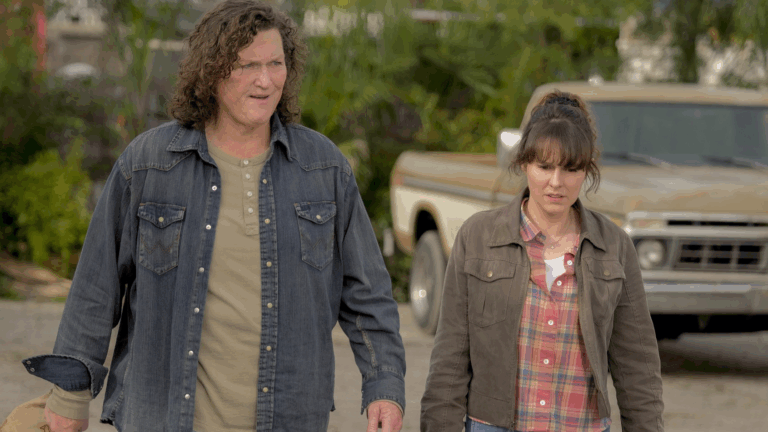
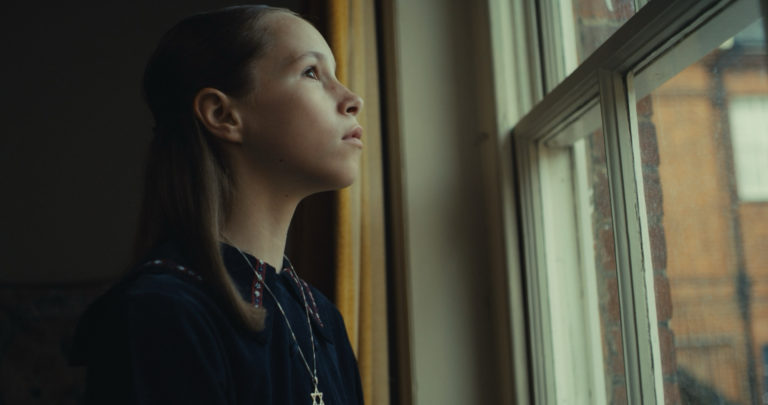
For To Fly or Float, director of photography Ben Saffer wanted to create a ’70s-inspired look built on layers and interesting contrast ratios, with bright elements in frame to anchor the shadows. Working closely with director Charlotte Peters, he chose the Blackmagic URSA Cine 17K 65 digital film camera to recreate the emotional closeness of handheld 16mm while conveying the sculptural space of 65mm, keeping the audience in the moment rather than in the position of observers.
Producer and writer Olivia Maiden grounded the film in the profound experience of childhood grief, while Saffer drew on visual references such as Kes, Ratcatcher, and Fish Tank to shape their collaboration. “From the start, Charlotte, Olivia, and I agreed on the tone and the texture,” said Saffer. “Those references influenced everything else, from the locations to the production palette, the lighting, and the choice of lenses.”
In this interview, Saffer discusses the choice of format and how it shaped intimacy and distance, as well as the practical decisions made on set and carried through into post-production.
Q. What drew you to the URSA Cine 17K 65?
A. I’ve always loved the look of film, so I wanted a camera that would let me trust my instincts on exposure. For me, that means a naturalistic look, because the color filters work naturally within the sensor, and the setup lets me focus on the essential details of a scene. For To Fly or Float, Charlotte and I chose the Blackmagic URSA Cine 17K 65. We configured it to produce structured images, with depth and interesting contrast ratios, and an emotional closeness with a certain sense of scale.
Q. What visual language were you after, and how did the ’70s setting shape it?
A. We wanted a very structured look, with interesting contrast ratios. There was almost always a bright element in the shot to anchor the shadows, which I think is essential. Since the film is set in the ’70s, we wanted a format that would let us create layers of depth throughout. We were looking for a camera and lens combination that would recreate the emotional closeness of handheld 16mm while conveying the sculptural space of the 65mm format. Something that makes you feel you’re in the moment rather than watching it.
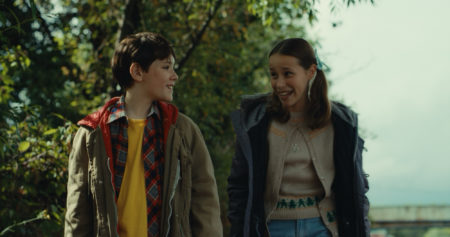
Q. What convinced you that 65mm could work as well indoors as outdoors?
A. When I first considered shooting this film in 65mm, the producers thought it was the ideal format for landscapes, but they wondered how well it would suit confined interior spaces. I understood that instinct. But I also think cinematographer Bob Richardson proved what 65mm can do in interiors, and that helped me clarify my intention to use the format for this story.
Q. How did you build your lens and coverage strategy for 8K open gate?
A. We planned around the URSA Cine 17K 65’s full sensor coverage, using the camera’s 55.91mm image circle and 8K open gate capture to get the equivalent of 5-perf 65mm. That let us embrace large format depth and framing from the outset. Then we chose the appropriate lenses: two Cooke Panchro 65/i lenses (40mm and 75mm) and GeckoCam Opia lenses to go wider or tighter.
Q. What did you think of the URSA Cine 17K 65 system in practice?
A. What struck me in practice was how easy the URSA Cine is to use. Having shot narrative films on both the Blackmagic URSA Cine 12K LF and the Blackmagic URSA Cine 17K 65, I think they make an excellent A and B camera pairing. Our Steadicam operator used both cameras, and because their setups were so similar, she would forget which one she was working with. I can easily see myself shooting a feature or a TV show with both URSA Cine cameras, since they weigh almost the same and their accessories are interchangeable.
Q. How did 65mm affect exterior framing and your sense of space?
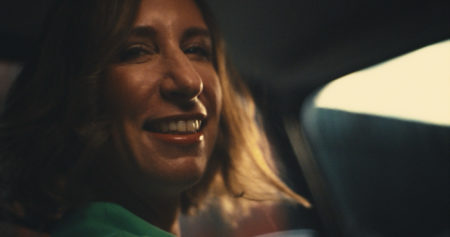
A. I’m always looking for a format and lens combination that gives me options without distancing the audience from the story. With 65mm, you get a creative option that differs from my usual anamorphic approach. For one exterior sequence, we wanted a canal in 1970s Birmingham. It was shot entirely in daylight. With trees on one side and reflections on the water on the other, it gave us exactly what we were looking for. To reproduce the geography and the space, I would normally have shot anamorphic on a 50mm or 60mm lens. But the 65mm format lets you step back while getting the same level of compression. With the URSA Cine 17K 65, I was able to use the Cooke Panchro 65/i 75mm spherical lens, which is fairly long, while keeping a sense of immersion.
Q. How do you protect intimacy without intrusion or distance?
A. That balance is important. In an intimate scene, you don’t want to be too close, because it feels like you’re interrupting something. But I also didn’t want to use a long zoom, with its voyeuristic or journalistic effect. The format is essential. If I had shot wider on a smaller sensor, I would have lost all the compression in the background, and it would have felt distant. The 65mm format gives me another creative option besides anamorphic.
Q. What told you the camera would render skin tones well?
A. The URSA Cine 17K 65 is very clean in the lower part of the skin tones. A little luminance noise is fine, because it can resemble film grain. But you absolutely have to avoid chroma noise. I think a good camera should be able to use the sensor’s full tonal curve as naturally as possible.
Q. Describe a scene where all these choices came together.
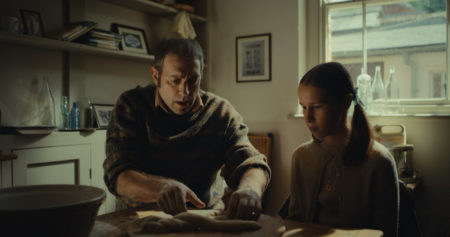
A. A good example is the kitchen scene. Most of the film was shot in fairly tight spaces, so I tried to keep the light as soft as possible. I wanted a single-source, naturalistic scene, but with scale. For the kitchen, I used a Vortex8 with a large 8×8 silk to bounce the light. It works like a book light, but set up very simply. Then there was the hard light coming through the window behind the uncle. The lighting, the grading workflow, and certain production choices allowed us to achieve this look. But shooting in 65mm also plays a part. It’s an intimate story about a young girl, but I wanted to give it a certain scale, because these are the most important experiences she has had in her life. 65mm definitely brings that sense of significance.
Visit the URSA Cine 17K 65 gallery page to learn more about Saffer’s work on To Fly or Float, including downloadable Blackmagic RAW files from the short film: www.blackmagicdesign.com/products/blackmagicursacine/gallery#toflyorfloat.