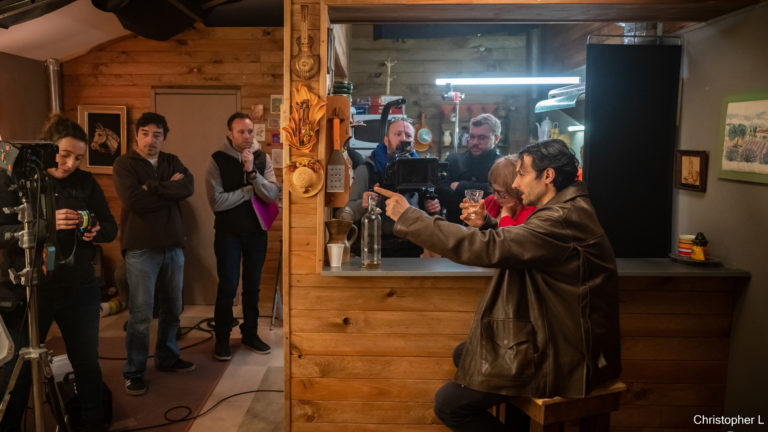
In Welcome to Wrexham, actors Rob McElhenney and Ryan Reynolds learn to run Wrexham AFC, the third oldest professional football club in the world. This critically acclaimed documentary series chronicles their journey from Hollywood to Wales and presents their experiences as football club owners and the club’s ties to the town.
The series, praised for its storytelling, won five Creative Arts Emmys this year for best unstructured reality show, cinematography, editing, directing and sound mixing.
Following Wrexham’s quest for promotion, the second part of the series covers the 2022/2023 season through interviews with key team members, highlighting the production process and the technologies used to frame this fascinating story.
Having worked on the entire series, camera assistant Gareth Roberts notes a significant evolution in the show’s visual quality. “When the first season started, the production was still very much figuring out the visual approach. But things evolved as the importance and budget of the show grew.”
The discussions about improving the show’s aesthetics began with director of photography Craig Robert Hastings, writer-producers Bryan Rowland and Josh Drisko, and producer Patrick McGarvey before the second season shoot. “We sought to adopt a more authentic visual approach by moving away from the overly bright style of the first season.”
Their goal was to give the series a more cinematic feel to enhance the dramatic side of a small football club’s journey to reach the EFL.
“We had several cameras to cover the matches. However, most of the time, we only needed a single handheld camera,” explains DP Craig Robert Hastings. “We needed a compact, lightweight camera that offered good low-light sensitivity and variable speed options.”
Both seasons were captured in 4K using Blackmagic RAW, with the production choosing to use URSA Mini Pro digital cinema cameras alongside Blackmagic Pocket Cinema Camera 6K Pro cameras.
“As a sports documentary, the most important thing is having the right camera for the right situation,” says Hastings. “For each season, we hire the best camera equipment available. The URSA 12K allowed us to switch between higher frame rates while including audio capture, something many other cameras don’t offer. Likewise, being able to shoot in 4K RAW at 100 fps was a major advantage, as it heightened the dramatic feel of match days. However, the Blackmagic RAW workflow was our biggest asset, as it gave our post team more control during editing and grading,” stated Bryan Rowland from Maximum Effort, who served as director, editor and writer-producer for the series.
On match days, the production team splits in two. The first team films the news, the pre-match anticipation, the team’s arrival and the energy in the stadium. “When an episode follows an individual’s story, we are there first, documenting what happens before and during match day,” notes Rowland.
The second team focuses on match action and captures everything from various vantage points around the ground. “We need cameras that are compact and lightweight, so that the crowd and players don’t feel the camera’s presence and forget it’s even there,” explains Hastings.
Roberts adds: “The Pocket Cinema Camera 6K Pro is the smallest camera we use for the show. It can be used at 120 fps with a large lens, which is what our producers want. Having a small camera that achieves that is brilliant.”
For sit-down interviews, the production uses three URSA Mini Pro 12K cameras equipped with Cooke S7/i Full Frame Plus prime lenses. “The 12K cameras give us incredible latitude for framing and reframing in post. Being able to shoot in 8K and deliver in 4K gives us room to punch in without losing detail,” says Hastings.
The post-production workflow for Welcome to Wrexham is managed by a team of editors and colourist Lauren Duval at Light Iron, a Panavision company, based in Santa Monica. “For the second season, we didn’t change our post-production process much, which includes DaVinci Resolve for ingest and finishing. However, we optimised the shooting and data management, which allowed us to focus more on the storytelling in post, particularly since the characters had already been established in the first season.”
The Welcome to Wrexham team also edited certain episodes in DaVinci Resolve Studio, according to Rowland, who recently won Emmys for editing and directing the series. “For example, for the seventh episode of the first season, I was able to work entirely in DaVinci Resolve, as its format was different from the rest of the show. I focused on directing and shooting the episode, then on post-production. I used DaVinci Resolve for editing and compositing with Fusion to reduce our production timelines. Being able to ingest rushes, edit, do online finishing, and grade all in one application is a huge advantage.”
“The evolution of ‘Welcome to Wrexham’ shows Blackmagic Design’s real commitment to documentaries. The ability to shoot in RAW, combined with the power of DaVinci Resolve for editing and grading, gives documentary filmmakers tools that were previously only available to big-budget productions,” concludes Grant Petty, CEO of Blackmagic Design.