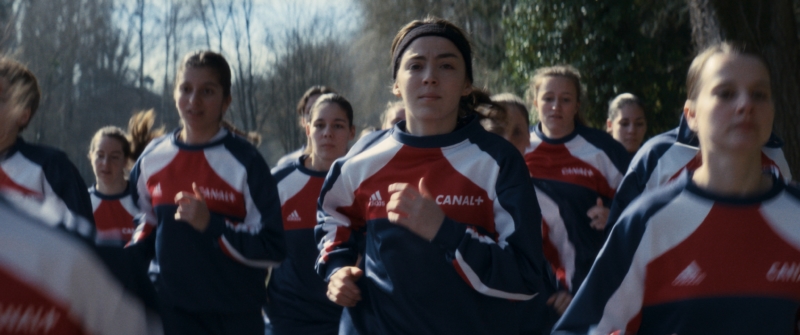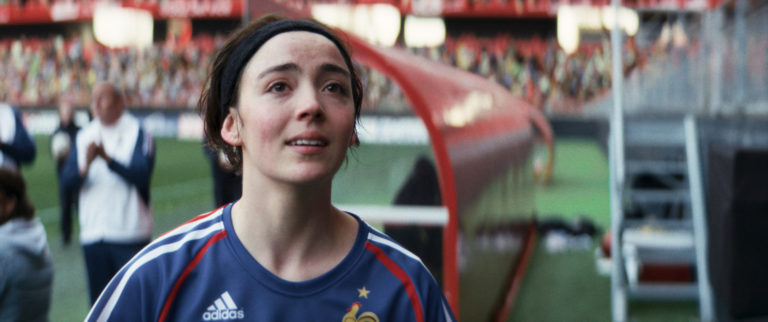
Shot in early 2022, the simply titled film Marinette is the first biopic dedicated to a female athlete in France. It tells the story of Marinette Pichon, a pioneer of French women’s football and one of the sport’s greatest stars, who became the first French woman to sign with an American professional league and the most capped player in the French national team.
Beyond football, and in keeping with director Virginie Verrier’s vision, the film is also the portrait of a young woman from a working-class background whom nothing predestined for this extraordinary career, addressing the issues of domestic violence, the evolution and recognition of women’s football, and the emancipation that sport provides.
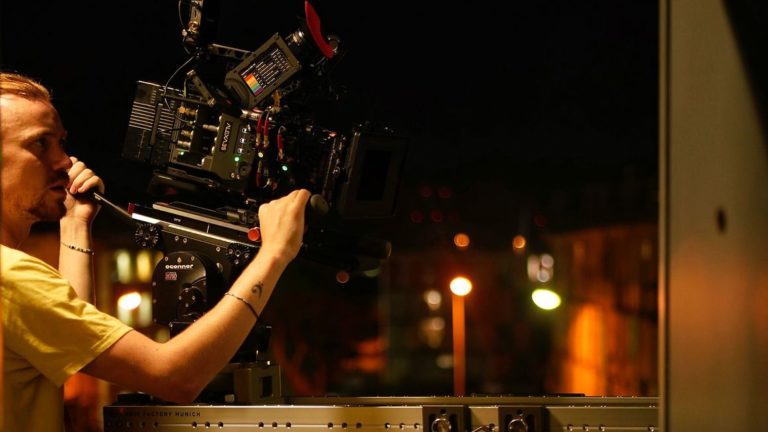
Xavier Dolléans, the film’s Director of Photography, talks about the origins of the project and his preparation for its seven weeks of shooting.
“We had a long pre-production phase, with preparations that began in September 2021 for a shoot in January 2022,” he recalls. “Very quickly, many questions arose: how would we film the matches? How would we recreate American stadiums while shooting in France? What cameras would be used? And so on.”
“These questions led us to collaborate with MPC, a company specialising in visual effects with extensive experience in crowd duplication techniques needed to fill stadiums, which form a large part of the story.”
The production team filmed matches in several stadiums, including a significant portion at the Stade Jean Bouin, a venue usually reserved for the Stade Français rugby team’s matches.
Very quickly, Xavier Dolléans realised that duplicating crowd shots would take an enormous amount of time. After discussing with Laurent Larapidie, VFX supervisor at MPC, it was decided that Larapidie, along with a camera assistant, would form a separate team working independently from the main unit to manage the extras for these scenes.
“I had entire stadiums to fill with 70 extras,” recalls Larapidie. “We filmed these extras from different angles, frequently changing accessories and clothing. We also frequently changed their positions. It was a time-consuming exercise, and the ability to work independently on this part of the shoot saved us and the production a considerable amount of time.”
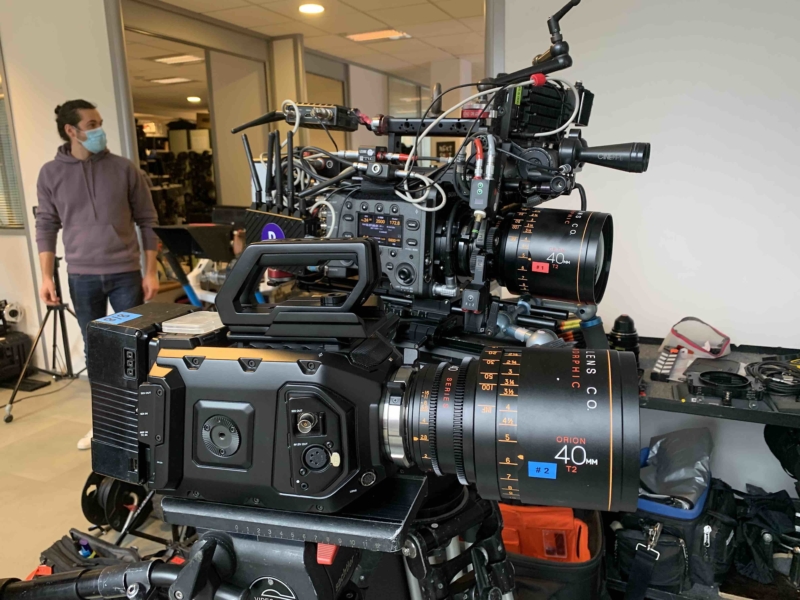
“We obviously used CG crowd simulations for the very wide angles, but the ability to use crowd elements gave us more opportunities to achieve convincing effects,” he adds. “I was immediately interested when I learned that the team was going to use the URSA Mini Pro 12K, given its resolution. With a VFX approach like ours, where we needed maximum detail for our crowd tiles, 12K is ideal.”
“For a VFX supervisor, the ideal camera provides the highest resolution with the minimum of noise and chromatic aberrations possible, unlike a cinematographer who would typically prefer a completely different look. We are not looking for the same thing.”
“Moreover, it is an easy camera to set up, simple to use and well designed. I would not necessarily have had confidence in other cameras for this shoot. The technical team gave me a quick overview to explain how it works, and very quickly, I was ready to go.”
“Furthermore, it is relatively lightweight, and we could mount it on a slider, which allowed us to be mobile. This made it easy to use on the pitch as well as for angle changes. I have worked a great deal in stadiums in the past, but this was the first time I could film these crowd elements myself.”
The URSA Mini Pro 12K was equipped with Atlas Lens Co. Orion anamorphic lenses (and sometimes Angénieux 4.0 anamorphic lenses). Most VFX shots were captured in 8K at 48 frames per second and shot in 2:39 format to match the main unit cameras.
VFX supervisor Niranjan Siva confirms the benefits of working with high-resolution files in post-production. “We worked on 4K EXR files, sampled down from 8K by the lab, followed by an ACES colour-managed workflow. The added value lies in the ability to reframe or zoom into the images without sacrificing quality. It is a valuable advantage for maintaining a high level of detail,” he stated.
This sentiment is shared by Dolléans. “In the film industry, it is not uncommon for VFX artists to be called upon to perform miracles on shots that lack detail and resolution. With Blackmagic’s 12K sensor, this problem does not exist,” he notes.
In addition to its use for crowd duplication, Dolléans used the URSA Mini Pro 12K to film blue-screen scenes, for instance to simulate the stadium behind the commentary box, as well as establishing shots and beauty shots.
“At the end of each day, when everyone was packing up the equipment, I would talk to the director and she would tell me she wanted to take advantage of the landscape colours to do some additional shots,” Dolléans concludes. “Having access to a stripped-down URSA 12K with an anamorphic lens allowed me to go and film these moments without needing a support crew, enriching the film’s narrative.”