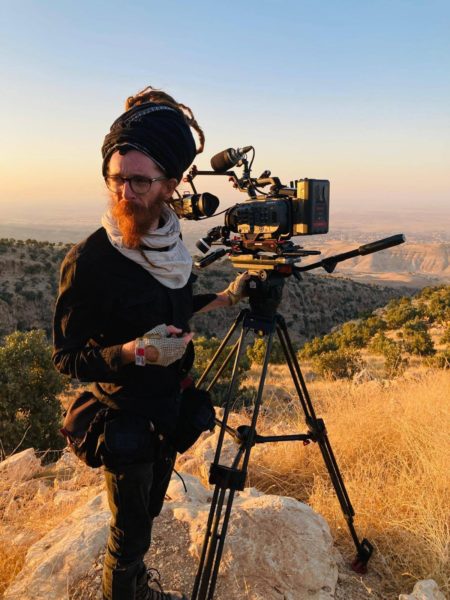
Julien Gidoin © Lucas Charvet
Julien Gidoin is a documentary cinematographer. In 2018, he took to the streets of Paris to photograph social movements, with nothing but his experience as a DP to go on. Ever since, he has kept searching for the right way to capture life inside the protests.
Light, presence, gaze: a DP at the heart of the marches, where hope, solidarity and violence meet.
Julien, you’re the first DP who brought me into the profession. I immediately felt you had a singular eye, a sensitive way of framing and filming people. Before we get into that, let’s set your work in context: how would you describe your path today?
At first, my thing was soccer! But I didn’t make a career of it, you know. I was a bad student, looking for a breath of fresh air outside school. I drew, and I met an art teacher who later ran a film option; he really encouraged me. Drawing led me to film photography, with a camera my father no longer used.
Since I wasn’t good at writing, I probably found a refuge there. Later on, visual storytelling replaced every other kind of writing. I left school very early. At first I shot weddings and short fiction films, and I was in touch with students from La Fémis. That’s where I met a gaffer who taught at the school and gave me my first break.
In fiction, I started as an electrician on lighting crews: driving the trucks, running cable, rigging the lamps. When I moved up to best boy, I gradually left that path. Meanwhile, I kept making short films as a DP.
When did you start going out into the streets with a camera?
It was at the very end of 2018. I was working all the time, regularly in Los Angeles, on feature documentaries (well, now I don’t want to fly for work anymore!). I heard about the Yellow Vests without really understanding: I didn’t have time to follow the news. Back in France, I looked into it. The first images made me wonder: all that fire, those cars… the first Yellow Vests speaking out… Something was happening.
I thought I’d make a short documentary, find a production company and a sound recordist to team up with. On the production side, I got turned down, or was told kindly that it wasn’t the right time. As for the sound recordists, they were afraid for their gear, maybe just afraid, period. I ended up on my own.
A director I was close to told me: “Go ahead, grab your camera, do what you do when we’re together and you take pictures of us. Take the same photos you take of your uncle.” That’s how I started.
Why black and white?
I’ve always shot black and white on digital and color on film. I stuck with that idea; it came naturally. It’s true that in the early days of digital, color rendition wasn’t good, and skin quickly turned magenta.
Many photographers say something I fundamentally agree with: viewers see colors first, and that steers their gaze. In black and white, it’s the feeling that comes first. The eye can’t wander off to a red car in the background, for instance.
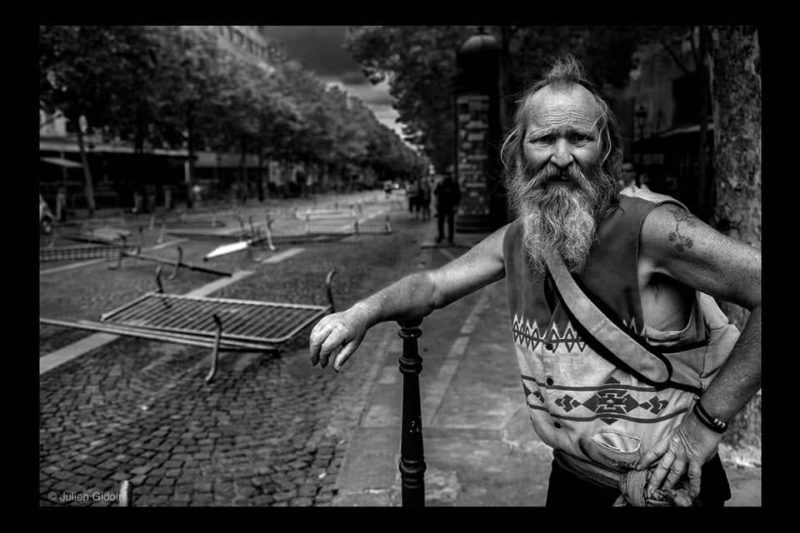
July 14, 2019: Act 35 of the Yellow Vests
How did you learn the ropes of protests and their “rules”?
I wasn’t a protest person at all: I grew up in the countryside, with no political background.
Besides, with the Yellow Vests, it didn’t look like a protest! There was no identifiable zone; it was always on the move. People speaking up and making their demands loudly, walking fast, doing lots of things at once. Many ate their sandwiches as they marched; gatherings sometimes lasted… 10 hours. Nothing was compartmentalized; everyone was together all the time.
Me, I’d slip into groups and listen a lot, to try to get it right. A bit like a camera that listens.
With the Yellow Vests, it happened gradually. I’m very recognizable; sometimes people would spot me again from one event to the next and we’d talk.
With others, it depends. Photographing firefighters is no problem: they set up fire lanes, their setup is very easy to read, and you know where to position yourself in a tense moment. More broadly, I quickly watched how the “old-timer” photographers positioned themselves.
Photographing the police is tricky: these are people who don’t want to talk to you and don’t want you around. You can be a problem for them. There’s no dialogue possible; I’ve often tried.
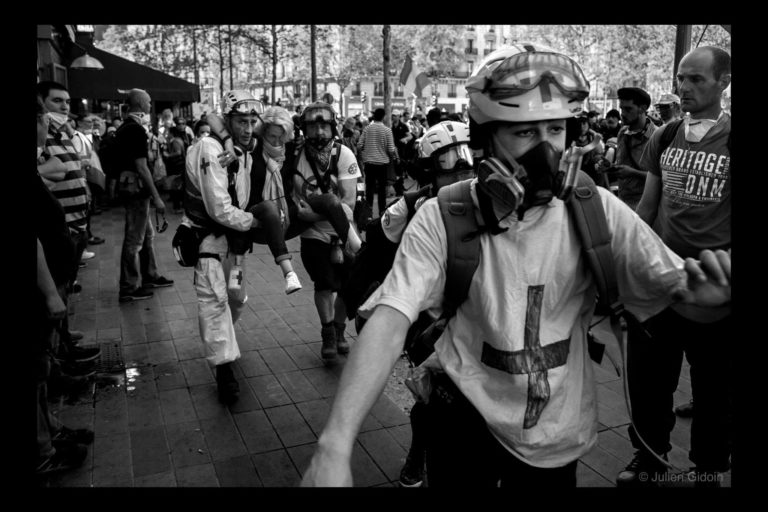
The street medics [volunteer caregivers who provide first aid at protests], for their part, usually gather around an injured person to create a safe space. They keep an eye on the photographers to spot the ones whose approach is sound. Documenting the injured together is clearly hugely important.
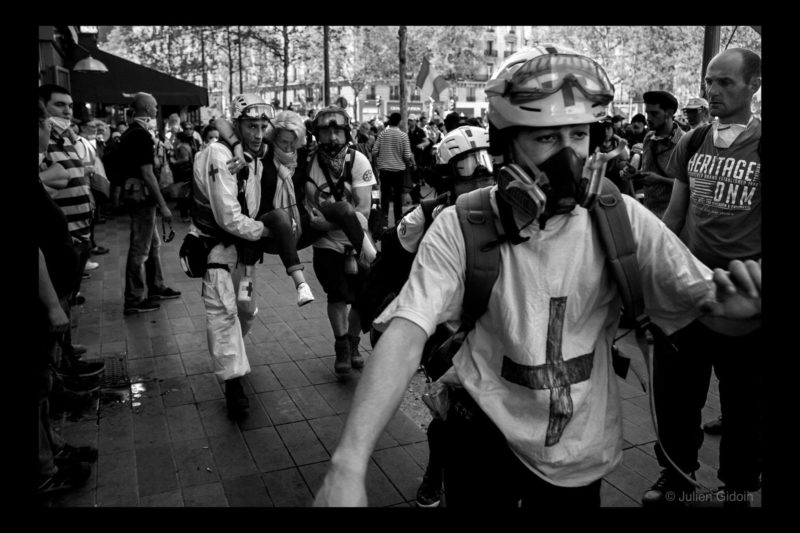
April 20, 2019: Act 23 of the Yellow Vests
In very practical terms, how do you gear up for a protest?
For a long time, I had a Canon 5D Mark II with a loupe on the LCD screen: the autofocus was poor, and the loupe let me see the image clearly despite my safety goggles.
For the past 2 years, I’ve been using a Canon R3 with a Canon L-series 35mm f/1.4, plus a Canon 40mm pancake. I shoot almost all my photos wide open. The R3’s viewfinder is good enough, for that matter. I like big camera bodies, out of habit from working with cine cameras, I’d say. I also have a GoPro HERO7 on my helmet, 3 batteries and a V-Lock in my backpack if it’s a long day.
As for safety, early on I didn’t protect myself well. Now I have a skate helmet, thicker than bike helmets, shin guards, and a gas mask with a chemical cartridge, the kind house painters wear, covering me from chin to nose. And MSA firefighter goggles: they can’t catch fire, they’re watertight and sturdy, and almost no gas gets in (anyone can buy them on pompier.fr).
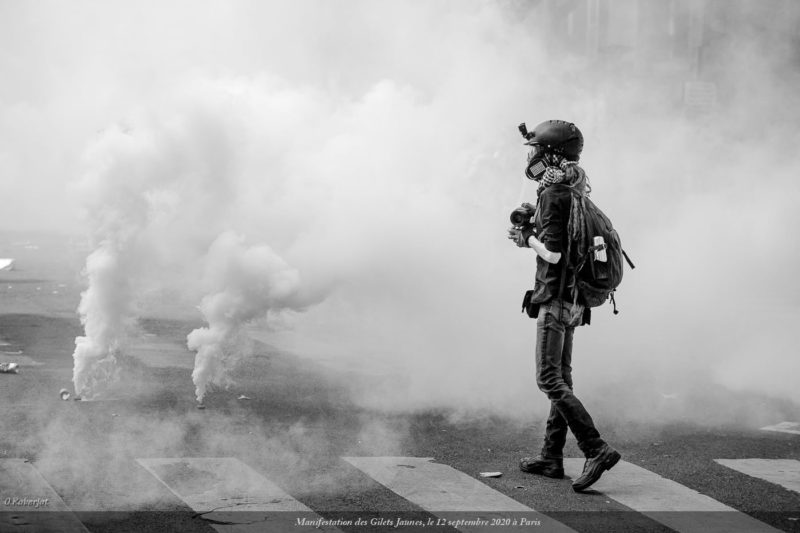
September 12, 2020: Julien Gidoin at a Yellow Vests protest © Olivier Roberjot
Today, the weapons used at protests aren’t really the same anymore. There are way more grenades; it’s insane!
The water cannons have changed too: it used to be a very stinging liquid (you needed a rain jacket). Now the liquid is really strange: very sticky, with a smell like a dead animal. My camera body keeps that smell for a long time, my clothes keep the smell of tear gas, and so do my V-Lock batteries; it’s really hard to get rid of.
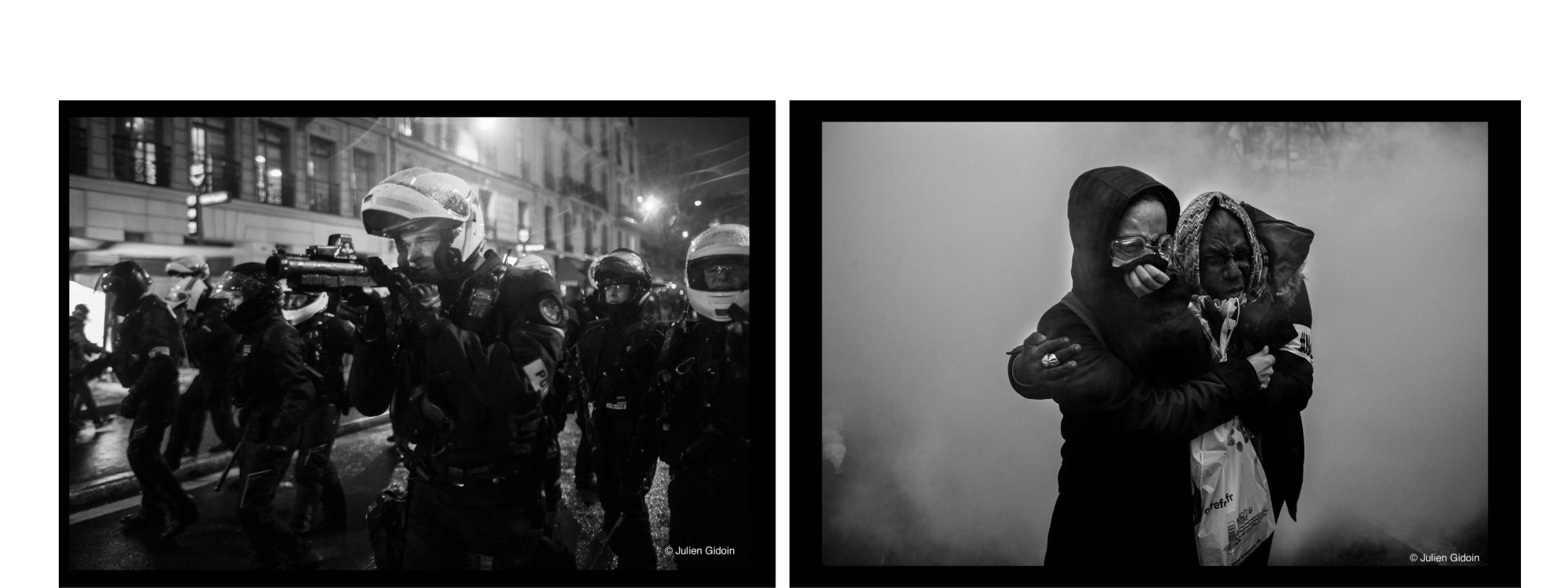
Left, April 9, 2020: pension reform protest. Right, November 20, 2021: the Yellow Vests’ third anniversary
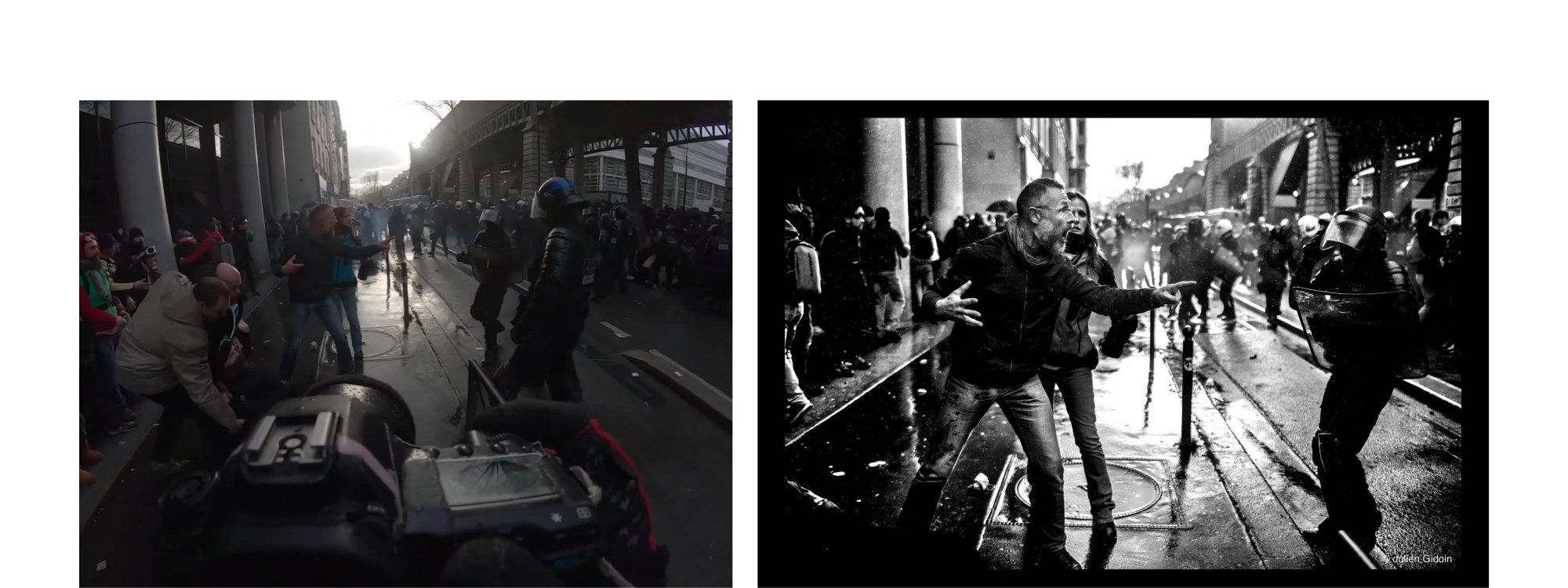
You created a film format based on your photos, released on YouTube and social media. It combines stills and video footage. Why did you want to do that?
To think clearly about what was happening to me, something was missing. All the more so because I had to stay alert so I wouldn’t get hurt. I wondered whether what I’d felt in the moment really matched what had happened. So I put a GoPro on my helmet, to review the footage away from the heat of the action and gain some distance. It also let me analyze the situation in terms of photography and light: I wasn’t always happy with my images, and it gave me pointers for next time.
One day, coming home from a protest, I realized while going through my footage that my camera kept coming into frame. I’d seen that plenty of times in documentaries. I started cutting it together on my own and posting it online. Some journalists reshared the videos. It became a series.
Watch the Dans le Viseur series on YouTube
How do you anticipate violence, to protect yourself while still documenting it?
The more chaotic it gets, the harder it is. And the harder it is, the calmer your demeanor becomes. I don’t know if that’s true in my heart and my head, but I think it’s important to move slowly, maybe even to wait sometimes. If you wait a bit, the chaos organizes itself somehow; it gets clearer, and you see better. Being a professional in a place where there are wounded people, screaming, bleeding… You’re not in the fight yourself; you’re documenting the fight. In principle, nobody’s going to hit you, or if they do, it’s by accident.
And then, as an occupational habit, from shooting documentaries with big cameras that stick out behind your shoulder, I always keep in mind the space I need behind me. If I can’t get through with that volume, I shouldn’t go. It’s like a bubble around me.
And finally, I listen closely to what’s going on.
What did being a DP before this protest work bring you?
Being a DP gave me everything I needed to photograph in the street. Technically, to begin with: RAW, image processing, focal lengths, distances, focus, depth of field, lighting angles.
The rigor of preparation, too, as before a shoot. I arrive on the ground as a professional, so I go on being one. And I come with physical experience, because our shoots are long and physically demanding. As a DP, you walk forward, but also backward.
The approach, though, is completely different: in photography I talk a lot more, whereas on a shoot I barely speak to anyone.
What matters most in the image, for me, are faces and expressions. At a protest, you’re outdoors, facing weathered faces: that’s where life is. All the work we DPs do on skin tones becomes very concrete.
What helps you know when to move and where to stand at a protest?
I really do think a lot about light when I take pictures; otherwise, why put yourself in that kind of situation? If you’re going to take a risk, the photo might as well be right.
And yet I often find it’s a failure. So I ask myself why it doesn’t work.
We’re responsible for the image of the people we film. That’s not my line; Patrick Chauvel [war photographer and filmmaker] says it all the time. Someone crying, who let you into their conversation, who’s suffering, who’s full of rage… you want to do right by that.
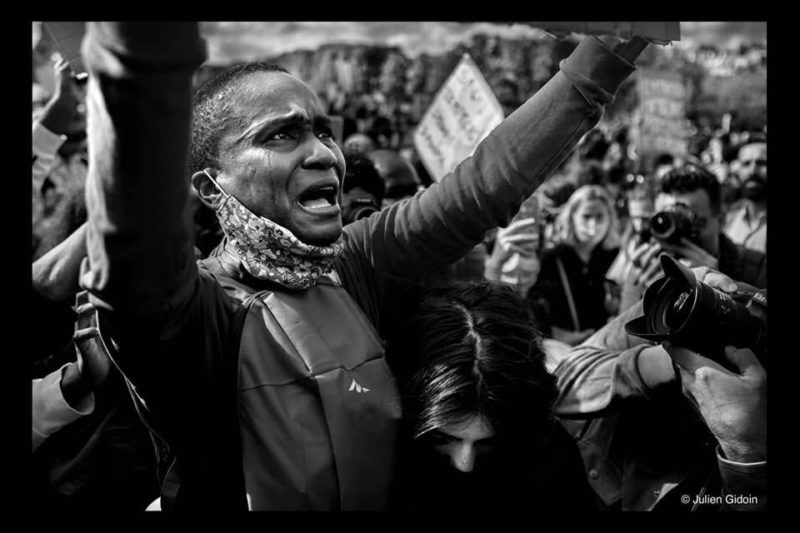
June 6, 2020: Black Lives Matter
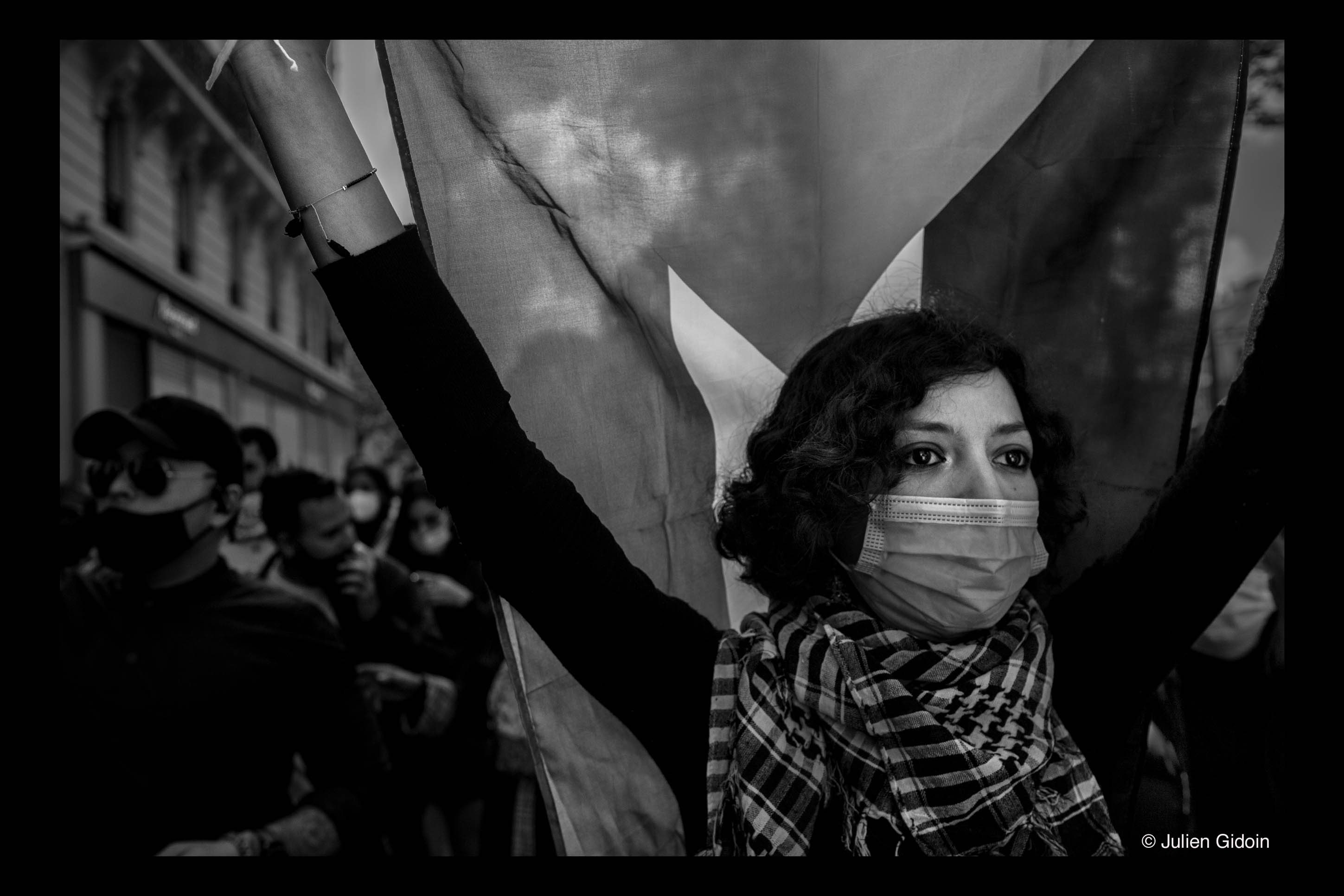
May 15, 2021: support for Palestine
Has the way people see you as a professional changed since this photo work?
Yes, I’d say so. I think some people decided that was it, I was a protester, even a Yellow Vest, so maybe less of a professional. For quite a long time, my phone stopped ringing, because of my “commitment,” I assume. People who decide to stop working with someone for that kind of reason are actually very strongly committed themselves! They’re not exactly heading toward open-mindedness, I’d say…
And then there are those who reach out to you, and there were some! Producers who let me keep working in documentary and trusted me with more personal stories. Thanks to them, I moved into feature films.
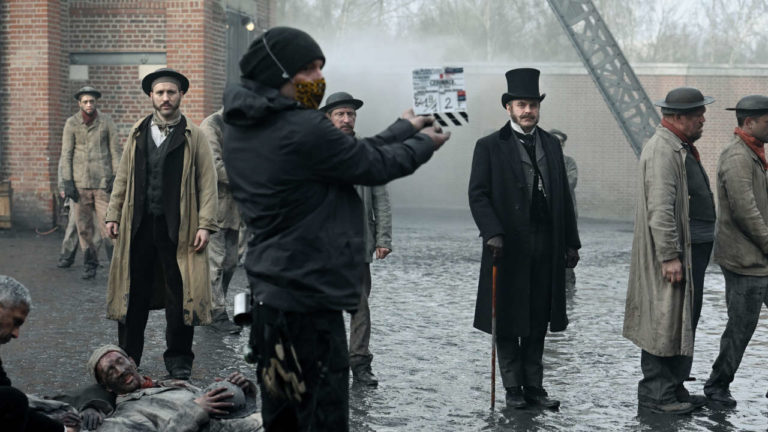
In fact, very concretely, if I went to Iraq, it’s partly because I did this image work among the Yellow Vests.
What does it bring to your work as a DP?
A few years ago, I had lost hope of making films. I was mostly shooting TV magazine segments, with no point of view whatsoever. I spent my life with suitcases, in taxis or planes, interviewing people who were about as expert as I am at making cement. There was little room for reflection. It made no sense, apart from the paycheck. The poetry had disappeared. All that effort for that: it just wasn’t possible. We DPs shouldn’t be technical service providers.
Now I’m more motivated than ever. I’ve left that world, and today I work in feature-length documentary. I hope I can put myself at the service of a point of view. That’s what we love as DPs, I think: all that immense work that adds up to a documentary film and allows a viewer to be moved. With our profession, it’s really wonderful to go where you’re not invited. Take a hospital: normally, you go there when you’re sick. But for a film, you go back often, because you’re trying to understand something there. It’s your work that takes you there; that’s very different.
Photography put both my feet back in a reality I had drifted away from, within our little world. What it gave me is fundamental: a radically… expanded open-mindedness!
With photography, I’m rediscovering how vital it is to make images.
We should never forget that what we do matters, without any pretension. Today, society needs us. Anyone can make images, but making them regularly, with professional rigor and an authorial point of view: that’s precious. Our work as DPs should anchor us in a certain reality, I believe.
These past few years have made me want to move toward films that are truer, that tell the story of what’s real. The films I want to make aren’t the same anymore. Conflict, death, sadness… are places I want to go now. I don’t really know why or how. Going to a land of conflict where there’s nothing left, with people who have met absolute horror, where women have lived through hell, where kids are in a devastated psychological state… Are you going to die there, are you going to make it home or not… A few years ago, I don’t think I could have imagined it.
It changed everything.
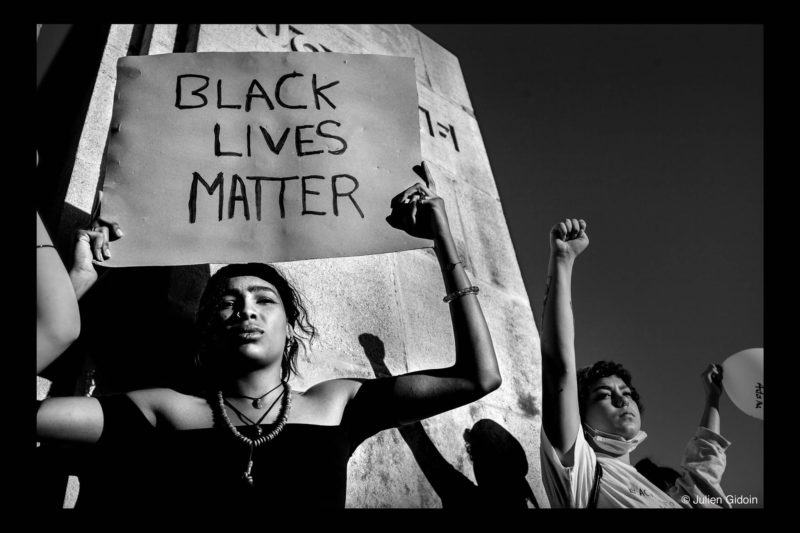
June 6, 2020: Black Lives Matter
Before, my fuel was poetry, auteur cinema, documentary. Now there’s anger too. I think I need it, and need to feed it by making images, because it’s energy in itself. And I’m not going to do anything stupid with that anger: it serves me when I film or photograph. It changed my reality; I didn’t know that before the protests.
How do you see this image-making work in the field: an appointment you can’t miss, a personal quest, a media mission, or even an act of care?
If the “appointment” means being part of history, without any pretension, mind you… then yes, absolutely! There’s nothing more nerve-racking, at moments like these in society, than not being in it. If I miss that appointment, anxiety wins, as far as I’m concerned. Because I might misunderstand, be poorly informed. I’m not an intellectual… and if I’m not there, I don’t understand much.
A personal quest, I don’t really know what to tell you. It has definitely changed my life and the way I see the world. My work has changed. People also call me because they’ve seen my photos: if you can do this kind of thing aesthetically, can you develop it in a film?
A “media mission,” absolutely, no doubt about it. Patrick Chauvel says that a photo or a film you make isn’t necessarily what you’ll release. That’s also our life as DPs: we don’t just make films. Most of what we shoot, nobody will ever see. We create documents and archives.
Independent media are becoming essential to tell things accurately. The mainstream media carry immense weight, which we’re right to push back against, because they’re opinion-driven, propagandist media. You tell yourself: OK, I’m an audiovisual professional, I analyze what I see on TV, how it’s put together, what words are used, whether they’ve been redefined. Those images of the event: I was there, but that’s not what happened; it was more complicated than that.
It’s good to remember that those millions of views, we generate them too, us and our fellow image-makers. We exist, and we have to exist deeply.
An act of care, you said? Having tenderness for the people you photograph isn’t a bad thing. Without slipping into pathos, by finding the right distance. It’s much easier to photograph people in the middle of chaos or in action; it’s no accident that social media is flooded with images of chaos. But when nothing seems to be happening and you get within 3 feet of someone to photograph them, it’s something else. There’s an exchange, a presence with the other person. Tenderness comes in the calm moments.
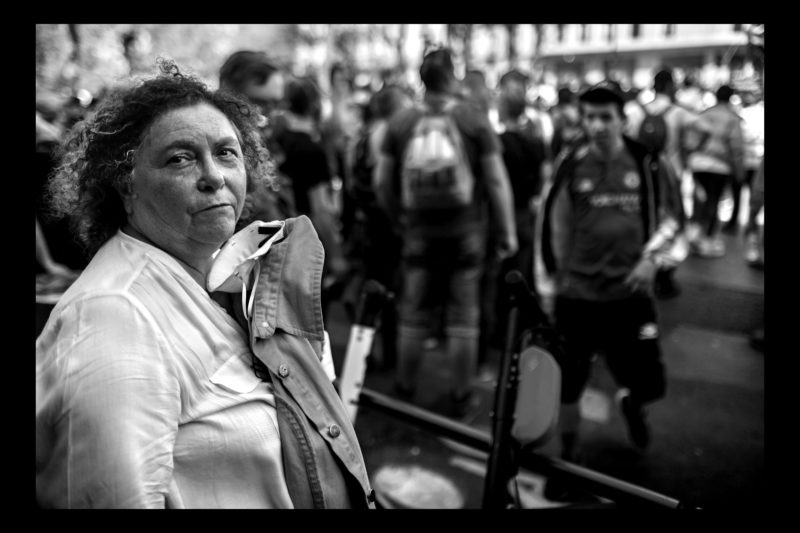
April 20, 2019: Act 23 of the Yellow Vests
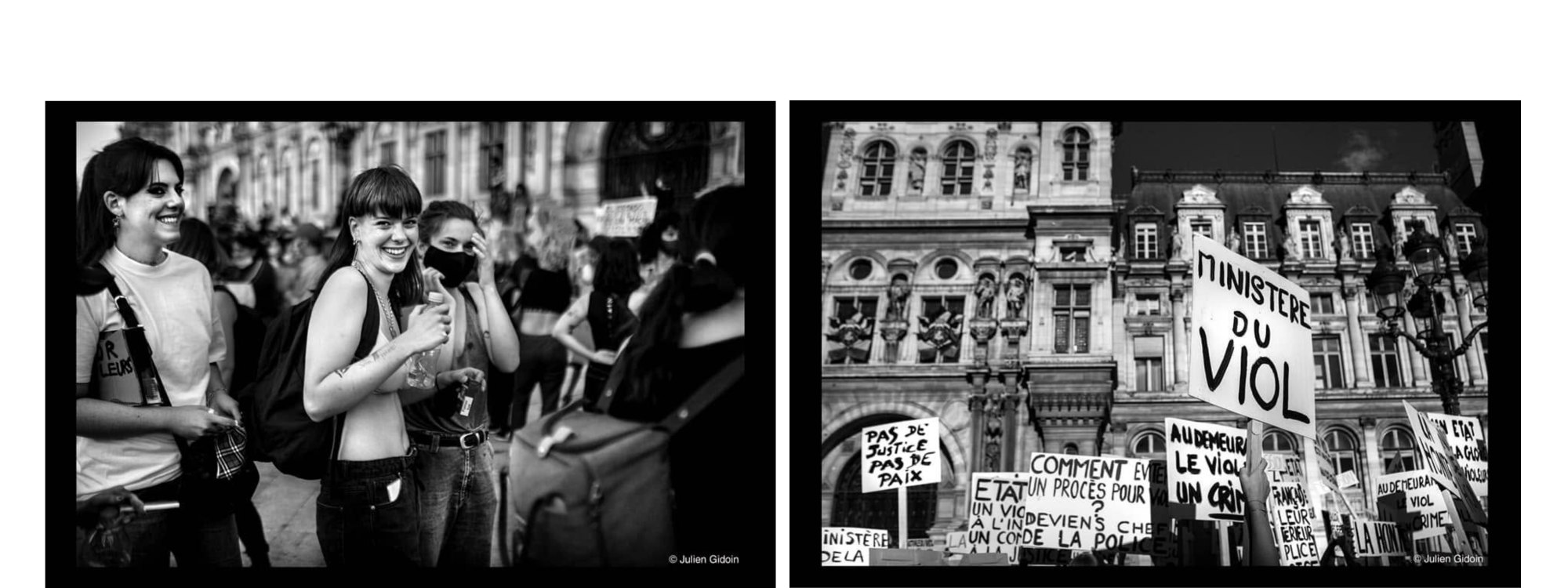
July 7, 2020: feminist protest
We see so many images that it makes us sick! Even I, who look at a lot of them, get dizzy. We have to heal somehow, and images can do good too. For yourself, first of all. And then for others: when you look at still images together and talk about them, it can be soothing. There’s surely some care in that.
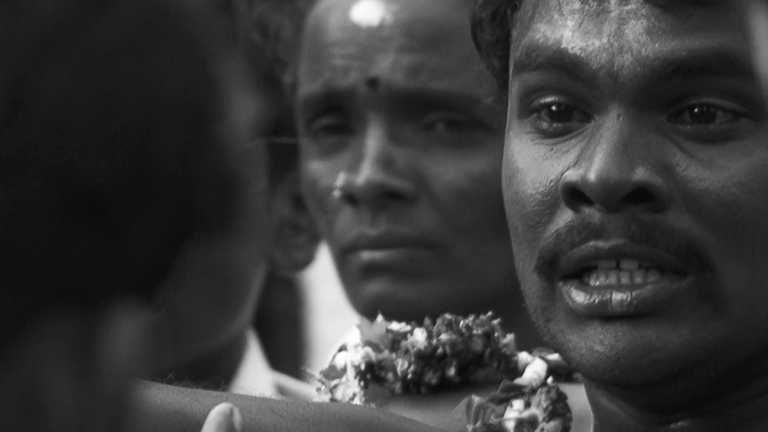
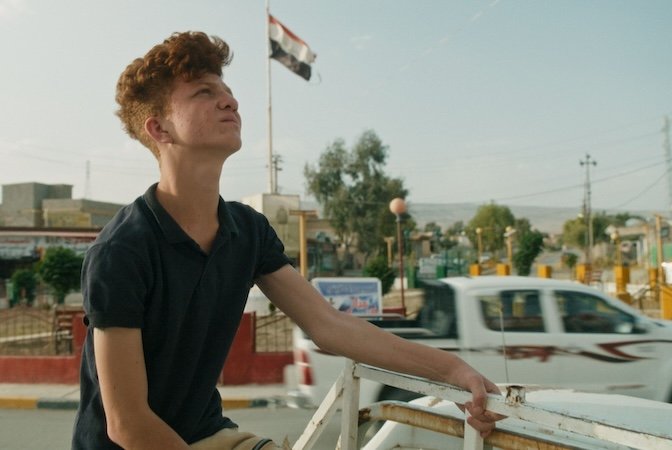
In documentary film, discussions tend to happen after the screening, in the theater, and that’s amazing too! The latest example I have is the screening of Rashid, the Boy from Sinjar, with my parents. They came out of it… whew. Shaken! The film is about what it means to be devastated, in the fullest sense. It really opened up conversations… talking is essential.
For this film, that’s exactly what I was asked to do: film with tenderness.
Further viewing and reading:
- War Photographer, Christian Frei
- Les Pompes de Ricardo Jesus, Patrick Chauvel
- Photographer of War, Boris B. Bertram
- Bons Baisers des grèves, Philippe Baron
More of Julien Gidoin’s work:
www.juliengidoin.com
www.instagram.com/julien_gidoin
Photos: Julien Gidoin, unless otherwise noted.
Interview by Mathilde Gaillard.