With the experience of lockdown and now the prospect of its easing, we are all living through a tangible experience of notions that seem trivial, except perhaps to cinematographers. Near, close, foreground, middle ground, background, far away: these notions are among our tools for working on, understanding, and ordering the images we make.
Staging and lighting distance in relation to the point of view is our business. It took me several weeks to gather my thoughts on what this new notion of distancing might mean…
After days and weeks of lockdown, we now have a pretty good sense of what distance is. The enclosed space of our homes, whose every nook and cranny we now know, imposes short distances, measured in steps, in arm’s lengths, in fields of view too. The outdoors, potentially limited to a one-kilometer radius, is something we have all learned to gauge, and faraway places have come to feel like memories, or like the future!
Then comes a notion that is new to many of us: distancing, and even “social” distancing. Its yardstick is far from precise, and it is subject to all sorts of variations, somewhere between what one might imagine to be common sense, the reassuring norm of scientific recommendations, and ultimately the pragmatism that suits the demands of reality.
No less than 1 meter; then no, actually, more like 1.5 meters, and 2 if possible. In the street, we sidestep one another more or less visibly. On planes, there would be at least two empty seats between passengers. On trains too. In taxis, a partition would separate the driver from the passenger.
“Social” distancing will thus redefine notions of relative distance, of sanitary distance, almost of safety distance… This will inevitably affect our shared sensory and emotional experiences; I am thinking, for example, of live performances and movie screenings (for others it will be sporting events, religious services, and so on). And it will likely affect the social experience of how our profession is practiced: a profession of intense exchanges, where we constantly handle equipment with a precision that is at first approximate and then almost down to the millimeter, where we need to feel a closeness, a shared set of ideas, both intellectual and practical, with colleagues we work with for a day or for several weeks. How is this going to play out? Could we really work differently without losing out?
Until herd immunity provides its natural protection, let’s bet that masks, suitable gloves, and hand sanitizer can do the trick!!
In front of the camera, however, one can imagine distancing becoming a major problem for directing, and for actors. Drama works fundamentally with notions of distance, proximity, separation, contact… Here again, there is no doubt that distancing will become a parameter to reckon with, a harsh injunction or a potential creative invitation.
In nonfiction film, distancing may be just as problematic, but above all it reminds us that the notion of distance is central to documentary. Metaphorically for directors, and in practice for cinematographers too, since the camerawork must carry the director’s gaze, and the camera is aware both of what is at stake and of how fleeting the moment of shooting is. In this context, the question of the “right” distance has always arisen.
Commentators discuss the “right” distance with in mind what sufficient detachment from whoever or whatever is in front of the camera would or would not imply: a synonym for “approach.” The “right” distance should be close, but not too close, which would risk empathy or sympathy, and not too “distant” either, which would mean missing the emotion or, worse, missing one’s subject. I can’t help thinking that this bias toward the “right” distance is the one imposed by the journalistic lens, which aims for the “right” measure (even good taste) under the guise of supposed neutrality: neither too much nor too little.
In my view, documentary directors and cinematographers couldn’t care less about the “right” distance; together they work out the distance best suited to telling the story they want to show the viewer, finding the clearest point of view, sometimes the best stance, the appropriate focal length, or even the spot from which to film most effectively in terms of room to maneuver and ease of operation!
When the cinematographer is also the director, one can imagine that the intuition of the right distance is very direct, very concrete; here the “approach” is undeniably physical: where do you stand to film?
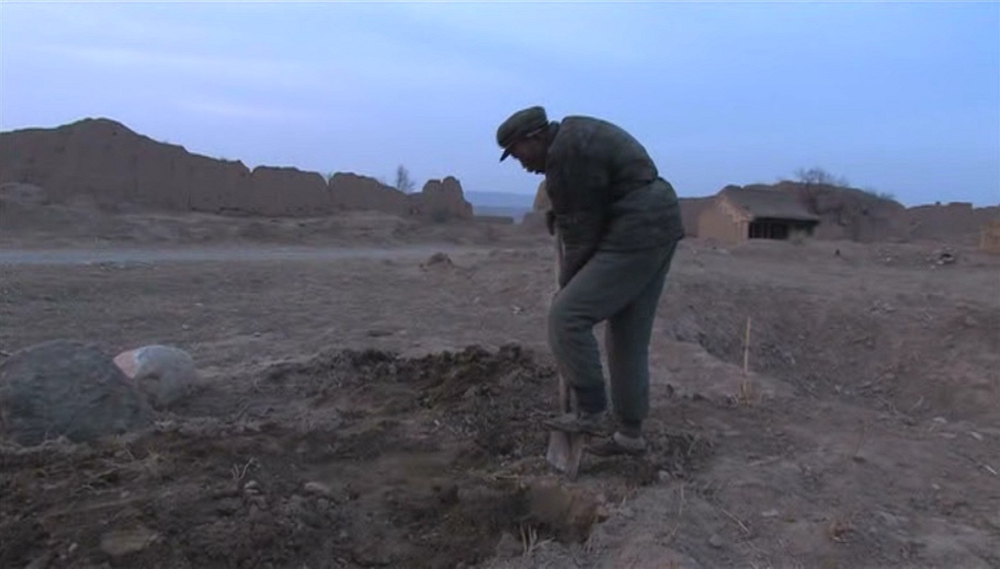
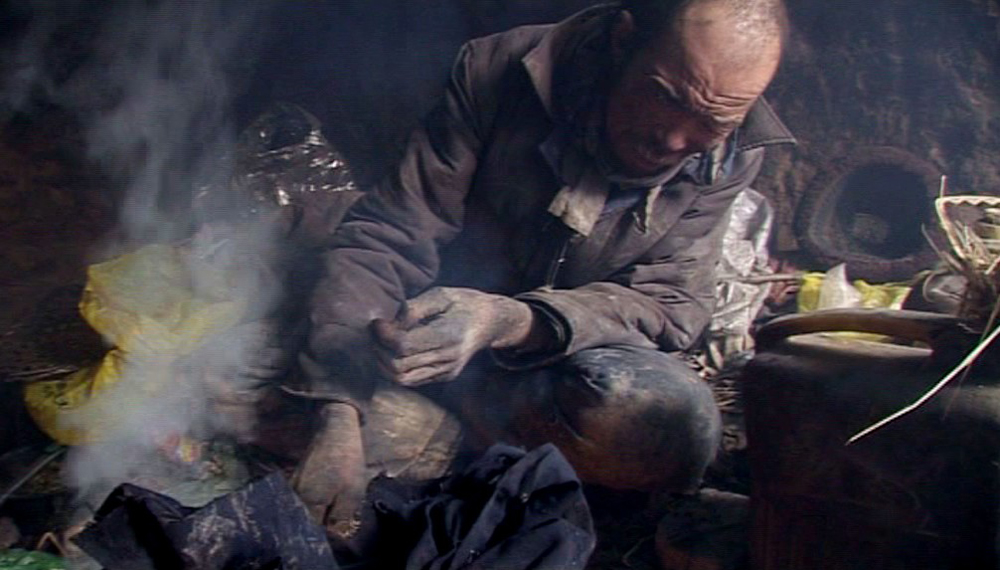
Man with No Name © Wang Bing
Speaking about Man with No Name (2009) in a 2017 interview with AFP, Wang Bing explained: “When I start filming, I think about the relationship I establish with the people I film: each time, from the outset, there is no distance. I naturally enter their lives.”
Given that this is a 92-minute film without dialogue, sometimes shot in near darkness, about a man living in a kind of hollow, a cave in the middle of the Chinese countryside, Wang Bing had to find not only the right approach but also the physical distance, the right place to film from, in a cramped, confined space.
Other director-cinematographers, Raymond Depardon and Johan van der Keuken, to invoke two guiding figures, deliberately chose to avoid a false objectivity by owning the artifice their presence brings to the people they film, including themselves in the common experience of a moment shared between filmer and filmed. Perhaps it is this uninhibited, openly acknowledged relationship to the presence of the camera and of the person operating it that gives viewers the feeling of being in direct contact with an idea of the Real, of being “with” and not “at a distance”…
In this approach, the look into the camera is surely not the least striking effect of the abolition of distance Wang Bing describes.
About a dozen years ago, I experienced these questions of distance, of including the point of view in the setup, and even of the look into the camera, in a very concrete way… I still don’t know whether all this was conscious at the time of shooting or only in hindsight. Surely a bit of both: intellectually perhaps, but instinctively without a doubt.
I was traveling in southern India with my father, and as it happened I had a camera with me: my first camera of my own, a Full HD camera that shot progressive, at 30p, and had the virtue of being very discreet. I have never thought of myself as a “filmer”: the very word bothers me. Until then I had thought that you had to write, devise a coherent and relevant setup, choose your tools, and prepare the shoot, technically, intellectually, and financially of course, before shooting a single shot of the film to come. But after a few personal projects (as a director) had ended up at the bottom of a drawer, and with the images a certain Chris Marker snatched from time as a distant patron, I decided to buy an inexpensive camera that would let me film whatever passed before my eyes, like a photographer, so to speak.
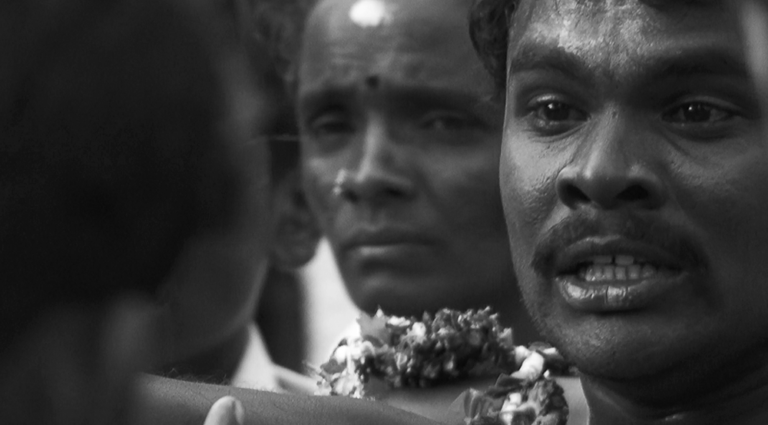
And that day, outside one of Tamil Nadu’s many temples, a noisy crowd caught our attention. Two men were screaming at each other, surrounded by onlookers entirely focused on their confrontation. I took out my camera and started filming almost continuously, to get continuous sound. And little by little I moved closer to the epicenter. Cautiously, to be sure, but I kept getting closer and closer. And with every step, sensing the tension of the moment, I wondered whether I was right to stay there, to keep insisting on getting closer, when I clearly had no business being there. What if someone ended up noticing me, noticing that I was recording everything that was happening? When the bodies were too close together and I could no longer decently move forward, I went to a longer focal length, zooming in to pick out the figures and clearly make out the overwrought behavior of each of the protagonists.
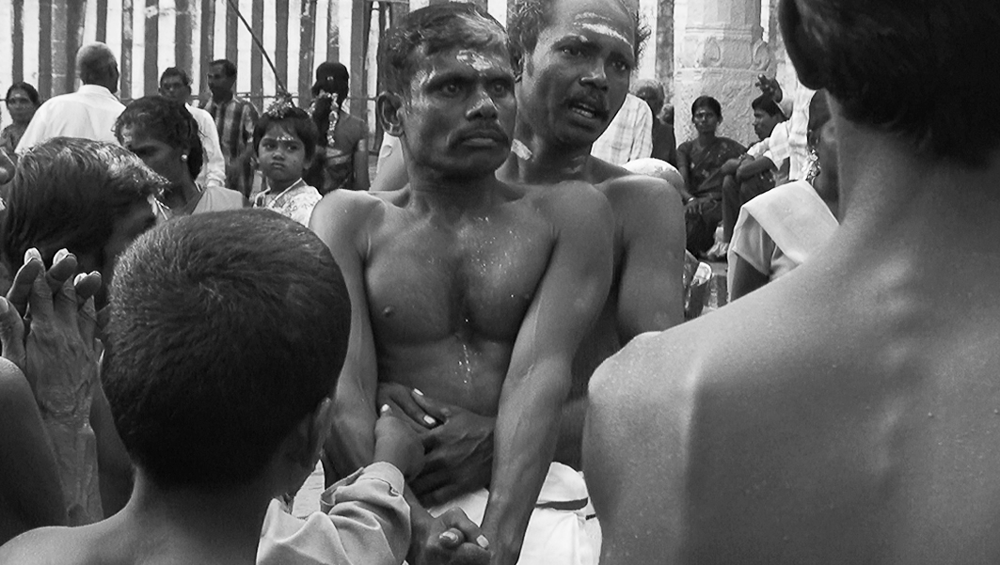
Controversy, produced by Mirage Illimité
I no longer remember when or why I decided to cut, but I left with 27 minutes of footage, and watching those images, I decided they had to become a film. After several years of on-and-off editing, it became my shortest film and, to date, the one most often selected at festivals.
In the end, this little black-and-white film in Tamil, without subtitles, became a kind of personal parable about this question of distance, and perhaps that is all it is about: how close should you get? At what moment, at what point do you end up too close? To the point of perhaps being too visible…
The question of “social” distancing will probably arise in other terms, but around the same stakes: how close to get in order to be at the “right” distance while keeping a reasonable distance, health-wise, and how far to pull back, at the risk of losing the complicity, the closeness we need to make our characters come alive for the viewer, to approach intimacy?
Will focal length, the range of our zooms that lets us get close, be enough to make up for what is about to creep into our lives: the idea that proximity is potentially dangerous?
Will we still be able, as Wang Bing put it, to work with no distance at all? Will we be able to be “with” again?
Let’s hope that this distancing, which forces us more than ever to assess what a distance is, or even what the “right” or “proper” distance would be, will not keep us too far apart from one another, together but alone.
When we do so much better being alone, but together.
Controversy, 7 min 30 s, 2013, can be watched here