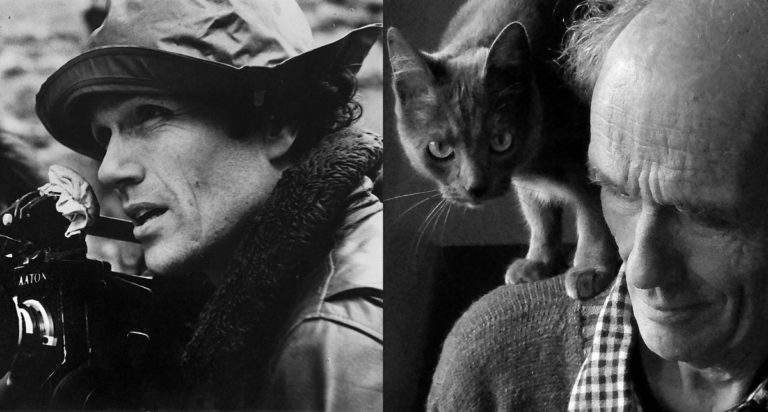
Through a collection of question-and-answer portraits, the Union introduces the members of the association. Today, Ned Burgess.
When and how did you become interested in cinematography?
My arrival in Paris to attend film school was driven by mixed motivations. The idea had actually been suggested by an English teacher who supported my desire for a different cultural horizon, and who pictured me in a profession straddling art and technology. I didn’t yet see myself in any particular career, but I had been frequenting art-house cinemas in New York since the early 1960s, and by watching foreign films I was discovering a universal country, an intimate elsewhere. I knew I would feel at home in France, thanks to the films of the Nouvelle Vague. But beyond that, I had not yet considered how the various film professions were articulated, nor envisaged my place in a crew. Upon learning about the programme at IDHEC, I knew I wanted to do the “cinematography” section, although I could not have explained exactly why. I think the idea of placing myself at the intersection of art and technology appealed to me, as did the prospect of working alongside a director rather than being one.
Which films have particularly struck you visually, to the point of drawing you specifically to the work of cinematography?
The films that struck me are those by Godard, Rohmer, Pialat, Garrel, Cassavetes, Ozu, Mizoguchi, Bresson, Tarkovsky. But I did not think specifically about the image work. I perceived the cinematic experience of each of their films as a whole, an inseparable set of elements, thanks to the synthesis of the collective work driven to completion by the filmmaker. It is this alchemy—a result that transcends the sum of its components—that creates the specific interest of cinema, and that I always hope to recapture in practising the craft of cinematographer.
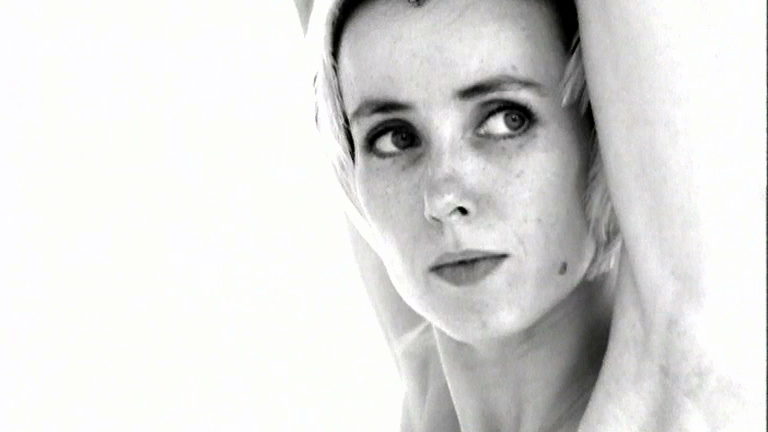
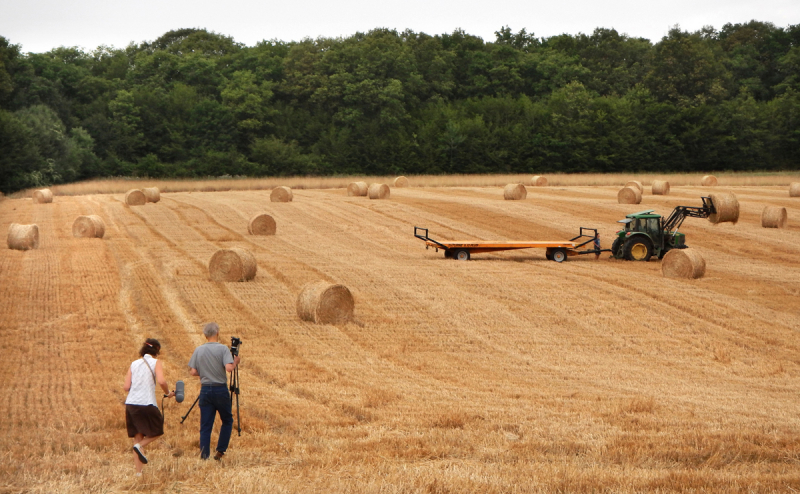 Suzanne et René, un pays sur terre, directed by Maria Reggiani – Les Films d’ici
What was your initial training?
The cinematography section’s curriculum had strangely omitted preparation for the assistant’s role, and my first improvised shoots outside school did not fill this gap. After leaving IDHEC, I managed to get hired as a trainee on a feature film, then as an assistant, then as a first assistant—a path that took me about six years. There were decisive encounters during that period—I will mention two. In his Montparnasse studio, a fashion photographer took the time to teach me how to read light, a skill that was not properly addressed at IDHEC. And on a feature film by Jean Eustache, I had an unexpected encounter with a cinematographer who had replaced the original DP at the director’s request. He performed a complicated handheld tracking shot on the steep staircase of an old Parisian building. That was Nestor Almendros, whose work I was later able to discover and admire.
What types of films have you worked on, and what would be the ideal next project?
Practically every type of film and shoot. Fiction, documentary, corporate, institutional, music videos, multi-camera captures, and artist installations. On the other hand, I never managed to break into the advertising world. There was an incompatibility of vocabulary, and I would take offence… When, for example, after showing my “demo reel” (which I had painstakingly assembled for the occasion and was proud of), I was asked if I knew how to do close-ups.
The best next project? It would be a film that allows you to dodge the formatting assumptions that weigh on today’s audiovisual landscape. A film where you can still feel that “the cinema machine” has a soul and is not just a product of formats and algorithms.
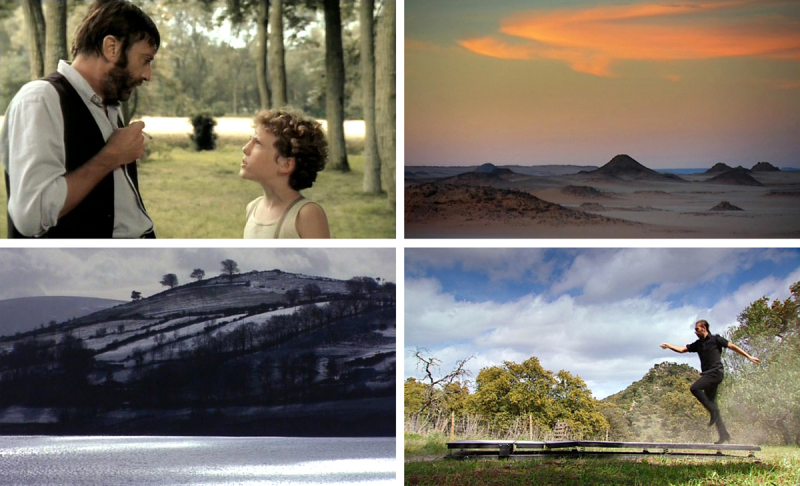 A few shoots and a few memories
What are your artistic sources of inspiration?
The people in life, nature, and more nature, works of art, and the artistic experience itself—that is, the possibility of rediscovering what already exists as though it were new.
Do you remember any regrettable blunders that turned out to be instructive?
Opening a can of exposed film stock in broad daylight. Or keeping silent when I should have spoken up, just as much as missing the chance to keep silent. Instructive blunders indeed, insofar as for me the only way to ward off mistakes has always been to make them, at least once.
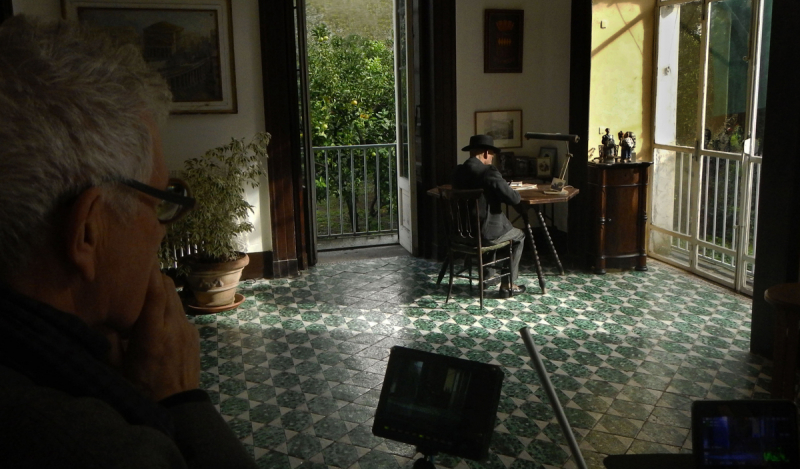 Lénine et Gorki, la révolution à contretemps, directed by Stan Neumann – Les Films d’ici
Have you experienced moments of doubt about your work or your professional environment?
Yes, there have been many: periods of inactivity, professional turning points, the digital revolution with its upheavals and opportunities. And, of course, the constant doubts during a shoot—about a choice of framing, lighting, or approach. Those doubts are part of the profession and often lead to better work.
Can you describe a particularly original technical or artistic setup?
A pivotal encounter was my collaboration with the painter Fabienne Verdier and the musician Didier Music quartet. The starting point was a commission from the Cité de la Musique. I designed a setup of four cameras under the table to obtain an elongated format with a 64:9 ratio (4 × 16:9), a widescreen format suited to the artist’s gestural painting, which unfurled like writing. This setup was used to film and then to reproduce the appearance of the painting on four screens in a work titled L’expérience du langage at the Musée Voltaire in Geneva in 2016. The installation in Aix-en-Provence posed an unprecedented challenge: finding a shooting (and editing) strategy that would reproduce this singular vision of painting on four screens, while simultaneously inserting the musicians’ presence and an overview of the overall scene. It took fierce complicity during the shoot and a long search in the editing room to achieve it. This encounter between painting and music in an audiovisual work spread across 4 screens remains a unique experience.
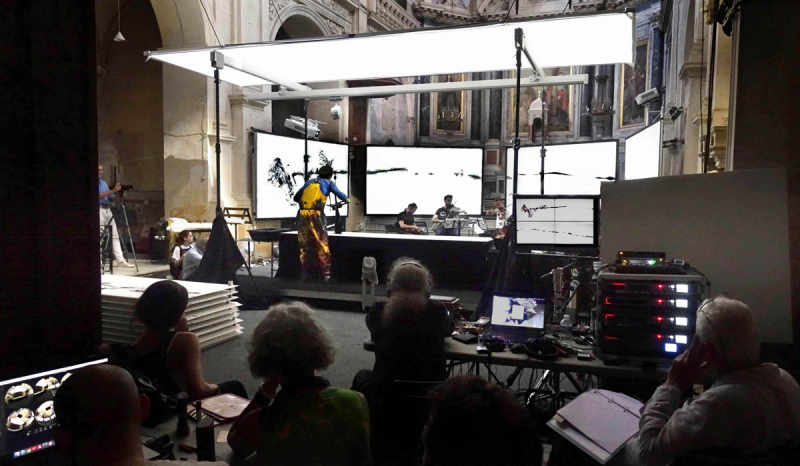 Fabienne Verdier installation
Have you ever wanted to direct?
Move to directing the way you move to the dinner table? Change profession? Have two? Once I had a personal film project about lithography, but after six months of research and writing I felt as though I had mislaid my craft. I am a shoot addict. And a firm believer in the tandem with a director. Shooting a film means committing to an in-between—between what is and what will be, and between oneself and the other. Ultimately, what remains of a film, what endures, belongs to all those who believed in that in-between. And, with a bit of luck, to the viewers who carry on.
What do you love and what don’t you love about your job?
I love doing this job for the same reason I am grateful to the films that marked my adolescence: for the way a film can bridge the gap between oneself and the world. First, I experienced this sitting before a screen in a darkened room, and later, when that connection to others and to the world could also happen “live” within a film crew, it was an unhoped-for bonus. Since childhood I must have been carrying a passionate desire to be less of a spectator in life, and the profession of cinematographer has helped me fulfil it.
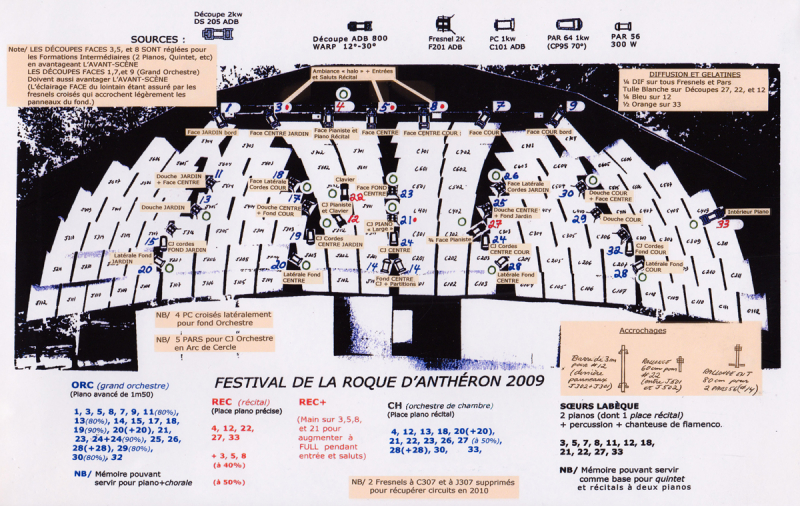 First lighting plot for a setup designed and built with sources that are “less overhead” than classical musicians generally prefer—the idea being to take advantage of the summer heat and the song of the cicadas to get them to tolerate the glare of a light in their field of vision, and thus to improve the style of the images during the Arte captures.
What advice would you give to an aspiring cinematographer?
Given that I have always had to learn systematically from my mistakes, I will always respect anyone who has the courage to ask for advice. When someone asks me for a tip on entering the profession, I always say: “It’s 50% technical competence and 50% human relations.” I usually add that I don’t mean you need connections. I could say 100% technical competence and 100% human relations, because you always need to be fully committed to what you do, but that would just be a manner of speaking. Since you must constantly mitigate these ingredients in alternation, it’s 50/50.
Ned Burgess on the United Cinematographers website