Jeanne takes her six-year-old daughter for a weekend in Majorca. But very quickly, everything turns out to be the opposite of a postcard.
Palma won the Jury Prize and the Best Actress Award at the 2021 Clermont-Ferrand festival.
An email interview with Colin Levêque, the film’s cinematographer, and Alexe Poukine, its director.
With Colin Levêque
Can you tell us about your collaboration with Alexe Poukine? How did you approach the shoot, and what references did you choose?
Working with Alexe was very simple, pleasant, and natural. It was the first time we had worked together, but we had known each other for a while. We met when she was shooting her documentary Sans frapper, and we had friends in common. I think she had also seen films I had worked on.
The shoot was easy to approach; Alexe had a very clear idea of the setup she wanted: a very small crew and very little equipment, to leave as much time as possible for directing and acting, with great technical flexibility.
She had told me about a film I had seen and really liked, Emmanuel Marre’s Le film de l’été, which was shot in conditions similar to her setup, with a very strong visual identity. We also talked about Andrea Arnold’s films, especially American Honey, which is obviously a very ambitious reference in the way it blends apparent technical lightness, formal rigor, and precise directing that gives the actors great freedom.
How do you work with a director who is also the lead actress, and with a six-year-old child?
Alexe had brought in Delphine Girard, a director herself, who followed the whole process of the film, from casting to shooting. Delphine had also worked as a children’s acting coach on films, so she had very valuable experience for this film and was able to accompany Lua (the young actress) with great tact. There was already a lot of trust between Delphine and Alexe before the shoot, and Delphine could give Alexe and Lua very precise feedback on their performances, since she knew exactly where the film needed to go. Being a small crew also helped Lua feel confident, I think. There were 5 of us on set (including the 2 actresses). I sometimes gave feedback on the acting when I felt it was needed, but having a single point of contact saves time on set.
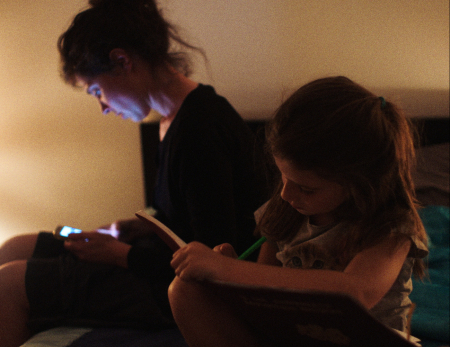
This image illustrates the hardest sequence to shoot for the 2 actresses, a very intense one that required real emotional truth. We spent several hours in that bedroom shooting several takes, each a little different. This sequence rings very true in its progression, and I think it is the cornerstone of the film. We turned on the 2 bedside lamps without adding any light, so we could shoot in every direction. The important thing was for the technical side to take up as little room as possible, so the acting could be free. This sequence is a good illustration of the film’s approach.
What choices were made, in terms of image treatment, for this intimate film?
The idea was to stay light: I naturally went for Zeiss High Speed lenses and shot on an Alexa Mini.
Alexe wanted a fairly raw, colorful look, an image that wasn’t too “clean,” with texture and few “fictional” artifices, which implied fairly raw lighting. I had prepared LUTs before the shoot to previsualize this look, and we then worked with the colorist, Miléna Trivier, to refine the idea.
In particular, I had tried to get closer to images I had shot on film, to recapture the texture and contrast of film. I exposed at a base of 1600 ISO (which I always do when I shoot in S35 on the Alexa). The LUT is only a pale copy of the film look; we are still a long way from film’s color quality, skin tones, depth of blacks… But shooting this film on Super 16 was out of the question for us, because of the amount of footage we would have needed!
The intimacy came naturally, because there were few of us on set; the fact that we all lived in one house for almost 2 weeks and spent our entire days together probably contributed to it.
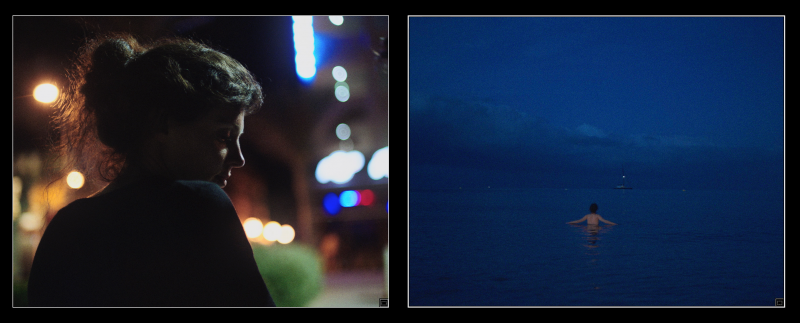
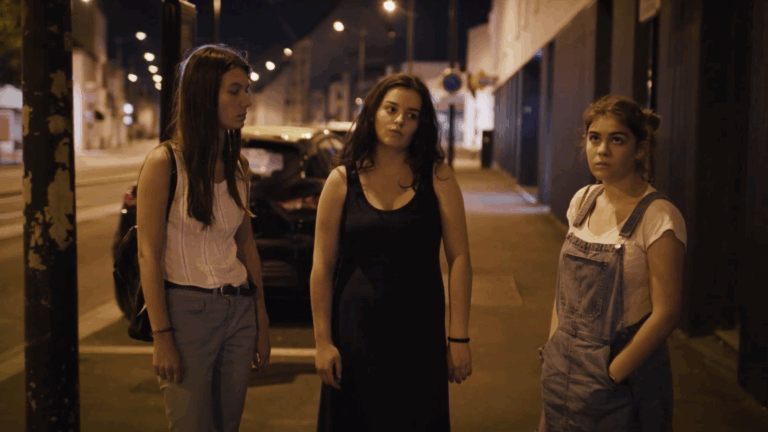
Here are 2 images from the night we spent filming the wandering through Palma. I really like this sequence in the film, probably because nothing was planned except to provoke chance encounters, and I think it adds a truthfulness and an intensity to the film that go beyond what a written script can say (like that somewhat surreal conversation with the man along the beach, which could never have been written as it is). The night ended with the swim at dawn, which was a great moment for all of us.
The 1.33:1 format is a bit out of step with current trends. Can you tell us about that choice?
For me, it’s no longer really an unusual format; it is making a comeback and is often associated with auteur cinema. Since Gus Van Sant’s trilogy, Andrea Arnold’s films in fact, or Ida and Cold War more recently, to name just those films, the 1.33:1 format has become more and more common. For us, the choice was quite clear for Alexe, and this format made sense to accentuate a certain closeness, to focus on faces, on portraiture, and on the isolation of the characters within the frame. Alexe liked the aesthetics of the 1.33:1 format.
The film was shot entirely on location. What was the lighting strategy?
Natural light was a basic element of the setup. The choice of locations and their orientation, and scheduling according to sunrise and sunset, were important factors for the image. I occasionally added a small source for certain scenes, but rarely. The idea was rather to set up the frame in a direction that took advantage of the natural light, and Alexe gave me a lot of freedom there, which was very pleasant. Since I was on my own, I didn’t have much time for big lighting changes, so the idea was more to take light away than to add it (turning off a lamp, adding a black sheet, etc.).
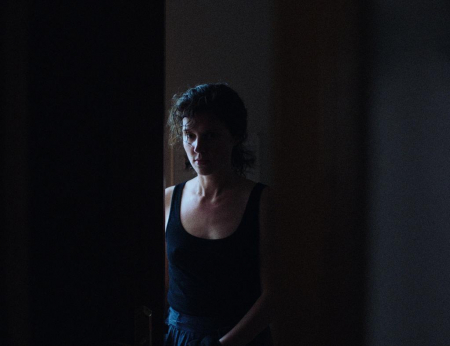
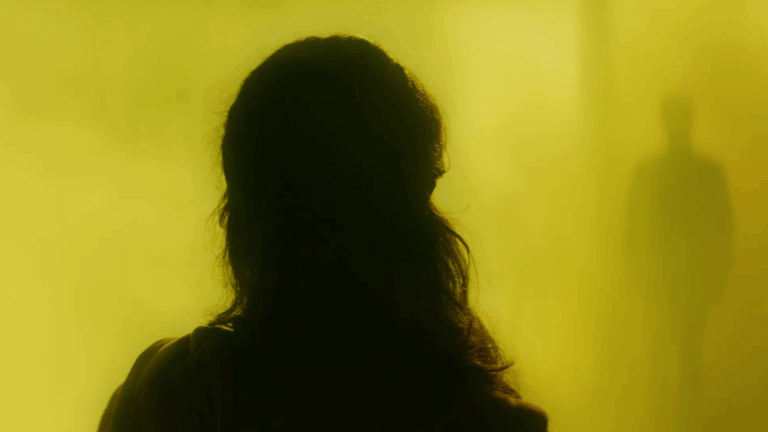
The apartment walls were very light, so rather than turning on the interior lights, I put a lamp in the stairwell outside, bounced, which created a soft, contrasty light and kept a dim feel that suits the intimate early-morning moment between Alexe and Lua that follows.
I really like this direction of light. As a director, Alexe didn’t find acting in front of the camera easy. I think she looks very photogenic in this image.
With Alexe Poukine
Can you tell us about your collaboration with your cinematographer? How did you approach the shoot, and what visual references did you work with?
I knew I wanted to make this film with a very small crew (there were five or six of us, depending on the day). So I had to find a cinematographer who was also a camera operator, focus puller, electrician, grip, a bit of a prop master, a bit of a driver, a bit of a location manager… I wanted to work through improvisation and try to capture as much as possible of what reality brought in the way of the unexpected. Colin is quite used to this, because, like me, he has made documentaries.
Setting out with such a small crew, I knew everyone would play a very big part in the directing. In a way, we are all authors of this film.
Colin and I went to Majorca together for a few days, a month before the shoot, to choose the locations and the Spanish actors. We did filmed tests, and that was invaluable, because we realized together, for example, that contrary to what I had imagined (and what worked very well on paper, but not at all cinematically), the mother could not wander alone through the night without it becoming boring, or even affected. So we looked for people she could meet during that long night of wandering.
I remember that before shooting, we talked about the films of Andrea Arnold and Joachim Trier’s Oslo, August 31st. But those were filmmakers I was thinking of because of their sensibility, not because I wanted my film to look like theirs. I feel that we mostly look for references to reassure ourselves. I know that during the shoot, what matters (for me, at least) is what happens emotionally between the characters, and how we manage to render it in images and sound. We didn’t try to make it “like…”.
How do you direct and act at the same time?
What was complicated was the feeling of having to make two contradictory moves: acting requires a kind of self-forgetting, a letting go, whereas directing is more about control.
We had decided that I wouldn’t watch the takes as we went, because I was afraid that judging myself would completely inhibit me. I watched the dailies, rather quickly, in the evening. But what enabled me to act was that I trusted Delphine Girard completely; among other things, her role was to tell me what she thought of the acting. She was also the one who talked about the acting with Lua Michel, who plays Vanya, because I didn’t want her to have several people giving her directions.
I feel that my role as director was concentrated before and after the shoot. During it, the crew was directing.
__
Palma
40 min – 1.33:1
Director: Alexe Poukine
Production: Kidam and Wrongmen