Salman, a 22-year-old Afghan who left his homeland to reach France clandestinely, is preparing for a hearing to obtain his papers. A moving portrait of this young refugee, and the memories of his first and only Buzkashi match, Afghanistan’s national sport.
An email interview with Lucie Baudinaud, cinematographer on the film directed by Antoine Beauvois.
Can you tell us about your collaboration with the director? How did you approach shooting the film, and with what visual references?
I met Antoine a few weeks before the shoot began, in a fairly classic way. He had seen my work, and through mutual acquaintances he suggested we meet. He had a clear idea of what we would try to achieve visually, and this confirmed our shared desire to collaborate.
Antoine knows his subject well, since Buzkashi and Afghanistan run through part of his own family’s history, which allowed him to approach this practice with precision.
He mainly showed me photographs — we looked at photos, often black and white, that he loved very much. His grandmother had taken some in Afghanistan; there was also the film adaptation of Kessel’s novel, and Delacroix’s paintings, where the number of horses’ legs is often greater than normal to create a sense of chaos… as well as certain ideas storyboarded by an artist close to Antoine, Robin Salomé.
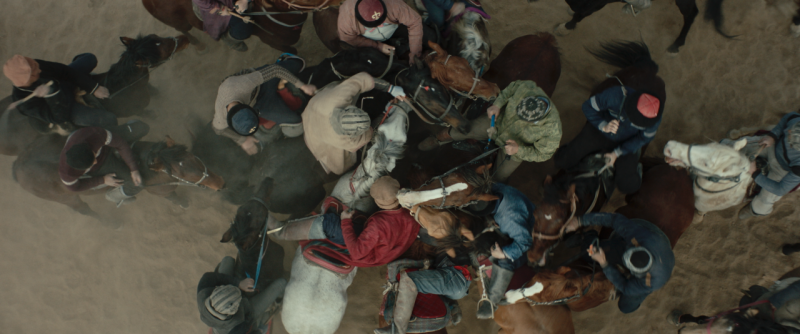
Also, for the horse-following shots, Antoine had a strong desire for the shots to be stable, which became the main focus of my technical research.
There are two main settings, Paris and Afghanistan. How was the shoot organised?
We couldn’t shoot in Afghanistan, and since Buzkashi is extremely widespread in Uzbekistan, the film’s producer, Arthur, decided to move the Afghan sequences there. Naturally, all the shoot’s focus was directed towards the Uzbek portion.
A first, fairly chaotic scout gave us a sense of the work ahead, while also being quite promising visually…
The cultures are very different, and within the economy of a short film, nothing is straightforward. It’s hard to secure the arrangements that are the sinews of war when working on a project as financially fragile as a short film… Because over there, nobody really understands the economic difference, and filmmaking is very little practised in the region.
It’s often dizzying, but ultimately it’s also a chance to question how we make films, to set priorities, and to open ourselves up to very rich cultures that also feed the imagination.
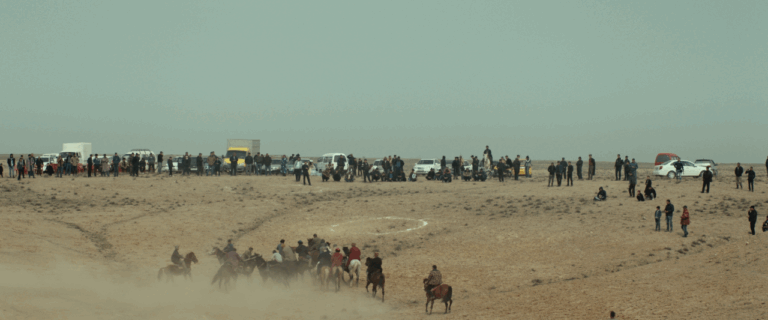
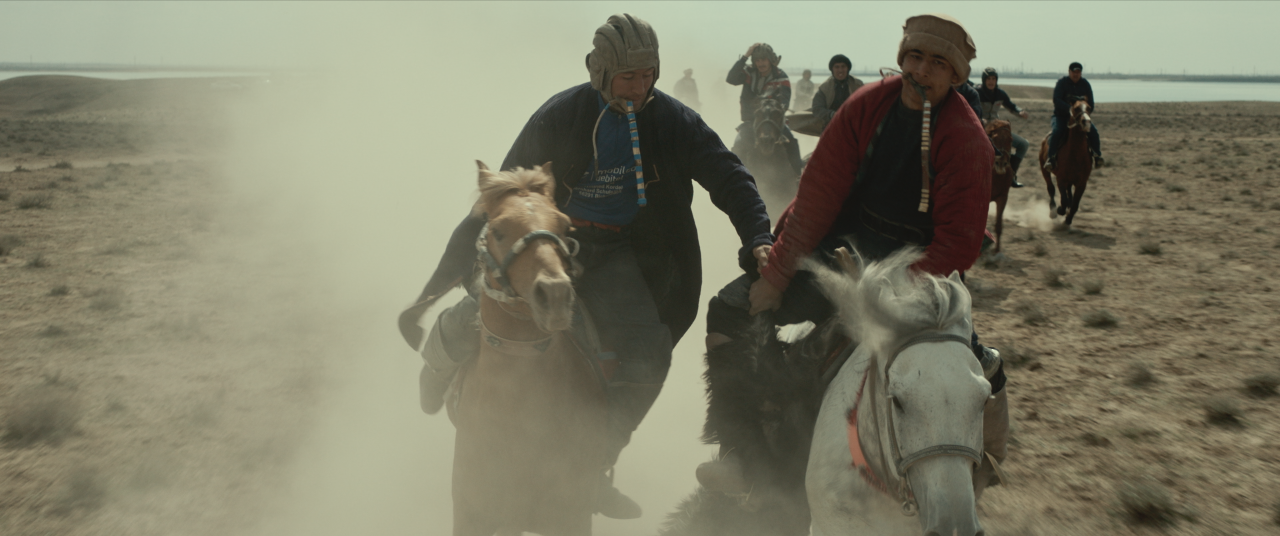
We managed to work with a well-established Russian grip company on the ground, who knew Buzkashi and the “roads” there well — that’s how a 25-metre crane ended up being transported in an old Russian army truck, over terrain where even a Jeep struggled to get through… Or how I was able to follow the horse races with a handheld camera, a Ronin held at arm’s length in the back of a pickup truck, thanks to a fairly optimal safety setup given the situation… Or how nobody batted an eye at seeing 30 worked-up horses fighting over a goat carcass, sometimes slamming their entire flank into the base of the 25-metre crane!
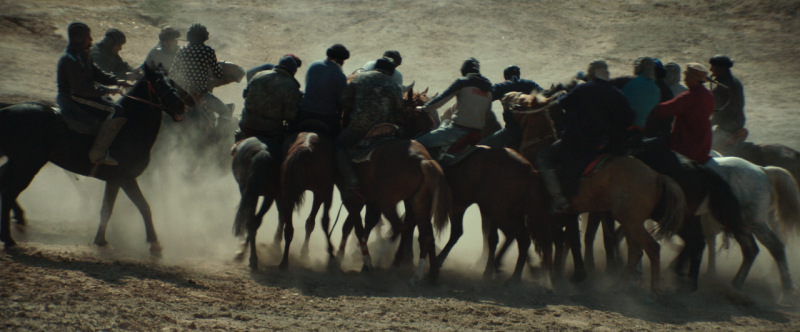
Alongside all this, during prep, every time we visited the location we would get lost and, by luck, find a new spot to shoot — which we would then lose the next day in favour of another… Hard to imagine that, on the day itself, everything and everyone would be ready at the rendezvous before sunrise!
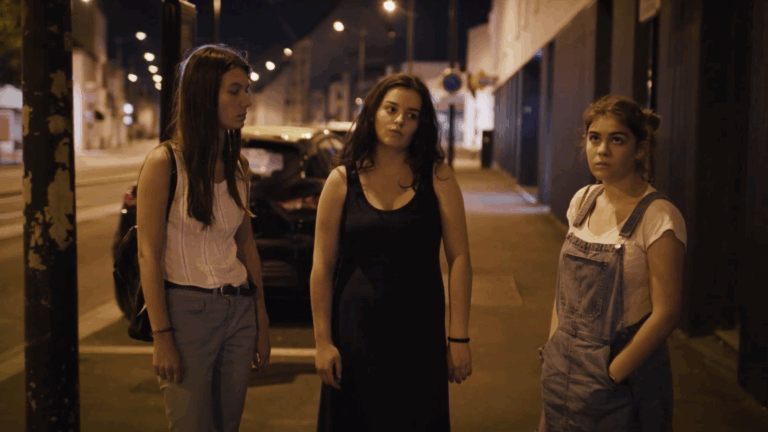
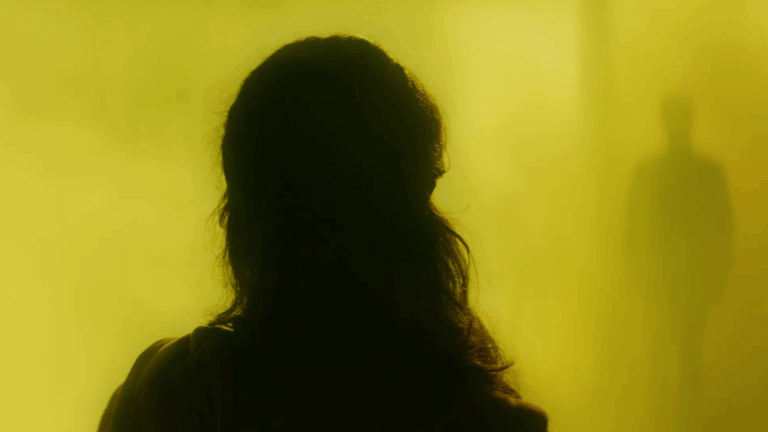
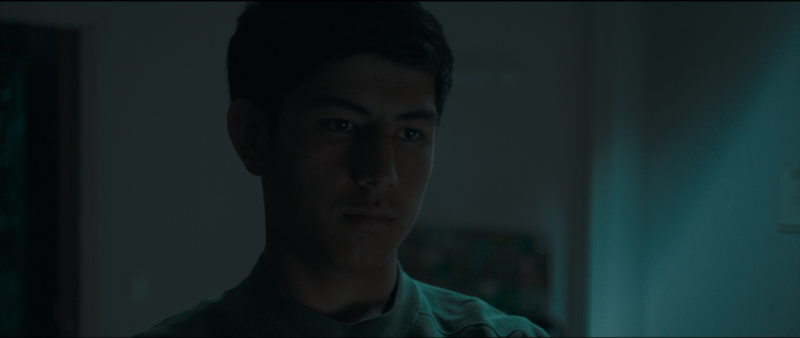
Back in France, the 4 days of shooting seemed very simple, at least conventional in how they were carried out. But with a strong aesthetic stance for certain sequences… Like when the room is lit in a colour you can’t quite place, somewhere between cyan and blue… I love that, as well as the bold, deep shadow that you can’t entirely decide on alone — Antoine trusted me completely and backed this choice all the way through to the grade, without fear.
What were your choices in terms of image treatment, particularly regarding the scope format?
Antoine’s first wish was to shoot the horses in scope. To be honest, that seemed obvious to me too… We did some initial tests in anamorphic, but for financial and technical reasons, I also wanted to show him spherical 2.35. We both fell in love with the Cooke S3s, a certain warm, vintage quality that instinctively convinced Antoine. For the look of the image, I suggested a Fuji LUT to Antoine during testing, which we kept applying throughout the shoot. It wasn’t dialled in at 100%, but it let us set the colour range and contrast as early as the edit, refined later in the grade.
The film is shot on real locations. What was your lighting strategy?
For the Uzbek part, my main strategy was making sure the schedule held… So, for instance, I spent the day before placing markers all along the road through the desert so that nobody would get lost… My only light source being the sun, I couldn’t entirely rely on the local wisdom of our guide/general fixer (a fascinating history teacher, as it happens), who, when asked “Are you quite sure everyone will find this spot in the desert?”, would answer, “That’s the game of life!”
Our big wide shots exist thanks to the crew. When you put the crane up that high, you see an endless expanse of onlookers with their cars, come out of curiosity to see what we’re doing. The riders get tired of pretending to play; they want a real Buzkashi, and just kicked one off further away… And there, 3 people are what make this shot possible: Antoine doesn’t panic, encourages us and stays patient — he believes in it. Renaud, our assistant director, who doesn’t speak a word of Uzbek, watches us calmly and goes off to rally the troops… Meanwhile Arthur, our producer, took it upon himself to get a real Buzkashi going again, by offering the goat carcass to the winner… In 45 minutes, the field was cleared, the horses and the chopendoz (Buzkashi players) ready to enter the frame of the camera perched on its crane…
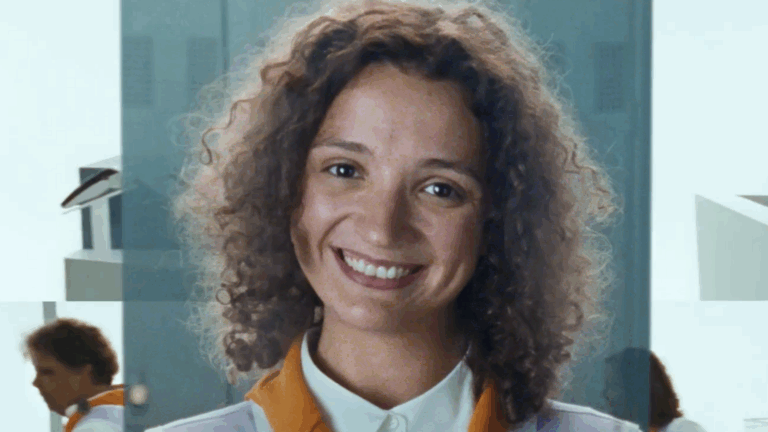
Then, for the French part, Antoine guided me very early on regarding his aesthetic wishes. While he didn’t want to betray the plain, impersonal nature of the shelter’s décor, he wanted the image to sit in just the right place between stylisation and the honesty he cared about. So that’s what we looked for, even when the character is filmed between 4 white walls…
I kept the same LUT, so that the colour range and skin textures would carry well between the two countries. An image originates in the encounter with the director — not from the cinematographer alone…
Le Cercle d’Ali
15′ – 2.35:1
Director: Antoine Beauvois
Production: H Rouge Production, Lionceau Films