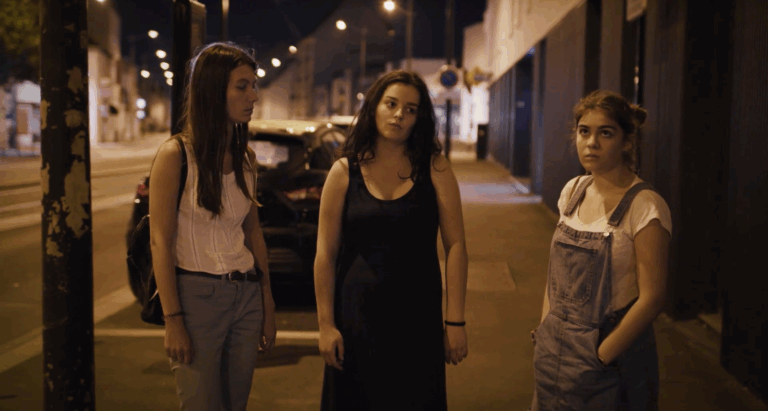
Over the course of one long evening, Héléna and her friends are led to re-evaluate their relationships with others, to understand their subtlety, and to open themselves up to the unexpected.
An email conversation with Cécile Bodénès, the film’s cinematographer.
The framing and the lighting are very discreet, almost invisible. What drove you as cinematographer during this shoot?
This is a film made with very little means, just one region, Loire-Atlantique. As with many shorts, you’ll say… For the director, Marjolaine Grandjean, and the producer, David Tuil, it was important to pay every member of the crew. Technical resources were consequently limited: a Sony FS5 with an external recorder, a set of Canon CN-E lenses and a few lights (Kinoflo, Lucioles and a bit of LED).
All the performers are non-professional; it was their first experience.
Our choice, with the director, was to put
Our choice with the director was to prioritise directing the actors. In some of her previous films, she had been burned by too heavy a technical presence, which had stopped her from achieving what she wanted.
That’s no doubt one of the reasons for this discretion.
And it’s a choice that pays off — I really love this film, centred on its characters, its main character Héléna.
Another reason probably comes from how I practise my craft. I mostly work in documentary, particularly in immersive documentary, where the magic can happen if we manage to make the people we’re filming forget we’re there.
It amuses me to think that, watching a fiction film I shot, people find my work discreet, whereas the feedback I get on my documentary work is that it stands out — or at least stands apart from what one usually sees in documentary.
Did you and the director have any visual references?
The two references for this film were the films of Jacques Rozier, in particular Du côté d’Orouët with the excellent Bernard Menez, and Le plein de super by Alain Cavalier.
We were trying to make a “period film” — by which I mean the period when the director was the protagonist’s age, since it’s an autobiographically inspired film.
This was all the more present in our work since the director and I met when we were 18, students in Nantes, and this shoot marked our reunion, 20 years later.
So we tried to find, to imagine, the colour of being 18!
A sequel is planned; we’ll find Inès Leluel again in a summery Paris. I’m hoping to shoot it next summer. We’ll be looking for the colour of being 25.
The film is shot on real locations. What was your lighting strategy, common to all these places?
The challenge for me on this film was lighting continuity. Managing, in 10 days of shooting, to respect the story’s chronology, with everything taking place over one evening of the 14th of July, between 6pm and 6am. I think it worked.
So if we’re talking strategy, it would mainly be a lot of scouting and a shooting schedule built around the light — but I’m stating the obvious here!
This choral film seems to have been shot with a single camera. If it had been possible, would you have preferred shooting with several cameras at once?
It would never have occurred to me to shoot with multiple cameras. The idea that it might save time on set is, to me, a mistake. It often results in a lack of choices in the direction.
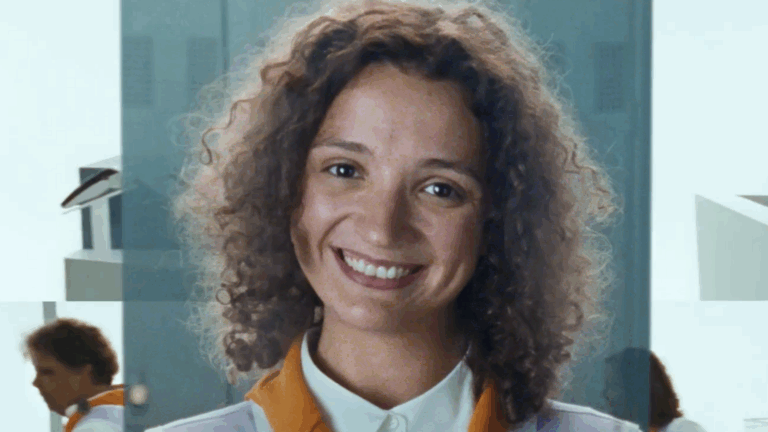
Certain close-ups stay with you, like those of Mathieu’s mother, or the final shots of the film’s heroine. Can you tell us about these two examples?
The sequence with Mathieu’s mother nearly got cut in the edit, so it’s funny that in the end it’s one of the images that stays with you.
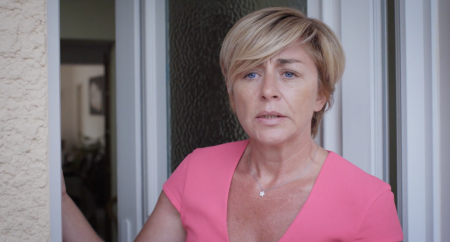
Not much to say about this shot — for this sequence I worked with a flag and a reflector, one source for the interior. I think what gives this shot its strength plays out between the shot and reverse shot. The shot on Héléna is almost devoid of colour, while the one on the mother is bright and acidic.
The casting for this character worked out very well. The woman who plays the role runs a restaurant where the director had lunch while prepping the film. She offered her the part on the spot.
Inès Leluel, who plays Héléna, was also spotted through an open casting call.
Which brings us to the film’s final shot.
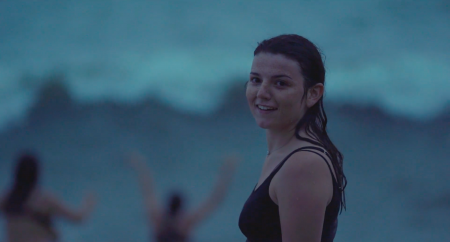
It’s a shot where the bond between the character, Héléna, the actress, Inès, and the director, Marjolaine, becomes visible. In the edit, all the crafting, the staging of the shot, was kept — including a reframe, not always easy for a cinematographer to see, in the finished film, as something that could be seen as a production flaw. But we all know that once shot, the rushes no longer belong to us.
And then, above all, there’s that magical moment during the shoot when the actress’s face is lit by the foam of the waves — and there, there’s nothing left to say, just to watch.
This shot moved me deeply. I saw in it a kind of farewell to a certain period of her life, the serene feeling of a page turning, the peace she makes with herself… The whole film prepares us for this shot.
Does the magic you describe, with the big wave for instance, illustrate the saying that luck favours the well-prepared?
Yes — preparing, listening to the director and trusting her in a moment like that, even if as a camera operator it puts me in a difficult position, but I hold the shot. This way of working is fed by the immersive documentaries I take part in.
Once you’ve earned the actress’s trust, you’re ready to capture that moment, that light.
What you say about this shot is very touching, and very true. The fact that it was the last thing we shot gives it great intensity. It was the last take of the last shot, on the last day of the shoot. It was a race against the light — we were shooting a dawn effect at dusk. Maybe that’s why the crew and the actress put so much into it.
I’m glad you chose two close-ups of faces; I think that’s what I love filming most. The period we’re going through makes me question a lot about how I practise my craft — we talk about it with other cinematographers within the Union.
How does this film’s style fit within your filmography? Do you think directors approach you for a particular visual style?
I learned my trade on fiction sets as a camera assistant; my filmography as a cinematographer is mostly made up of documentaries. As a result, I meet directors who love documentary and who draw on it. The line between fiction and documentary is becoming increasingly porous.
What brings directors to work with me is always a meeting, an encounter.
“Juste à Nantes” is selected in the national competition.
Cécile Bodénès is a member of the Union des Chefs Opérateurs.