1997 saw the release of Daft Punk’s function(){return ‘Around the World‘;}, one of the most iconic tracks of the French Touch movement, whose music video played a huge part in its worldwide success. Directing was the endlessly creative Michel Gondry, with the equally talented Alex Lamarque AFC behind the camera.
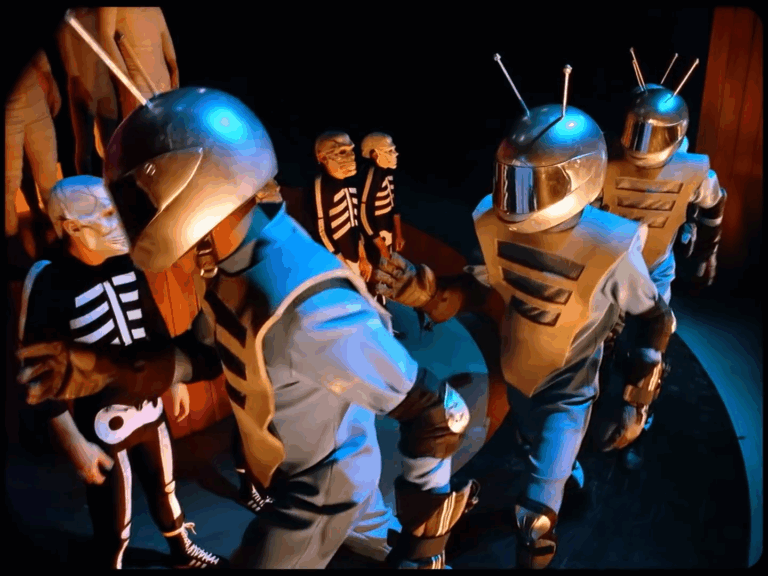
The video very visually stages the layering of each of the track’s sound elements, embodied by several families of moving characters. Among them, we see robots wearing helmets, years before the duo themselves would wear them for their live shows. These robots walk mechanically across a giant vinyl turntable, animated by the track’s electronic vocals. They’re joined by break-dancing athletes who climb a ladder and race down staircases in either direction, in time with a bassline.
A synth sound with disco undertones sets synchronised swimmers in sequinned retro swimsuits wandering through the scene. At the centre of the platform, skeletons sway to a guitar riff, while on the central stage, mummies fall in sync with the track’s drum machine.
function(){return ‘Around the World‘;} is a concept video where the staging, the choreography, the costumes, the set, the lighting and the camerawork each represent an enormous artistic and technical challenge, all achieved in record time. Aside from a few sketches, one interview with the director and a very condensed making-of, it’s extremely hard to find details on how this cinematic gem was made.
It was with this in mind that I got in touch with Alex, so he could share this extraordinary adventure with us.
Hi Alex, can you tell me how you came onto this project?
Michel always has ideas only he could have, and he’d already worked his project out well before I came on board. I landed on it because I’d already done quite a bit of work at Midi-Minuit. I went to see them, we had a meeting — it was the first time I met him. We talked, and he explained in detail what he wanted to do. Obviously, he’s a hard worker; he was already in touch with a choreographer, Bianca Li, and he’d worked out a set that fit perfectly with her choreography and the precise idea he had in mind.
The concept was that each dancer represented an instrument, so he built a choreography that rhythmically underscored the bass, the drums, the organ, the guitar — that spoke to him a lot, because Michel is a drummer.
So you worked upstream of the set being built?
Yes, they had the set built by the production designer, based on Michel’s sketches, which depicted a vinyl turntable. Scale was very important, and calculated so that on screen you could believe the whole thing was either very big or very small.
They ran a lot of tests to calibrate the height of the steps as well as the width of the platform, in line with the dancers. He then decided we’d put lighting inside and behind the set — in particular what you see in the light-up circles, but also under the steps, the disc and the podium.
For the background section, what we had to build were giant pixels capable of reproducing any colour. With Patrick Contesse, my gaffer, we put three dimmed Mandarines behind each circle, along with red, green and blue gel.
But depending on the colour, we obviously didn’t get the same stop, so we readjusted everything to keep the same output throughout. We calibrated each source according to its colour and repeated the process forty times. These were tightly sealed boxes so the light wouldn’t leak from one side to the other. We then had to diffuse the whole thing twice to even out the three beams.
Funny story: the rental house had run out of Mandarines and 500W globes, so we had to grab other bits and pieces, which as you can imagine didn’t make things any simpler — but we managed pretty well. I lit it all in tungsten, since there was no LED back then; it was the only way to be able to dim the light, so it wasn’t really a question we asked ourselves.
By the way, how did you manage to vary the light in such a distinctive way?
On paper, Michel’s idea was: we’ll recreate a wall of pixels, we’ll automate everything, we’ll record everything, and when we do takes, the light will always stay in sync with the music — whether on the stage, on the dancers, or in the background. For the time, that was a huge challenge, especially in so little time — but that was without counting on the formidable resources Michel had around him.
This video is a bit of a family affair, and among the Gondrys, they’re all gifted. His father had developed software that let you visualise, select and animate, in the form of a matrix, the colour and intensity of the set’s pixels. The computer generated a signal that was translated into RGB via a home-made electronic interface, connected to countless multicore cables and Socapex connectors.
It was his brother, Olivier “Twist” Gondry, who took on the soldering of it all — so we spent nearly 48 hours without sleep before shooting! At one point I went to rest for a few hours, but I don’t think Olivier slept at all!
In the end it worked; we spent two days on prelight and a full day of adjustments to calibrate the programme, the lighting and the camera moves in correlation with the dancers. The whole rig was pre-programmed on a console, as was the lighting coming from the floor — you’d hit Play on the computer and the track would play along with all the lighting in sync, via SMPTE timecode driving the DMX. We might have had a crash or two during the shoot day, but on the whole it worked really, really well.
For the camerawork, did you have a specific setup, several cameras?
No, no need for multicam since the lighting was perfectly synchronised! We shot on 35mm with a single Arri III on a Technocrane and on rails; I operated the head using the wheels. The crane moves were very precise — we didn’t have a stabilised head back then, and with the music playing we couldn’t hear each other, so I had a headset mic to talk to the grip.
The Technocrane on rails let us place the camera exactly where we wanted and push in on axis, getting very close to the dancers both at ground level and up high. We’d also set up a circular dolly track, which we used for the reverse shots from the back of the platform.
For lenses we had a Panavision Primo 10mm T1.9 and a Panavision Primo zoom 17.5-75mm T2.3, to reframe more easily without constantly having to rebalance the crane head. It was the ideal tool for this project, especially since the soundstages we shot in were big enough to give us the distance we needed.
The stock was Vision 500T, exposed at 1000, no doubt the way I did things back then. With Vision 500T I always set my meter to 1000 ISO — I always found the result better when correcting on the timecode rather than opening up a stop. So I worked on the basis that my stock was twice as sensitive, without overdeveloping it.
What’s more, the way we shot this video was a little unusual — we slowed the music down and shot at 18 frames per second, which is why the characters look so sped-up. The idea was to make the dancers’ movements more robotic and more elastic, so we slowed the soundtrack down by 28%, which means that when you play the whole thing back at 25 frames per second, they appear accelerated.
I know you had a background in electronic music — was that an extra motivation for making this video?
I was really into a genuinely underground scene throughout the years 95 to 2004.
I made electronic music myself, as a DJ, so at the time I was completely into this kind of video. I already knew of Daft Punk, but this was the chance to really get to know them through this project.
Did this project lead to other similar projects?
Afterwards, Michel called me back to do Kylie Minogue’s Come Into My World video, another huge motion-control challenge, and then he started making films, so those were the only two projects I did with him.
On the other hand, on this shoot I became friends with Olivier “Twist”, his brother, which allowed us to work together on quite a few advertising projects afterwards.
Alex Lamarque has since shot the cinematography for numerous French feature films, including Le Petit Poucet, La Vie promise, Les Rivières Pourpres 2 by Olivier Dahan, Sheitan by Kim Chapiron, La Mécanique de l’ombre, and most recently Les Promesses by Thomas Kruithof, with Isabelle Huppert and Reda Kateb.
Alex left us shortly before this article was published. He was someone whose talent and technical skill were widely recognised by his peers. He loved his craft as a cinematographer more than anything, and knew how to pass it on with the trust and generosity that so defined him.
On behalf of the members of the Union des Chefs Opérateurs, we extend our most sincere condolences to his family, his loved ones, and to all those who had the chance to know him in this profession.
- function(){return ‘Around the World‘;} music video by Daft Punk – Director: Michel Gondry / Director of Photography: Alex Lamarque / Production: Partizan Midi Minuit, 1997 / Song written and composed by Thomas Bangalter and Guy-Manuel de Homem-Christo (c) 1997 Daft Life
https://www.youtube.com/watch?v=K0HSD_i2DvA
- function(){return ‘Around the World‘;}, making-of
https://www.youtube.com/watch?v=vemkhYYb16w