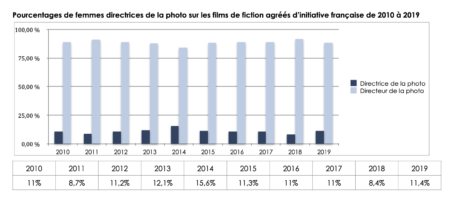
Between 2010 and 2019, only 11% of fiction feature films were shot by a woman cinematographer. And contrary to all expectations, no increase was noticeable over this period.
Context
In March 2021, the CNC published its latest prospective study on the place of women in the film industry. This study is a concrete and necessary tool for objectifying the inequalities between women and men in our industry and thus beginning to combat them. However, cinematography is buried within the broader category of technical trades, making it difficult to extract relevant information.
At the UCO (United Cinematographers), we felt compelled to produce a complementary study focusing exclusively on the place of women in cinematography (Director of Photography) for fiction feature films released in France between 2010 and 2019.
This study was carried out from CNC data, cross-referenced with crew lists from the “Unifrance” database. Films with budgets below €1 million — typically self-produced projects — were deliberately excluded to focus on films with a professional production framework.
The study was conducted by Thomas Lallier with the invaluable help of an intern, Diane Plas.
Results by production budget
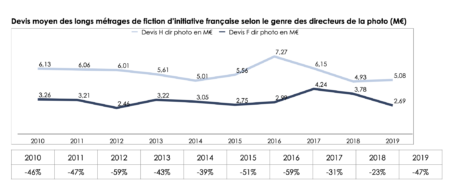
The average projected budgets of films shot by women are half those of films shot by men. Once again, no significant change was observed over the 10 years of our study.
The higher the film budget, the lower the percentage of women cinematographers. For films with budgets exceeding €5 million (the average budget for films with male Directors of Photography), only 4.34% of women hold the position of Director of Photography.
Results by director gender
We note a 22.9% share of women cinematographers when the director is a woman. When the director is a man, this percentage drops to 8.3%.
The increase in the number of women directors is a valuable yet limited lever for change.
Why change things?
The consistency of the results is as follows: until 2019, 90% of fiction films in France were shot by male profiles.
A finding that can be extended across all French fiction, as echoed by our study: the European Audiovisual Observatory has just published an equally alarming report about the place of women in the European television fiction industry.
This imbalance has consequences beyond mere gender statistics. It has a major impact on the images produced; for instance, the portrayal of the female body on screen is overwhelmingly shaped by a male gaze. Bringing more women behind the camera is essential, as the images we see are inherently influenced by the person who crafts them.
Furthermore, it impacts the economic fabric of our profession: the Observatoire de l’égalité shows that the overall income of women working in the audiovisual sector is 25% lower than that of men. Improving gender parity in crew composition is therefore both a social and economic necessity.
For production companies, there is no doubt that those implementing gender parity in their crew composition will greatly enhance their reputation with various funding bodies, particularly television networks and streaming platforms, which are already highly attentive to this issue.
WHAT CAN BE DONE TO CHANGE THINGS?
Since 2019, the CNC has granted a “parity bonus” of 15% in support funding to films that achieve gender parity across the following eight key positions: directing, production management, cinematography, sound, costume design, production design, editing, and screenwriting. This single measure will certainly not be sufficient.
The under-representation of women in cinematography is due to multiple factors:
– The problem of role models: if girls don’t see women in this profession, they cannot project themselves into it, or even consider it as a possibility.
– Young female cinematography graduates are significantly more affected by career breaks after their studies.
– When a film is looking for a Director of Photography, women are statistically less likely to be on the shortlists.
– The working conditions on set (long hours, heavy equipment, physically demanding environments) are too often designed for and by men, without questioning whether different approaches might work just as well.
The UCO is firmly committed to contributing to gender parity in cinematography through concrete actions:
– We strive to ensure equal representation of women in all our activities (publications, events, discussions).
– We work to raise awareness among production companies, directors, and agents about existing biases in hiring.
– We support initiatives that promote women’s access to the profession and encourage mentoring programs.
We call on the entire profession — producers, directors, agents, institutions — to take action so that the images on our screens reflect the diversity of those who create them.