Episode 1. A lens in a haystack.
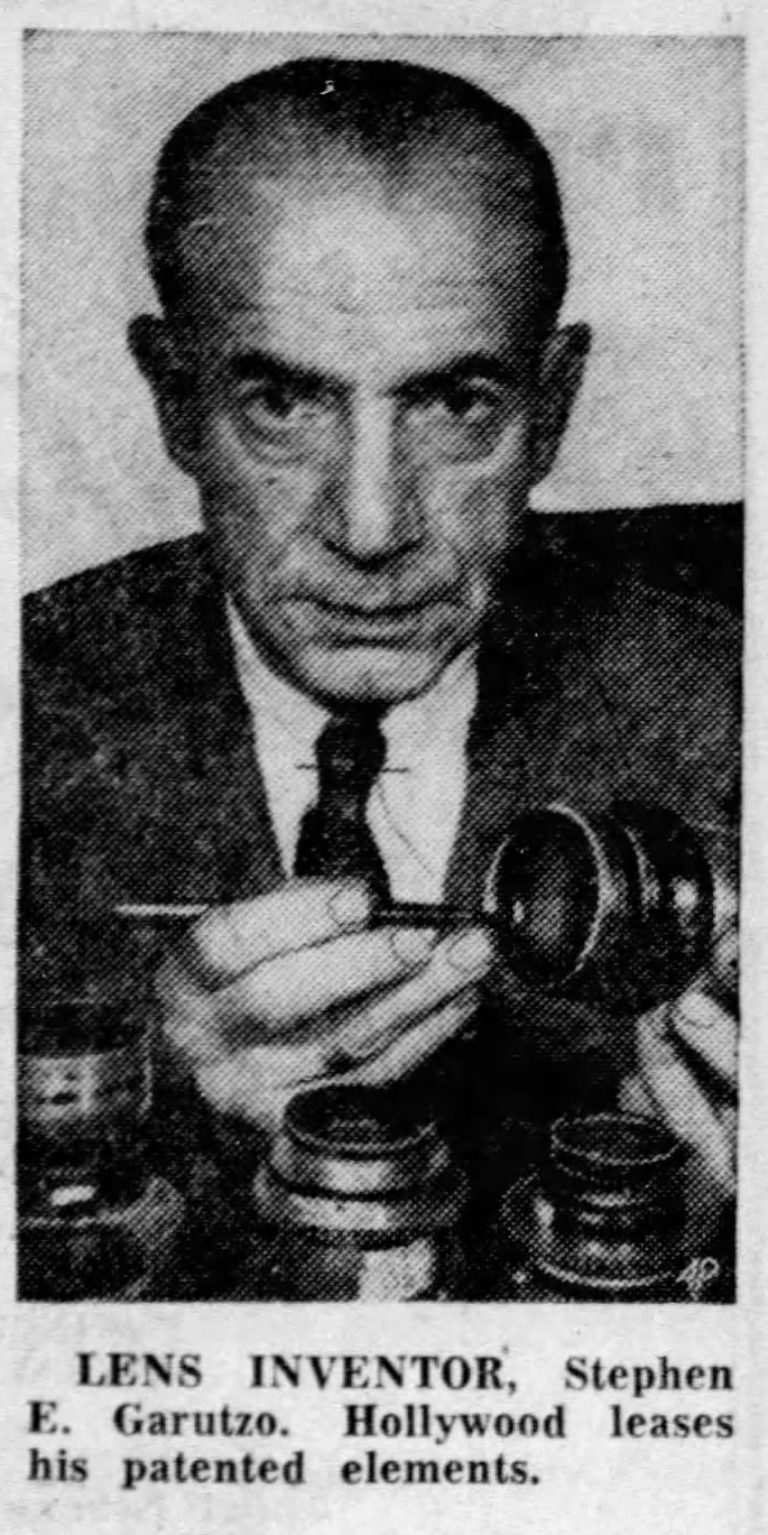
Some stories are a joy to tell: they take on an air of mystery and fall into your lap by chance one evening as you read by the fire. Add a touch of the exotic, some forgotten newspapers, an anti-communist Russian inventor, genealogy, a bra, and the California white pages, and you get the incredible story of Stephen E. Garutso, a man you have probably never heard of.
Apart from the fact that I don’t have a fireplace and that the exotic side of this story will be confined to the West Coast of the United States, everything you are about to read is true.
It all began one evening in October 2020, when I had just received several English-language books about cinematography. In one of them, a cinematographer mentioned in passing a seemingly revolutionary lens I had never heard of: the “Garutso Balanced Lens.”
For the record, I haven’t been able to identify the book in question with certainty. I think it was Masters of Light by Dennis Schaefer & Larry Salvato, but there were so many books and the sentence was so short that I still haven’t managed to find it again. The search continues, though, and rest assured that if I find it, you’ll be the first to know.
But back to this lens. That very evening I began my research, thanks to the magic of the internet, without leaving home. After a few hours of wandering online, I had to admit that the results were not very impressive: a few rare mentions on a photography forum, one or two posters for films from the 1950s, and the photo of a man who wore his suit as well as his baldness.
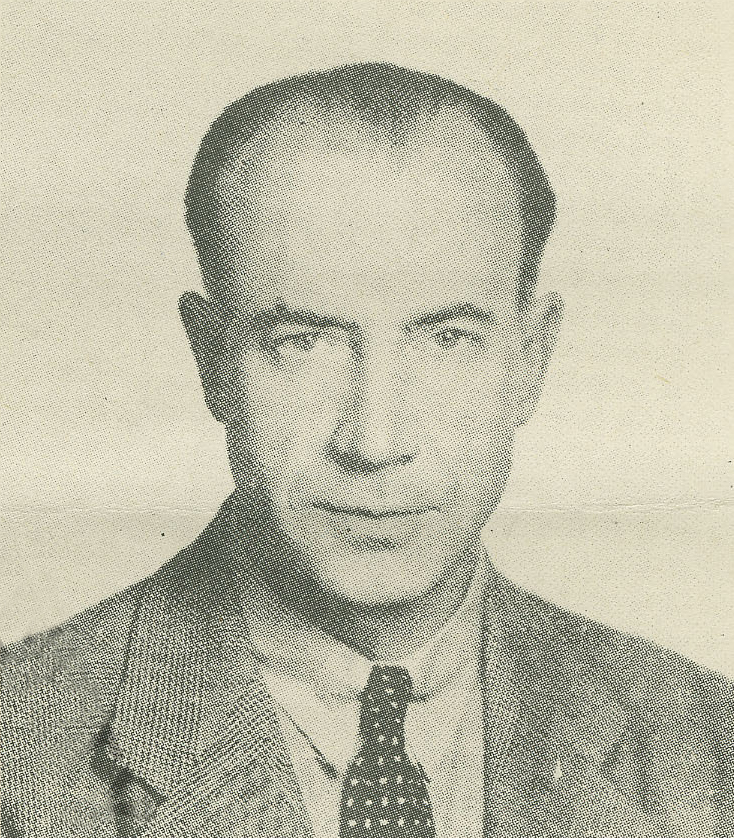
Have you seen this man?
Being ever so slightly obsessive and vaguely monomaniacal, I kept searching over the following days. Note, at this point, my soft spot for lost causes: at this stage of the story, I still don’t know exactly what makes these Garutso lenses so brilliant, which goes to show that sometimes we have time to waste.
Fortunately, Google came to the rescue. Alongside its projects for connected humans and cargo airships (yes, really), the California company had the idea of digitizing every patent filed in the United States since the dawn of time (or nearly) and making them available to the public. Needless to say, I, the public, was delighted.
In the depths of the internet, I found a first patent dated October 25, 1945, in which our vanished inventor explains how to make a lens that would achieve hyperfocal focus at full aperture.
Yes, you read that right: this document specifically detailed how to add annular lens elements to a Cooke 47mm f/2.5 lens and thereby produce a perfectly sharp image from 40 inches (101 cm) to infinity.
I don’t know about you, but for me the hyperfocal lens had always been a kind of legend.
I had heard of the Hoge lens (named after the chief electrician on Citizen Kane, who is said to have developed a hyperfocal lens), which was used notably in 1952 on certain shots of Robert Wise’s Captive City, but all of that had remained at the prototype stage, nothing more.
Yet as I kept digging, I discovered in the September 1949 issue of American Cinematographer that a major advertising campaign had been launched to encourage the cinematographers of the day to use these revolutionary new lenses on their upcoming film projects.
I also discovered that these lenses were not sold but only rented, through an exclusive agent, one E. Goulden, which at that point did not help me clear up the mystery of this invention.

The first real turning point in this investigation was discovering a website created by American newspaper publishers, who had decided to put all their archives online, going back to the beginning of their publications.
To get a sense of the scale of this project, the site contains every newspaper (national and local) from every state, county, and city in the United States since the mid-19th century (spare a thought for the intern at the photocopier). In short, it’s huge.
After accepting the terms of use of newspapers.com without reading them, I began a trial period that gave me access to the entire archive without having to sell a kidney.
Thanks to this site, I could virtually travel back in time and finally lift the veil on part of the mystery. So here is what I discovered about Stephen E. Garutso, whose personal story is as incredible as his inventions.
Stephen E. Garutso was born on August 14, 1895, in Russia. He seems to have fled his native country after the uprising of November 7, 1917, following which the Bolshevik party, soon to become the Communist Party, seized political power in Russia.
His first years in the United States are rather hazy (the man was not yet known, so the newspapers did not yet write about him); we know that he chose to settle in California and began working on his inventions there.
He first turns up in the September 21, 1945, edition of the Brooklyn Observer.
The paper devoted an article to Dr. Sonia Poushkareff, a Russian immigrant who had fled communism in 1924 (sound familiar?) and settled in Hollywood as a dentist to movie stars, not without first trying her hand at screenwriting and acting.
What does this have to do with our story, you ask? It turns out that Dr. Poushkareff, although already very busy with Hollywood’s teeth, also found time to be the assistant of an increasingly well-known Russian inventor, one Stephen Garutso.
She is very important to our story, because two years later she would become the inventor’s wife, and she herself would have an extraordinary destiny, but we’ll come back to that later.
From then on, the press took more and more interest in our prolific inventor.
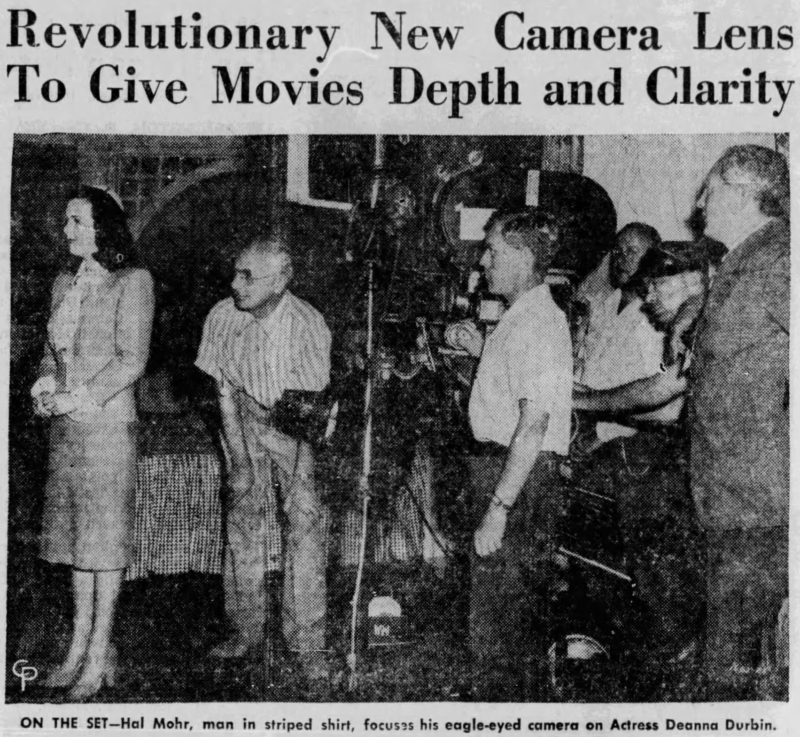
In December 1945, the Sikeston Standard reported on how wartime technologies were benefiting film production. This short article mentions the story of a Russian immigrant named Garutso, whose new lenses were said to give films a 3D effect. Six months later, a legal notice announced the creation of the Garutso Optical Balance Company.
But it was in its December 20, 1946, issue that the Messenger Inquirer reported that cinematographer Hal Mohr, ASC, would carry out, in early 1947, the final tests of a revolutionary lens developed over 15 years. The cameraman even described this discovery as almost as important as the arrival of sound and color in films.
The journalist wrote: “Scenes projected on the screen are clearer, especially in color films. Since these new lenses keep an entire scene perfectly sharp, it will be much easier to film continuous action.
Thanks to this incredible depth of field, you experience the illusion of three dimensions. Mohr also believes that these new lenses will probably cut the amount of sets needed to make a film by a third.”
The tests were convincing, and after a few more years spent improving the invention, a major advertising campaign was launched in the press. Stephen Garutso decided not to sell these lenses but to rent them. He thus appointed one E. Goulden, who had a storefront on Hollywood Boulevard, to handle this worldwide exclusivity, while he himself pursued his research into new optical systems.
Continuing my investigation, I (finally) found a document dealing in more detail with the technical side of these lenses. It was in the September 1949 edition of American Cinematographer that an article (which is also clearly a commercial operation) explains that these lenses are indeed made up of both annular elements and more “conventional” ones, making it possible to achieve hyperfocal focus at full aperture.
The article says that these lenses had already been used to make three B movies (that part is me talking): L’inconnu aux deux Colts (its French release title), Apache Chief, and Tough Assignment.
It seems that it was not until 1950 that the major studios finally took an interest in these innovative lenses, notably for Michael Gordon’s Cyrano de Bergerac, which earned its lead actor José Ferrer an Oscar (the first Puerto Rican to receive the statuette), and whose cinematography is simply stunning. The film is available for free on the Internet Archive, and I warmly recommend watching it, as some shots are just breathtaking.
American Cinematographer gave me one last important piece of information: the composition of a commercial set of Garutso Balanced Lenses, namely seven lenses of 25, 30, 35, 40, 50, 75, and 100mm.
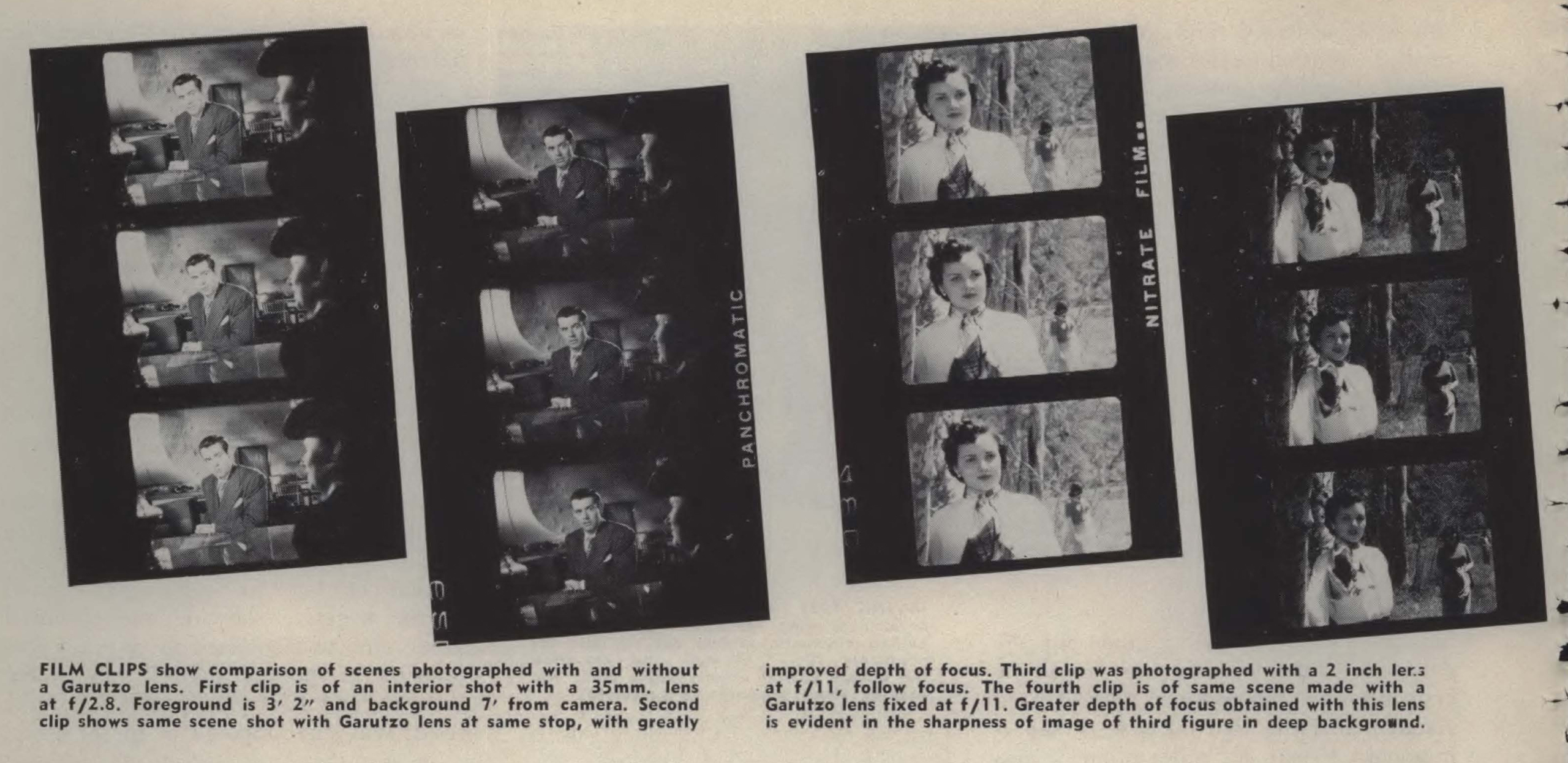
At this point in my research, it is June 2021, and several questions remain unanswered.
Why did this inventor and his inventions (for there would be others, as you’ll see later) disappear from history? Is there still a set of these lenses somewhere, sleeping in the forgotten attic of a Hollywood Boulevard storefront, just waiting to see the light again? And finally, are there any descendants of Stephen Garutso I could write to, to learn more about their inventor ancestor?
This first installment on Garutso’s vanished lenses is coming to an end, but know that many of these questions have been answered, and that there is still a lot to tell about the life of the inventor and his creations.
That said, like any self-respecting episode ending, here comes the cliffhanger: thanks to the internet and Mormon genealogy, I tracked down Stephen Garutso’s granddaughter in Hollywood. I wrote her a long letter about her grandfather, asking her all these questions. And guess what: she wrote back.
To be continued.