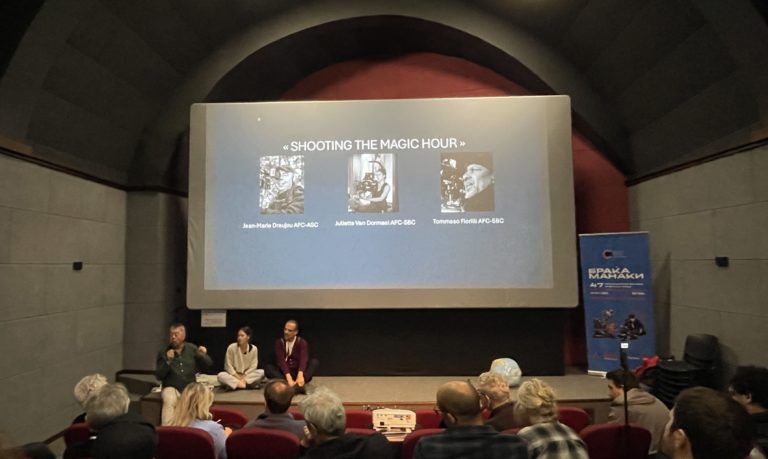
At the 47th Manaki Brothers International Cinematographers’ Film Festival in Bitola, North Macedonia, the AFC presented a masterclass titled “Shooting the Magic Hour” on September 24, 2026. Jean-Marie Dreujou AFC-ASC hosted it alongside Juliette Van Dormael AFC-SBC and Tommaso Fiorilli AFC-SBC.
Tommaso Fiorilli first laid out the physics of twilight, with diagrams to back it up; each speaker then talked about a shoot, from Brussels to the mountains of Morocco and Inner Mongolia, before an exchange with the audience.
The poster for the AFC masterclass, September 24, 2026.
The speakers
Jean-Marie Dreujou AFC-ASC’s presented a sequence from Balzac and the Little Chinese Seamstress (Dai Sijie, 2002) and Wolf Totem (Jean-Jacques Annaud, 2015).
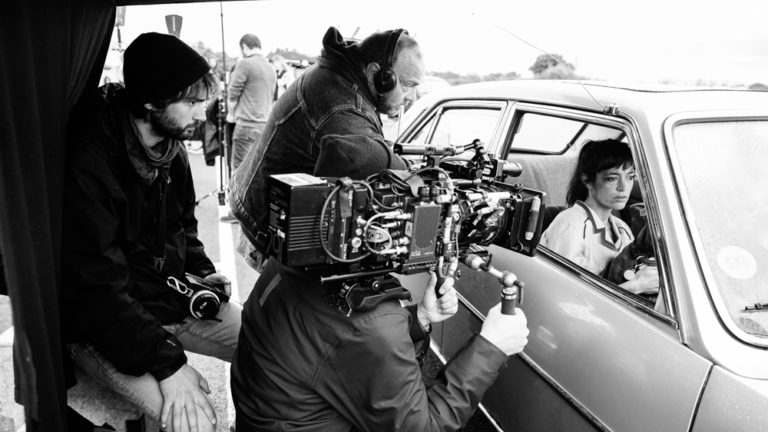
Juliette Van Dormael AFC-SBC, based in Brussels, presented a scene from Through the Night (Delphine Girard, 2023).
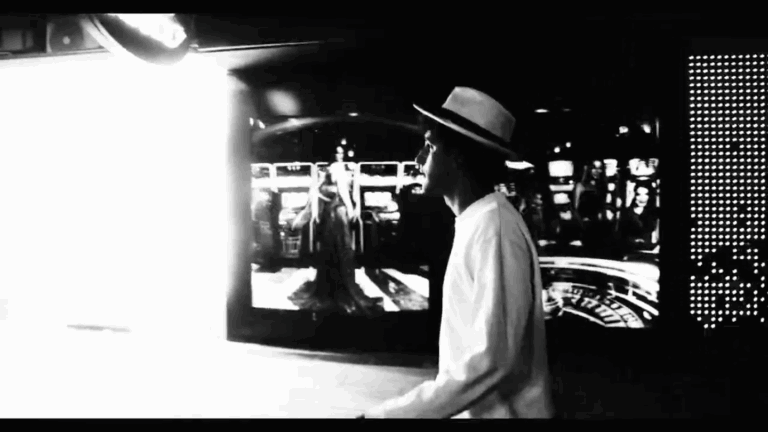
Tommaso Fiorilli AFC-SBC presented a scene from Black Hearts – saison 1 (Ziad Doueiri, 2023).
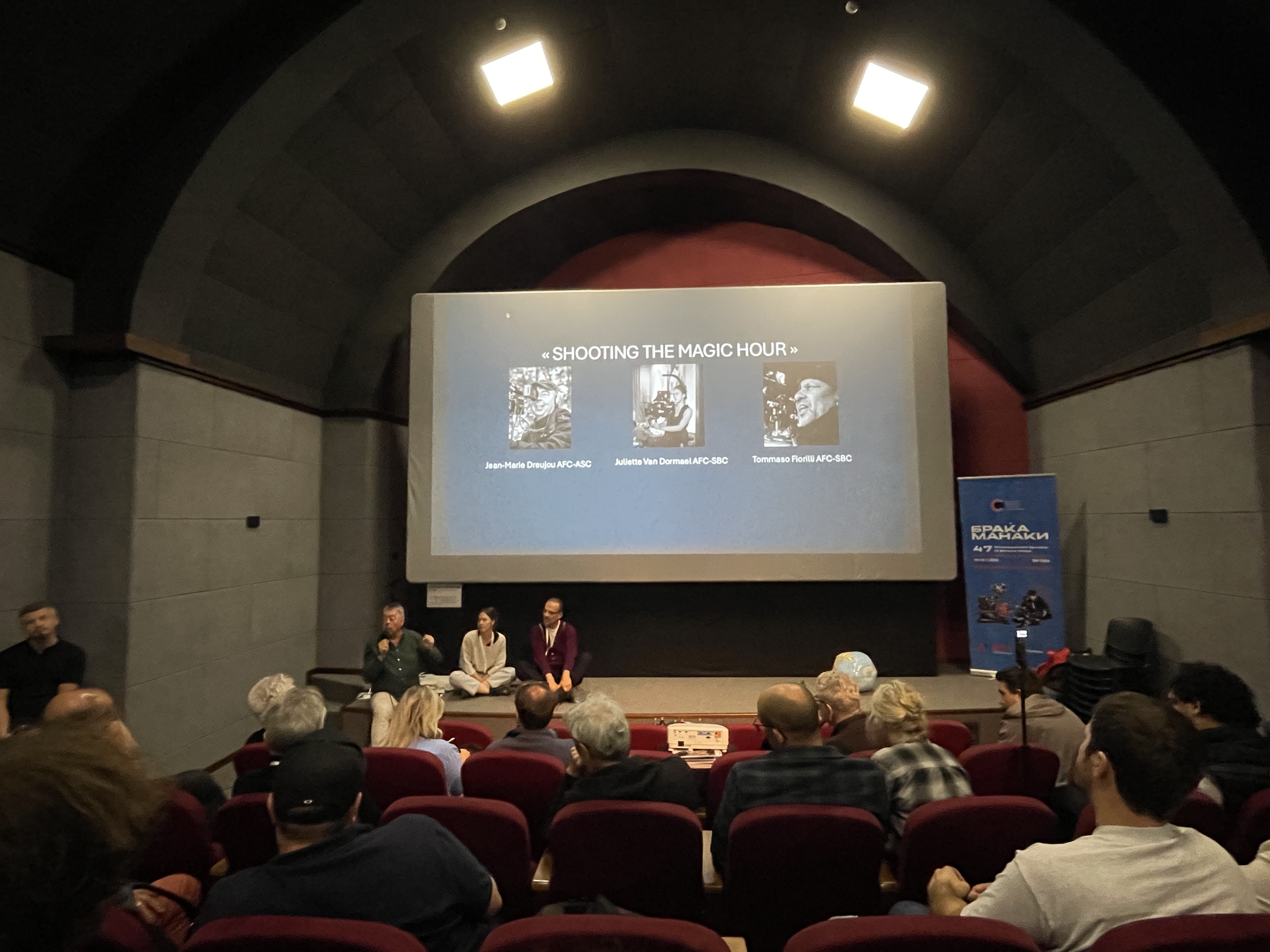
From left to right: Jean-Marie Dreujou, Juliette Van Dormael and Tommaso Fiorilli.
Time, rigor and a little madness
Jean-Marie Dreujou: We’re very happy to talk about magic hour. At a time when digital tools tend to make us believe that everything is easy, shooting at magic hour remains, I think, something that belongs to us, to cinematographers. When you find a sequence at sunset or at dusk in a script, you’re very happy if it’s short: you shoot it during the real magic hour.
If it’s very long, with explosions, emotion, long dialogue, animals, it will be very difficult, and our job is then to find a way to make it happen. It takes a lot of preparation, time, rigor, a little madness, and a lot of luck. A close working relationship with the director is crucial: on our own, we can do nothing.
Juliette, Tommaso and I are going to share our magic hour moments, each from our own experience, but first I’ll let Tommaso introduce a few technical notions.
Counting in degrees
Tommaso Fiorilli: Here’s a little time-lapse I shot in Paris. It’s marked in degrees: we talk about degrees rather than time, and you’ll understand why. People sometimes say, “I have 10 minutes to shoot”: we should be thinking in degrees. If there’s one thing to remember, it’s this: a given number of degrees below the horizon corresponds to a given type of light, and that’s true anywhere in the world, at any time, at any latitude.
Here we are at sunset. Civil twilight is the first band. Then comes blue hour, when you can still see the person on camera very well. And now you need practicals in the frame: without them, she would be very dark. That’s nautical twilight; I’ll come back to it. Once nautical twilight is over, it’s more or less night.
I chose this image from The Little Prince, by Antoine de Saint-Exupéry. He lives on a tiny planet and only has to move his chair to watch the sunset again: one day, he saw it 43 times. We don’t have that luck. We have to plan so we get it right the first time; otherwise, we wait 24 hours.
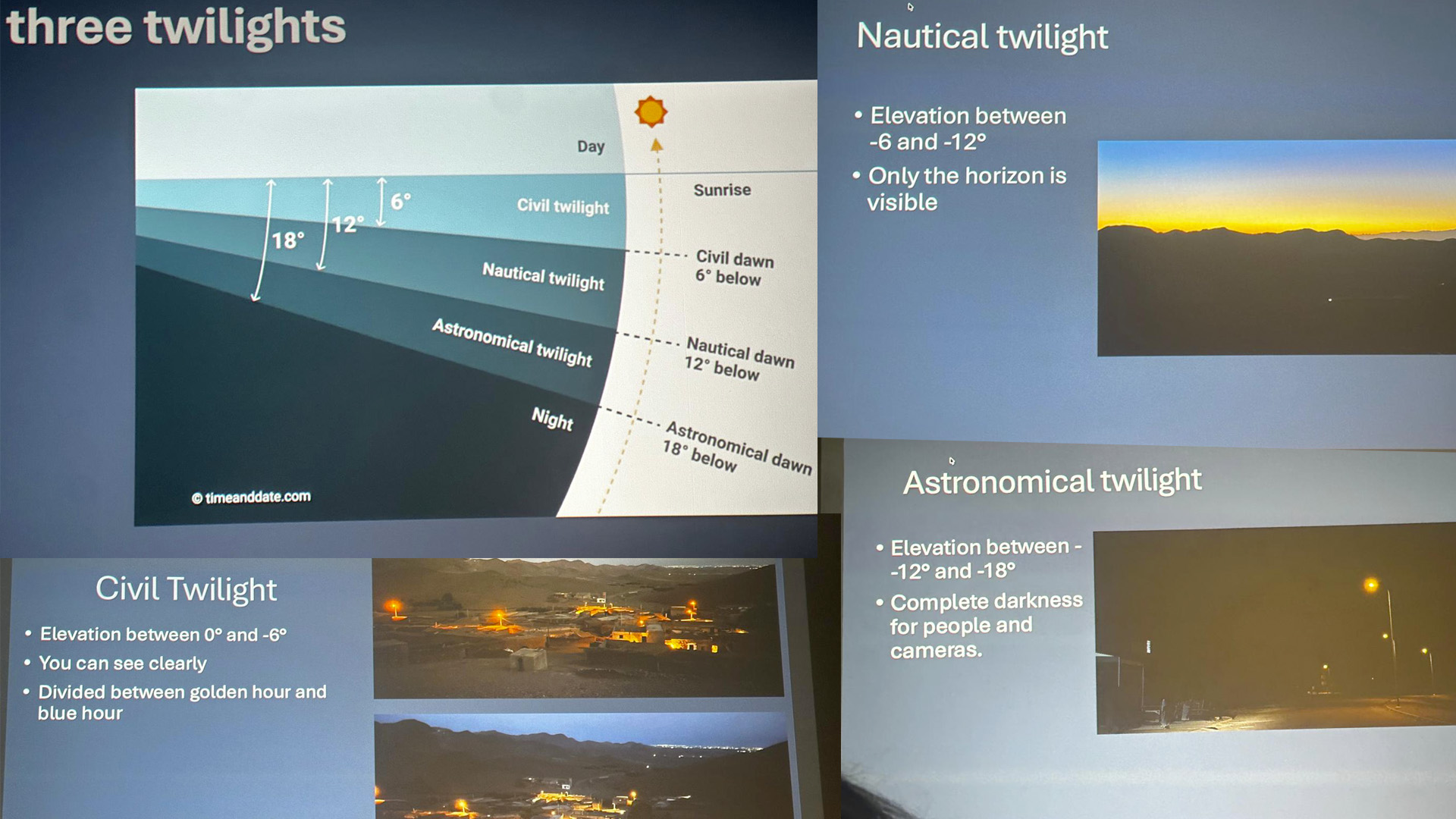
Twilight is divided into 3 bands, defined for practical reasons by professions other than ours. Civil twilight is called that because you can still see well enough to do more or less whatever you want; planes, for example, can still fly without the instruments required for night flying.
We talk about the sun’s elevation: you could say its altitude, but “elevation” is less confusing. Between 0 and −6 degrees, at some point, and we’ll see why, the light switches from golden hour to blue hour. Here are 2 examples, tests I shot for the project I’ll show you an excerpt from later: golden hour at the top, blue hour at the bottom. The switch from one to the other takes a few minutes.
Nautical twilight is called that because sailors, before GPS, had to calculate their position: they needed to see the stars and the horizon at the same time. It’s roughly the moment when the stars appear while you can still make out the horizon. The rest is very dark.
It’s very beautiful, for example, for a night scene where you want to keep a clear sky. You can already see that there isn’t “the” twilight, or “the” magic hour: there are 3 zones, with 3 different settings. When preparing the shoot, you can decide to do one shot at golden hour, another at blue hour, another in nautical twilight, and the result is completely different.
Next comes astronomical twilight. For us, it’s useless; it’s very dark. It’s called that because astronomers needed it: after it, they can see the stars clearly; before it, the sunlight gets in their way.
What happens at sunset? First, a sharp drop in light. It happens at 0 degrees, not when the sun goes behind clouds or mountains. If mountains hide the sun between 6 and 0 degrees, it’s like being in the shadow of a building: the sun hasn’t set yet, and the light doesn’t drop.
As soon as it passes below the horizon, though, the drop is very fast. Here’s civil twilight: at this latitude, it lasts about half an hour. And here, there’s practically no light left to shoot with, only the sky, and you need practicals in the frame to see anything. After that, it’s more or less night.
Quick reference
- civil twilight: from sunset down to −6° below the horizon;
- nautical twilight: from −6° to −12°;
- astronomical twilight: from −12° to −18°.
Why the sky turns blue
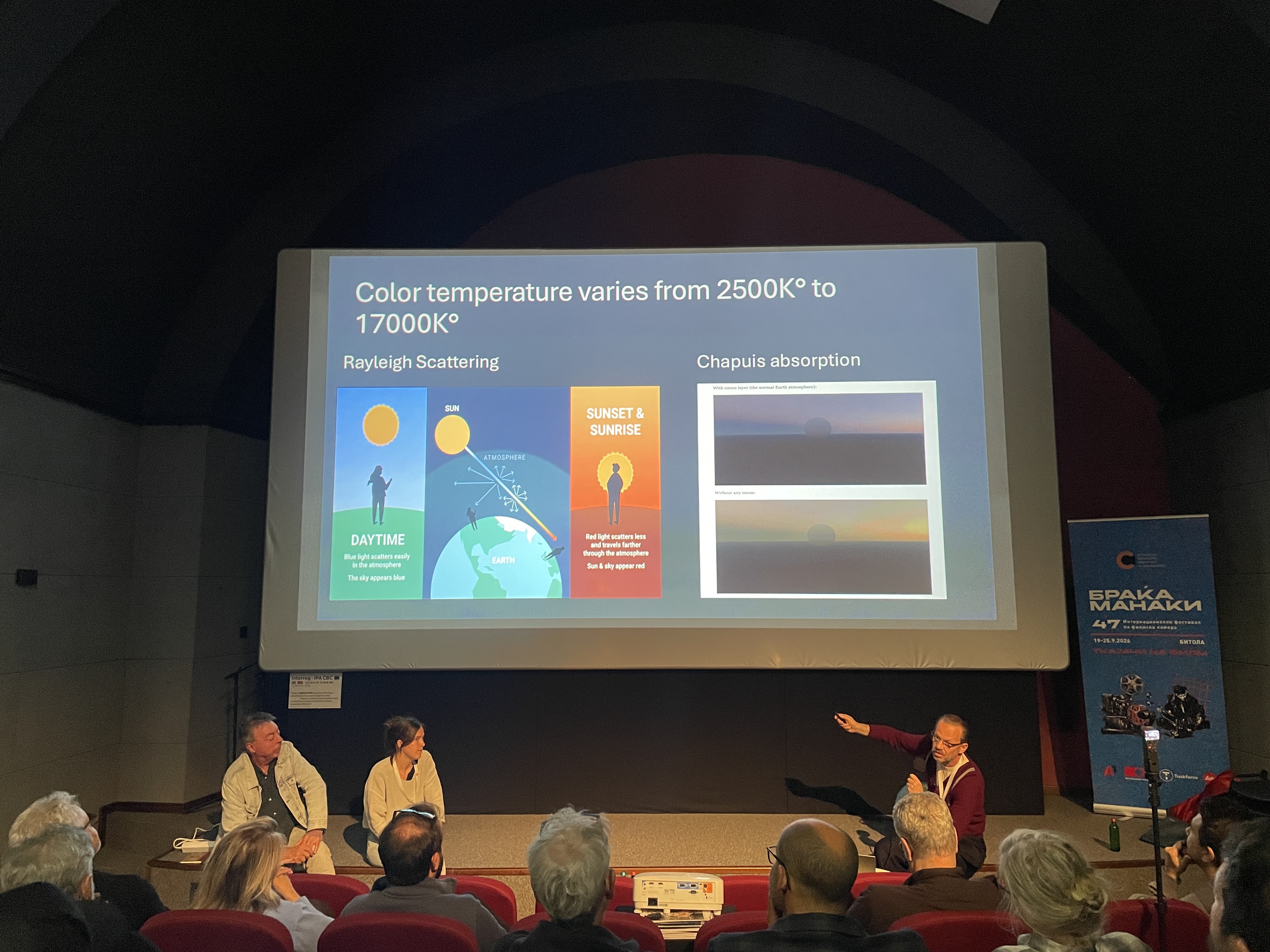
Tommaso Fiorilli in front of his slide on color temperature, from 2,500 to 17,000K: Rayleigh scattering and Chappuis absorption.
Tommaso Fiorilli: The other phenomenon is a major color shift. It’s a bit complicated. First, there’s Rayleigh scattering: the atmosphere scatters blue light in every direction, and that’s why the sky is blue. At sunset, the sun, lower on the horizon, has to pass through much more atmosphere: more blue is scattered along the way, and the sun turns orange. That’s golden hour.
Later, once the sun has gone below the horizon, it only lights the upper atmosphere. Between 11 and 50 km up is the ozone layer, and ozone has a particular property: it absorbs yellow and red. At the bottom, you see a simulation of the sky without ozone; above, the sky with ozone, which absorbs the reds and yellows.
That’s why there is a blue hour: the sun, lower down, only lights the upper atmosphere, where ozone absorbs red and yellow.
How long does twilight last?
Tommaso Fiorilli: The question everyone asks is: how long does it last? First, you have to ask how fast the sun crosses these degree lines. Its angular speed is 15 degrees per hour: in 24 hours, the Earth makes a full turn, 360 degrees, and 360 divided by 24 is 15.
If you look at the sun and come back 1 hour later, it will have moved 15 degrees. Easy: 6 degrees at 15 degrees per hour makes 24 minutes. Except the sun only crosses the horizon vertically at the equator. Everywhere else, it crosses at an angle, and what we care about is its vertical speed, the time it takes to go down from 0 to −6 degrees. So you have to take into account the angle at which it crosses the horizon.
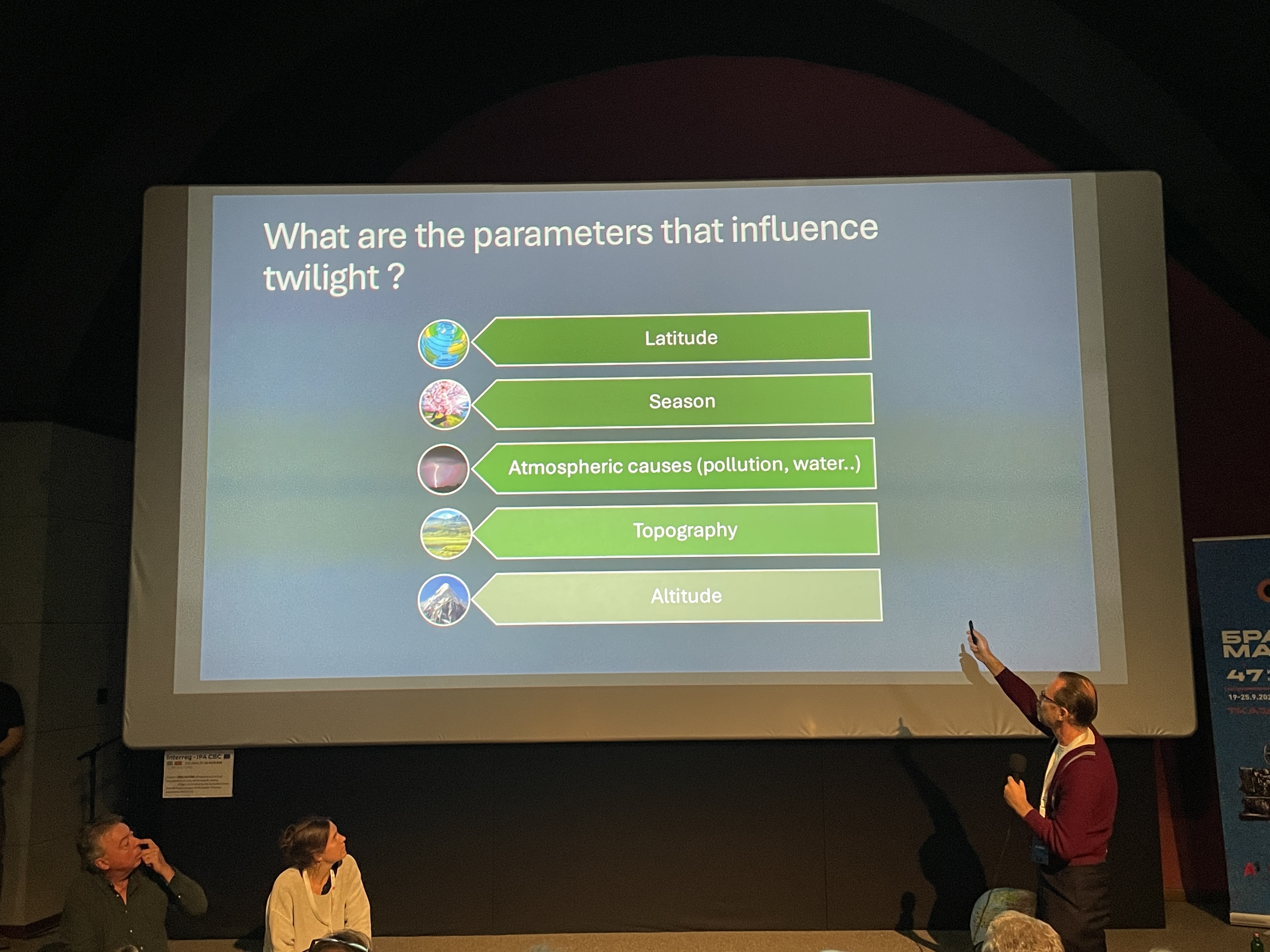
The parameters that influence twilight: latitude, season, atmospheric causes, topography, altitude.
Here, roughly, are the parameters that affect sunset and twilight. Latitude, of course. The season, which raises more or less the same issue. Atmospheric causes: pollution, water in the air, clouds. Topography: behind mountains, you won’t really see the sunset or the twilight. And finally altitude, which doesn’t change how long twilight lasts but delays it; we’ll come back to that.
As for latitude: at the equator, the sun’s path is perpendicular to the horizon, so civil twilight lasts 24 minutes. Near the pole, the sun may never cross the horizon and stay at the same height. At 45 degrees, in between, you need a bit of trigonometry, but that’s the principle.
As for the season, it would be too easy otherwise: the Earth goes around the Sun on a tilted axis. [Tommaso Fiorilli has an audience member play the Sun.] Depending on its position in its orbit, it’s summer or winter. The Earth spins on itself, so you see daylight at some point, but in the northern hemisphere, in winter, the sun hits the surface at a much lower angle and goes down more obliquely: that’s why sunset lasts longer in winter.
Audience member: Thanks for picking me to be the Sun! (Laughter)
Tommaso Fiorilli: As for atmospheric causes, high clouds, cirrus, cirrostratus, altocumulus, like the ones in this photo, reflect sunlight: they’re what gives you those spectacular sunsets. When the forecast calls for cirrus or altocumulus, you can plan that kind of shot.
Pollution, on the other hand, gives you those hazy sunsets; if you like that, that’s what you’ll get. It also works with dust or water: you need particles, not necessarily pollution. In overcast weather, the best thing to do is reschedule. Nothing happens, and at sunset the light plunges straight into night, with no afterglow. If you really have to shoot, shoot earlier; don’t wait for sunset: nothing will happen.
As for topography, as I said, sunset begins when the sun goes below the horizon, not behind the mountain. Behind the mountain, you can fake it for a while, but you’re in shadow and the light is rather dull; the beautiful skies only come when the sun actually reaches the horizon.
Altitude doesn’t change how long twilight lasts, but it matters a lot if you’re shooting in the mountains or on top of a very tall building. If you’re planning a sunrise and you show up at the time given by Sun Seeker, you’ll be late: Sun Seeker doesn’t take into account the height you’re standing at. Other apps do, PhotoPills for example; I encourage you to check it out if you have an early-morning shot to do.
And if you search online, you’ll find this rule of one minute per 1,500 meters. It’s a myth, copied from site to site. It’s wrong, the difference is much bigger: don’t believe it.
Finally, atmospheric refraction. When you see the sun on the horizon, it’s actually a little lower: the atmosphere bends its rays. For you, it doesn’t matter; all the apps take it into account. If you zoom in on Sun Seeker, you’ll even see the sun make a little hook that it doesn’t make in the sky. The app cheats up to that point, to show you where you’ll see the sun, then brings it back to its real position. That’s it for the technical part.
Through the Night: connecting 2 characters who only meet at the end
Juliette Van Dormael: We’re now each going to present some of our work at magic hour, and I’ll start. I’m a cinematographer based in Brussels, but I work mostly in France. Here’s an excerpt from a film shot in Brussels in 2022, on the Sony Venice. It brings together 2 passages, linked in the story by magic hour, but also by sound and other elements.
[Screening of the excerpt.]
Juliette Van Dormael: The film is called Through the Night. I put the synopsis on screen, it’s simpler: there are 2 main characters, who only see each other at the very end. We had to think about how to bring them together through image, through sound, through all kinds of cinematic means, without ever having them in the frame together.
For the first part, I wanted to link the 2 characters. We start at Anna’s workplace, and I wanted to cut, in direct continuity, to the other character at the very beginning of the day. I wanted one to be seen in silhouette in the car, and the other in silhouette at her workplace.
We had to reschedule that shot. We were shooting on a location where we stayed about 8 days, lit mostly with Astera tubes rigged on the ceiling during the prelight with my gaffer. On the day planned for that shot, the sky was very overcast. Since we were lucky enough to be there for 8 days, we rescheduled it to get a nicer sky; it really mattered to us.
We also wanted to link them with a focus pull: in both cases, the focus starts in the background and comes onto them. In the car, to make the most of magic hour, we had put fake condensation on the window, to make the image bluer and softer.
The second passage is linked to the first: it’s a kind of memory that comes later in the edit. She remembers the conversation from the previous excerpt, and it was to link the two that we shot it at magic hour. That one was very simple: we just had to be there at the right moment, and there was no way to reschedule it, as the shooting time was very short.
In the car, we just added a small light panel. Then comes the last part, near the wind turbines, which follows in the excerpt; in the edit, other scenes come in between, which is why the grade is a little different. There too, only natural light, with a small source on her face for the close-up. Tommaso is going to present his excerpt.
From day to night in the Moroccan mountains
Tommaso Fiorilli: Here’s a sequence from a TV series, a story about soldiers. The whole point of the scene is going from day to night. I’ll talk about it right after.
[Screening of the excerpt.]
Tommaso Fiorilli: It’s obviously a completely different kind of work from Juliette’s: a series, with other ways of doing things, you all know that. We were shooting on the Alexa 35, in Morocco. Here’s roughly our kit: lightweight Angénieux Optimo zooms, then Zeiss High Speeds and another set of primes for the night scenes.
This is the prep. You can see the difficulty: very rough terrain, and this is how we had to carry the gear up. Just the climb was very hard. We organized our days to avoid going up and down: we stayed up there, shot night scenes, day scenes, and went straight into the dusk, since we couldn’t go up just for that.
First setup: 2 cameras on top of that mountain, from roughly the same point of view as the image on the left, filming the road below. We had all the summit scenes to shoot, and as soon as the sun set, we filmed these shots at golden hour. We needed the stop: we were using these zooms at around T5.6, which ruled out blue hour. And that served the story, since we were after that progression. So this part was shot at golden hour, at around T5.6.
What came next was very complicated: as soon as the soldiers got up, they dropped their weapons, their gear; on that terrain, with all that equipment, we had to redo the take 4 or 5 times. That’s why some shots were done in nautical twilight, to make them dark.
For continuity, it doesn’t really hold up, but dramatically, those silhouette shots are very beautiful. It’s something to keep in mind for this kind of shot: you really have to cheat with time. The sequence you just saw lasts about 5 minutes on screen, in continuity, but it covers about 1 hour of changing light.
As you can see in Children of Men, as long as you stay consistent in the direction of the change, without going backward, it works very well.
For the other setup, on another day, same thing: we had to climb the mountain with the donkeys. We had 2 cameras; I would have loved to have 3, it helps a lot, because you have very little time to shoot. In 1 hour, you go from T5.6 to T1.4, and to ISO 3,200 or 1,600: you have to anticipate that and be ready.
You start straight away with the fast lenses, and you don’t switch between zooms and primes along the way: there’s no time, you have to be efficient.
The last scene, at the end of the story, when they come back down the mountain toward the little hut, we shot during the day, in overcast weather, without waiting for magic hour: as I said, in overcast weather, waiting would have made no sense. The upside is that it gives you much more time.
And once the mood is established, shots with imperfect light still work. In all, 4 days, and every evening a tiny window: we shot other things at the summit, got ready for sunset, and shot each time during the half hour of sunset.
Wolf Totem: 3 evenings, 3 cameras
Jean-Marie Dreujou: Here’s an excerpt from Jean-Jacques Annaud’s Wolf Totem (Le Dernier Loup), adapted from a famous Chinese novel of the same name. The story takes place during the Cultural Revolution, in Inner Mongolia, where we shot. In this excerpt, the main character, Chen, has captured a wolf cub that he’s trying to raise, and the pack is looking for the cub.
[Screening of the excerpt.]
Jean-Marie Dreujou: First, you find the location. Then you draw up the shot list, and looking at it, we saw that the only shots we could do without magic hour were those of the wolf cub in its cage. All the others had to be shot at the real sunset. We decided to spread them over 3 evenings.
First evening, first setup at the top of the hill, for the wolf shot and the wide shot of the village. I had prepared lights, because I knew the light was going to fall and that I would start before sunset: 2 big SoftSuns, each on top of a cherry picker.
These SoftSuns are very handy; you can dim them from 0 to 100, so you can hold the sky, hold the light throughout the sequence. For the wide shot, I could hide them behind a rock, and on some shots, remove them in post. I also used Dinos for the headlights: the script called for a moment where the character had to read a letter by the headlights of a car.
The Dinos can be dimmed too, which makes things very simple. I had 3 cameras: the A camera, an Alexa with Cooke S4s, on the mountain for the wide shot, and the B and C cameras on the wolf, closer to the village. That was the first evening, already very difficult, with the wolf and everything else to manage.
Second evening, 2 setups. The first for the dialogue scene, again with 3 cameras: A, B with the zoom, C with another zoom, a 24-180. With so little time, 3 cameras are very useful. The second setup followed the same principle, with cameras A, B and C.
Third evening, we finished with the wolf cub, which I adore. I chose to go handheld, because with the little wolf, we never knew exactly where it would be, and we kept the same setup for A, B and C.
Balzac and the Little Chinese Seamstress: a single evening, on film
Jean-Marie Dreujou: I’d like to show you another film shot in China, about ten years earlier, set in the same period, the Cultural Revolution. That one I shot on film; it wasn’t the same thing. The character returns to the village where he lived through the Cultural Revolution, and he’s looking for something.
[Screening of the excerpt.]
Jean-Marie Dreujou: For this sequence, I only had one evening. The shots where the character, in the water, looks for his message among the little boats, I shot during the day, with a black flag to cut the sky; I could do all of them beforehand. Then I prepared the wide shot: the camera, an ARRI 535B, on the crane, and a second camera ready for handheld. As soon as the crane wide shot was in the can, I jumped onto the second camera for the other shots.
The difficulty is that you don’t know exactly how long it takes to light all those little boats, and you have to shoot at the right moment. Everyone tells you we can go, but it’s not time yet. You have to decide: go ahead, light all the little boats, then wait for the right moment to shoot.
And every time, everyone asks you: what time do we start? The pressure builds. As Dan Laustsen said 2 days ago, on that, we’re on our own. It’s up to us to decide: this is the moment, let’s go. It’s the hardest part, especially since at the time there was no proper video assist, just a small combo monitor: you rely on the light meter.
Before the questions, Juliette has put together a short montage of films shot at magic hour.
[Screening of the montage.]
Jean-Marie Dreujou: Thank you, Juliette, for this montage. Time for questions.
Sunrise or sunset?
Audience member: I’ve always wondered: can you tell the difference if you pass off a sunset as a sunrise, or the other way around?
Tommaso Fiorilli: Not really. At sunrise, there’s much less dust in the air: that’s the only difference. You can absolutely cheat; you just have to build your day backward. It works perfectly; passing one off as the other is no problem at all.
Sunrise will just be a little bluer, a little less hazy. It’s a matter of taste. I’d say it’s better to shoot at the wrong time with a beautiful sky than at the right time with an ordinary one.
Jean-Marie Dreujou: The problem with sunrise is having everyone ready to shoot: it’s very complicated.
Juliette Van Dormael: I think the same. The excerpt I showed, we shot at sunset, but it’s placed at sunrise in the film: that was decided for scheduling reasons.
Convincing the production
Audience member: Your technical explanation was excellent. Have you ever shown all these diagrams to a director and had them tell you they don’t care, it just has to get done? Or, on the contrary, had them get excited?
Tommaso Fiorilli: I wanted to talk about that, then gave up for lack of time. Knowing the science behind it is precisely what allows you to show it. Everybody says, “Of course we can shoot 10 more minutes.” No, you can’t shoot 10 more minutes. You don’t have them, period.
And what really opened my eyes is that you know not only how much time you have, but what to do with it. If you look at the excerpts again in light of what I explained, you can see what was shot in nautical twilight, at golden hour, at blue hour, and you can organize yourself that way.
Magic hour is 3 different kinds of light. Being able to explain to the producer, the director, the first AD why they can’t do whatever they want is very useful.
Audience member: It’s not really a question, but I wanted to share an experience. I once had to shoot a scene at sunset, quite complicated and important. There were 4 shots, I think, and 20 minutes to get the right sequence. We shot one take of one shot, then one take of another, and so on, in rotation.
The camera positions were prepared, and the kids could improve their performance from one take to the next. We shot until the very last possible moment. Sometimes, in the edit, we went back to an earlier take, but we had the reference, so matching was easy.
But my gaffer hadn’t anticipated that the balance would flip with a practical lamp in the frame, and he hadn’t prepared ND filters. That very soft lamp became too strong; we had to turn it off. It’s something to plan for, like the dimmable SoftSuns Jean-Marie mentioned: you only really know the balance between the source and the sky when it happens. You have to prepare for it, imagine it.
Jean-Marie Dreujou: That takes very hard preparation. The whole crew has to know exactly what to do during that moment. With Jean-Jacques [Annaud], we called it the crazy fifteen minutes: during that time, everyone goes crazy, me included.
Tommaso Fiorilli: I agree, and you can prepare for it. It isn’t mathematical, but if you count in degrees, in an open space rather than an enclosed location, you get the same kind of light. If you know you have to shoot in a particular street, in a particular kind of environment, and that the light you like is between 5 and 7 degrees, you can measure it on another day, at another location, and you’ll get roughly the same amount of light.
LEDs help us a lot these days: you can set everything up and dim along the way. The best thing is still to get organized, at least so you’re not completely caught off guard.
Audience member: A small technical question for Jean-Marie. Throughout the sequence, the flashlights had a clearly green tint. How did you do it?
Jean-Marie Dreujou: I did a lot of research to find the right flashlights, because there were several scenes with flashlights in this film. I took very powerful LED flashlights, which the props department had to dress so they looked period-accurate: several weeks of work.
Then we put gels in front. That way we could change the intensity: I started the first shot with an ND 0.9, I think, and finished without. And the color, we had under control.
And in black and white?
Audience member: Thank you for such thorough research. I have a question about black and white, which you could also have shown examples of. I recently worked on a black-and-white film, and I drew a lot on The Tragedy of Macbeth (2021 – dir: Joel Coen, image: Bruno Delbonnel, AFC-ASC). How do you do it when there’s no longer color to tell you it’s blue hour or golden hour?
Jean-Marie Dreujou: I’ve done it in black and white too. In black and white, you can shoot whenever you want, and the main problem becomes the light level. It all depends on the particles in the shot, that kind of thing, and on whether there are practicals in the frame: without them, it would be very easy to shoot the sequence after sunset.
Tommaso Fiorilli: When you shoot in color to finish in black and white, you can also play with the colors of the location. A blue sky, for example, you can make very dark just in the grade, with a LUT, or with a polarizer: you just select the blue and darken it.
And I think in black and white you can move a bit further away from realism than in color: in my experience, you can go for more dramatic light. It’s a different way of thinking, maybe easier, in any case different. Technically, you have more tools than in color.
Jean-Marie Dreujou: I remember 2 films that made me wonder how they did it: with Billy Wilder, the final escape in Some Like It Hot, and Sunset Boulevard, with its shots after sunset.
Tommaso Fiorilli: Roma (2018 – directed and shot by Alfonso Cuarón) is also a very beautiful black-and-white example, with a remarkable scene.
Stretching time
Audience member: A piece of advice, if I may: take reference photos. With all the possibilities of grading, it happens that, when it comes to grading, nobody in the room believes how beautiful what we saw was. Once, I had a very purple sunset, and I was told: “It’s too purple, it’s crazy.”
I answered: look, everyone has photos of that moment, it was like that, we can go for it, because it was extraordinary. Without proof, you’d better keep a record of what you saw.
Audience member: At magic hour, essentially, you’re stretching time: you’re trying to make a very short moment last as long as possible, to shoot one or two scenes. You’ve touched on it, but what are your tricks? Which shots do you do first, and why?
Jean-Marie Dreujou: It’s a difficult part. You print and hand out the whole continuity, because you might shoot shot 15, then 1, then 7, then 25: it’s very complicated. You have to talk it through with the whole crew, who need to know the continuity and the shooting order exactly. And as I said at the start, a close working relationship with the director is crucial. Preparation, of course, but that bond counts enormously.
Juliette Van Dormael: I’d add: rehearse beforehand, if you have access to the location. Everything that’s complicated, do it without the right light, so you’re ready when it comes. I’ve done that several times.
Tommaso Fiorilli: I agree, rehearsals help a lot. And having a director who agrees on what we’re going to do really helps. You can also, as you’ve seen in many films and in the excerpts we showed, plan the money shots, then others of lesser quality.
If you don’t see the sky, for example, you can get away with shade. You have a stunning shot of the character walking on the beach, then, for his phone call, he stops somewhere in the shade, and it works. It may not be ideal, but it’s better than shooting everything in daylight, which would be impossible for continuity.
In the excerpt I showed you, as in Children of Men (2006 – dir: Alfonso Cuarón, image:Emmanuel Lubezki) and other examples, they get away with a lot. In Children of Men, if you watch the whole scene, it starts at night and ends in broad daylight: 3 shots later, the sun is out. Shot in real time, it would have taken 3 hours; the action lasts 3 minutes. So be confident, and go for it.
Recorded at the Manaki Brothers festival. Transcription and editing: UCO editorial team.