The second and final part of the diary kept by Yvan Rodionov, a student finishing his master’s degree, during the 47th Manaki Brothers International Cinematographers’ Film Festival in Bitola. From Tuesday, September 22, to Thursday, September 24: the bazaar, the Women in Cinematography round table, the UCO delegation’s own round table, the manufacturers’ dinner and one last film. Part one covers the opening ceremony and the first three days.
Day 4, Tuesday, September 22: Bitola’s bazaar
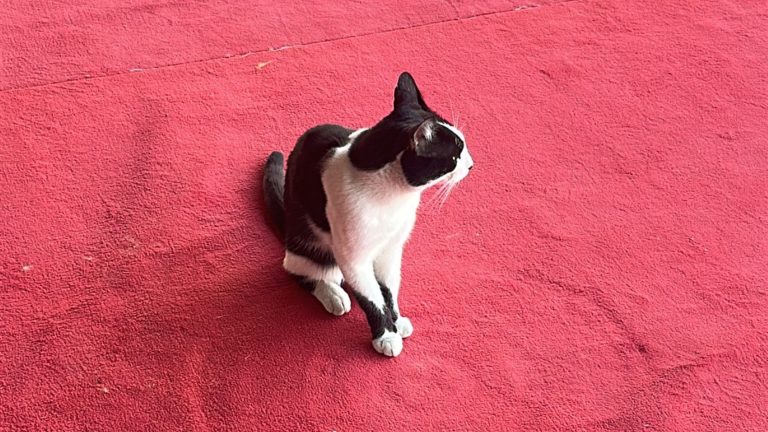
This morning I wander away from the main street to explore the bazaar and its surroundings, hoping to uncover a few of the town’s secrets. This part of Bitola, like much of the town, feels authentic and unspoiled. There is a real café-terrace culture, where people take the time to enjoy the day at their own pace. And throughout the stay I come across countless stray animals, mostly dogs, all of which seem eager to make friends with absolutely everyone.
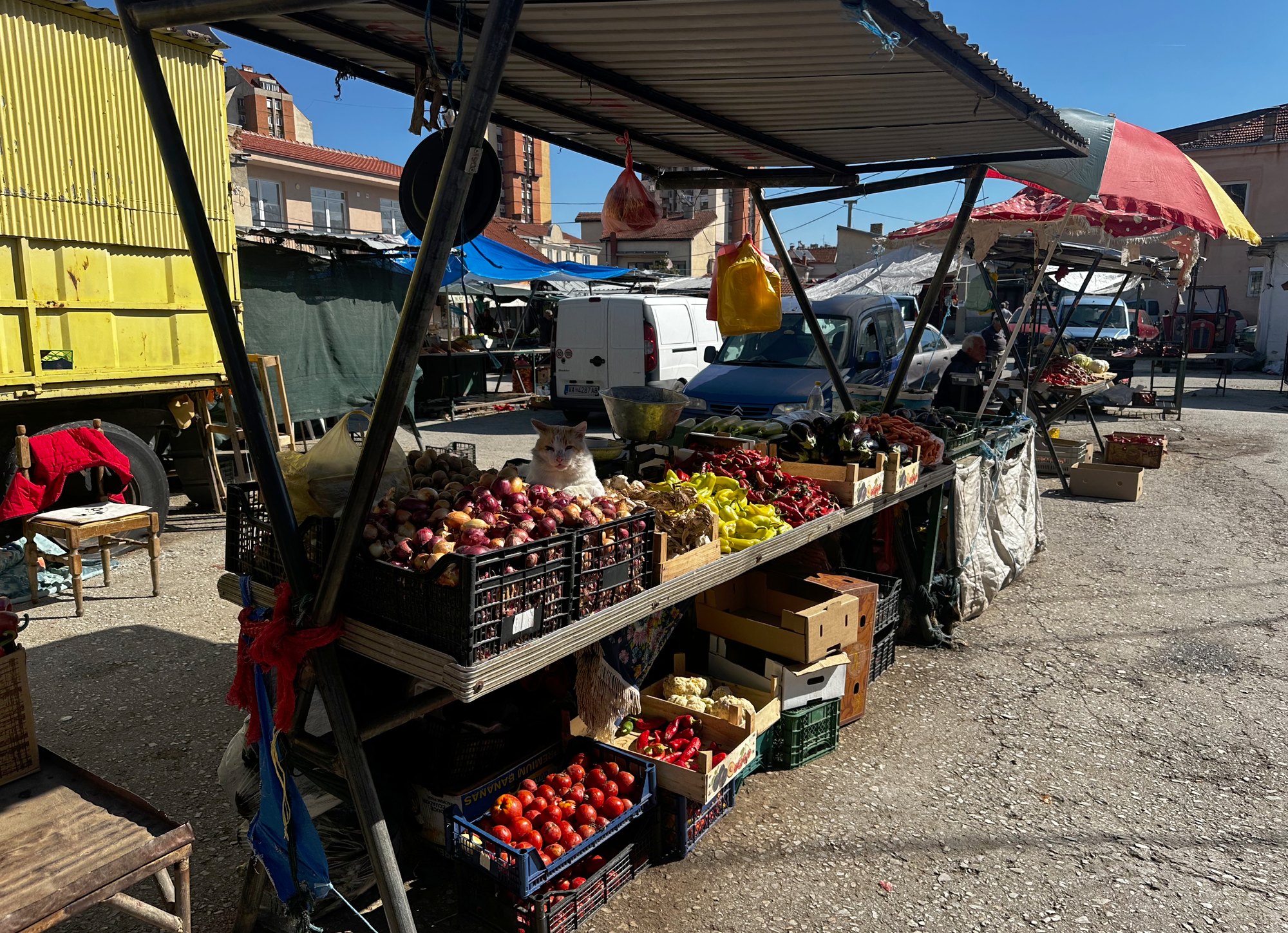
At the Bitola bazaar. Can you spot the cat?
Knowing your limits
At noon, the Women in Cinematography collective brings together six cinematographers for a round table titled “Mental Health, Limits & Conflict Management.” Hearing them describe their experiences, and how they lead their crews on productions of this scale, is fascinating. Their backgrounds and experiences are very different, but they all share a sound kind of pragmatism: each department is trying, in its own way, to get what it believes is best for the film, so common ground is almost always within reach. Still, they insist on the need to know your own limits and to have them respected. We all have them, and acknowledging them is as legitimate as it is necessary.
I walk out thinking that even at the more modest scale I work at, the logic is the same: everyone is looking for what they think is best for the project, and we have to be able to respect one another along the way.
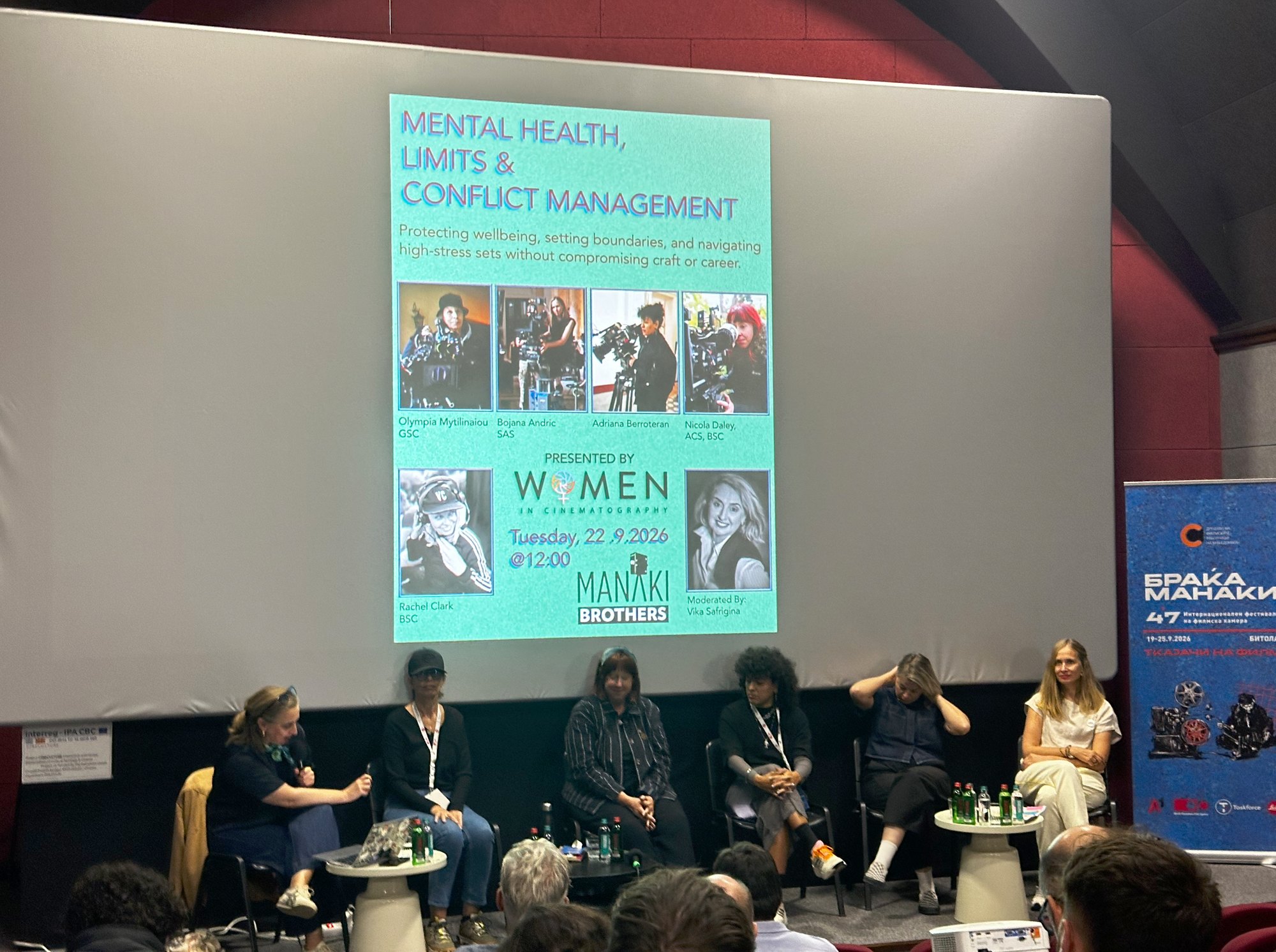
The “Mental Health, Limits & Conflict Management” round table, organized by Women in Cinematography.
We then meet for another long lunch, a chance to go back over the discussion together and talk about what each of us can do, and already does, at our own level when problems arise. Our work is done entirely with other people: understanding how they feel, how they think and what they need will always be essential to building healthier, more pleasant sets for everyone.
A son behind the camera
The transition to the next film is a little abrupt. Truly Naked, directed by Muriel d’Ansembourg and shot by Myrthe Mosterman, NSC, opens with a teenager filming his own father’s porn videos. So much for healthy sets… The film is hard to judge: to my mind it has major flaws, but it at least has the merit of opening serious and important conversations about patriarchy, masculinity and what becomes of them in the age of social media. Some scenes ring very true, especially those between the actress who appears most often in the father’s videos and the protagonist’s girlfriend: they speak to the possibility of breaking free from these norms and stereotypes. Those are the moments I will remember, even if I wish the film had gone further in that direction.
After the screening, I head off to explore the town again while the others scatter across various screenings. Bitola is small but has a lot to offer, above all thanks to its people, whom I find deeply kind and always happy to share their culture. You keep running into faces you have already seen, which quickly creates something familiar and reassuring, as in those small towns where everyone seems to know everyone else, more or less.
A house closing in
In the evening, I go to see an official selection film I had been eagerly waiting for: Queen at Sea, directed by Lance Hammer and shot by Adolpho Veloso, recently acclaimed for the visual power of Train Dreams. I have a rather funny moment with Marie, already settled in the theater after the previous screening, as I try to “sell” her the film when I arrive. With such a heavy subject, Queen at Sea is not the easiest sell. Juliette Binoche plays a woman who, together with her stepfather, has to make a series of extremely difficult moral decisions about the health and future of her mother, who suffers from severe dementia, decisions whose consequences end up spilling over into the rest of their lives. You may think you know this kind of story, but this one takes a rather different turn, which I would rather not reveal, even if the details are easy to find: the ethical questions it raises are very contemporary, gripping and difficult.
The film also follows the daughter of Binoche’s character as she forms new relationships in a new city, so that the story traces a kind of life cycle across several generations. The fact that it all takes place in London certainly shaped how I received it: I know the city well, I am very attached to it, and I rediscovered it with a lot of nostalgia through the filmmakers’ eyes.
Shot on 35mm, the film immediately has that texture we all love, and the density of color that only film can give. At first I wondered what had motivated that choice and, to be honest, I’m not sure I found the answer. But I quickly stopped asking, so intelligently does the cinematography serve the story. From the opening sequence, inside a narrow English house filmed entirely in static shots on sticks, Binoche’s character discovers something about her mother and stepfather that deeply shakes her. The compositions are strange: the characters seem lost, almost trapped in the corners of the frame, surrounded by large empty spaces, while the lines and perspectives of the house seem to close in on them. The approach stood apart from everything I had seen at the festival so far, and it conveys the characters’ unease very clearly.
This work on composition goes hand in hand with a restrained, cool and sober palette. In the kitchen scenes, the light follows the characters’ emotions: natural and dominated by daylight, it warms and softens for an intimate family dinner, then turns darker, denser and more contrasty when major upheavals strike. I really loved this film, despite a few inconsistencies in its visual language: the cinematography truly elevates the whole, in service of an already powerful story carried by some of the best performances I have seen on screen this year.
Day 5, Wednesday, September 23: Our round table
Another gentle morning, which I decide to keep a little for myself, simply to enjoy the sun. I probably need it: today is our big day, the day of our round table. We rehearsed the day before, fine-tuned what we wanted to say as best we could, and when I arrive I feel ready, if a little nervous, of course.
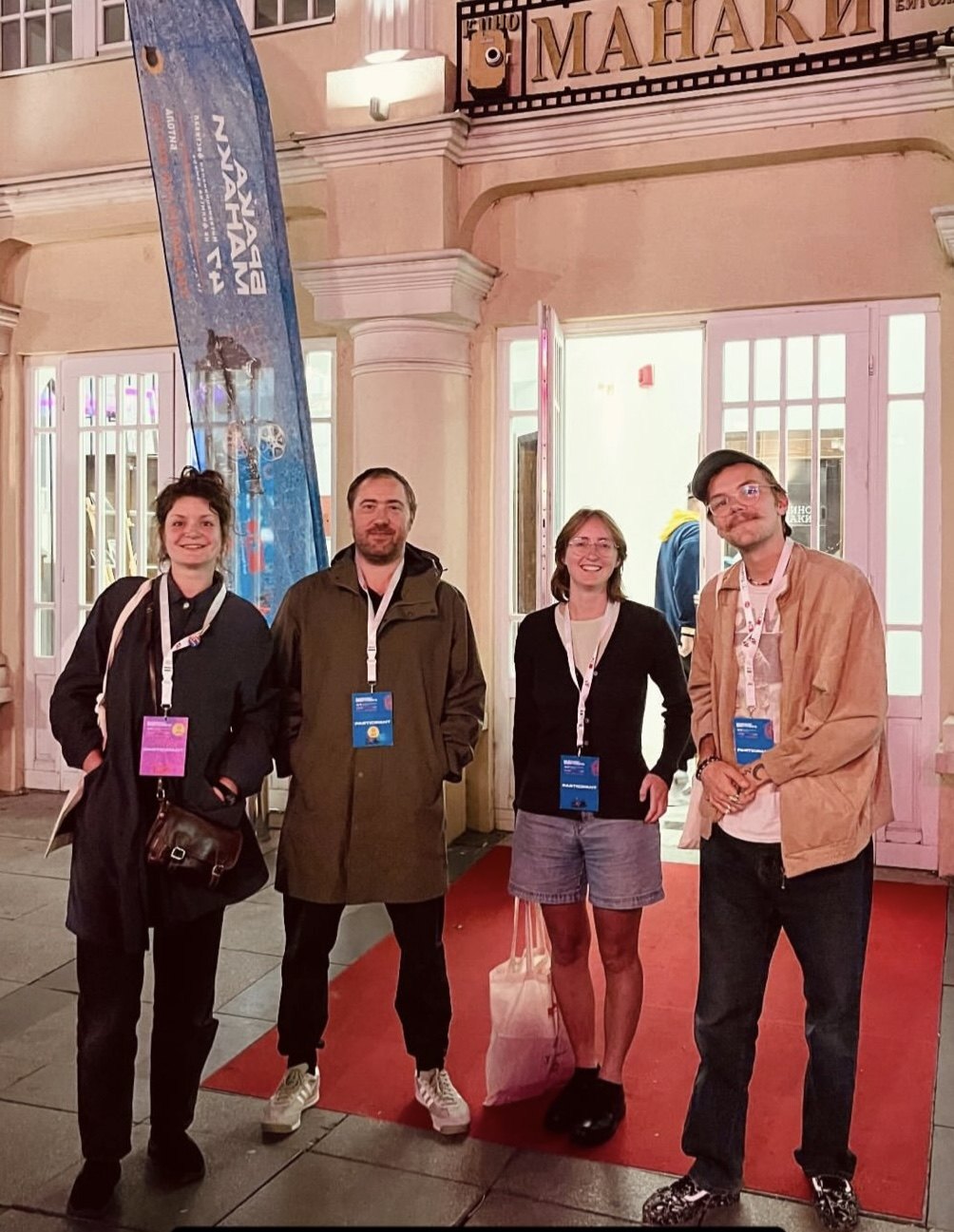
The UCO delegation outside the Manaki venue: Thomas Lallier, Charlotte Alma-Michel, Marie Mercier and Yvan Rodionov. Photo: rights reserved.
Speaking in front of an audience like this is completely new to me, but I feel well supported. Our round table, “Knowledge Talk: How Do You Learn, How Do You Teach?”, starts from two simple questions: how do you learn cinematography, and how do you teach it? Around the table are two professionals who also teach, Charlotte and Thomas, and two students finishing their master’s degrees, Marie and me.
The conversation flows very naturally for an hour and a half. We talk about our backgrounds, how each of us got to where we are, what you can’t really learn in film school, what teaching brings to practice, the balance between personal life and work… The audience is attentive and curious, and given everything we still have to say, we could easily go on for another two hours: the subject is almost inexhaustible, it opens up so many directions. We even have a rather special guest: Peter Zeitlinger walks into the room and tells us he now lives on a farm with his wife, where they look after their animals between shoots.
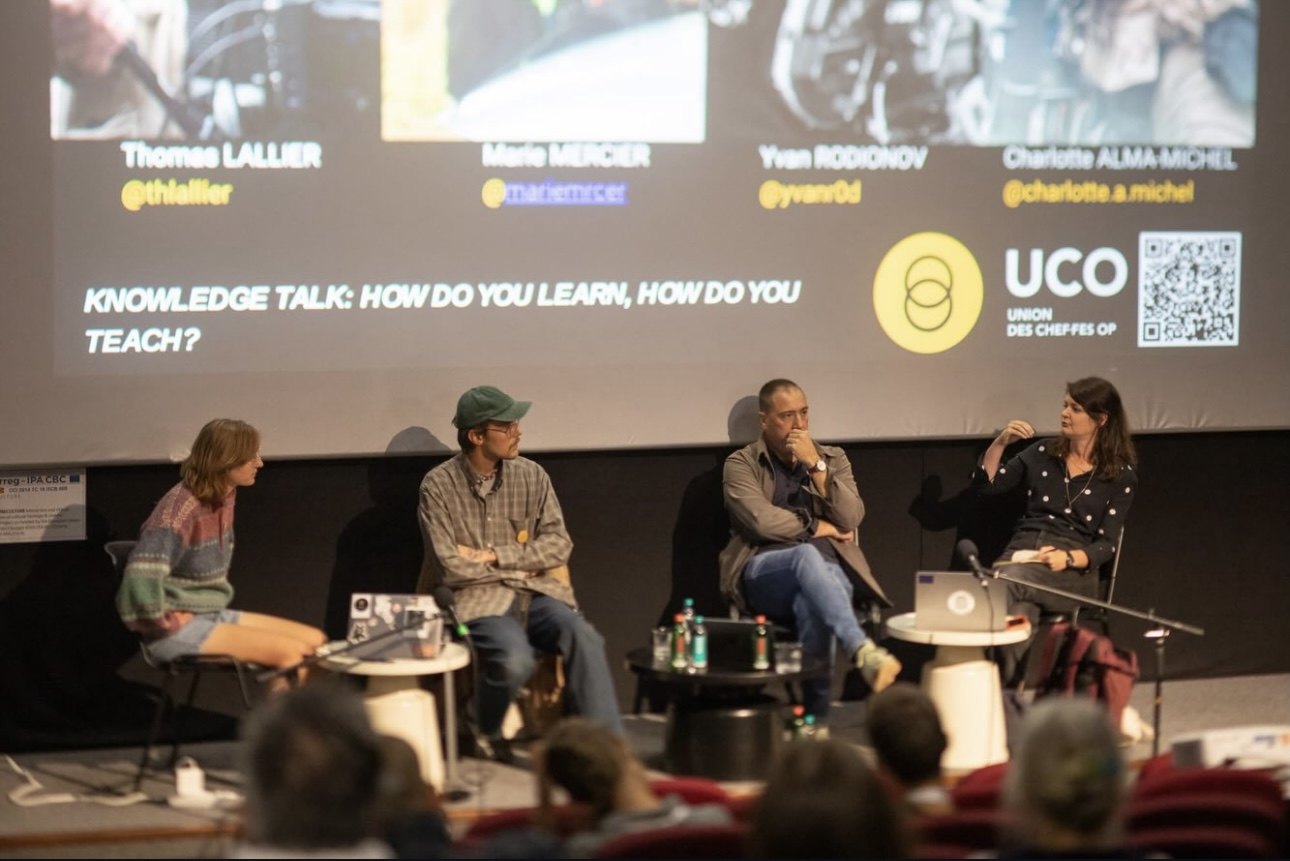
“Knowledge Talk: How Do You Learn, How Do You Teach?”, the UCO delegation’s round table, September 23. Photo: Manaki Brothers festival.
I think we are all pleased with how it went, that we managed to steer it the way we wanted and covered most of what mattered to us. In any case, I come away very happy, and grateful to have had this experience thanks to the UCO, the festival and our little group.
We celebrate over another lunch, where once again we lose all sense of time, as if we had finally adopted the Macedonian pace.
Peter Zeitlinger: the relentless camera
We then practically run to see the new film shot by Peter Zeitlinger, ASC, whom I admire enormously, especially for his long collaboration with Werner Herzog. He is presenting The Lost Son, by Darko Štante: an investigator reunites with his violent younger brother, and the two sink into a cycle of violence that seems already written into their history. It is probably the closest thing to genre cinema I have seen at the festival, somewhere between crime drama and thriller, steeped in film noir, a story that sticks to you like gum on the sole of your shoe. The narrative is extremely violent, the characters hard to like or to follow, and the structure almost predictable, since everything only gets worse. I leave the theater genuinely needing some fresh air: the film never lets up, which, in my eyes, is rather a compliment.
The story didn’t move me much, even though it rests on an original visual approach. The camera almost never stops, shifting from one position to another and panning briskly between actions and characters: the speed of these moves is what creates the intensity. They are sometimes deliberately unmotivated by the action, as if the camera were trying to catch the drama rather than follow the most natural gesture, which creates a strong feeling of breathlessness. Yet it all remains remarkably controlled, with a fluidity that at times recalls a gimbal, and it showcases Zeitlinger’s skills as an operator. It is not necessarily an approach that speaks to me personally, but it is entirely at the service of this contemporary crime story about violence passed down from one generation to the next.
A broken filter and blades of grass
We have barely started talking about it when Eva, a new friend and cinematographer from Zagreb, sweeps us off to the next screening: Until the Day Ends, selected at the Venice Film Festival and directed by a friend of hers, Jelena Maksimović, in her first fiction feature. Shot by Paul Spengemann, the film is set in Serbia, against the recent and very tense political backdrop that pits a government accused of corruption against a young generation in revolt. We follow a protester who falls in love with someone on the other side of the political divide. The film leaves many questions unanswered, and I felt some context was missing, to the point that I sometimes struggled to understand who I was following and what was really at stake. But it has a rare energy, the energy of a demonstration, of a riot, something frontal, almost aggressive, and precisely for that reason bold and refreshing.
It is a true cinematographer’s film, with a lot of style, sometimes at the expense of substance, and an impressive number of visual ideas, such as the broken filter placed in front of the lens, which produces one-of-a-kind flares. The image is dense: powerful colors, deep blacks, lots of contrast. It looks almost torn, heavy, dirtied. The compositions are often striking: the camera loses itself with the characters in near-total darkness, or a perfectly locked-off frame suddenly switches to handheld in a split second. The last shot, a long zoom take that gathers a multitude of moving elements in a large field, is one of the most visual ways I have seen this year of expressing a complex situation without a single word. Here again, the shot takes its time, sustains the tension, and the camera sometimes chooses to focus on a few blades of grass rather than tell us clearly what is happening. A very inspiring film to watch, bold in its approach, even if it is a shame the story is not always strong enough to carry all that atmosphere.
The manufacturers’ dinner
The evening continues at the dinner hosted by the manufacturers present in Bitola, including RED, Zeiss, Rosco, Leitz, ARRI and Sony: a chance to meet more people and talk about the future of the industry, the direction it seems to be taking and the tools that may soon be coming our way. The Sony team lets Marie and me play for a while with the brand-new FX5. We have fun trying to see in the dark thanks to its impressive range of high sensitivities, before being shown a prototype of the Rialto 65, the 65mm sensor block in development for the Venice 2. Some really great moments, where we finally let out the gear geeks we truly are deep down, get to know our favorite toys better and, along the way, put our technical knowledge to the test a little.
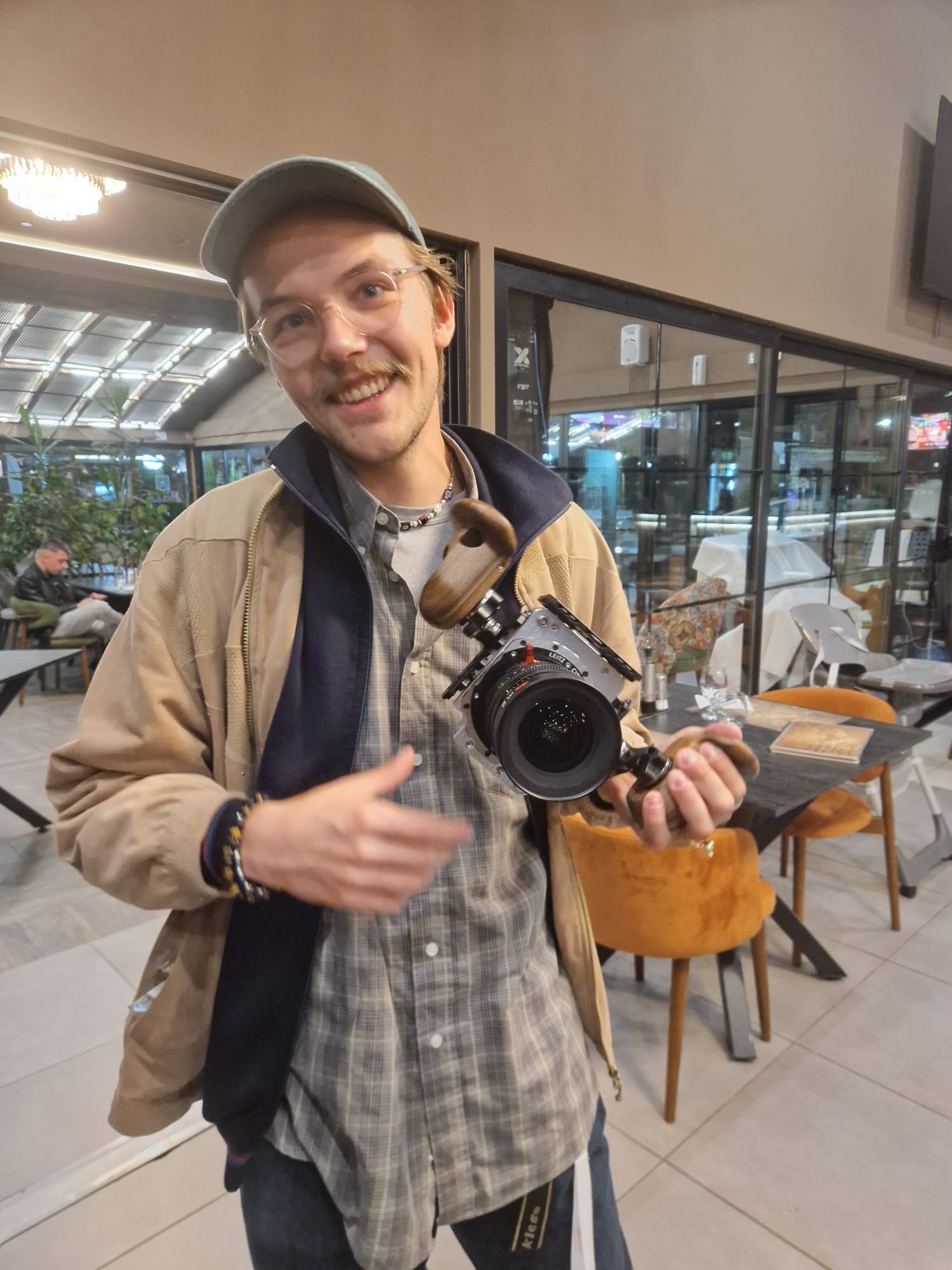
Yvan Rodionov at the manufacturers’ dinner. Photo: Marie Mercier.
Day 6, Thursday, September 24: Magic hour
Last day in Bitola. I start my goodbyes by going back to the bazaar for the souvenirs I spotted two days earlier: hot peppers in a plastic bottle, honey, a bag of spices and a few small gifts for my loved ones. We are surely not the first to do this, but picking the funniest possible fridge magnet remains one of the great pleasures of my travels. I leave delighted, with everything I needed.
I then join the team for the AFC masterclass devoted to magic hour, “Shooting the Magic Hour.” It is led by three of our French-speaking colleagues: Jean-Marie Dreujou (AFC, ASC), Juliette Van Dormael (AFC, SBC) and Tommaso Fiorilli (AFC, SBC). The session, very structured and very rich, moves from a genuine little science lesson to very specific field examples: how to prepare, plan and work around obstacles to make the most of that very particular light and atmosphere. Thomas Lallier has produced a detailed transcript of it.
We come out with our heads full of ideas. Thomas and I then spend a long while with our friends from Zeiss before having lunch with them: a lovely way to begin saying goodbye, talking at length about their vision of the future, grounded above all in their hands-on experience of the craft. Then we meet up with Marie and Charlotte over a few local beers, set on UCO coasters, to talk about the films they have just seen. Marie and I leave quickly: we are determined to see Krakatoa, which several friends have told me about.
A fisherman facing the volcano
Directed by Carlos Casas and shot by Benjamín Echazarreta, this half-fictional story opens with a text that sets the scene: its hero, a young Javanese fisherman living alone on his bagan, a bamboo fishing platform, will have to survive the eruption of Krakatoa. It had been a very long time since I had had such a powerful cinema experience. The film is entirely sensory: the soundscapes and the images that unfold slowly, often at the sole pace of the fisherman’s gestures, reach a kind of transcendence. It is one of those films I would rather say very little about, and that everyone should discover in a theater.
Its form gripped me: above all, the film documents how small and fragile we are in the face of a nature that can so easily swallow us. The character’s journey is magnificent to follow as he sinks deeper into a world that itself seems increasingly unreal. Entirely artificial colors end up flooding the spaces; every place seems alive, crossed by incredible textures that almost take over the screen. I am deliberately staying vague, simply to make you want to discover this absolutely incredible work of cinema. The film truly left me speechless.
Marie and I leave the theater completely elated by how unique the experience was. I could hardly have dreamed of a better way to end my time as a spectator at Manaki.
Goodbye, Bitola
One last drink with my new friends from the UCO, to say goodbye to what will remain a special, precious week for me. I am deeply grateful to have discovered everything a festival can offer, starting with that very simple feeling of being connected to one another through our small shared niche: images, and the way they are made. It also reminds you that you are surrounded, and never really alone in this profession. I hope to see all these faces again, and Bitola too, much sooner than we imagine today, and that our shared passion for cinematography will give us many more chances to meet again.
Photos: Yvan Rodionov, unless otherwise noted.