The UCO delegation to the 47th Manaki Brothers International Cinematographers’ Film Festival, held in Bitola, North Macedonia, from September 19 to 25, 2026, brought together two professionals who also teach, Thomas Lallier and Charlotte Alma-Michel, and two students finishing their master’s degrees, Marie Mercier and Yvan Rodionov. Yvan kept a diary of those six days. Part one, from Saturday, September 19, to Monday, September 21: the opening ceremony, the talks by Dan Laustsen and Jeff Cronenweth, and the round table with Janusz Kamiński and Timo Salminen.
Day 1, Saturday, September 19: Arriving in Bitola
After half a day of travel, through Serbia and Skopje and on to Bitola, I finally get a chance to take in everything that has just happened to me. North Macedonia is a country I had never had the opportunity to explore. It keeps a low profile on the crowded map of Europe, yet just through the window of the minibus taking us to this small town, closer to the Greek border than to the capital, I discover beautiful landscapes of mountains and remote villages, with a certain peacefulness about them. Already, the experience is full of charm.
I have always found it rather extraordinary how cinema manages to bring people together, especially in the places where you least expect them to gather, like here, in a picturesque town of some 70,000 inhabitants.
When I finally meet up with Marie Mercier, who, like me, is finishing her master’s degree, we compare notes on how we each got here. She tells me how she backpacked through several neighboring countries, with a stop at Lake Ohrid. We quickly pick up our tickets for the opening night, then walk the red carpet, slightly underdressed, but with plenty of laughter.
The opening ceremony
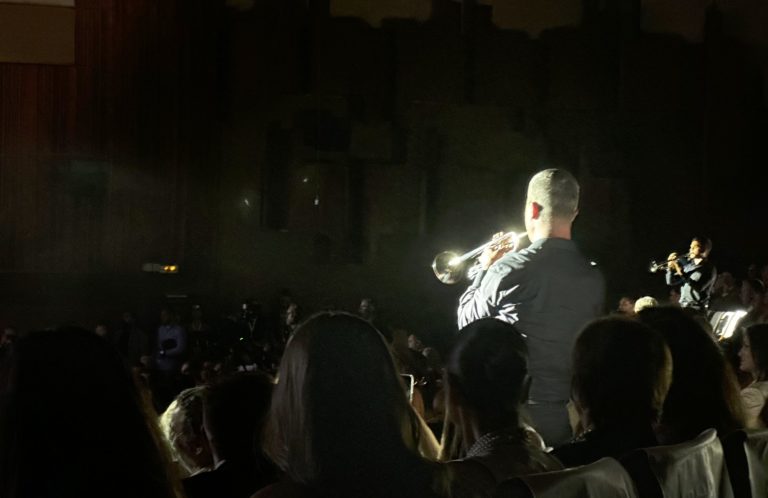
We take our seats for a truly beautiful opening ceremony. I had never attended one before, so I had nothing to compare it with, but I certainly did not expect an orchestra of this caliber, with musicians spread throughout the auditorium rather than confined to the stage, playing a string of classic film themes, joined by a choir.
The musical opening is followed by the Golden Camera 300 awards: to Dan Laustsen, ASC, DFF, for lifetime achievement; to Janusz Kamiński, who finally collects the award the pandemic kept him from receiving in person in 2020; and to Jeff Cronenweth, ASC, for his contribution to the art of cinema.
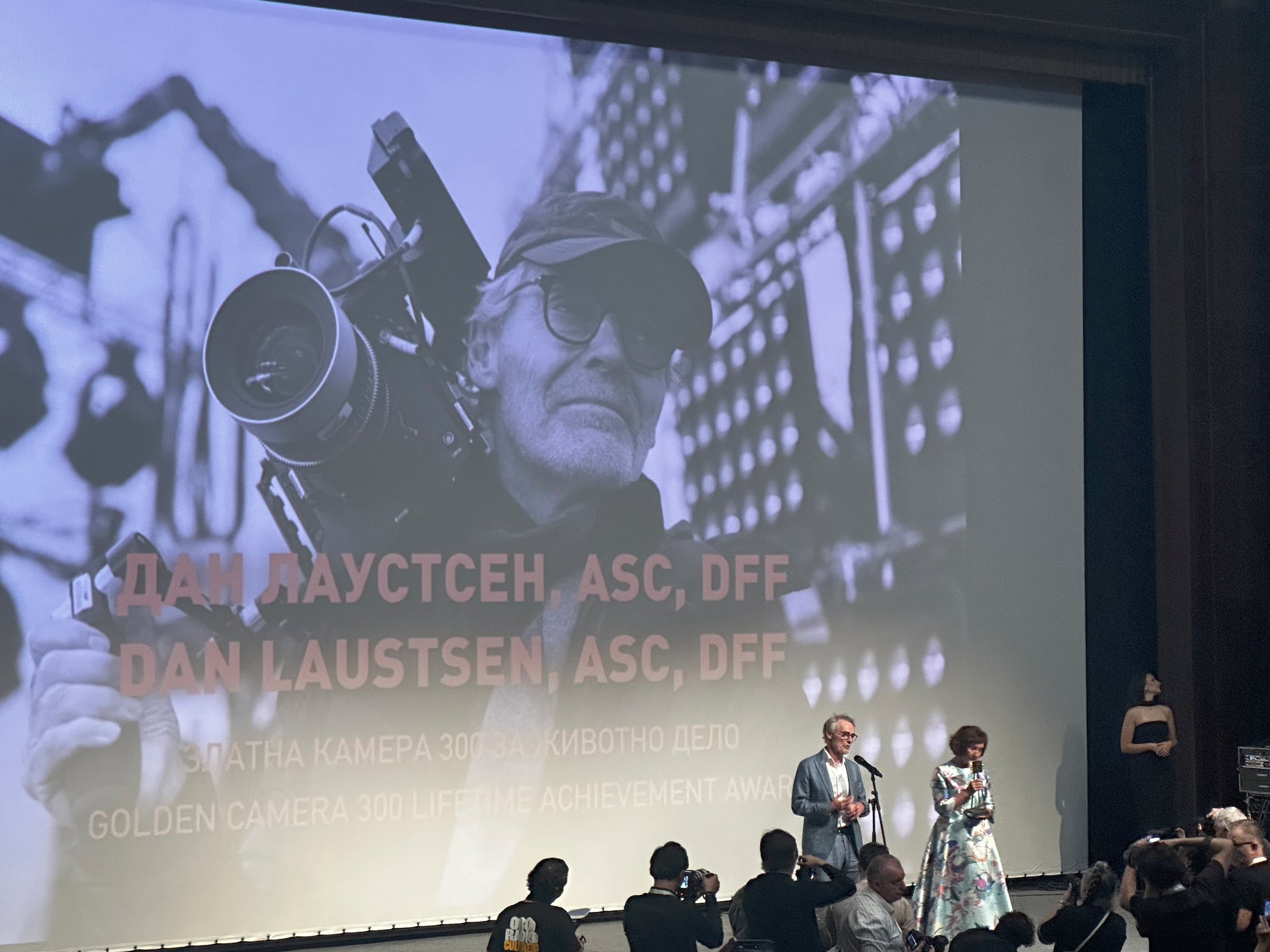
Dan Laustsen receives his Golden Camera 300 from Gordana Siljanovska-Davkova, President of North Macedonia.
Being in a small town quickly takes the edge off the starstruck feeling I expected to have seeing these cinematographers on stage, or simply being in the same room with them. The atmosphere in Bitola is actually very open, far from the world of flashbulbs and prestige. You easily end up talking to just about anyone.
But perhaps that also comes from the temperament of many cinematographers, and of those who aspire to become one: people who often prefer to hide behind a camera and speak through it.
The opening film
The festival’s opening film was Skateboarding Is Not for Girls, directed by Dina Duma and shot by Frédéric Noirhomme, SBC. This Macedonian film, shot in Skopje within a Roma community, tells the story of two sisters trying to resist the traditions and patriarchal rules of their world.
The younger one, Adela, wants to win her school’s skateboarding competition, hoping it might stop her mother from forcing her older sister, Zara, to marry a richer man, after the family discovers that the father has abandoned them, leaving them in poverty and surrounded by lies.
Up close with the characters
I felt lucky to discover a film from a culture I know little about. For me, that is precisely the point of going to festivals abroad: discovering films you might never have had access to otherwise, but which deal with subjects that can move anyone, anywhere in the world.
It is always heartbreaking to watch deeply bonded families suffer from traditions and norms they are trying to break free from, and from all the injustices that follow.
The cinematography serves this idea with precision. The camera is mostly handheld, in a near-documentary approach, with very natural light. Even when the lighting is shaped, everything is done to make it feel organic and almost invisible. Above all, the camera seeks to depict reality truthfully, staying as close as possible to the characters’ emotions and journeys.
The documentary feel is pushed even further with vertical shots filmed on a phone when Adela prepares for the competition, a visual language that makes the film more accessible. There are also many beautiful wide shots of the group and the family, always handheld, with an intimate intensity that makes you want to keep following these characters.
The shot that stayed with me comes just before Zara’s wedding, when she is gathered with her friends, far too young to be witnesses at her marriage. Through its intimacy and the softness of its light alone, I felt a strong contrast in this moment when they all find themselves in a situation imposed on them, one they never wanted and whose significance they do not grasp. They look excited about the celebration ahead, yet frightened of what it will bring.
The film was a fine way to open the festival. It let everyone take the measure of where they were, while giving an immediate sense of what the festival stands for: making room for different voices, different sensibilities and different forms of creation.
Day 2, Sunday, September 20: Dan Laustsen’s light
After a peaceful night and a quick coffee, I head straight to Dan Laustsen’s masterclass. The morning is particularly rich. I always enjoy listening to professionals talk about their careers and experience, even if the same little thought often crosses my mind: their definition of a “small budget” is no longer quite the same as ours! But in the end it is only a matter of experience and scale. Deep down, our craft remains the same: we pursue the same intentions and tell stories that touch and move us, in a visual language we invent together, simply with different means.
Laustsen begins with his career, his first steps in the profession and the Danish film industry of the time. He advises us to always keep taking photographs, to hold on to that discipline as a way to keep improving, while leaving ourselves free to search for and develop our own style.
As you might expect, he talks at length about his collaboration with Guillermo del Toro: how it began, how it grew, and above all what matters most in that very particular bond between a director and a cinematographer. He stresses the need to share a common vision, and to build the relationship on affection, respect and passion. The personalities, like the stories they tell together, must eventually merge into a single gesture, a single interpretation of the story.
On the technical side, he walks us through his approach to light. He almost always favors a single source, for the way it sculpts faces and makes the image more dramatic. Very little fill: he prefers to move his key light or make it bigger.
Working with production designers, especially on del Toro’s films, he often chooses to light from outside the sets, leaving the actors and the camera as free as possible. This matters all the more because camera moves in those films are frequent and complex. Hence his reliance on DMX consoles, which let him vary the intensity of different sources as the camera travels through the space.
Jeff Cronenweth: digital, exposed like film
After a short lunch break, Marie and I head back for the talk with Jeff Cronenweth. Like Laustsen, he has built a long-standing collaboration with a filmmaker whose visual world is instantly recognizable: David Fincher. He recalls his beginnings in music videos, at the height of MTV, up to the day he found himself on set with Fincher. He describes their collaboration as a true partnership, fluid, almost magical, so naturally do their sensibilities align.
Fincher knows the post-production pipeline inside out, and that mastery, Cronenweth explains, creates a favorable dynamic on set: the director can support his cinematographer and help him get the images the story needs. Cronenweth then talks at length about digital capture and the control it gives Fincher. Somewhat ironically, he says that to this day he still sets his exposure as if he were shooting film, always sticking to a single LUT. It gives him a more reliable read of what he is seeing, helps him spot problems faster and keeps his way of working consistent.
In the same vein, he challenges the idea that digital is necessarily cheaper than film. Digital may seem simpler, but it sometimes requires a bigger crew to handle the technical chain; film is expensive, but it can allow smaller crews and shorter shoots.
Eyes too blue
Right after, Marie and I attend the screening of a major European co-production set in Greece which, like the previous day’s film, deals with tradition, but in a more fantastical and metaphorical register: The Boy with the Light-Blue Eyes, directed by Thanasis Neofotistos and shot by Djordje Arambasic. Petros, a young boy, believes he is cursed because of his eyes. The belief is imposed on him by his possessive mother, by his domineering grandmother and, more broadly, by the whole village. Together with his best friend, he sets out to question the norms, traditions and beliefs of his community.
The story and characters moved me less personally, but I am very glad to have discovered a film like this one, wholly original in the way it builds and tells its world. With great simplicity and subtlety, the filmmakers have crafted a very particular point of view around this boy who lives with a mask over his eyes. It is precious that films like this exist.
The cinematography plays a lot, and simply, with depth of field to isolate Petros in his own world. It is striking from the big wedding scene at the start: the intensity of the close-ups almost makes the celebration seem to pull the characters apart rather than bring them together. Everyone expects something different from the moment; some want to control it, others to escape it. The handheld camera conveys this cleverly, easily isolating each person in the frame, then almost entirely giving up group shots toward the end of the scene.
A few dreamlike underwater shots left a particular mark on me, for the magic with which they give shape to the film’s metaphors. They come when Petros loses himself beneath the surface of a lake, overwhelmed both by the possibility of escape and by the lies he has lived with until then. I would rather not reveal more about what they show or where they fall in the story, but they are well worth discovering.
The student shorts
We finally catch up with Thomas Lallier and Charlotte Alma-Michel, the other half of our delegation: a missed connection cost them an entire day in Belgrade. Together we watch a selection of student shorts from North Macedonia, France, Spain, Lithuania and Germany. It is the Lithuanian film Past the Hill of Napoleon’s Hat, directed by Arnas Balčiūnas and shot by Milda Juodvalkytė, that will go on to win the Crystal Camera 300 in the student competition. Shot on 16mm, a first for its cinematographer, the film has a strong visual identity, cold and observational. It portrays the silent bond between a father and his son, and ultimately says a great deal about our own inability to express what we feel. The stillness of the camera heightens the restraint between them, as if that immobility embodied their inability to take the step that would break the ice and give them back something of what they once were to each other.
As a cinematography student, I find this selection particularly stimulating: it shows what other students across Europe are doing, the stories they choose to tell and the visual means they use to tell them. Naturally, it is almost impossible not to compare their work with mine. All of these films offer interesting, accomplished images in the service of stories strong enough to stay with you.
Day 3, Monday, September 21: Janusz Kamiński and Timo Salminen
As on the previous day, things start slowly. Bitola gradually comes to life ahead of the round table “Finding New Ways into the Audience’s Heart and Minds,” moderated by Matthias Fleischer, which brings together Janusz Kamiński and Timo Salminen, FSC.
The dynamic between the two cinematographers makes the hour and a half particularly entertaining: on one side, Steven Spielberg’s longtime collaborator, with an assertive, not to say forceful, personality; on the other, Aki Kaurismäki’s cinematographer, far more reserved and calm. Their approaches, their styles and above all the very different scale of their films fuel a fascinating discussion about how they tell stories, and about the balance to strike between visual style and narrative.
They look back on their long partnerships with these two great filmmakers, to whom each has given a great deal, then the conversation drifts to other directors: what made them decide to work with them, and how images can accompany, even guide, a story. Kamiński dwells on The Diving Bell and the Butterfly and the balance he had to find with the film’s very strong visual concept. He describes several unusual techniques used for those images, including a hand-cranked camera that let him play directly with the frame rate and make its variations part of the storytelling. Salminen, for his part, talks about films he shot in Argentina. He stresses the importance of story and script, and the trust a cinematographer must be able to place in the director he works with.
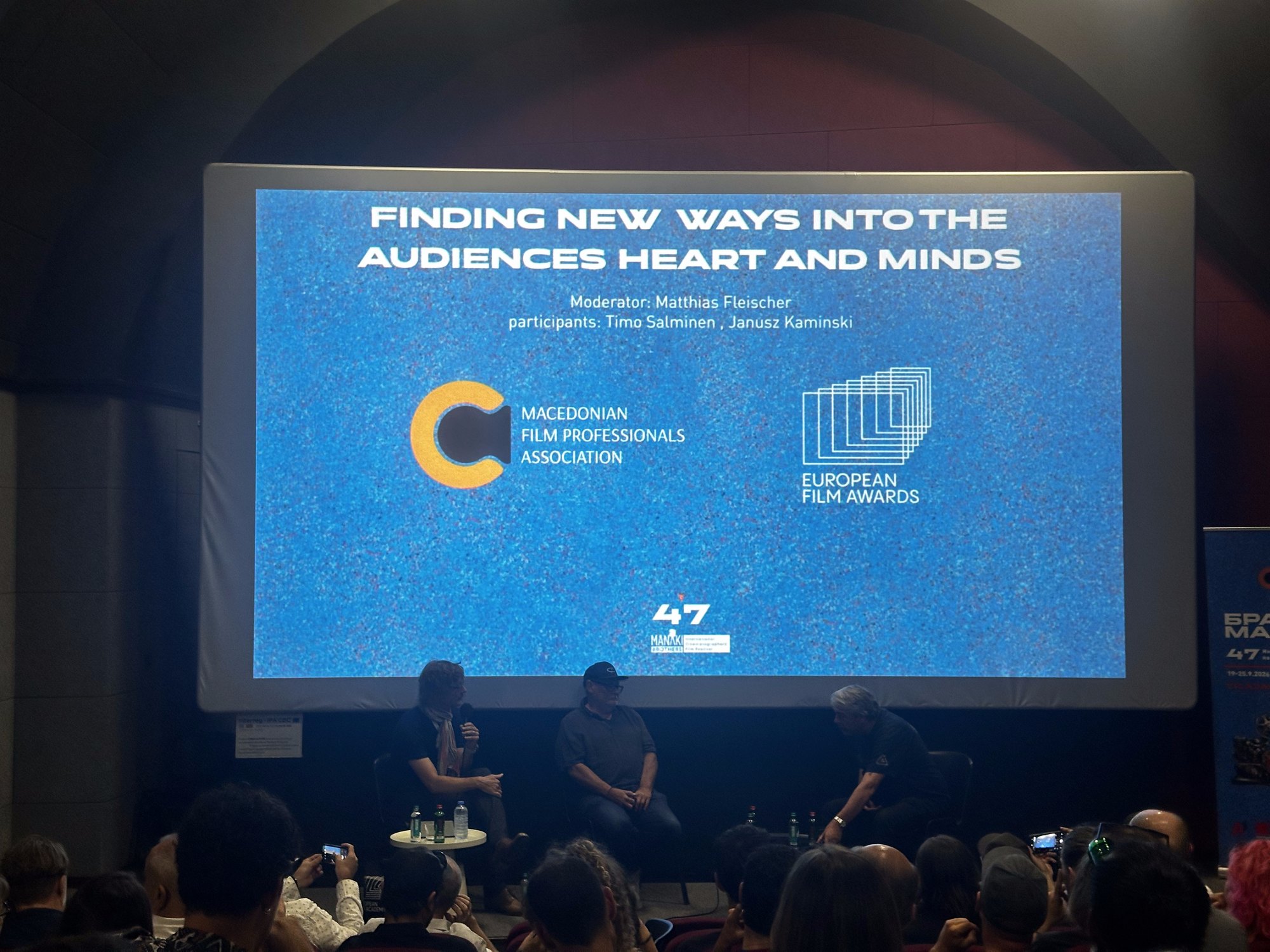
Janusz Kamiński and Timo Salminen at the round table moderated by Matthias Fleischer.
The four of us then set off to find something to eat, and a torrential downpour catches up with us. We are not alone in weathering it: a few new friends have joined us, along with, and not the least of them, a little cat that came to keep us company. Despite the rain, the atmosphere of the festival keeps carrying me along. Since I arrived, I have felt a remarkable momentum, no doubt coming from the people I am sharing the adventure with, but also from the simplicity of the place and how naturally the festival fits into the town.

Keeping us company in the rain: a future member of the Union?
Lighting a space rather than marks
Carried by that momentum, I don’t want to waste a minute. To escape the rain, I follow my instinct and walk into the first screening I come across: Black Money for White Nights, by Kristina Grozeva and Petar Valchanov. An elderly couple has saved for years to fulfill their dream of seeing Saint Petersburg and its famous White Nights, only to watch the whole plan collapse when the war in Ukraine begins. Their relationship and their convictions are gradually put to the test, as the shell they have built around themselves over the years begins to crack. The film is a real surprise: despite a few shortcuts in the writing, it keeps me on the edge of my seat from start to finish and keeps heading in directions I did not expect.
I later learn from the cinematographer, Alexander Stanishev, that the shoot relied heavily on improvisation, to the point that several different endings were filmed. Having worked in settings where improvisation played a big part myself, I recognize a lot of myself in this way of working, and I am lucky enough to chat with him for a while about how he prepared for this kind of staging. His answer is simple: his documentary background taught him to light spaces rather than specific marks, while still steering the actors toward the most visually interesting spots. And the trust he shares with the directors gives him enough freedom for his own visual language to come through. What I take away above all is that mutual trust, and the idea of lighting a set with enough control for it to become a stage capable of welcoming the unexpected.
And you can really feel it on screen. The cinematography, very colorful and saturated, contrasts with the gravity of what is happening within the couple, like a heightened reality. The handheld camera keeps something of documentary and anchors the characters in the real world, while the warm tones paint a world more beautiful than it truly is. Like a postcard slowly beginning to fade.
This is exactly the kind of film that, for me, makes festivals so beautiful. I walked in expecting nothing and came out feeling that an original idea, even one made with limited means, can become a beautiful film when it is driven by genuine intent and a shared belief in the project.
I go to bed happy, fulfilled by the day, and above all with a stronger desire than ever to create and make films.
The story continues, from Tuesday, September 22, to Thursday, September 24, in part two of this diary.
Photos: Yvan Rodionov.