D’Ocre et de Suie (literally, “Of Ochre and Soot”), a short film by Romain Grésillon.
The film is set in the Upper Paleolithic and tells the story of a rivalry between two brothers. In this particular arena, there are only two light sources: the sun and fire.
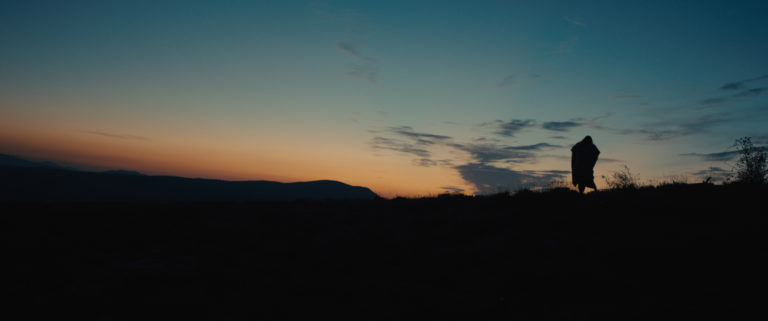
The unique challenge of this shoot was to create images with strong intentions while keeping the method pared down, as the director and I both wanted, but also as the shooting conditions demanded: you have to walk a lot, and far, to find a place where a wide shot on a 25 mm lens reveals absolutely no trace of the modern world.
Naturalism doesn’t particularly interest me. I don’t try to reproduce what I have in front of me on set; my aim is rather to create an image that conveys a strong, true intention, even if that means betraying reality in order to rebuild it better. So there was no question of simplifying the setup so much that it disappeared…
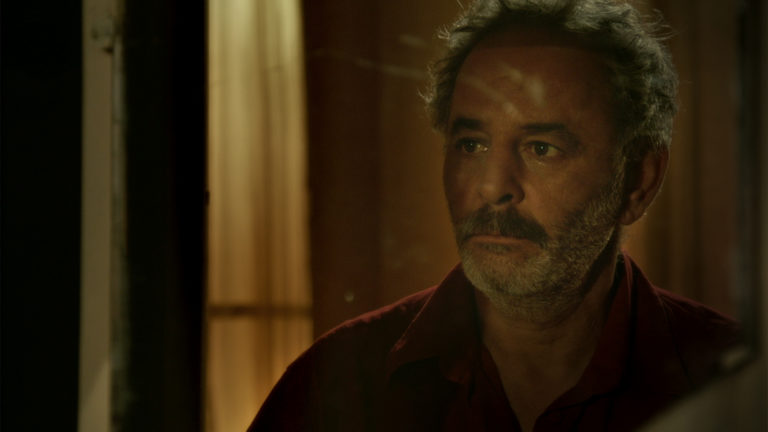
The lighting on set was built around several principles worked out in advance with the director. The first was to light entirely without electricity. So we chose to light the whole film with “paleo-compatible” sources: stone lamps made by the art department, torches held by hand off-screen by the gaffer, Jean Riou (who became chief pyromaniac for the occasion), and makeshift sources built from double-wick candles and aluminum foil. The main sources were often visible in frame, and the density of the shadows on faces was controlled with a handheld fire source next to the camera, sometimes diffused to slow the flicker and soften the light, sometimes not. Since we were after a dense, contrasty image, the hardest but truest choice was sometimes simply to resist the temptation to add light.
Second, I had asked my gaffer to paint poly boards in different colors matching the landscape we were filming. In nature, shadows take on the colors that surround them. Sunlight bouncing off grass takes on a green tint, which is very visible in summer landscapes. To me, it made no sense to bounce light with a white reflector; it had to be done through green, brown, or blue, to reproduce the richness of nature’s colors. Poly boards of different sizes had been prepared, and we often used them, rather than simply to fill in the shadows, to create a second direction of light, usually opposite the sun. That way, the characters were tied back to their environment, their faces echoing the nature around them.
Finally, when the natural light was too diffuse, we used negative fill to increase the contrast and reinforce the directions of light I was interested in, flatly refusing omnidirectional light, even under overcast skies. The actors’ faces, all very photogenic, had to be shown off with all their roughness and relief, so there was no question of smoothing out the slightest wrinkle or distinctive feature.
I chose to shoot the film on an Alexa Mini with Zeiss Super Speed lenses. I was looking for a camera and lens combination that could render the textures of the sets and costumes in detail, without losing a single hair of fur. That is also why I didn’t use any filtration. For texture, the film was shot entirely at 2000 ISO (which meant constantly having NDs in front of the camera), and grain was added in post-production. The color temperature was set to 4000K to cool the image slightly, which was then offset by a film LUT that warmed the whites, so as to get an image with a cool tone (especially in the midtones) without giving the impression of a “blue tint.”
Ultimately, the image had to bear the constant imprint of an omnipresent, overwhelming Nature. That is why, to go with this shooting approach, we graded the film with an emulation of bleach bypass processing, further accentuating the already very strong contrast of the original photography and making the colors less welcoming. The resulting look is colder and more hostile; it hardens faces and deepens textures. Perfect for a film that puts humankind at the mercy of Nature.
D’Ocre et de Suie, by Romain Grésillon.
Produced by Les Films de l’Autre Cougar.
Director of photography: Maxence Muller – IG @mullermaxence.
Colorist: Guillaume Schmitter – IG @guillaume_schmitter.
Gaffer: Jean Riou – IG @jeanriou.
Shot on Alexa Mini / Zeiss Super Speed.