Michele Gurrieri, a member of United Cinematographers, recounts the thinking about the image that he and director Laure Desmazières shared ahead of the shoot of her fiction short Zaïna46 (Haïku Films, 22 min, color, France, 2018).
Michele Gurrieri, cinematographer, and Laure Desmazières, director and screenwriter, met at La Fémis (class of 2010). Zaïna46 stars Djemel Barek, Foëd Amara, Baya Belal, and Julia Perazzini. The film was pre-bought by France 3 and won the SFCC Critics’ Award at the 2018 Grenoble Open-Air Short Film Festival, the Best Screenplay Award at the 2018 Court en Scène festival, and the Best Actor Award for Djemel Barek at the 2019 Lille International Short Film Festival.
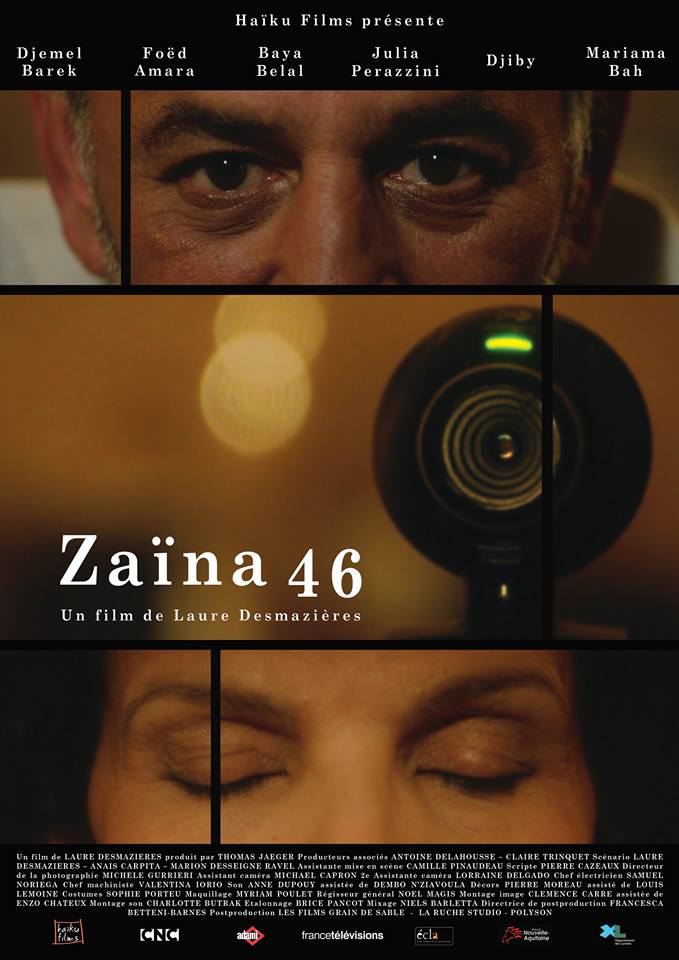
©Haïku films
Laure Desmazières’s film Zaïna46 grew out of an encounter she had as a student. Abdel, an undocumented Algerian man in his fifties, was then working as a handyman in a bar-hotel in Paris’s 20th arrondissement. He could not go back to Algeria to see his wife, whom he phoned every day, when he discovered Skype. The software allowed him to see his wife again. The film imagines the consequences of this virtual reunion: long-buried desire, suppressed by Abdel, violently resurfaces, and his heartbreaking loneliness is laid bare.
Zaïna46 was produced by Thomas Jaeger of Haïku Films and financed by the Nouvelle-Aquitaine region and France 3. It was shot in 2017. The film posed many challenges in terms of image and staging: it is a chamber piece set in 2006, with foreign characters from different, though French-speaking, cultures, and the computer is at the center of the entire second half of the film, with a long Skype conversation that forms its dramatic climax.
Framing, with the choices it involves between off-screen and on-screen, whether in terms of narrative and psychological stakes for the characters or of staging possibilities, was a key factor for the film. The question of aspect ratio also came up quickly: computer screens at the time were still largely 4:3, and the film’s key scene takes place around a computer screen. Would we show the Skype conversation full screen, or film the screen with a foreground element in frame? So what was the right aspect ratio? Widescreen ratios (1.85, 2.39) were ruled out immediately as inconsistent. After ruling out 4:3, too stifling for a film that was already a chamber piece and making it hard to place foreground elements in front of a screen, we considered 1.55 (the ratio of 24×36 still photography, which seemed consistent since the images draw heavily on the work of various contemporary photographers), but after tests on location we opted for 1.66, an aspect ratio found in many European films of the 1970s and 1980s, which we had already chosen for Laure’s previous short, Noche Flamenca.
Screens and thresholds are everywhere in the film, and they signify isolation: the bar’s blind that Abdel raises at the beginning of the film, revealing Anna, a regular and an unattainable young woman; the serving hatch in the door separating the kitchen from the bar room; the hotel corridor, whose doors each enclose a solitude; the wall through which Abdel hears, at night, a woman moaning, perhaps from a porn video, perhaps imagined, and through which the camera passes to reveal the object of Abdel’s desire: a caress from his wife, desire, skin-to-skin contact.
The Skype call between Abdel and Zaïna, which takes up a third of the film, raised many questions: would we play it live, with what system, over a real internet connection or a local network, with what interface for the software (we were supposed to be in 2006)? What was the best system to give the actors as much freedom as possible, without technical constraints, while avoiding network glitches? After weighing the options, we went with the simplest: a real-time call on an actual Skype platform (production designer Pierre Moreau had managed to install an old version) over a closed Wi-Fi network. Since this is a chamber piece, the work on the set was fundamental; moreover, Laure’s directing relies heavily on the set to convey the relationships between the characters and shape their interactions. We had first thought of building a set in a studio, but production constraints forced us to give up on that. Before we had even found a production designer, Laure and I scouted locations in Seine-Saint-Denis, visiting hotels frequented by foreign workers, very similar to the hotel in Paris’s 20th arrondissement where the real Abdel worked, which has since been turned into a trendy café. Since the Aquitaine region had financed the film, the shoot had to take place in the Landes department. So we had to find a run-down Paris-area bar-hotel… in a tourist department in the southwest!
The bar was relatively easy to find, in Mont-de-Marsan: a bar next to the bullring, with somewhat old-fashioned architecture, offered a space that matched our staging ideas (a kitchen connected to the bar room through a door with a serving hatch, a long room separating the entrance, fitted with a blind, from the counter, picture windows with blinds that let us create semi-darkness…). It worked very well thanks to the essential work of production designer Pierre Moreau (building a hinged door with a serving hatch to separate the bar room from the kitchen, shrinking the room by blocking off access to the restaurant’s second dining room, hiding the way to the patio with plants and drapes, removing all the bullfighting-themed decor). But finding a hotel floor was another matter. After extensive and fruitless searches throughout the department, we finally found the perfect location in Mont-de-Marsan, right next to the bar: a small hotel that had been closed for ten years because it did not meet code. The layout of the stairs and the corridor, the wallpaper, even the sinks in the rooms: everything matched almost perfectly the very precise specifications Laure had set herself. We had to make a few minor changes, age things, dress the set, but the essentials were there.
The lighting, and color in particular, was the subject of a long preparatory process with Laure, which began well before the actual prep for the shoot. We started from the work of several photographers who had explored domestic worlds shaped by hardship and uprooting. One of our main references was two series from the early 2000s by the Hong Kong-born British photographer Dinu Li: Secret shadows, about the living spaces of undocumented workers in London, and Press the * and say hello, about internet cafés where foreign workers on the phone with their loved ones are forced to share an intimate moment with strangers.
Dinu Li’s approach, neutral yet humane and dignified; the aesthetic, chromatic, and visual richness, the attention to textures; the ability to transfigure the trivial, the sordid, and the mundane through photography: all of this gave us the idea of giving the film’s imagery a poetic angle while keeping the staging realistic and attentive to detail (almost documentary, in a way), aiming for a kind of non-naturalistic realism. The idea was to move away from an aesthetic widespread in French films that deal with social themes, one that, to caricature it only slightly, seems to impose the equation: depicting poverty = ugly framing, lighting, and sets. French photographer Françoise Huguier’s work on communal apartments in the USSR, Kommunalka, also inspired us: the lack of space that forces residents, for instance, to hang their laundry in the bedroom that is also their only living space; the overcrowding of Moscow apartments; the harsh light of bare bulbs (which we had also noticed in the hotels of Seine-Saint-Denis); the color palette of the peeling walls in the shared spaces; the fact that residents, even in dire circumstances, decorate their homes with whatever is at hand to create a world that is as intimate and pleasant as possible.
As for the lighting, or rather the light sources, the question was crucial in a chamber piece that largely takes place at night. The central presence of computers in the film gave us a decisive element for finding an aesthetic direction: the cold light of the computer screens would inevitably mix with the warmer light of the practical sources, so why not extend this mix into a richer color palette? Inspired by the work of cinematographer Robby Müller (notably on Wim Wenders’s The American Friend and Barbet Schroeder’s Barfly), we decided to mix very disparate light sources, achieving a color palette that could resonate with the emotional nuances of Abdel’s character while creating believable lighting moods.
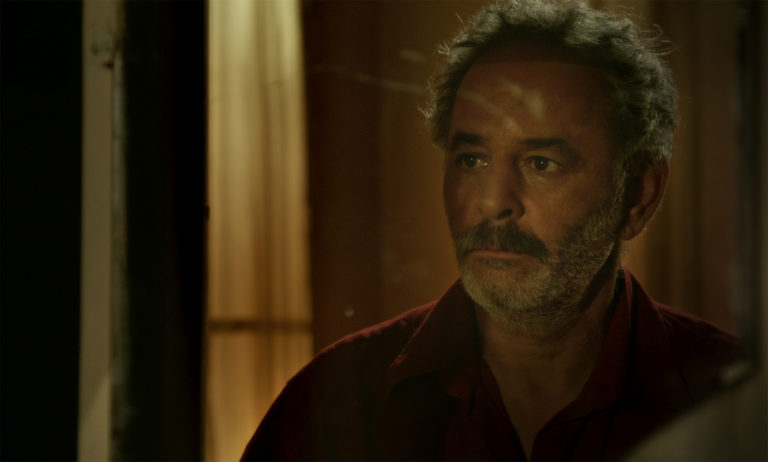
More broadly, we mapped out a kind of path for the light throughout the film, in which the bar set returns several times, in very different lighting and color moods. For the beginning of the film, Laure had envisioned, from the screenwriting stage, a semi-dark atmosphere in which Abdel’s face would be gradually revealed over the course of the first sequence. A photograph by the Belgian Harry Gruyaert gave us the direction for this opening: inside a bar, we glimpse the silhouette of a man, of whom we can only make out the parts of the body lit by sunlight filtering through the openings. The exposure is set for the lit parts of the image, and the result is very contrasty and striking: an ordinary scene fills with mystery thanks to Gruyaert’s choice of exposure.
In Zaïna46, we added to this high-contrast lighting direction the formal theme of mixed light sources: the counter is lit by uncorrected tungsten bulbs, whose yellow color mixes with the morning sunlight.
Midway through the film, we return to the bar room in a less somber atmosphere, a hot, muggy summer morning. And for the final scene, the empty room where Abdel finds himself face to face with Anna and with his own desperate desire is bathed in a milky, cyan light.
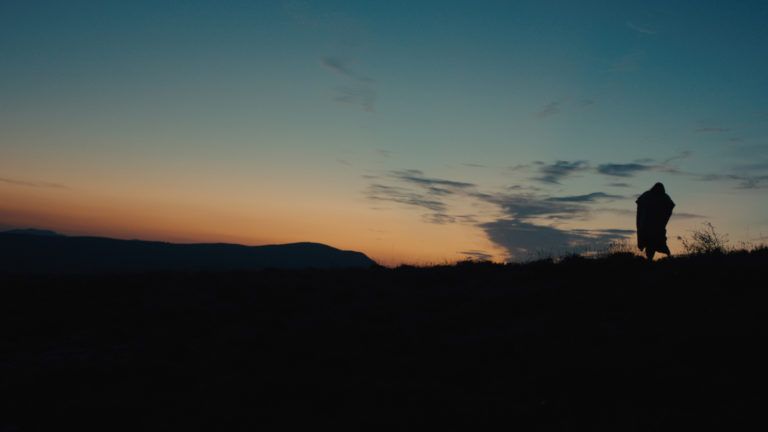
For all the bar sequences we systematically used a smoke machine, to give the light substance and to subtly seek a period look: the quality of the blacks, lifted and tinted, combined with a strong color scheme (yellow/orange and cyan), deliberately references the work of cinematographers Vittorio Storaro (in his Bertolucci/Coppola period) and Stephen Goldblatt (notably on Tony Scott’s The Hunger) between the late 1970s and the mid-1980s. Zaïna46 was shot on an ARRI Alexa Plus. A ProRes 444 2K workflow naturally seemed to us the best compromise between the film’s relatively modest budget, the money allocated to post-production, and ARRI’s image quality. Laure loves zoom moves, which underline moments of introspection and emotion in her characters.
We had already used a zoom on her previous short, Noche Flamenca. I chose a motorized Fujinon Alura 19-90 T2.9, a latest-generation lens that has the advantage of a macro mode and of being extremely compact and light, which served us well on the set of Abdel’s room. The whole film was shot with Warm Black diffusion filters, plus Mitchell filters for the close-ups. The equipment was rented from Papaye.
Zaïna46
a film by Laure Desmazières, France, 2018, color, 22 min / Written by Laure Desmazières, Marion Dessaigne-Ravel, Anaïs Carpita / With Djemel Barek, Foëd Amara, Baya Belal, Julia Perazzini, Djiby and Mariama Bah / Producers Thomas Jaeger, Antoine Delahousse / Production designer Pierre Moreau / Costume designer Sophie Porteu / Cinematographer Michele Gurrieri / Camera assistants Michaël Capron, Lorraine Delgado / Gaffer Samuel Noriega / Key grip Valentina Iorio / Key makeup artist Myriam Poulet / Colorist Brice Pancot – La Ruche Studio
Images from Zaïna46 are published courtesy of Haïku Films © Haïku Films 2018