Louis Dabrowski has been working as a Cinematic Artist for 6 years. He draws on the codes and the language of cinema to create fully digital images, built directly inside the game engine. That closeness between our two worlds made me want to ask him a few questions, looking back on the making of GreedFall: The Dying World from the studio Spiders, which has just been released. As a cinematographer used to making images out of the real world, I wanted to set our practices side by side and explore what brings them together and what sets them apart.
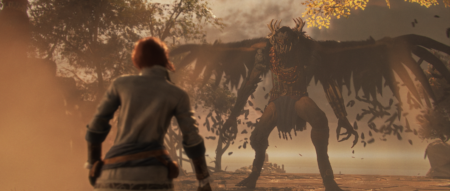
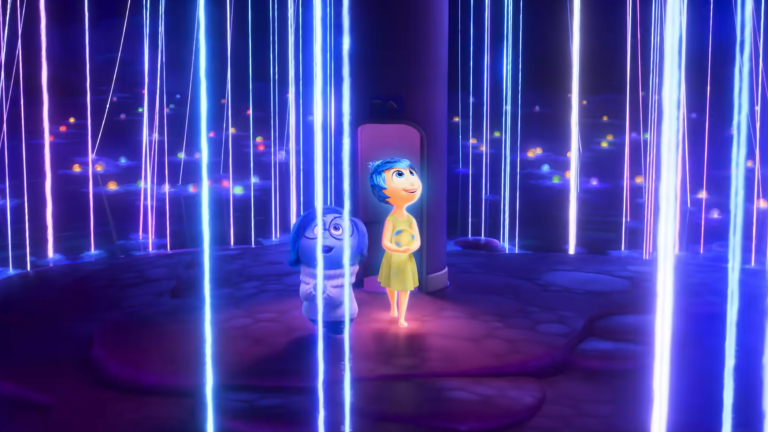
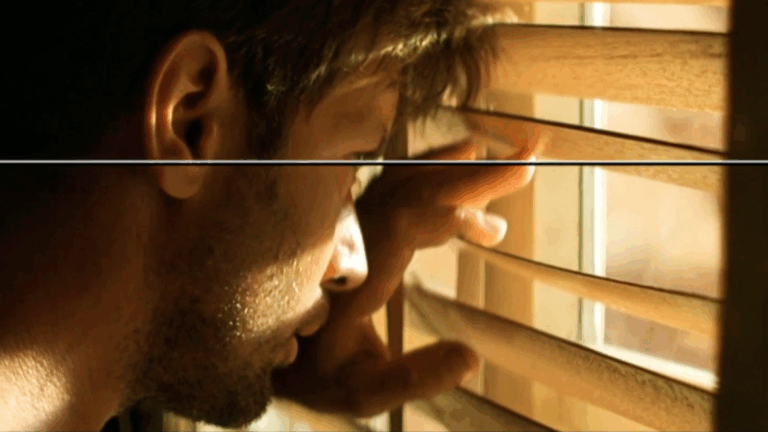
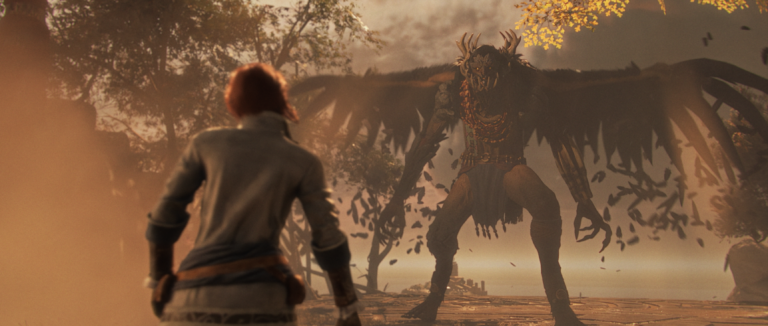
A still from a cutscene in GreedFall: The Dying World, developed by Spiders, published by Nacon.
Can you introduce yourself in a few words?
My name is Louis Dabrowski. I originally came from live action. After a camera and image course at 3iS, a film school, I spent 7 years taking on all kinds of work as a director and editor. During that time I worked on film and series marketing, among other things: cutting trailers and various promotional material, while developing my own short film projects as a writer and director.
On the other side, I’ve always been mad about video games. I got my first console at 7, a Game Boy Color. My love of cinema and my love of games fed each other. I remember at 11, for instance, working my way through every De Palma and every Coppola in the video store next door after reading a piece in PlayStation Magazine listing Rockstar’s influences for GTA 3 and Vice City. Same thing with Hong Kong cinema from the late 80s to the early 2000s: I dived into John Woo, Johnnie To and Tsui Hark after Max Payne (Remedy) knocked me flat.
I’d always had a secret dream of working in the industry, but I didn’t see myself as a game designer or a developer. Then, at the end of 2020, when I saw a job ad for a Cinematic Artist at a French publisher (Twin Sails Interactive, formerly Asmodee Digital), I jumped at it.
That’s how my run as a Cinematic Artist started: first on the marketing side, on the strength of my trailer editing experience, then on the narrative side from 2023, at Spiders, a French studio specializing in the RPG* genre.
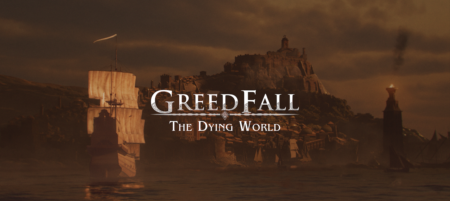
A still from a cutscene in GreedFall: The Dying World, developed by Spiders, published by Nacon.
What exactly does a Cinematic Artist do?
The first thing to keep in mind is that the term Cinematic Artist doesn’t quite cover the same job depending on whether the person works for a publisher or for a development studio.
On the publisher side, the Cinematic Artist shoots in-engine footage for marketing purposes, captures gameplay, does motion design and cuts the trailers. They don’t work directly with the development team. In my case, at Twin Sails, I was in regular contact with the teams at the various studios: partly to pick up information so I could make the most of the assets* we had to work with, partly to get their feedback on what we were producing.
Now let me focus on the heart of the subject: the Cinematic Artist’s work inside a game production. They are in charge of creating the cutscenes*, implementing them in the project, and following them through the whole development of the game.
Creating a cutscene, we actually wear 3 hats: director, cinematographer and editor. We design the shot breakdown, we do the blocking* with the various characters, we create the cameras and their moves within the scene, and we cut the whole thing inside the engine.
Directing the actors is usually down to the Lead Cinematic or the Cinematic Director during the motion capture shoots. But it varies from studio to studio. Sometimes it’s the Creative Director, as with Hideo Kojima on Death Stranding (Kojima Productions). And on games with a huge number of cutscenes, there are cases where one person does nothing but direct the actors on the mocap stage; then you’d call them a Shooting Director.
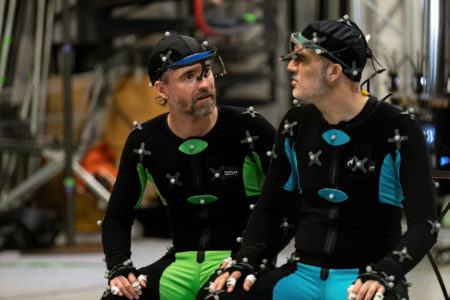
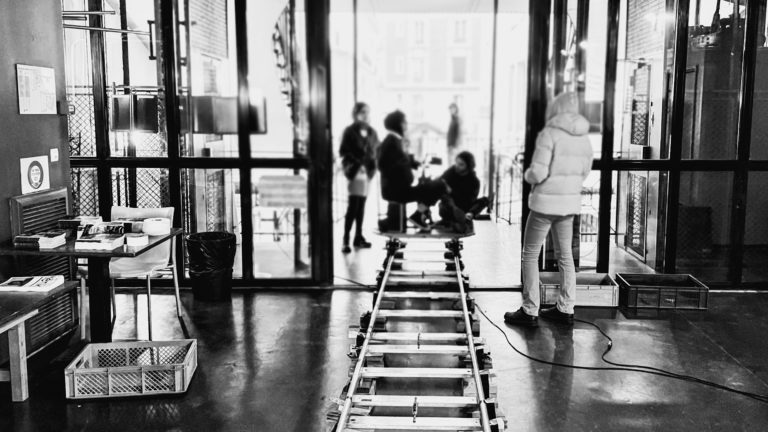
The two actors: Éric Geynes and Romain Ogereau.
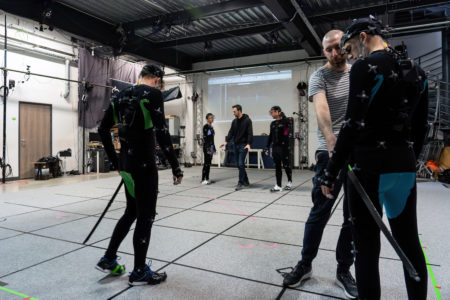
Maxime Perlini, center, blocking the scene with the actors.
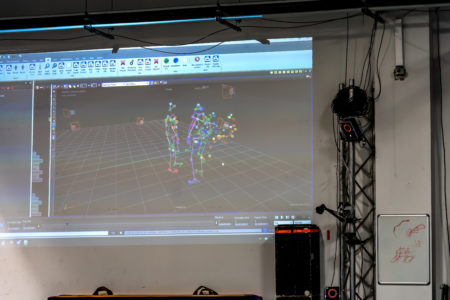
Photos from the shoot, mocap session for GreedFall: The Dying World.
Photo credit: Yoann Thiébaut-Georges.
I mentioned the director, DP and editor hats, but at Spiders we were lucky enough to have a fourth one: writer. Working with the creative director (Jehanne Rousseau) and the quest and level designers, we wrote the cutscenes and were free to pitch our own ideas.
As for implementing the cutscenes and following them through, you really have to understand that a game is a permanent work in progress until it reaches alpha. That’s usually a stretch of 2 years or more during which any aspect of the game can still change, right up until the content is locked and you move into polish, then debug. So part of a Cinematic Artist’s job is to keep constant track of how the production is evolving, in order to protect the quality of the cutscenes in the game.
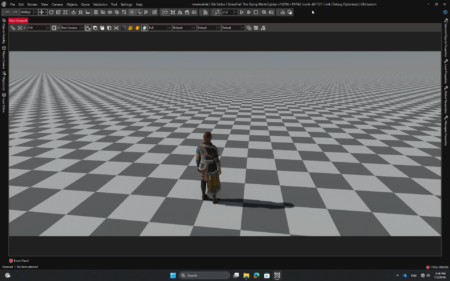
A capture of the default level in the game engine, the Silk Engine, software developed in-house at Spiders.
In practical terms, how do you build a cutscene inside the game engine?
The first step is placing the cutscene in its level. There are two options: either the cutscene takes place in an area used for gameplay, in which case you coordinate with the level designers and environment artists so the set can be built in a way that reconciles its function in the game with our staging intentions. Or a set is built purely to be used in a cutscene. And then you really can work the scene the way you would on a soundstage, arranging the space to serve the composition of the shots.
Personally, I love doing the blockout* of a set in that situation, placing the walls, the props and so on myself with the shots I want to get already in mind. Then an environment artist goes back over the scene, refines the details, brings it to life, creates new assets and brings their own eye to it the way a production designer would. I got to work that way on a few cutscenes for GreedFall: The Dying World and it was a real pleasure.
Once the cutscene is placed (this step really matters, because the position of the characters and the cameras is tied to the coordinates of the Actor the cutscene is attached to), we bring in the motion capture. Which means I import the data into the cutscene, match the animations to the various characters and place them in the scene, creating a camera that gives me an overall view of the set. It’s a bit like blocking a scene before you shoot it. Then I cut into the animations and refine where the characters stand, so it sticks as closely as possible to the drama and the rhythm of the scene.
Then it’s time to create the various cameras, animate them, and fine-tune how one shot cuts into the next. That’s obviously my favorite part. There’s a sandbox quality to it: I can experiment, try different shots for a single action, and realize that some of my ideas maybe weren’t so great after all.
And once the cutscene is built in the engine and signed off, the work with the other departments begins (animation, lighting, VFX, sound and so on) to polish it as far as it will go.
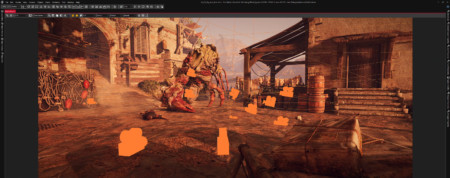
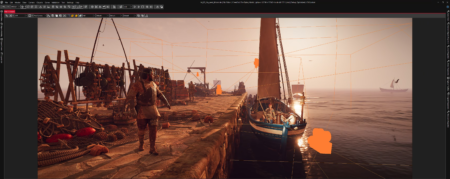
Captures of the cutscene editor in Silk, the game engine, showing where the various cameras in the scene are placed.
When and how do you fine-tune the look, the overall texture of a shot?
When I build the cutscene in the engine, the levels are often still under construction. It’s not unusual to be shooting in sets that are still nothing but gray walls, or across big empty stretches of terrain with no skybox* on the horizon. So in that first phase I focus purely on depth of field, and I set it very roughly.
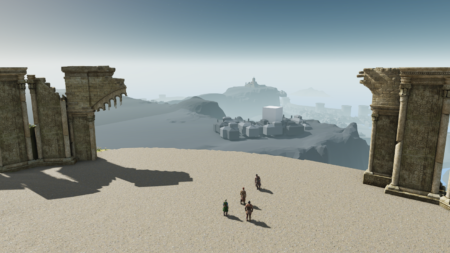
A still from a cutscene in a level still under construction.
I do go back over every shot in the polish phase, though, once the environments are finished and the lighting artists and VFX artists have done their work on the cutscenes. That’s when I fine-tune the post-process and the details of each camera, with the shot rendering in something close to its final form.
That said, you can’t forget that we have to match the game’s rendering and art direction. So unless it really makes narrative sense, I’m not going to indulge in a bleach bypass or crank up the grain if that runs against the look of the game in gameplay.
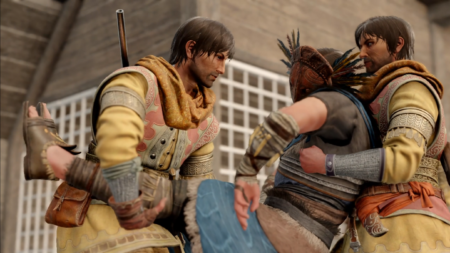
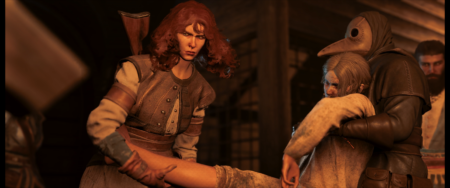
Two before/after pairs showing how the rendering of the cutscenes progressed.
Top, pre-alpha version. Bottom, finished version.
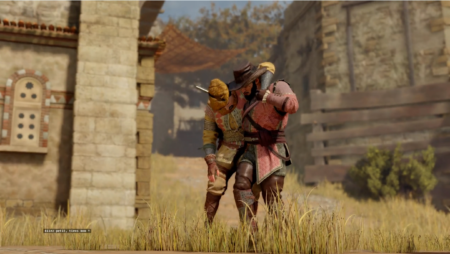
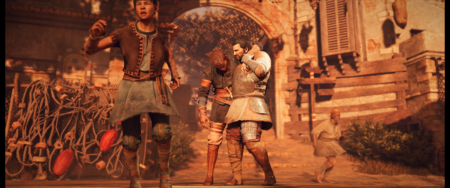
Where do you sit in relation to the other departments?
One of the reasons I love this job so much is that we’re in constant contact with every team: narrative design, level design, animation, the environment artists, the lighting artists, VFX artists, sound, rendering, etc. Even the engine developers: since Spiders had its own in-house engine (the Silk Engine), we held regular meetings to see how the tools could be improved. Every department affects the quality of the cutscenes.
But Cinematic Artists are still at the end of the chain: the heart of a game is its mechanics, the layout of its levels, gameplay in the broad sense. The other departments often take priority over us. It can be frustrating, but you have to remember that we’re working on a game and not a film.
Who writes the scenes and the dialogue, and who proposes the shot breakdown?
At Spiders, Jehanne Rousseau, the creative director, designed the game’s entire storyline. The quest designers backed her up on writing the various quests.
The cutscenes were written by the Cinematic Artist team (Maxime Perlini, Guillaume Godde and myself) in close collaboration with Jehanne, as I mentioned. She then took on writing the cutscene dialogue, along with all the dialogue in the game, in preparation for the motion capture shoots.
The shot breakdown is 100% the Cinematic Artist’s job. I’d say it’s the very heart of the craft. You can work with a storyboard artist beforehand, or go straight to previs in the engine or in any 3D software.

A still from a cutscene cut from GreedFall: The Dying World, developed by Spiders, published by Nacon.
What is the difference between gameplay and a cutscene?
A simplistic way to answer would be to say that gameplay covers the moments when the player interacts directly with the game, and that cutscenes are the narrative sequences that rely exclusively on cinematic language.
But plenty of games have blurred that line, with cutscenes where the player can keep interacting. Only their options are limited: they can still move, at a reduced pace, while the camera locks its axis onto a specific element in the scene. And the whole thing is staged like a continuous take. Games like Cyberpunk 2077, The Last of Us II and the 2018 God of War have used that kind of “gameplay” cutscene with real virtuosity.
There is also the “Quick Time Event”, which you could roughly sum up as a cutscene where the player has a narrow window to hit one button or another and influence what happens next. You find that kind of mechanic in Life is Strange (Don’t Nod) or in Quantic Dream’s games such as Heavy Rain and Detroit: Become Human.
In every case, with “in engine” cutscenes (not pre-rendered 3D, but played directly in the engine), you need to keep the rendering, the lighting and so on consistent between gameplay and cutscene, to protect the players’ immersion.
How do you handle the transition between the two?
Most of the time the move from gameplay into a cutscene happens on a cut or a fade to black. In the engine, that means placing a trigger* for the cutscene in the level, and the cutscene starts when the player walks through it.
As a player, I love it when a game slides seamlessly into a cutscene. Often your character opens a door or squeezes through a gap, and before you have even noticed it, you have tipped over into a cutscene. It protects the immersion, and you don’t get that unpleasant feeling of the game telling you “put down your controller and let me roll out my story…”. It’s something I’m genuinely passionate about. At Spiders we had prototyped that kind of approach for Mist, a game that will now never happen because the studio closed. Without giving too much away, the project was built on fairly short gameplay loops, 15 to 20 minutes. Time was a resource in its own right, and a decisive one. So it was essential to avoid giving the player the feeling that the game was going “on pause” for the length of a cutscene.
Prototype of a seamless transition from gameplay into a cutscene for the Mist project.
Do you use the same cinematic language as a cinematographer?
Completely. We think in terms of camera angles, shot sizes, movement and camera height. For every shot I make, I systematically ask myself about focal length and depth of field, but also about the kind of camera support I would be using. Some engines, like Unreal Engine, even let you set the camera’s sensor size.

A still from a cutscene in GreedFall: The Dying World, developed by Spiders, published by Nacon.
I ask myself: “on a shoot, would you do this one on sticks, handheld, on a Steadicam, on a dolly?” and then I execute it consistently with that decision. We have the tools to add shake, for instance, to simulate a handheld camera. I can push it further with tools like CamtrackAR or Unreal VCam, which pull position and rotation data from an iPhone to create a 3D camera: much the same principle as motion capture, but to recreate a camera move.
We also have endless post-process tools for replicating the small “imperfections” and quirks of shooting for real: lens flares, lens dirt, chromatic aberration, motion blur, vignetting, spherical or anamorphic bokeh, even the circular bokeh of a Petzval lens… I was rather amused playing 007 First Light (IOI Interactive) recently. On some shots they replicated the slight lag you get when a focus puller pulls focus on a very fast lens. All those details are what anchor our shots “physically”.
To my mind it’s essential to think the way you would on a live action shoot. In 3D we have no physical or material constraints; the only limits are time and resources. You can absolutely do a shot that starts at the far end of the map* in a top-down view and ends macro on a horse’s retina, traveling at supersonic speed, with the focal length going from 5 mm to 700 mm. Sure, it can be impressive, but if a cutscene does that non-stop, I think anyone would get bored after 2 minutes.
Asking yourself those questions is a way of giving our work a sense of reality.
Excerpt from a cutscene in GreedFall: The Dying World, developed by Spiders, published by Nacon.
How do you handle lighting inside the game engine?
Lighting is handled by the lighting artists. They have their own eye, and they are also aware of the various technical optimization constraints specific to the project. On my side, I pass on my intentions and define the overall mood. In certain cases I will do a first lighting pass myself, if I have something very precise in mind. At the very start of the game, for example, there is a long sequence set in the brig of a ship. There is a time jump of several days right in the middle of it. For me it was hugely important to mark that jump visually by having a different mood from one scene to the next. So I did a first pass on the lighting, placing torches and lights in the scene to create a night mood. Then I changed the light and the general mood for the second part, going for dawn.
In that case it mattered to set those intentions very early, because I knew the lighting artists would not get to the cutscene for several months. Meanwhile other departments had to work on it, particularly on the environment side. The final shot, on a wide sweeping camera move, showed the ship heading toward the mainland. We needed a specific composition, and I knew the position of the sun in the scene would shape how the set was built. So the intention had to be as clear as possible, as early as possible, for everyone to work with peace of mind.

A still from a cutscene in GreedFall: The Dying World, developed by Spiders, published by Nacon.
In practice, a game engine gives you different types of lights that correspond to the kinds of sources that exist:
- the “directional light” stands in for natural exterior light (so the sun or the moon);
- “spot lights” throw light in one particular direction and correspond to Fresnel-type units;
- “point lights” are spheres that throw a softer light in every direction, the way a China ball would;
- “rectangular lights” throw a directional light, like a light panel.
We have full control over the intensity, the color temperature and the tint of the sources.

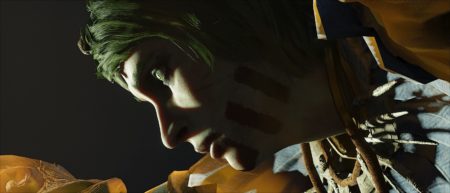
Stills from cutscenes in GreedFall: The Dying World, developed by Spiders, published by Nacon.
Since we work in real-time 3D and not pre-rendered 3D, everything has to be optimized as far as it will go. There are plenty of ways to “cheat” on the rendering side to give an illusion of realism in the way light interacts with the environment:
- Screen Space Global Illumination: simulates light bouncing off the surfaces of objects visible on screen;
- Shadow Maps: simulates shadows by projecting a texture onto a surface;
- IES light profiles: replicate the way light from different types of lamps spreads;
- Lumen (on Unreal Engine): a dynamic global illumination and reflections system introduced with Unreal Engine 5.
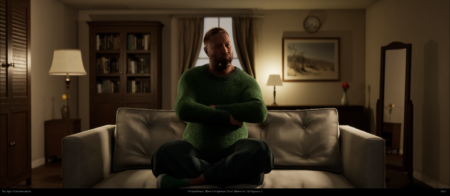
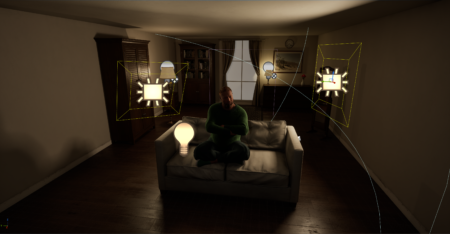
An example of light placement in the Unreal Engine game engine, on a scene created specially to illustrate this article.
Who owns the look of the game?
Since a video game is by nature a collective work, where every craft contributes something to the overall look, the question of one person carrying sole responsibility for the image doesn’t really come up. Some big studios do have the equivalent of a DP specialized in 3D imagery (the “Head of cinematography” role at Naughty Dog, the studio behind Uncharted and The Last of Us, for instance), but that remains the exception.
Does the RPG genre have particular needs when it comes to cutscenes?
In RPG storytelling, on top of the classic cutscenes, we lean heavily on automated dialogue. They are used for situations with lower stakes without justifying the use of a cutscene (which, let’s not forget, is quite costly in terms of time and resources): when one or more characters come to provide information to the player, or even when we have to make certain choices that lead us to new branching points in the plot. For those, we use a predefined set of cameras, with editing options programmed according to the lines and the speakers. That lets you iterate across dozens, even hundreds of dialogues. On that specific part, the Cinematic Artists design the cameras and the editing options, customize dialogues where there are specific staging needs, and go back over all of them to fix bugs. It is painstaking, detail-by-detail work, but it is essential on games where world building* matters this much.
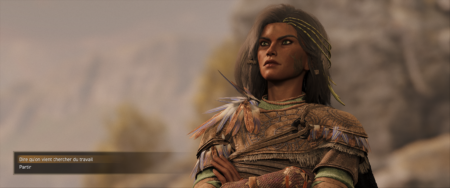
A capture of an automated dialogue in GreedFall: The Dying World, developed by Spiders, published by Nacon.
An aside on AI…
Before we talk about AI, I think it’s important to recall the situation the video game industry finds itself in today. The sector has been in a deep crisis since 2022. We’re talking about studios closing one after another, at least 45,000 people laid off worldwide. What at first looked like a hangover from the sharp growth that followed the 2020 lockdowns turned into a far more structural crisis, exposing the flaws in the AAA production model (the very biggest budgets) as well as the growing precarity of AA studios (working with mid-range budgets). In France, things have grown enormously tense since the beginning of 2026. Ubisoft (Assassin’s Creed, The Crew) was already weakened, and since then Nacon, Spiders’ publisher, has been closing its studios one by one after going into receivership, Quantic Dream (Detroit: Become Human) has announced a layoff plan putting 115 jobs at risk, the future of Don’t Nod (Life is Strange) is uncertain… The companies that employ most of the industry’s workers in France are the ones now teetering.
We still lack perspective because we’re right in the middle of it, but the explosion of LLMs* and generative AI has probably made things worse on the social front. Some studios, like Krafton in South Korea, have tried to cynically ride the wave and the promise of productivity gains on the cheap by pushing an “AI First” policy. So far we still haven’t seen the results.
I’m fairly critical of AI overall. But there are still a number of developments I find interesting. DLSS (Deep Learning Super Sampling), for instance, which raises a game’s frame rate by rendering its images at a lower resolution and then upscaling them on the player’s graphics card. I’ve been using it as a player for years, and it’s pretty incredible. On Cyberpunk 2077 it let me play with path tracing on, at around 50 frames per second on a 4K screen. Without DLSS the game would have run closer to 10 or 15 frames per second at those settings. Nvidia took a serious backlash recently after unveiling DLSS 5. Rather than guaranteeing fidelity to the original image, they built in generative AI that alters the lighting and the way faces render. In the demo images they showed, the result on Resident Evil: Requiem and Starfield changed the look of the image and the art direction. For a dubious result. The reaction from the public and from professionals was immediately very negative. We were passing around memes making fun of the disaster at the studio. I find it fairly reassuring that this kind of reaction happens when projects threaten to distort the original creative intent.
On the tools that are genuinely useful for cutscene work, there is everything that lets you do motion capture from one or several video files. Epic has just built that function straight into Unreal 5.8 with the Metahuman Animator Markerless Motion Capture plugin. It runs locally and it’s free. It obviously doesn’t replace a shoot on a mocap stage. But for someone like me who uses Mocopi trackers for previs, the jump in quality is pretty wild. On small productions it’s also very handy for creating background characters, building up your animation library, and so on.
That said, personally, I don’t believe for a second in the idea of an industry tipping over into 100% generative AI. Will it be possible one day to generate a game from a prompt? Probably. Just as it is possible today to generate an entire scene from a prompt on Seedance. Will it be any good? Will players hand over so much as a cent to play it? I doubt it. Designing a game is a long process of prototyping, testing, balancing and iteration. Every mechanic, every area of every level, every shot in a cutscene is constantly questioned against one thing: does the whole hold together well enough for the player to stay with the game for 15 minutes? 1 hour? 10 hours? AI can copy human beings with varying degrees of success, but is it capable of understanding and anticipating a player’s emotions? As a player, and as a viewer in the broadest sense, does the prospect of facing a work where some or all of the creative elements have been handed over to a machine stir anything other than boredom and deep indifference?
While keeping the social and ecological impact of this technology in mind, I personally draw a line between using AI for technical purposes and using it for creative tasks. Using it to optimize rendering, help with debugging, automate tedious programming tasks or cut certain hardware costs, why not. But using it for storyboards, concept art, character voices, 3D models, writing quests and so on strikes me as absurd. The standardization and uniformity of contemporary video games get called out constantly, and rightly so. Why pile more on?
A word on the end of Spiders…
Spiders is the first studio Nacon closed. I won’t go back over the details of Nacon’s receivership and the liquidation of Spiders. Plenty of articles (Le Monde, Origami…) already cover it and I don’t think I have anything to add. I’ll just say that it breaks my heart. First as the professional who worked there for 3 years: there was an enormous amount of talent at Spiders, people who cared. Closing the studio means, above all, 70 people out of work. GreedFall: The Dying World had a rough production, but every one of us gave what we had to make the best game we could. Mist, the project that had been in preparation for several months, was genuinely exciting. There was the makings of a lovely game there.
But it also breaks my heart as the player I am: I joined Spiders in 2023 because I love RPGs and because I found GreedFall and Steelrising striking. Those games are not perfect, but they have a singularity within the industry. Spiders was known for the quality of its world building, and for the ambition of its games, which sometimes outran its means. As with many studios that have closed over the past four years, I think it’s a voice that will be missed.
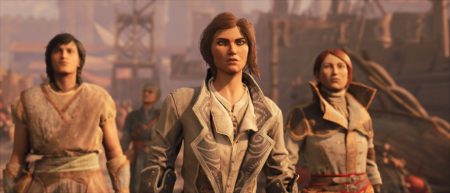

Stills from cutscenes in GreedFall: The Dying World, developed by Spiders, published by Nacon.
GLOSSARY
Asset: All the visual, audio and other elements that make up a video game in its entirety. ↑
Blocking: Planning the movements of the actors and the camera within a shot. ↑
Blockout: The rough layout of a level, built from simple untextured geometric shapes. ↑
Cutscene: A non-interactive narrative sequence, told through cinematic language. ↑
IES light profiles: Data that replicates the way light from different types of lamps spreads.
LLM: Large Language Model: the term for language models such as ChatGPT, Claude, Gemini etc. ↑
Lumen: A dynamic global illumination and reflections system introduced with Unreal Engine 5.
Map: A whole level in a game. ↑
RPG: Video games that draw on the codes and principles of tabletop role-playing games. ↑
Screen Space Global Illumination: A technique for simulating light bouncing off the surfaces of objects visible on screen.
Shadow Maps: A technique for simulating shadows by projecting a texture onto a surface.
Skybox: A sphere (or a cube) textured on the inside with an image, most often of a sky. The technique gives the illusion of a wide open space. ↑
Trigger: An element, invisible to the player, placed in the level to fire an event when the player interacts with it (a fight, a cutscene, or anything else). ↑
World building: The creation of an imaginary world. ↑