Walter Murch and the Golden Ratio in Cinematic Framing
One of the first seminars of this year’s Camerimage Fest comes from legendary editor Walter Murch – The Godfather (1972), The Conversation (1974), Apocalypse Now (1979), and many others – who shared his reflections on the Golden Ratio in cinematic framing. An intriguing theory about how DOPs and camera operators “naturally” tend to favor a similar position of a face in the frame.
One night while watching TV with his wife, Murch decided to try an experiment. So he grabbed some yarn from his wife (who was knitting at the moment) and taped the string horizontally on the screen at eye level. As they continued to watch, he noticed that the eyelines consistently fell into the same screen area. So being a somewhat mathematical person, he decided to take out a tape measure and measure the distance from the bottom of the screen to the yarn and then from the thread to the top of the screen. Then when he divided these numbers, the result was a ratio that he recognized as the Golden Ratio (1.618 or phi “ϕ”).
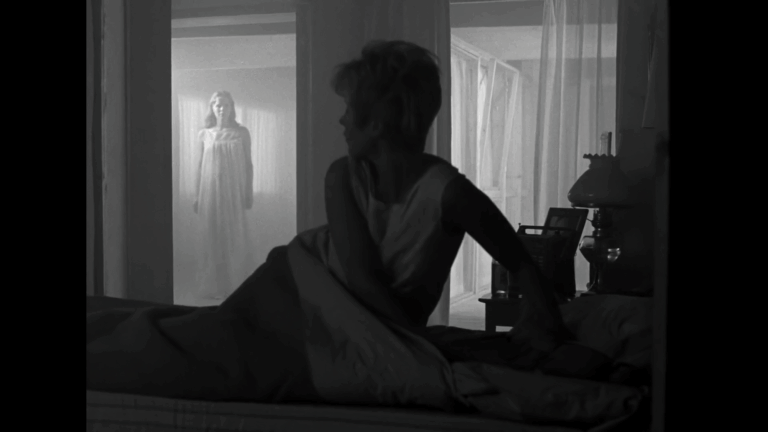
The Golden Ratio appears all around us in nature, from the spirals found in seashells, to the shapes of galaxies, even to the spiral of our own DNA. Intrigued, he began to wonder if this golden eye-line ratio appeared in other films and why he didn’t notice it after almost sixty years of editing films. So he put together a video of numerous film stills showing this relationship and spoke about it to Francis Ford Coppola and many of his cinematographer friends (including Vittorio Storaro and John Seale). He asked them why this ratio was so common. Was this some secret knowledge, or was it more instinctual among DOPs? John Seale suggested it’s probably the latter by saying he’s simply “trying to make the face feel comfortable within the frame.”
Murch has since looked for this ratio in numerous films (analyzing nearly 800 images) and has come to the idea that maybe this ratio is innate in us because it’s found all around (and within) us.
Perhaps that’s why when we frame the face; we have a sort of “feeling” when it’s in the right place of a frame. As he continued the seminar, he demonstrated how the human face itself is a “nest” of golden ratios. For example, the distance from the hairline to the nose divided by the distance from the nose to the chin is a golden ratio. So you have a face (a “nest” of golden ratios) framed within another gold ratio on the screen. To explain why this might be, Murch proposes another idea: “perhaps the screen is actually a face that looks back at the audience.”
Of course, this is not to propose a rule but to investigate a kind of natural or “neutral” framing of the face. Changing this ratio can create different feelings among the audience – putting the eyes above the golden ratio line might make a character feel imposing or threatening, while putting the eyes below the line might make a character feel weak. It’s not a formula but something to be aware of, something to play with, or a tool we can use as filmmakers. He mentioned, of course, that other counter-examples of this theory are also very successful, notably Ida (by director Paweł Pawlikowski and cinematographers: Łukasz Żal and Ryszard Lenczewski).
Mr. Murch will continue his research and explore other aspects of his golden ratio theory (like how it compares to the rule of thirds) in preparation for his next book. Although he didn’t hint at when it might be released, keep an eye out for it, as it’s sure to give us more to consider, discuss, or debate about in our continuing effort to become more masterful image-makers.