Through her account of her work on the short film Ourse, Pascale Marin (AFC, UCO) reveals the subtleties of the cinematographer’s craft with infectious generosity and enthusiasm. Her approach, both precise and accessible, allows the general public to understand the challenges of creating a cinematic image, while seasoned professionals find a wealth of technical information and reflections on the practice of the craft.
This transcription of her talk attempts to convey the richness of her words, her direct style and her unique ability to weave together technical considerations, shooting anecdotes and reflections on the art of image-making. She reminds us that behind every shot lies not only technical mastery, but also an intense human collaboration.
__
I studied at Louis Lumière, a renowned technical school that taught me everything I needed to know technically. The rest, I learned on set, as a camera assistant and then as a cinematographer. I’ve shot about ten feature films while continuing to make many short films, which I consider a fantastic playground.
The Ourse project
I’m going to tell you more about Ourse, delving into the behind-the-scenes secrets of how I worked to create the film’s images with the director, Nicolas Birkenstock. This isn’t my first collaboration with Nicolas — I met him right after graduating from Louis Lumière in 1999. Together, we’ve made seven short films, a documentary and a feature film, La Pièce Manquante (2012), which wasn’t a great success even though I still think it’s a very accomplished film.
Nicolas is currently writing his second feature. Since the writing process takes a long time, he really wanted to get back on set, so he decided to make another short film. It’s easier to shoot a short since it requires less money. He offered me Ourse and first told me about it in 2017.
Pre-production and the shoot
To give you an idea of the process, let’s start with the opening sequence…
The opening sequence
The film opens on a lunar eclipse. To film this sequence, we took advantage of a real total eclipse in January 2019 over Paris, even though the film wasn’t yet funded. I suggested to Nicolas that we film the eclipse, knowing the next one wouldn’t happen for years. He first said we could never afford to rent a camera, but I was shooting a documentary at the time and had a camera available. The documentary production trusted me and let me take the camera for one night. I just needed the producer of Ourse to invest between 50 and 100 euros to rent a more suitable lens, a 300mm. We set up on the roof of the Paris Observatory, keeping our fingers crossed for a clear night — which it was.
These images had been sitting on my hard drive for just over a year, and eventually ended up in the film. That’s one of the wonderful things about short films: something you shoot on a whim, on the cheap, can end up in the final cut.
Location scouting and references
The film is set in the fictional town of Orsay-les-Bains, but was shot in the real town of Boulogne-sur-Mer. During location scouting, we visited various sites that could match the film’s vision.
Nicolas and I share a passion for pictorial references. For Ourse, we drew inspiration from the works of Caspar David Friedrich, whose paintings capture a unique atmosphere of mystery and contemplation in nature. For example, the famous Wanderer above the Sea of Fog evokes the kind of feeling we were aiming for in the forest scenes. We also looked at works by Spilliaert, a Belgian painter of solitary, nocturnal scenes, and at the film The Others by Amenábar.
The sleepwalking camera
For the sleepwalking scenes, Nicolas wanted to use a GoPro. I know its advantages and drawbacks: it’s a tiny action camera, perfect as a compact shooting camera, but it performs very poorly in low light. I suggested we test different compact cameras. I knew the Sony Alpha 7S was extremely sensitive, which would be ideal for the long journeys Ourse would take through the city and then the forest.
We tested four cameras:
A Sony DV in night-shot mode (which reminded us of our teenage years)
The Sony Alpha 7S II
The Osmo with its built-in stabiliser
The GoPro
In the end, we created a hybrid look: we used the Alpha for its image quality, adding the grain of the DV camera. I filmed a grey wall with a DV camera, and the colourist Vincent Amor extracted the grain and applied it to the Alpha images. We also added the DV’s lens distortions to make it look more like found footage.
The locations
The bedroom had both advantages and drawbacks:
– It was cramped and had a mansard roof, which limited the possibilities for lighting through the windows
– We therefore had to light from inside
– However, a mezzanine above the bed made overhead shots straightforward
The Super Tacos restaurant: We found a fast-food place with a sea view:
– Because the manager was unavailable, we could only film the exterior
– For the interior, we used a school canteen:
– A large canteen with red walls and big glass windows
– We made the counter appear closer to the windows to give the fast-food place a reasonable size
– A particular challenge: since the shoot was in February, with only 8 hours of daylight, I had to compensate the lighting to make it look like daytime in interior shots filmed at night
Camera equipment
Main camera: ARRI Alexa Mini
Secondary camera: Sony Alpha 7S II (for the found footage / sleepwalking scenes)
Grip equipment:
Ideally, I wanted a “babydoll” — a 3-wheeled dolly, extremely manoeuvrable, but it was too expensive
We replaced it with a “gros chien” (a less manoeuvrable wheeled dolly)
We had a Steadicam for one night — I don’t operate the Steadicam, so a specialist operator came in
A classic dolly that we brought up into Ourse’s bedroom, very useful for smooth vertical movements
Equipment list preparation
These lists are sent to rental houses, which provide quotes. Sometimes the production finds it too expensive, and in that case:
Either I determine which equipment I can do without
Or I specify the exact days when I need certain more expensive items
For example, I made a supplementary list for the three nights in the forest, keeping the larger lights only for those scenes
What makes me choose a project
When people ask me how I choose my projects, I’d say there are three main criteria:
The screenplay
The relationship with the director — how we communicate about the script
The match between ambition and budget
If someone tells me “I’ve got 300 euros and I want to film Star Wars”, we might need to discuss that further… In short: production logic, a screenplay, and a human being.
Script breakdown and technical preparation
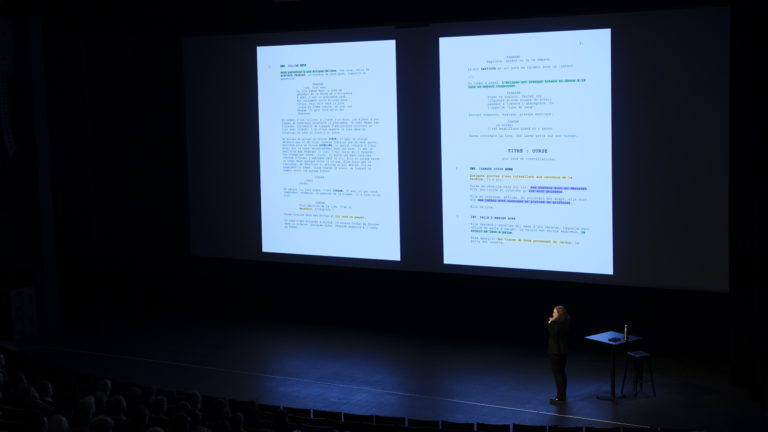
When I receive a near-final screenplay, anywhere from a year to a month before the shoot, I do what’s called a breakdown. I read the script with a technical eye. In fact, all departments — not just cinematographers — do this.
As an example for this talk, I used a colour code:
In green: everything concerning lighting (my area)
In yellow: set props
In purple: make-up
For example, when I read “they witness a lunar eclipse, the eclipse is nearly total and casts a red-orange glow over the terrace”, I think about what I need: what kind of artificial moon, what colour temperature, what diffusion…
I also note all the technical questions I need to discuss with the director. For Ourse, these were mainly:
What camera for the sleepwalking scenes?
What format and texture for the image?
A recurring question about how to show the lair/cave
Then come the location scouts. Once the locations are confirmed, I draw up the lighting and grip plan.
This is a concise document that gives me an overview, particularly of the transitions between sequences, and allows me to communicate easily with my crew.
The crew
On this well-funded short film (around 100,000 euros), my crew consisted of:
Two camera assistants (a first AC who pulls focus, a second AC who offloads the cards)
A gaffer and an electrician
A key grip and a grip
This is a crew almost larger than on some of my feature films that had a tighter budget.
Post-production
Once the shoot is over, the film goes into editing. Very often, I’m sent intermediate versions for my opinion. Since we saw the images as they were being made, people often say we are the film’s first audience. I have a fairly precise memory of every shot, so when I see an edit, I can say “are you sure? We also had that shot which might work at this point.”
In Ourse, there are quite a few visual effects (VFX) in post-production. I also give feedback on this part because it’s the finishing touch of the image work.
For example, the shot of the Moon at the beginning: you first see a light on its stand, which was erased and replaced with the images we had shot in January 2019.
For the train scene, we obviously weren’t going to put our actress in danger. The railway track at the beginning is a real track, but one that was under repair at the time. Later in the forest, it’s a narrow-gauge tourist train track — the rail gauge isn’t the same, but you can barely tell. We filmed the actress against a green screen with a large fan to create a wind effect. Then we filmed a real train from a consistent distance with the same focal length. The compositing then combined the two shots.
Colour grading
The grading stage comes once the film is edited. We readjust the shots in terms of brightness and colour to create a smooth visual continuity. For example, if you have footage shot in bright weather and other footage in darker conditions, this process harmonises everything so the viewer doesn’t feel it was shot out of order.
Q&A
Q: How do you manage your relationship with the colourist?
Increasingly, I have a single colourist with whom I work on all my projects — in this case, Vincent Amor. I send him images from the first day of shooting. He creates what’s called a LUT (Look-Up Table) — a colour preset that I apply on set. This helps me evaluate the image as close to the final result as possible.
This is especially important with digital cameras that shoot in LOG mode (a very flat image that preserves maximum information). Without a LUT, the image looks grey and washed out, which can mislead the director. With the LUT applied, the director sees something close to what the final image will look like.
On Ourse, with the various cameras and formats, it was essential to harmonise the different textures during grading. We worked at Éclair, which has since sadly closed.
Q: How do you choose your team?
I choose my crew primarily on the basis of trust and shared experience. We need people who are responsive, who understand the look we’re after without my having to explain everything. With Nicolas and me working together for twenty years, there’s an unspoken understanding that I also seek with my team.
That said, I also try to maintain a degree of diversity. I’d like our film crews to reflect the broader population a little more. Being a minority among cinematographers myself, it comes quite naturally to me.
Q: Which scene gave you the most trouble?
The dream sequence was certainly the one that required the most thought and the most equipment. It was our “little Hollywood”. There was notably the challenge of outdoor smoke — with the slightest breeze, it disperses very quickly. There was also all the care needed for the visual effects, particularly for the train sequence.
Audience reactions
Among the audience at the Espace des Arts, Martine, a regular attendee, was accompanied by her friend Annette, who was discovering the festival for the first time. Neither had ever attended a Cinema Masterclass in this format.
They particularly appreciated the meticulous exploration of the creative process, as well as how the work of the cinematographer was made accessible, far from the mysteries that often surround this profession. Technical terms that had long remained abstract — breakdown, grading — finally took on their full meaning.
But it was above all the screening of a shot from the film, immediately followed by its making-of footage, that brought the explanations to life, making tangible the alchemy between conception and execution. An experience as enlightening as it was enriching, and one they hoped would be repeated.
Thomas Lallier, UCO had dedicated a portrait to Pascale Marin, which you can discover here.
Masterclass photos: Antoine Mocquet, UCO.