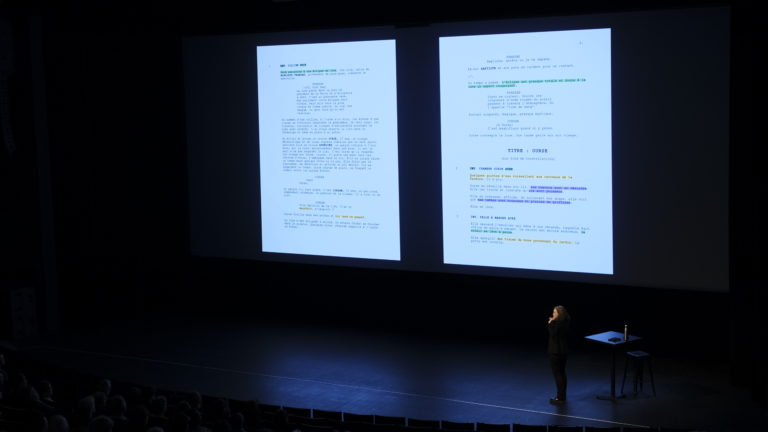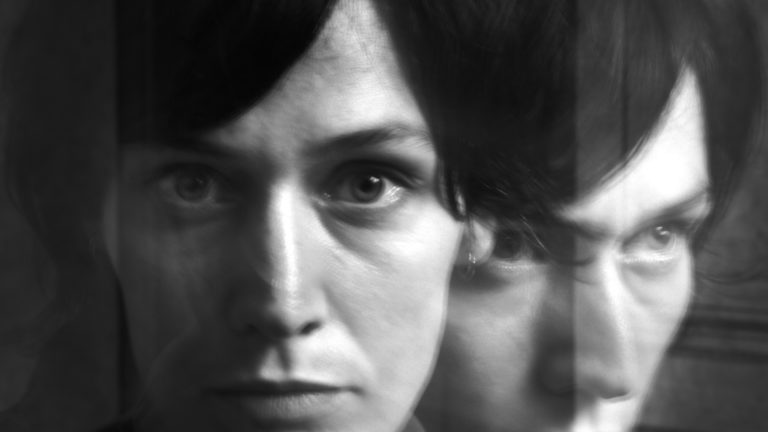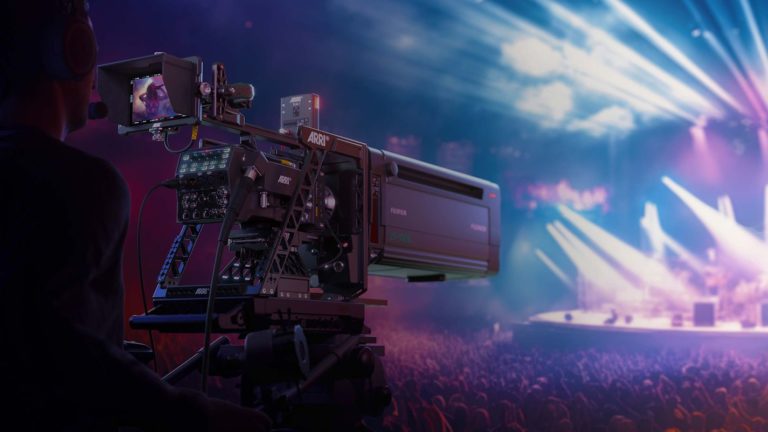
Two students from the 2024 class of La Fémis’ Cinematography department agreed to publicly present their research during the Festival.
• Far from the Eyes, Close to the Heart — Distance and Intimacy in the Image by Sarah Ackerer
How can an image that maintains physical distance from its characters generate a sense of intimacy?
• Research on the Alternative and Open-Source Creation of Spectacular Images on a Reduced Budget by Sofiane Houir-Alami
During her defence, Sarah, a cinematography student, presented an in-depth reflection on the relationship between proximity and intimacy on screen. Her work questions the apparent assumption that a camera physically close to a character creates emotional closeness with the viewer.
She observes that many films, particularly in contemporary French cinema, adopt this approach through extensive use of close-ups on faces and ultra-close framing. Yet she argues that this proximity can sometimes be intrusive rather than intimate. Drawing on the work of filmmakers such as Yasujirō Ozu, Chantal Akerman and Alice Rohrwacher, she demonstrates that distance — whether spatial, temporal or emotional — can paradoxically create a deeper connection with the audience.
Her analysis identifies several cinematographic devices for achieving what she calls a “cinema of restraint”:
- Wide shots that integrate the character within their environment.
- Use of off-screen space to let the unspoken exist.
- Static shots where characters enter and leave the frame without the camera following them.
- Lighting choices and underexposure to conceal facial expressions.
- Extended shot duration that invites immersion in the character’s sense of time.
As a counterpoint, she quotes director Ingmar Bergman: “Too many theatre people forget that our work begins with the human face. The ability to get close to the human face is undoubtedly the first and most distinctive quality of cinema.” An idea Sarah challenges, preferring Alice Rohrwacher’s approach, which critiques the dominance of a cinema centred on identification with protagonists.
Filming the Spectacular Without a Budget
The defence continues with Sofiane Houir-Alami’s presentation, which takes the opposite approach: how can we produce visually impressive images with limited means? As a self-taught filmmaker and La Fémis student, Sofiane explored the creative possibilities offered by open-source tools and non-standard camera techniques to create images with high visual impact.
His thesis is built around several experiments:
- Using Blender, the open-source 3D software, to generate virtual sets and integrate them in real time with physical shoots, replacing the use of expensive LED walls.
- Exploiting machine learning algorithms to generate textures, lighting effects and even camera movements from simple descriptions.
- Working with unconventional sensors (thermal cameras, infrared, night-vision cameras) to produce images with a singular aesthetic without costly post-production.
One of the most striking demonstrations was using Blender’s real-time rendering engine (EEVEE) to simulate an entire set, projected behind the actors via a simple video projector, creating a poor man’s virtual production setup. This approach, while less refined than an LED volume, proved surprisingly effective in achieving believable compositing.
Sofiane also addressed the question of image ownership in the age of AI: if an algorithm generates a texture or a composition, who holds the rights to the resulting image? A question that will undoubtedly become increasingly pressing in the coming years.
Two complementary visions of tomorrow’s cinematography
These two defences illustrate the range of questions that emerging cinematographers are asking. On one hand, a deeply cinephile reflection on distance, which deconstructs the idea that physical proximity is an emotional necessity. On the other, a desire to produce impressive images with limited means, by repurposing technological tools in creative ways.
This duality is a reminder that cinema is an art of constraint, and that it is often by bending the rules that the most striking images are born. The question remains: to what extent will the evolution of technology and viewing habits — particularly on mobile screens — alter our perception of intimacy and spectacle in cinema?
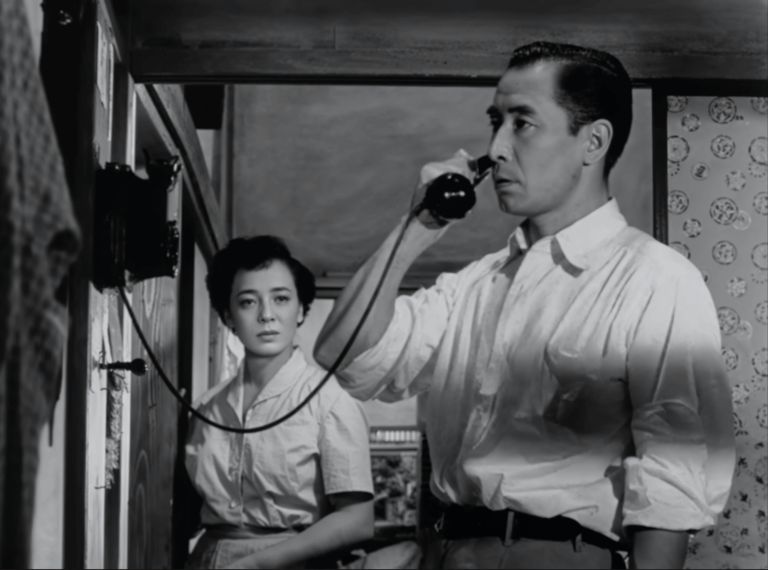
Cover image: Tokyo Story by Yasujirō Ozu – 1953
Available in 4K on YouTube