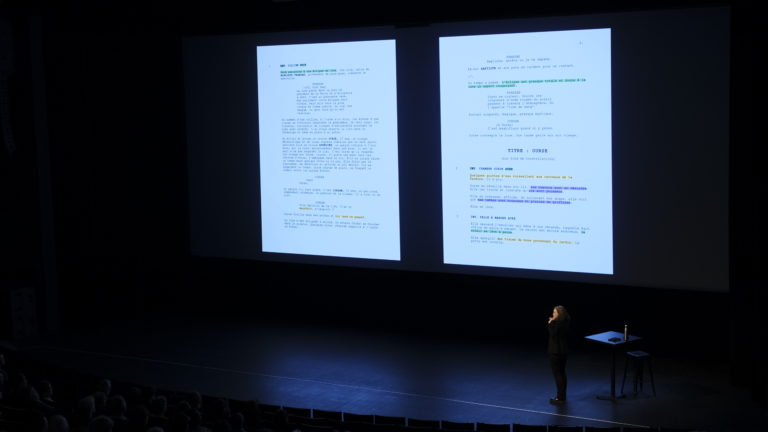
A particularly anticipated talk was given by Florine Bel, Color Scientist at MPC. Little known to the general public, this profession plays a central role in the image production pipeline, ensuring the colorimetric consistency and fidelity of audiovisual works.
A hybrid profession between science and creation
Florine Bel opened her presentation by explaining the nature of her work, which oscillates between the technical and the aesthetic. Unlike the colourist, who intervenes in post-production to adjust the image and give it its final intent, the Color Scientist works upstream on the management of colour spaces and the development of project-specific LUTs. This role supports both cinematographers and VFX supervisors in establishing a suitable colour workflow.
The origin of the profession dates back to the analogue era, when laboratories employed experts in colour chemistry. Today, with the rise of digital and multi-camera shoots, colour management has grown more complex, requiring in-depth expertise in sensor calibration, colour space conversions (ACES, Rec.709, Rec.2020, sRGB, etc.) and workflow optimisation between capture, post-production and distribution.
From capture to the final image: a rigorous colour pipeline
One of the key points of the talk was the demonstration of a film’s colour pipeline, from capture through to distribution. Florine Bel illustrated each stage with concrete examples:
- Pre-production: sensor choice and camera calibration according to the colour space defined for the project.
- Shooting: setting up on-set LUTs so the crew can see a preview of the final look on the monitor, without altering the source files.
- Post-production: adjustments in linear working environments (ACES) ensuring faithful conversion of images to various projection spaces.
- Distribution: adapting the final master to different display standards (DCI-P3 cinema, SDR, HDR Dolby Vision, consumer televisions, streaming platforms).
She emphasised the importance of rigorous LUT control and monitor calibration to guarantee faithful colour reproduction, regardless of the final medium.
The challenges of the modern workflow: HDR, metadata and dynamic textures
With the rise of HDR formats and increasingly sophisticated displays, colour management is becoming even more complex. Florine Bel addressed the need for dynamic LUT adaptation based on the dynamic range of the display medium. She also highlighted the growing role of metadata in colour management—information embedded in the signal that enables automatic adjustment of the image according to the viewing environment.
Another key topic was the influence of visual perception on colour management. Drawing on psychophysical principles, she explained how the human eye perceives colours differently depending on surrounding brightness and colours. This aspect is paramount in grading and LUT creation, particularly for preserving the consistency of contrast and colour temperature throughout a film.
A scientific approach to preserving artistic intent
Florine Bel’s talk shed light on the importance of colour management as a bridge between image capture and distribution. While grading relies on artistic sensibility, the Color Scientist’s role is to provide a technical framework that ensures this creative intent is respected across the entire production pipeline.
For imaging professionals, this expertise is a valuable asset in mastering the final rendering. Understanding the logic of colour space conversions, anticipating the challenges posed by different colour spaces and knowing how to work with a Color Scientist are becoming key skills in an audiovisual landscape that is ever more demanding in terms of quality and fidelity.