On Sunday, November 8, the first day of screenings at the 34th Camerimage, two rather unusual documentaries were shown at the Teatr Dokumentu. It was a chance for us to think about a question too often sidestepped, in part or in full: how much room our profession can come to take up in our private lives when our ambitions are at their highest. In other words, how far can we reconcile career choices with family life?
Life is making films!
Robert Richardson
The first movie, Robert Richardson: The White Devil, retraces RR’s career from the point of view of Jana Hojdová, a young Czech student whose approach will inspire more than a few, and the second, Magic Hour, directed by Marcin Borchardt, turns the spotlight on Piotr Sobociński in the rather uncommon setting of a father-to-son line of DPs. Not much in common on paper, and yet a muffled refrain breaks into both narratives. Here, Robert explains how much he regrets having been absent for his daughters. There, Piotr’s father half admits to feeling jealous of his son’s success, in proportion to the success he would have liked for himself.
And somehow, what they say echoes a reality we might sometimes prefer to ignore.
The White Devil
Let us linger first on Jana Hojdová’s film. Then a film student in Prague, she was looking for a subject for her master’s thesis when the idea came to her to contact Robert Richardson and suggest he tell his own story in a documentary. To her great surprise, he eventually answered her email and offered to meet her. He would go on to open up his archives, his family photos, his unfinished dreams. No lens choices, no lighting plots, no set photos, at most a few images from some of his films. This is an intimate project, gently painting the private life of one of the great cinematographers of our time, from childhood to his most recent films, by way of a cross-section of three of his most significant collaborations (Oliver Stone, Martin Scorsese and Quentin Tarantino).
I choose the work over the family…
Robert Richardson
RR’s words quickly cast a pall. As a child, he cannot hear and has to be fitted with hearing aids. His brother becomes an alcoholic; his relationship with his mother is described as “horrible.” He takes refuge in his studies and soon sets out on the path of a man who wants above all to give his existence meaning through his work. He is spotted and hired by Oliver Stone to shoot Salvador and then Platoon (1986), and from that moment his career takes off.
We know the rest: a towering figure, a distinctive style, grand projects and, in the end, an eloquent list of honors: Robert is unquestionably one of the very great cinematographers of our era.
The real subject begins when he meets the woman who will become his first wife, Monona Wali, with whom he will have two daughters, Kanchan and Maya. The film then quickly takes on the shape of a bittersweet plea, as RR’s work becomes his priority above everything else, his family included. Little by little we grasp the torments of a man who, consciously or not, seems to be seeking rehabilitation by putting his losses, his sorrows and his mistakes on screen. He will go through two more marriages, have two more children, and voice the same contrite regret over absences he never quite owned up to.
We also (re)discover the notorious reputation of a DP who, according to those interviewed, showed a great deal of contempt for his crews during part of his career. Quentin Tarantino explains that their first collaboration, on Kill Bill, was a difficult one, and that he hesitated to offer Inglourious Basterds to Richardson. In the end he did, asking him whether he thought he could behave differently… which seems to have been the case, at least on that film.
The discussion could tip over into the metaphysical, with the great question of the meaning of life and of the trace we want to leave behind running underneath, but Jana Hojdová manages to stay in the background and lets Robert Richardson exist with his flaws and his remorse.
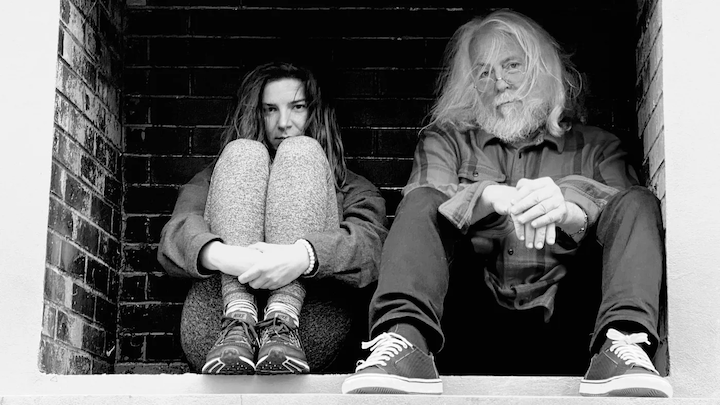
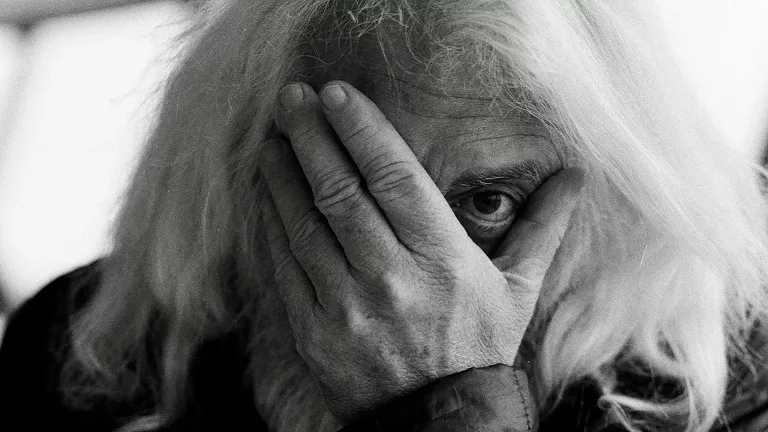
Robert Richardson: The White Devil, by Jana Hojdová. © CameRRaman
I didn’t really want to agree to film this documentary. You have tormented me.
Robert Richardson
The point here is not whether Robert Richardson made the right choices at the right times: only he knows. What emerges, more or less painfully (depending on how sensitive you are to the question), is an almost black-and-white opposition between throwing yourself body and soul into your work and your aspirations for a life with others. In essence, the movie says there can be no great career (read what you like into “great”) without sacrificing your family life, or more simply still your plans for one. No one can be the best parent while also being a celebrated DP.
So, is it fate? This documentary may inspire in us, to varying degrees, a harsh judgment of a man who would like to redeem what he now describes as failures: “you should have thought of that earlier,” we might write. But that would be to overlook his immense career and the three Oscars he has won (JFK, The Aviator, Hugo), along with his many other awards and nominations.
The issue could be summed up as owning your choices: in the end, whether we want a career full of success and recognition or rather a family life and a solid circle of friends, our choices are our own business and very few of them deserve criticism. It is when the two collide that the nature of our professions turns into a devouring monster, and that is this film’s verdict. Robert Richardson, from the height of his reputation, seems to want to say that he regrets nothing… while regretting a great deal.
Magic Hour
I didn’t think it would change our lives.
Hanna Mikuć
A curious family, the Sobocińskis. Piotr is a Polish cinematographer who graduated from the national film school in Łódź and began his career in the footsteps of his father, Witold (we will come back to that choice a little further on), himself a cinematographer and a Łódź alumnus. His wife, Hanna Mikuć, is an actress, and his three children will also end up working in film. Piotr comes to wide attention with his work on Three Colors: Red, which earns him no less than an Oscar nomination and a Silver Frog at Camerimage.
The film opens on the shooting of Twilight in 1998, directed by Robert Benton, with a cast including a certain Paul Newman, as well as Gene Hackman and Reese Witherspoon. We see a rather taciturn, introverted Piotr, who seems to exist apart from his surroundings while carrying out his job in a highly professional, deeply committed, even possessed way. Around that shoot, we meet his family, who have come to settle with him in Hollywood to share in the young DP’s success, and the narration by one of his sons (Piotr Sobociński Jr.) punctuates the documentary where needed.
Marcin Borchardt chose to build his project almost entirely from archival footage, most of it shot by Piotr, who filmed his daily life enthusiastically and down to the smallest detail. And little by little, a kind of unease sets in.
We understand, reading between the lines, that his father Witold still behaves like the dominant patriarch.
Piotr’s children would rather enjoy their father on weekends than be filmed from morning to night.
Hanna has given up her acting career to follow her husband and look after the children and everything else.
Piotr Sobociński had managed to balance work and family life early in his career, in Poland. His arrival in Hollywood breaks that balance and gradually turns a fulfilled man into his own ghost. Like an intense flash, his story comes to an abrupt end in 2001, on the shoot of Trapped, where he dies of a heart attack at 43.
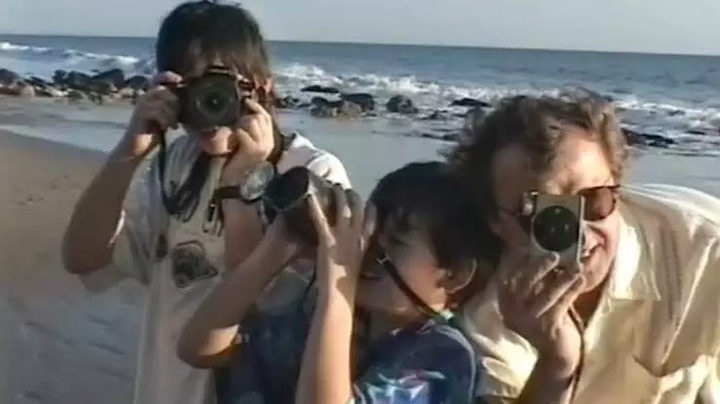
Magic Hour, by Marcin Borchardt. © Wytwórnia Filmów Dokumentalnych
My father didn’t force me into anything, but he gave me a gentle push in the right direction.
Piotr Sobociński
Several stories intertwine in Marcin Borchardt’s telling. The first, and the most obvious, echoes what we touched on in the first part: how to live a harmonious life, have a family, fulfill your role as a father… The second, barely more hidden, tells of the father-son bond across three generations and two very different relationships. Witold does not hide his bitterness at his son’s success, and he seems to poison, gently, deliberately or not, every gap he manages to slip into in order to reassert his role as patriarch. As for Piotr’s two sons, Michał and Piotr Jr., they express much the same impatience to enjoy their father as Kanchan and Maya do with Robert Richardson.
Magic Hour tells of a slow erosion, that of a man who finds himself more and more alone, literally abandoning everything he had built. He endured the pressure of his father and the pressure of Hollywood, and did not survive it: it is a tragic reality that these archives recount.
So, what remains of our choices?
The regrets Robert Richardson expresses in the present run all through the past reality of Piotr Sobociński’s life, and the two strike the same note. These two films, though they portray very different people and stories, leave us with a few questions as we walk out of the theater. And then again, these documentaries present two men (and in both cases women in their shadows, who gave up many of their ambitions), but we must not forget the reverse case of women cinematographers who want to have a child… or simply to live a balanced life.
Can we really reconcile the irreconcilable? With success, does it become necessary to sacrifice projects now and then in order to devote ourselves to those around us? Does the cinematographer’s profession, however exciting and intense, leave enough room for the wish for a family life, a social life?
Many questions, rather few answers: once again, our life choices are not up for debate; they are entirely our own. I simply dare to hope that, unlike Robert, we will not be left with lasting regrets when the time comes to take stock, and that Piotr’s tragic story will not be repeated for any of us.
To question ourselves is already to make the price of our choices real.