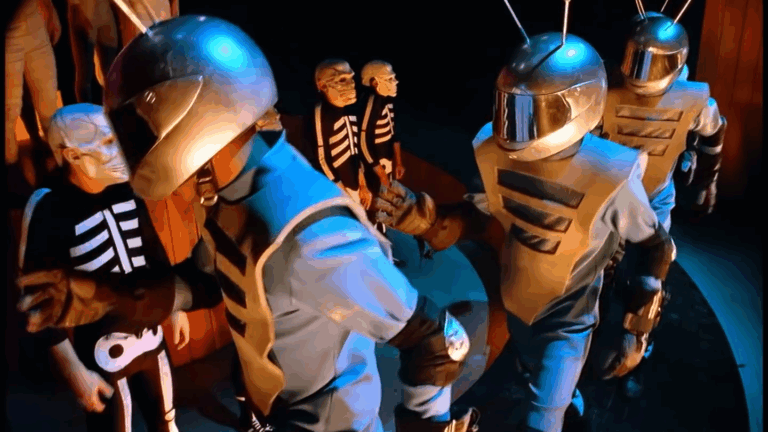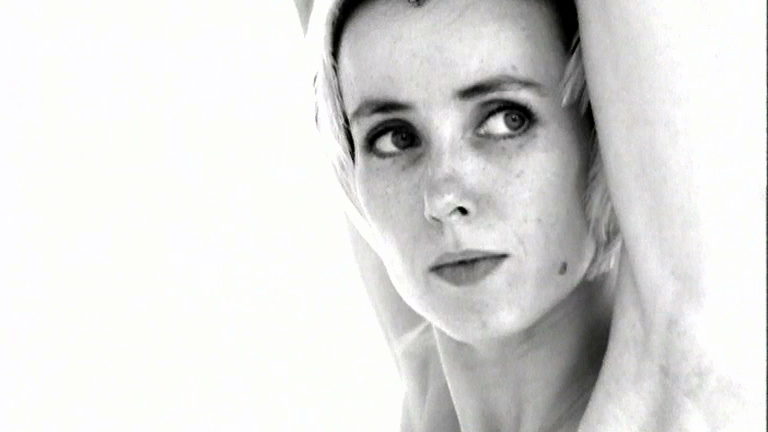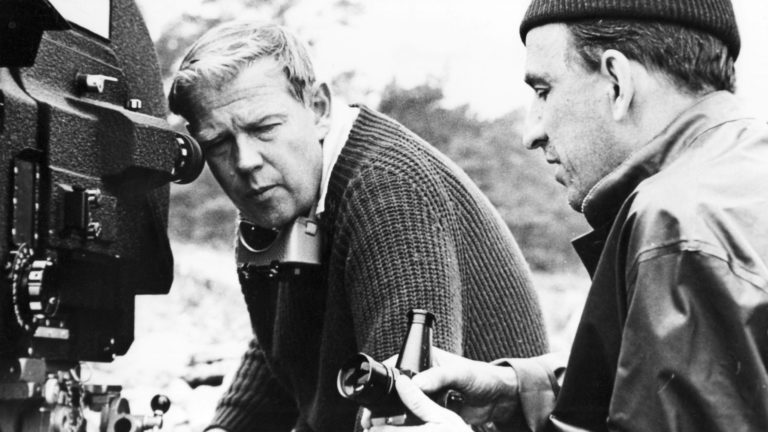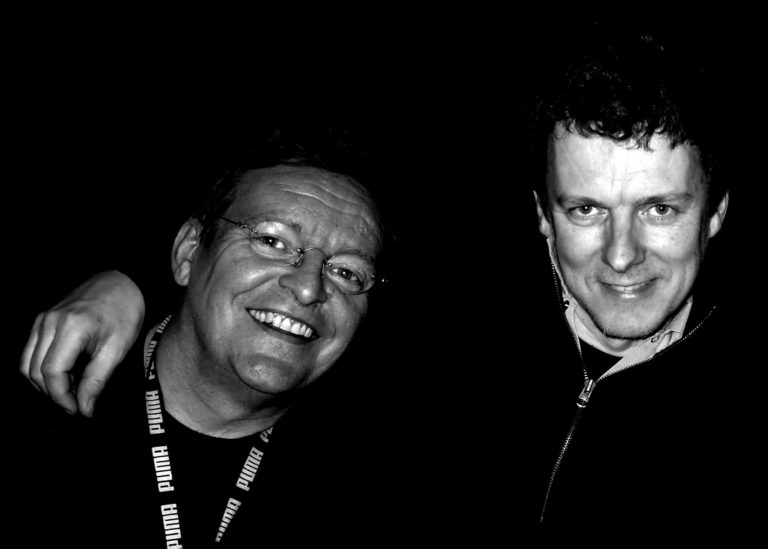
Michel Gondry and Jean-Louis Bompoint met in 1983 and began working together in the late 1980s, collaborating on many commercials, notably for Nike, Levi’s, and the famous Nespresso What else spot starring the unflappable George Clooney.
Their collaboration gave rise to legendary music videos, for the Rolling Stones and Radiohead among others; a documentary, The Thorn in the Heart; and a feature that became a cult classic, The Science of Sleep, in 2006. Gondry’s work is fascinating because many of his creations left their mark on a whole generation while keeping, years later, a certain air of mystery whose secret only he and his cinematographers know. Jean-Louis is one of them, and it is partly thanks to him that I was able to take up this profession. So it was only natural that he accepted my invitation and agreed, over the course of this interview, to share one of his memories from a shoot with us.
Jean-Louis, in 2007 you shot a music video for Paul McCartney called Dance Tonight, directed by Michel Gondry and featuring the wonderful Natalie Portman. It is a visually astonishing video, with Gondry’s trademark do-it-yourself feel. Still, it raises a few questions about how it was made, which is real illusionist’s work. I know magicians never reveal their secrets, but maybe you’ll make an exception and also tell us how the project came about?
– Michel called me and said: “We’re doing a music video in London with Paul McCartney, I need you, come and shoot it for me. There’s a huge set, several hundred square meters, you’ll need to go and scout it.” So the production company, Partizan, booked me a train ticket and I went over. I arrived at the studio, where everything was being built with Stéphane Rozenbaum, the production designer, and it was a bit of a surprise for me. Before I left, Michel had simply told me there would be a lot of camera movement and that he absolutely didn’t want to be hemmed in by lights on the floor. So I decided to work with lights rigged on the grid, so that the light would come from above, keeping the number of lamps on the floor to a minimum. What he hadn’t told me was that the set was built twice: on one side was the normal set with furniture, wallpaper, and everything you could want, and on the other side, symmetrically, was the same thing with black cubes and a black backdrop.
But Michel, the joker, hadn’t told me how it was all going to work, until at one point he called me: “So, how’s it going?” “Listen, not bad at all, I’ve figured out how to light it, etc.” And then, without explaining, he said: “So you’re going to do some tests with reflections for me.” I said: “Reflections of what?” “Don’t ask questions, trust me, do some reflections on the set and film those reflections.” So the production designer, who was in on the secret, rigged up a little room for me with, on one side, a set, an armchair, and props, and on the other a black backdrop, with a sheet of glass in between. I started working on it and finally understood what he wanted to do. I built the prototype, it worked, I went back to Paris, we sent it all to the production, and shortly afterward Michel told me: “OK, we can roll!”
Incredible, he really put you to the test on that one! But judging by the making-of, you two seem to have a great rapport!
– No surprise there: by the time we shot the video, we had already been working together for 20 years!
That certainly helps! Getting back to the video, you briefly mentioned how you lit the set. What kind of sources did you use: tungsten, HMI?
– As you know, I always mix sources, HMI and tungsten, on film stock balanced for 5600K. Up on the rig I had a mix of small sources such as Pocket PARs, Dedolights, and 300 W and 500 W Mizars, but also more powerful units fitted with Chimeras to concentrate and diffuse the light. It was a fairly substantial technical setup, with correction gels, diffusion, louvers, flags, and bounce boards, but most of the lamps were used direct, because the light absolutely had to be channeled and concentrated on the “dressed” part of the set and on the characters being reflected, without lighting the black backdrop.
We often see the ceiling on the set side, which rightly gives us the feeling of really being in Paul McCartney’s home rather than in a studio. Wasn’t that too restrictive?
– Yes, of course, it was an extra difficulty, so there’s no backlight when the characters are very close to the walls, but I worked a lot with the practicals, the set lamps, chandeliers, lampshades, and floor lamps, which were very useful for lighting. It was done hand in hand with the production designer; you’ll notice there are even lamps at the corners of Paul’s bed!
Indeed. And for the mirror side of the set, the dark part, what did you rig?
– As I was explaining, the big challenge of this shoot was lighting the characters on the black side of the set without lighting that black backdrop, which would have given the trick away and ruined the magic. So we used heavily diffused HMIs as three-quarter backlights, making sure, through careful use of flags, that only the characters were touched by the light. These HMIs produced a cold light that contrasted with the warm light on the set side. Natalie’s character occasionally got two key lights, one from below and one from above, usually placed near the glass at an angle such that the sources didn’t hit the black elements of the set. But to tell the truth, the rest of the time, for the extras and the big moves, I didn’t light anything, and that was the secret.
Really? That’s surprising! So what we see in reflection is sometimes just the indirect light bouncing off the lit part of the real set?
– Exactly, you’ve got it.
So did the characters we see in reflection wear special clothes, things that catch the light, special makeup?
– Yes, there was a huge amount of costume work. I don’t know if you noticed the characters: they weren’t dressed like everyone else, with spoons hanging from their costumes. It was very elaborate aesthetic work without being too technical. Besides white, some characters were covered with metallic surfaces made of aluminum foil and other highly reflective materials. As for makeup, Natalie had no special treatment; only the lighting enhanced her presence. A little quirk, and an anecdote: her dress was made of wooden beads because Paul McCartney had asked that there be nothing of animal origin on set. We all had to leave our belts behind, and those who had leather shoes went out and bought themselves a pair of sneakers. That was his one whim, and the only one, because Paul McCartney was extraordinarily kind, a lovely guy.
Did you operate on this video, and can you tell us about the camera setup?
– No, I didn’t operate, because I had to focus on adjusting and varying the light, which was entirely controlled from a lighting console. All the tungsten sources were dimmable, which was quite a challenge at the time, and, as you know, only the HMIs couldn’t be controlled. The operator was dressed all in black, in a suit made for the occasion out of matte black felt that absorbed light, like most of the set. We had a very light ARRI 235 with Cooke S2 lenses, plus a Zeiss 10 or 12 mm T2.1 for the opening rig-mounted shot. I had fairly deep focus, with a stop around 5.6 to 8; that’s something of a trademark of mine. Besides, given the unusual nature of this setup, with characters reflected on several planes in depth, it was better to see them sharp so as not to kill the effect, because you would immediately realize there was a sheet of glass.
Which film stock did you choose, and why?
– I chose Kodak Vision2 250D (5205) because it’s a versatile stock that handles both tungsten and HMI without oversaturating one relative to the other. It was the ideal choice, given that I had mixed several different sources. I want to stress that it matters to me that everything is done and locked in at the shooting stage: correction and diffusion filters go on the lights and on the camera, and charts and Macbeth charts are shot beforehand for each lighting setup. It is also very important to me that both the lab and the colorist respect the work done on set and print my images straight.
Did you work with your usual crew?
– Not at all, they were all British, but they were incredibly friendly; the gaffer was a lovely guy. We shot the exteriors in the English countryside in natural light, and together we did this wonderful work in the studio.
Did you use any special grip equipment on this project?
– No, just tripod and handheld for all the moves. Michel really likes that, and that occasionally off-level look, with accidents that make the effect even better. The only constraint was to always frame at a slight angle to the glass, so the operator’s body wouldn’t block the actors. That’s also why very few lights were placed on the floor, except for the angles that weren’t in the reflection.
Apart from the chroma key visible in some effects, was everything generally done in camera? And how did you make the plates appear superimposed?
– Almost all the effects were shot in camera. There was a very powerful video projector throwing light directly onto the characters in the lit part of the set. It was fairly complex exposure work, juggling between the incident meter and the spot meter while taking the reflected image into account to achieve the result. Not to mention the synchronization between the actors on either side of the set, orchestrated by our choreographer Blanca Li. The sparks, the projections, the light animations: it wasn’t easy, but Michel and I had a lot of fun. For the final party sequence in the basement, we really let loose: the electricians animated the lights with mirrors or by moving the sources, all the extras went wild, and Michel and I played drums with Paul in an improvised jam session. What a memory!
After this video, Jean-Louis shot the segment directed by Natalie Portman for the film New York, I Love You, rounding out his fiction filmography, which, besides The Science of Sleep, includes two other features: Grace Is Gone by James C. Strouse, with John Cusack, in 2006, and Broken Lines by Sallie Aprahamian, with Paul Bettany, in 2008.
Dance Tonight music video by Paul McCartney, ft. Natalie Portman. Director: Michel Gondry / Director of photography: Jean-Louis Bompoint / Production: Partizan Midi Minuit 2007 / Label: MPL Communications Ltd. under exclusive license to Starcon, LLC
https://www.youtube.com/watch?v=4NEQyJm87LY
Dance Tonight making-of:
https://www.youtube.com/watch?v=-lw5K7rbIqk