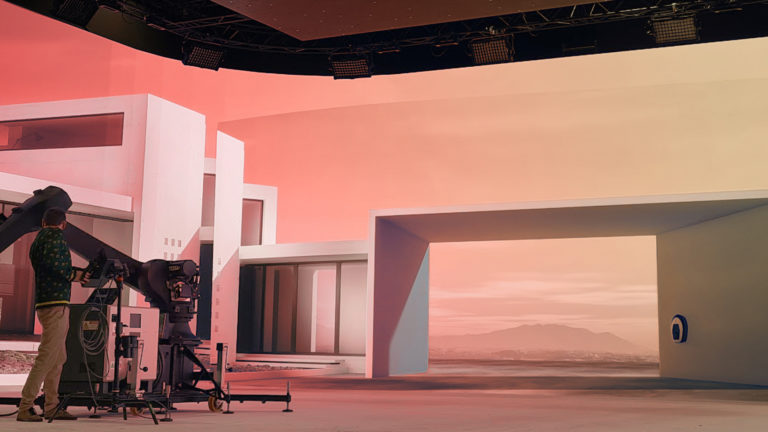
In late September, the inauguration evening was held for the new Plateau Virtuel studios, a 1,200 m² space at Porte de Versailles. Formerly based in Longjumeau at Novelty, the Plateau Virtuel group is now located in Paris itself, which marks a major change and a huge advantage for many productions.
The evening opened with a presentation by Bruno Corsini, Plateau Virtuel’s lighting director and partner. Sets built in Unreal Engine (a 3D video game creation engine) are projected in real time onto LED panels linked together to form a large curved screen. Thanks to a tracking system, the set’s perspective (parallax) shifts in sync with the moving camera, creating an illusion of continuity between the foreground and the projected set.
In addition to the vertical screen facing the camera, there is also a ceiling of LED screens that generates colour bounce from the set’s environment, as well as reflections on reflective surfaces such as cars or glasses. Combined with Unreal Engine, the Smode software makes it possible to disregard the screen’s edges, and so to shoot a virtual extension of the set beyond those edges for wide shots. Actors can also pass behind virtual objects recreated in 3D.
Demo videos and further information on the Plateau Virtuel website.
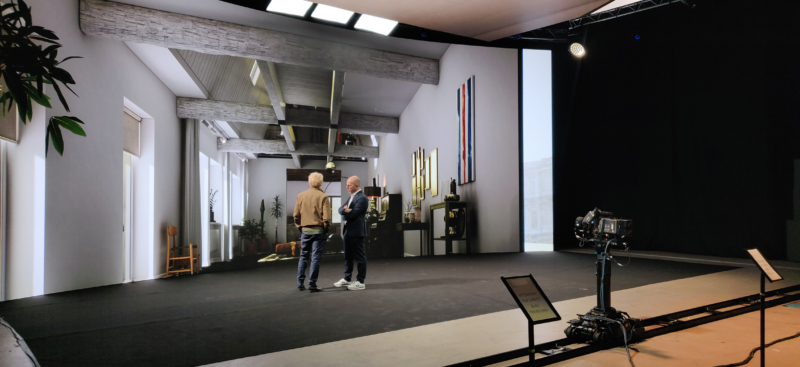
Photo credit: Nicolas Pradeau
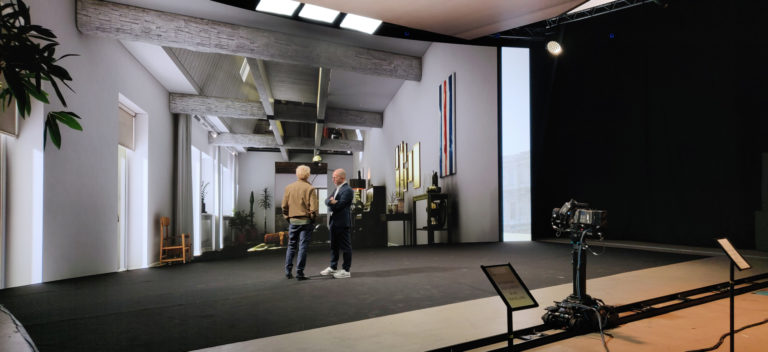
An auto-tracked Arri Amira was set up on a dolly during the evening, fitted with a Laowa OOOM 25-100 lens, and monitors were placed around the room to show how the set responded as it moved.
On top of this, a phone-mounted rig fitted with a tracker was set up so that we could interact with the set and keep footage of these tests. These allowed us to get a real-time sense of the constraints and advantages of the virtual set, and to observe the responsiveness of the sets, the dynamic range, the contrast, aliasing, flicker, and the reflections of harder or softer sources on the screen.
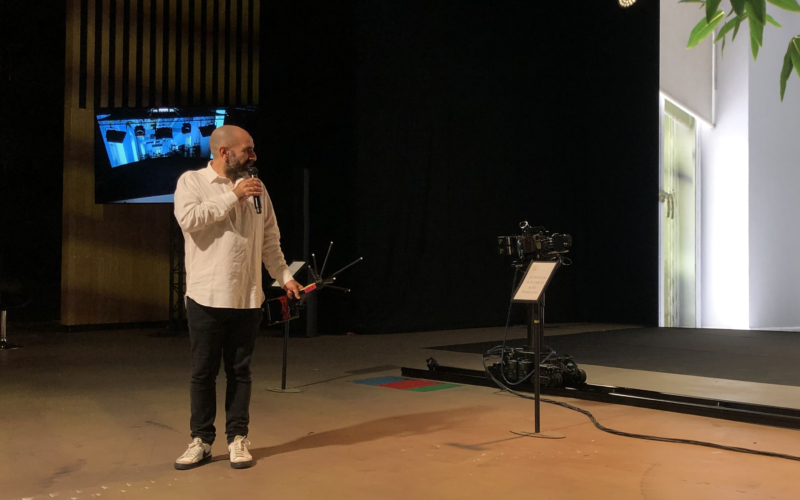
Bruno Corsini presenting the phone rig fitted with a tracker
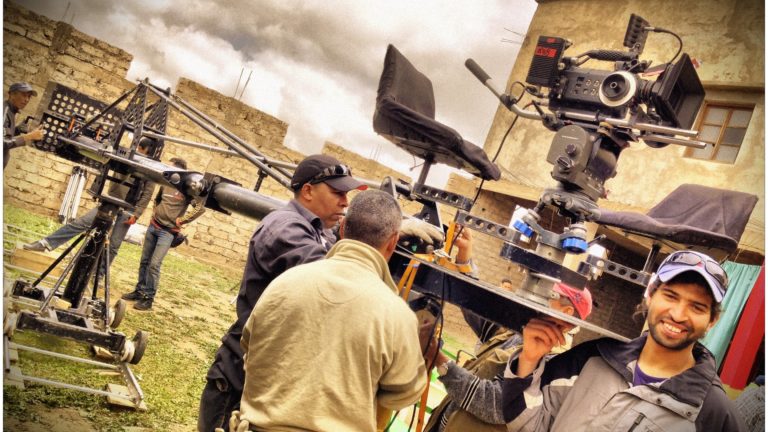
The screens are fully demountable and can therefore be transported to a shoot, for use on a location recce for example.
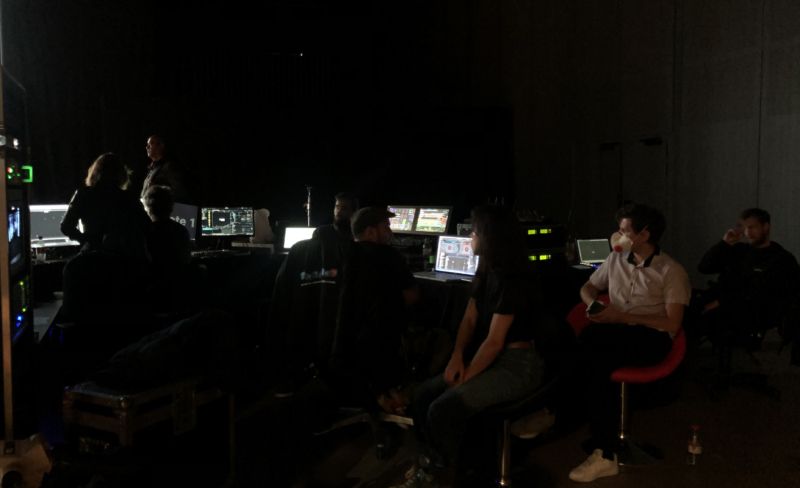
The team of technicians and operators for Unreal Engine, LED screens and OptiTrack
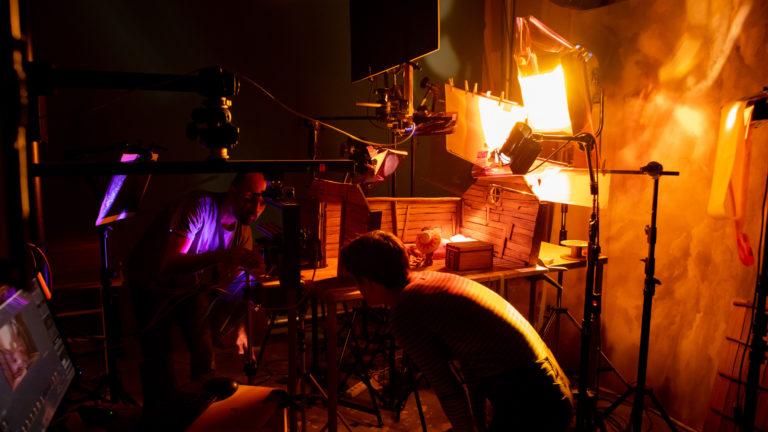
Plateau Virtuel’s LED screens open up new possibilities for fiction, music videos or advertising. What’s tricky with green or blue screens is lighting them, avoiding a green or blue colour spill onto the actors and, above all, not seeing the sets that will later be composited in. On a virtual set, on the other hand, the brightness of the LED screens facing the camera and overhead matches the brightness and chrominance of the environment. This is a very compelling solution for car sequences, or those requiring the recreation of lighting effects on characters — particularly moving light, such as a fire effect. By judiciously combining lighting fixtures and screen, it becomes possible to achieve a realistic fire effect on close-ups, with moving shadows and flame reflections, rather than a simple flicker from a dimmer or reflector.
On the other hand, filming in front of a screen brings other constraints and factors into play, such as realism. Indeed, if focus is pulled onto the screen itself, there is a risk of moiré. Conversely, if the depth of field is shallow and the vertical background is out of focus, this creates a flat, non-graduated blur — the same level of blur for objects meant to be near and those meant to be far away. This makes the presence of a screen felt, rather than a real set. Furthermore, because of the software’s processing speed, the frame rate is for now capped at 50 fps.
A shoot on a virtual set is a solution that obviously does not replace green screen, but offers complementary possibilities. It requires a great deal of preparation, thought and testing ahead of the shoot, particularly to shoot the “peels” beforehand. On the other hand, it can save enormously in terms of human resources, equipment and logistics on set, as well as in post-production. It also brings a not-insignificant comfort of immersion to directing and to the actors’ performance, directly impacting the final result, while also allowing for faster, more efficient shooting.