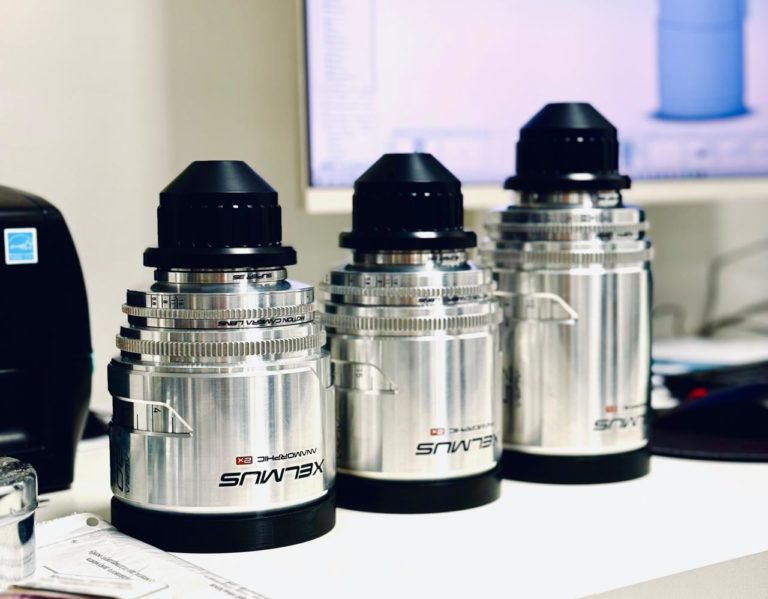
Every year, the Camerimage Festival is an opportunity to meet new manufacturers and get hands-on experience with the various tools contributing to the constant evolution of our craft and industry. For the 2024 edition, in a market that felt more stripped down compared to previous years, I had the chance to speak with Oleg Krasyuk, founder of Xelmus, a Ukrainian manufacturer of anamorphic lenses, including the Apollo series.
Xelmus, founded in 2018, is based in Kharkiv, a city in eastern Ukraine that has suffered greatly—and continues to suffer—from the Russian invasion that began on February 24, 2022. With Oleg, we discussed his passion for optics, for starting his company, and the challenges of sustaining that passion in a society beset by an ongoing war.
Vincent Tartar: There are two aspects I’d like to discuss. First, I’d like you to explain the technical process behind creating your lenses and what led you to found Xelmus. Then, I’d like to understand how it’s possible to carry out such a project in a country at war with Russia—how do you find the strength to keep going?
Let’s start from the beginning: how did the Xelmus adventure begin?
Oleg Krasyuk: Initially, I was a videographer. I’ve always been fascinated by the aesthetic of anamorphic imagery. To me, spherical images are just… normal. They don’t really transform reality. It’s not that anamorphic radically transforms it either, but when you look at an anamorphic image, there’s something truly different and beautiful about it.
I think anamorphic better aligns with our natural vision. Putting aside the bokeh, consider the field of view: when you open your eyes, it’s the same breadth you find in anamorphic. And on the edges, the image isn’t entirely sharp—unlike spherical, where everything is uniformly sharp. In anamorphic, the sides, the top, and the bottom retain a certain clarity while being softer.
I started with a Canon 5D Mark II. I bought an adapter on eBay for $300 and mounted it on a lens. It was complicated to use because you had to deal with dual focus. I wanted to synchronize the elements to have a single focus system, like on a standard lens. It was tricky but not insurmountable. The system was based on the Lomo style, with a square front where the optical elements are synchronized: when the anamorphic element moves, the spherical element moves simultaneously to maintain focus. I worked on the mechanics to couple the two focus systems, making the lens more natural to use.
That was my first lens, one I made for myself. Then I went through a tough time. In our country, we experienced high inflation. I decided to sell the lens because it wasn’t bringing me enough work. People in our country don’t have much money. I continued shooting projects for myself, but it wasn’t enough. So, I decided to sell it, and when I posted it on a forum for anamorphic lenses, many people showed interest. I thought, “Okay, it took me about 20 days to make this lens.” I decided to make more and sell them.
For my first lens, I used a Kowa 16. I started making more. Then I met people who suggested I make everything myself rather than just working with existing lenses. I started considering it, but it wasn’t simple—you can’t just walk into a store and buy parts.
It was a long journey to understand all of this—how to design an anamorphic system, the programming, all the knowledge involved. At first, I had help from someone with an advanced degree in optics from Kiev University. They train people for this. With their help, we began ordering glass, manufacturing it, and running tests. It didn’t work perfectly at first. But after several improvements, things began to take shape.
VT: When exactly did you start?
OK: It was in 2018, about six and a half years ago. For the first lenses, I used various combinations, like Nikon 1.4 or Mentex lenses. Not Helios, though, because even though they look good with anamorphic, they have a rather harsh bokeh and don’t let much light through—f/2 becomes T2.3 with anamorphic, so it’s quite dark.
VT: How many people are on the Xelmus team?
OK: At first, it was just me and two people helping me. Now we’re six. We don’t need more because we’re not doing mass production. What we do is artisanal, custom work. We decided on a smaller team because it made things simpler.
VT: How has the industry reacted to the Apollo?
OK: People started ordering them, renting them out, and some cinematographers really liked them. I didn’t have to ask for anything—they tested them, and it worked because they performed well. I think it also helped that they were full-frame. At the time, there weren’t many full-frame lenses, which was a big advantage for cinematography.
VT: And the Aura?
OK: We started thinking about it two and a half years ago. It took almost three years to finalize. The optical design is complete, as is the coating. For these lenses, we took a different approach—we calculated everything ourselves, without outsourcing. We use Zemax OpticStudio, software that lets us see the resolution, field of view, and bokeh. We can simulate everything before manufacturing.
Even with these simulations, when we ordered the first prototypes, they didn’t work exactly as expected. Software is just software—you can’t predict everything. We had to tweak things and adjust based on real-world results.
Now we’re starting to make our own glass. We have the equipment, but when we started, the war broke out in Ukraine, making everything incredibly difficult. Supply chains were disrupted, and there aren’t many people left in Ukraine who can do this work—many have gone to war.
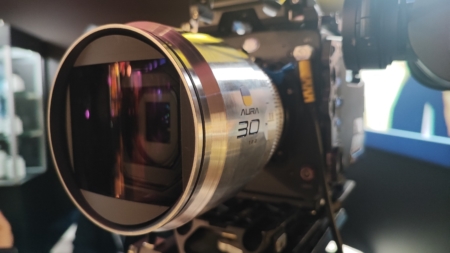
The Aura prototype
VT: Have any team members gone to the front?
OK: Yes, three people from our team joined the army. It’s really hard because many professionals have gone to war or may even have been killed. It’s a tough time.
But we try to keep working because, for me, it’s my only way to live. I love optics so much; I love the image. Every day since starting the company, I check tests and look for ways to improve our products. That’s what inspires me to keep going—I really want to see that beautiful image.
When we started working on the Aura, we studied all the anamorphic lenses on the market. We analyzed every system to see which worked best, and then we created our own lens based on what we liked.
VT: Why did you choose the S35 format?
OK: For the Apollo, I was advised to go full-frame because it was the trend. But personally, I think anamorphic looks better on S35. I don’t know why, but for me, a 50 on S35 is how it should be. Full-frame is beautiful too, but I still think S35 anamorphic is the best.
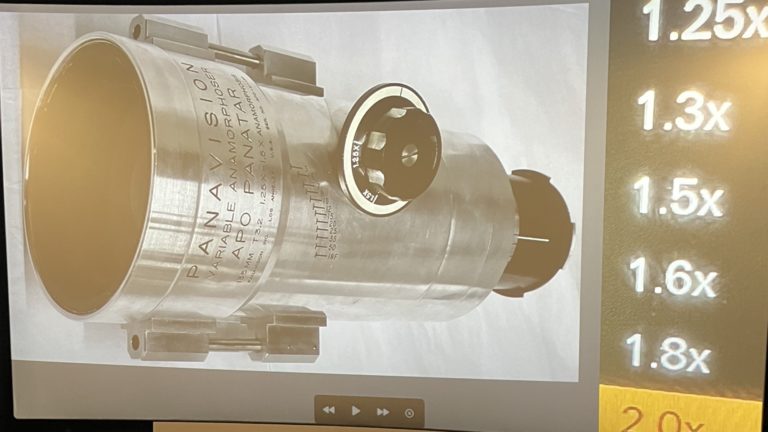
We also wanted to offer something different. And always in 2X, because I think that’s true anamorphic. Even if few people can tell the difference between 1.8x and 2x, for me, the result is significantly better.
VT: How do you manage production during the war?
OK: When you’re doing something you love, you never stop. You may face problems and pause momentarily, but you solve them and move forward. We relocated part of our team to the west, near Lviv, which is safer. We do some of the work in Kharkiv and some in the west. But nobody is truly safe in Ukraine right now.
VT: How do you envision Xelmus’s future?
OK: I see a future where we keep creating new products—interesting ones for people who truly want that cinematic image. It’s hard because there are already so many lenses, and you can’t radically change things. You can only tweak them slightly. It’s really challenging to create something truly original and new, but we keep trying because that’s what we love to do.