Benefiting from the announcement of a Vittorio Storaro ASC, AIC masterclass regarding his work with director Bernardo Bertolucci, the Arri Rental company wanted to take a look back at an unsurpassable icon of the german brand : the ArriFlex 765, a camera paradoxically arrived too late and too early in the cinema history.
Creation
Stakeholder for Arri Rental, the excellent Sasha Mieke presents the 765 genesis. The need for a large format but compact camera is felt from the 70s. The influences issued from the French new wave and then from the New Hollywood disrupt the codes of directing. It is about leaving studios, shooting lightly with direct sound and maintaining the large format unmatched quality.
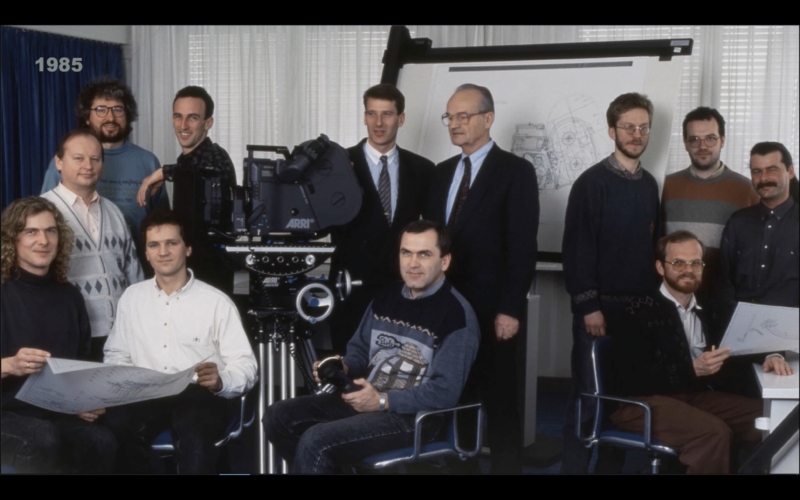
A design office was therefore founded in Vienna (Austria) from 1983. Bringing together a dozen engineers and technicians, the team decided to start from scratch and by dint of prototypes, a first version of the camera was presented in 1987. Ultimately, 10 cameras assembled manually will come out of the Arri workshops. Extremely modern, the carried researches during prototyping will find use to the future generations of the brand’s cameras, such as the 535 (1990), the 435 (1995) and to future Arricam LT and Studio (2000).
Characteristics
From a technical point of view, the camera thus uses the 65mm 5 perf format with a vertical scrolling film, less bulky than the Imax format with horizontal scrolling on 15 perf. The print window size measures 52,5 x 23mm for a 2,2:1 ratio. It is fitted with a variable shutter (from 180° to 15°) and can shoot from 12 fps to 100 fps.
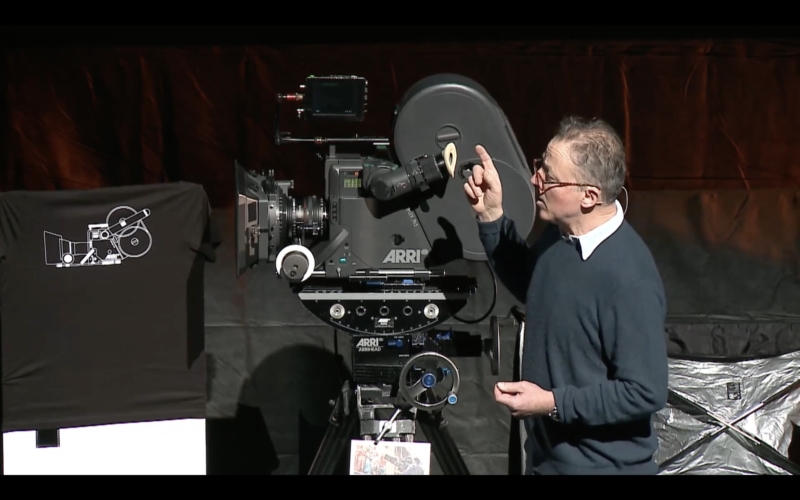
The 765 offers a reflex sight and comes with a Hasselblad optics series rehoused for cinema needs. It is worth mentioning a very specific mount : the Maxi PL (64mm diameter / 73.5mm flange distance). The focal lengths range from 30mm to 350mm open between 2.1 and 4.2, the 110mm being considered the normal focal length in this format.
Arri’s “compact” camera is nonetheless 57cm long, 37cm wide and 40cm high. Its weight without optics or accessories is 32kg with a 150m magazine (a 300m one also exists). It is self blimped and therefore relatively silent, the noise not exceeding 25dB at 24fps.
Filmography
In no time, the camera seduced the world of commercials. In 1989, director and cinematographer Siegfrield Steiner used several of them for BMW campaigns. The camera’s compact aspect allows easy rigging. The cinema also takes hold of the 765, especially Ron Howard for Far and Away (1992) or Kenneth Branagh for Hamlet (1996).
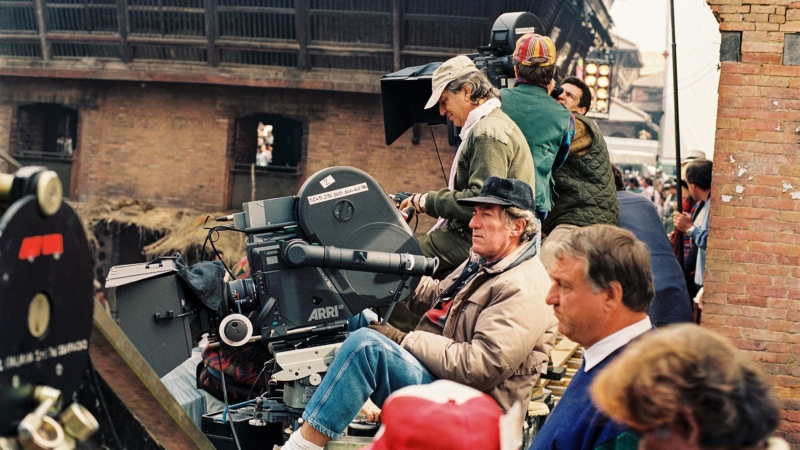
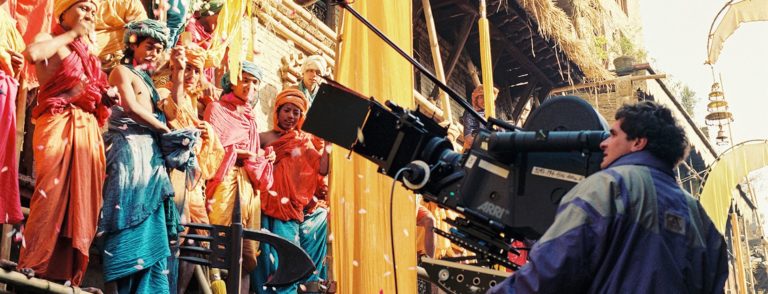
However, it is Bernardo Bertolucci’s Little Buddha that will make an impression. Shot in 92 in India, Storaro’s cinematography is magnified by the 65mm’s quality. It is a huge test for Arri caregiver technicians accompanying the four cameras across the subcontinent. The gear suffers, many technical reports travel between India and the Arri workshops. The movie is released in 1993 and is a critic and public success. On the same year, Arri, chief designer Otto Blaschek and his team will receive the “Scientific and Engineering Award” by the Academy of Motion Picture Arts and Sciences for their work on the ArriFlex 765. But the advent of Super 35 on the market allowing the use of a larger surface on film holds back the 65mm, already very expensive to employ.
The 65mm makes its comeback in the 2000’s, despite digital cinematography’s emergence. Blockbusters such as Sunshine by Danny Boyle (2007) or Gravity by Alfonso Cuarón (2013) are looking for a great resolution for their effects and can afford the excellence. Many big production movies will follow such as the latest James Bond No Time To Die by Cary Joji Fukunaga (2021). Film lovers Quentin Tarantino and Christopher Nolan embrace large format for their new productions. Taking advantage of the best of both worlds, it is shot in 65mm with digital post-production, thanks to today’s scanners quality. Although the phenomenon is uncommon, more modest film d’auteur gets hold of 65mm to “record the intimate” on the set of The Death & Life Of John F. Donovan by Xavier Dolan (2018).
Film
Who says 65mm camera, necessarily says film !
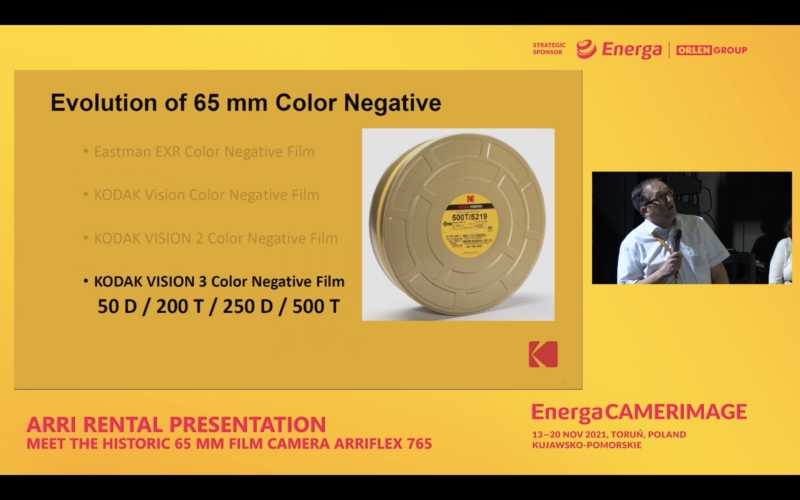
Kodak, represented at the seminar by Holger Schärzel, came back on celluloid’s historical and aesthetic contribution. Latest Kodak films generation, Vision 3 technology are available in 65mm according to the four traditional sensitivities : 50D, 250D, 200T and 500T. Praising film shooting advantages, especially greater thoroughness on set, Holger Schärzel enthuses : “It’s a choice for a cinematographer!”.
Andrew Oren from the American laboratory Fotokem participates from Los Angeles to bring up post production around the large format via an 65mm 8K scan (3 frames per second!), for VFX and for restoration and remastering as well. To support projection lovers, he mentions a few cinema theaters still providing 70mm screening.
The paradox
Out of the 10 ArriFlex 765 units manufactured, only 7 remain in working condition and from Arri’s staff’s confession, they will no longer manufacture them.
Here is the paradox of this outstanding camera. Despite all its qualities, the 765 showed up at the wrong time in history. Too late for the large format heyday in the 60’s and 70’s, struck by induced costs (rental, film, lab), soon after challenged by the Super 35 arrival, and then by digital. Too early to take advantage of the new craze for 65mm quality, especially thanks to 4K/8K film scan.
The ArriFlex 765 is still available at Arri Rental !
> Crédits photo credits : Arri Rental, Camerimage