Polish cinema of today is a cinema of reality, as reflected by the selection at Camerimage in the Polish films category.
Wether it is observation of a drama, study of a situation, the Polish authors who count today (M. Szumowska, J. Szelc, J. Holoubek…) do not try to make us discover a fantastic universe, a fantasized reality. On the contrary, they immerse us in concrete real situations, sometimes historical facts (cf. 25 year of innocence, J. Holoubek)… Bartosz Kruhlik is no exception for this first film he shot just after finishing his studies at the Polish National Film School in Lodz.
Much acclaimed during this strange year due to the health crisis, Supernova has won everything in Poland or almost everything (Grand Prize at the Gdynia Festival, running to represent Poland at the Oscars …). We can only hope that this new generation of authors will come and shake the dust off the Polish cinematography which still relies a lot (too much ?) on its dinosaurs (Wajda, Polanski, Holland…).
Young directors, young cinematographers, low budgets, more independent productions, Polish cinema indulges in everything, but does it really innovate ? At first glance, in Supernova, there is nothing really revolutionary in the narrative or the image. A drama developed in 3 acts and respecting the basic units of a classic narrative (unit of time, place and action). Hand-held camera that follows the rules and discoveries of the Nouvelle Vague. A lack of audacity ? Unlikely, because in his film Bartosz Kruhlik is daring in the subject without any self-restraint. It is at this level that the choice of a very classical narration, easily mastered and quickly intelligible by the viewer, seems justified, contrasting harshly with the acidity of the portrait he makes of his own country. He portrays an aging Poland, entangled in an often absurd Catholic mythology, at best helpless in the face of a corrupt government and apathetic representatives of the order.
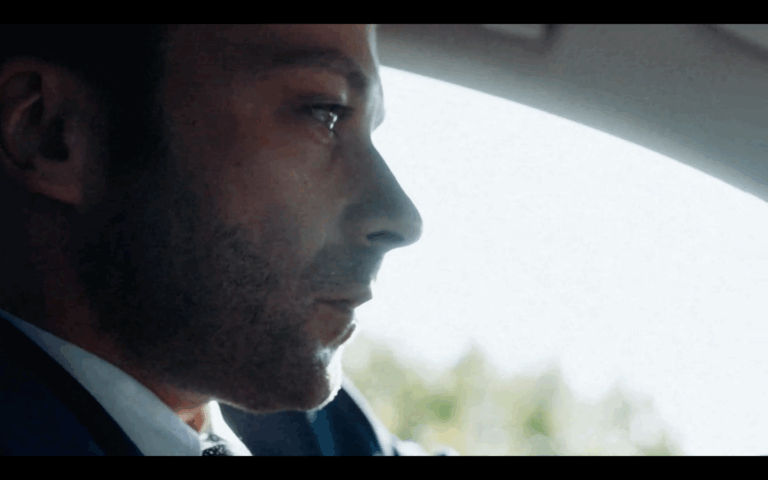
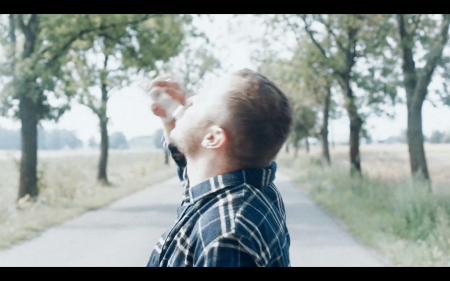
The critique is harsh, it leaves you with the impression of a hangover , like the one of Michał, the alcoholic husband of the victim and the character who really opens the film. In the image, the excessive intensity of light, the radiant whites (probably obtained by the use of a white promist in front of the lens) constantly bring us back to this unpleasant sensation of a temporary photophobia. The handheld camera moves between situations, observes faces, passes from one to the other. It is a camera that is scrutinizing while being unable to remain fixed, the spectator’s eye, his “balance”, is challenged as if to dizzy us.
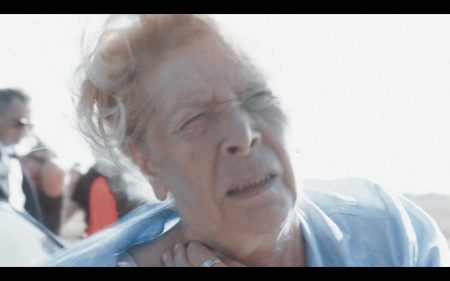
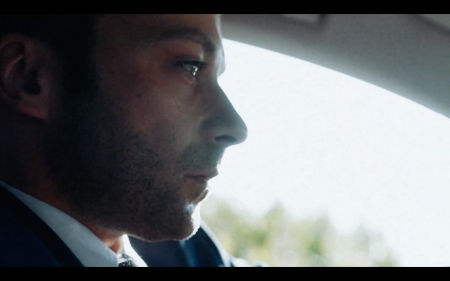
Criticism of a corrupt state, of a pervasive church that is not sufficiently helpful, of a police force incapable of protecting and serving, Bartosz Kruhlik’s film is mastered from beginning to end.
The epilogue supports this hopeless conclusion that nothing will change: a couple with a young child drives up to the site of the drama. Too far away to see what is really going on, they decide, after a few moments of immobility, to simply turn around and go home. In the same way, the author seems to tell us, all revolutions end up exhausted and disinterested. In the same way, is young Bartosz provoking us by proclaiming that nothing is better than old recipes and that there is no point in trying to revolutionize form ?
By naming his story Supernova, Kruhlik engages the analogy between the star in its particular state and his film. The definition given at the end aptly reminds us that a destruction is nothing other than the premise of a rebirth. Here Kruhlik is probably referring to the state of Poland more than to his art. Nevertheless, could it be that this young author is also predicting the death of this “old cinema” based on the rules of classical dramaturgy? In any case, his mastery of cinematographic know-how, demonstrated with this first film, makes one want to follow his evolution.