September 1, 1905. A 17-year-old seminarian is arrested for the murder of a 12-year-old child. To understand his act, doctors ask him to recount his life from childhood to the day of the crime.
Based on the true story of Bruno Reidal, a young peasant from the Cantal who struggled all his life against his murderous impulses.
Bruno Reidal (released internationally as “Bruno Reidal, Confession of a Murderer”) is the first feature by Vincent Le Port (Le Gouffre, medium-length film, 2016). Selected for Critics’ Week at Cannes in 2021 and at many festivals, the film was released in French theaters on March 23, 2022, to critical acclaim.
Cinematographer Michaël Capron (Fort Buchanan, Benjamin Crotty, 2016; De la terreur mes sœurs, Alexis Langlois, 2019) also makes his feature debut with Bruno Reidal. Vincent and Michaël met at La Fémis, from which they graduated in 2010.
How did you begin your shared discussion about the image?
V.L. For us, the discussion started with the script, without any reference images.
When you write, do you necessarily start from literary material, or do you sometimes start from an image?
V.L. For this film, in many sequences, I had no images in mind. The script does start from literary material. For Le Gouffre, I had more precise images in mind. Here, I couldn’t really visualize things: wide shot, close shot, movement or not. It was more open. Since the writing and prep took a long time, a body of work inevitably built up in our references, along three lines: period films, teen movies, and killer (or psychopath) films.
M.C. The discussion was rich in references, but they were very abundant, and sometimes even very scattered. There were many period photographs. We mustn’t forget that the film opens with an identification photo scene that follows the principles of police anthropometry introduced by Bertillon in the 19th century. He had created a protocol-based filing system meant to classify and monitor criminals.
V.L. For a long time, the script began with the scene in the medical examination and photography room; the idea was for the directing to take over from the doctors and photographers.
M.C. The outlook of the time was shaped by the idea that through the objective eye of photography, by observing the outside, one could analyze the inside of a human being, and in a way probe their mind.
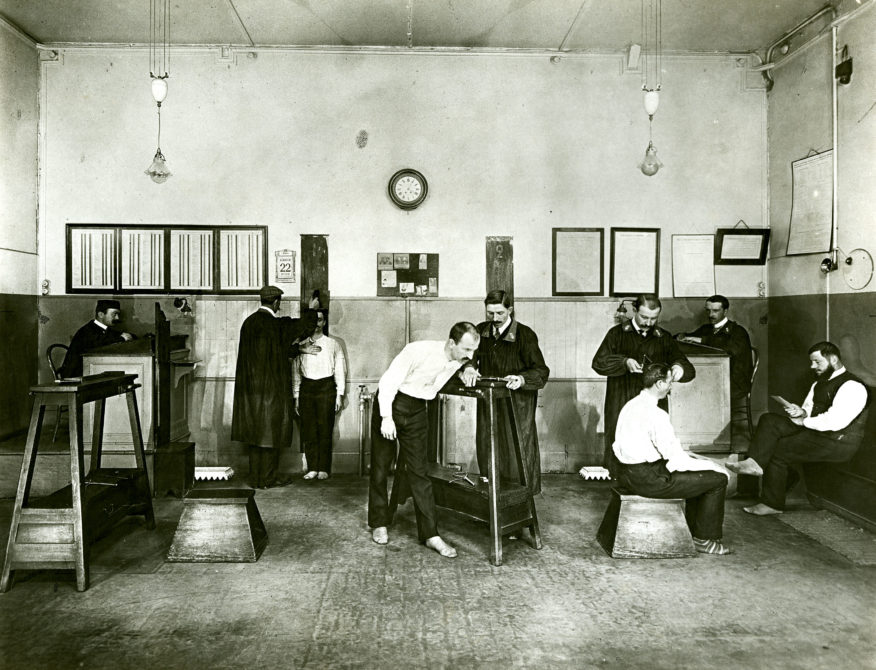
Speaking of which, in the framing we often find a certain orthogonality, a pronounced symmetry, reminiscent of identification photos. There are shots in the film that start out blurry and chaotic, then everything falls into place in a harmonious composition with the human being at the center; and at the same time, the gaze on Bruno is not a doctor’s cold gaze, but rather an empathetic, human one, which pulls off the very risky feat of empathizing with a killer. How did that gaze translate into concrete choices, like focal lengths or camera height?
V.L. There’s one thing we didn’t consciously forbid ourselves but never considered as an option for the shot breakdown: playing madness through short focal lengths and canted frames, which can work in some films, like Angst (released in France as Schizophrenia, Gerald Kargl, 1983), but for us it had to be medium focal lengths, centered, with clean, limpid frames, always leaving headroom, in close-up but never cutting off the top of the head. Headroom keeps the frame from being directive.
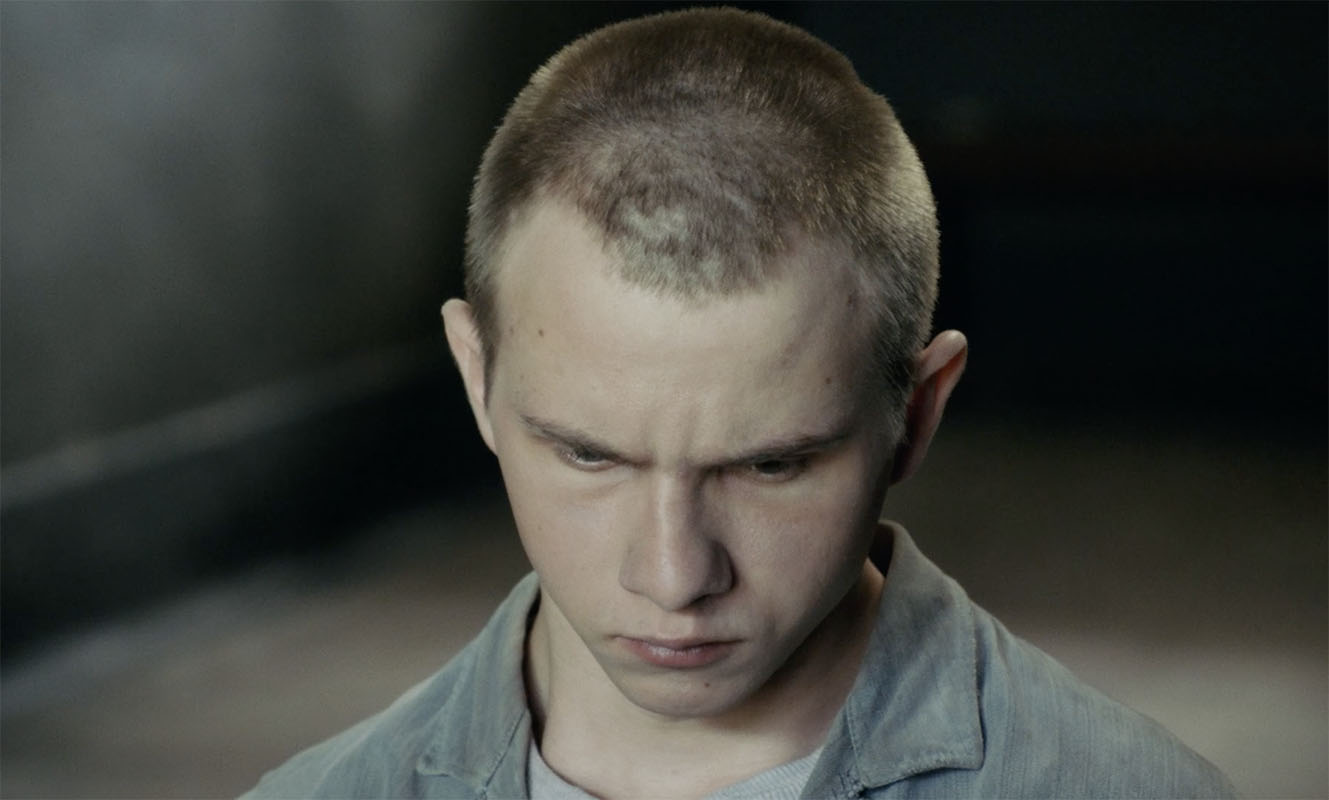
I imagine the choice of the 1.66 aspect ratio came out of this discussion?
V.L. It took us a while to make that choice. We hesitated between 1.37, 1.50, 1.66, and 1.85.
It was a kind of neutrality that led us to choose 1.66, but perhaps also the sets: we didn’t want to go too wide, so as not to film the period reconstruction too much and to stay focused on the characters.
It was also Michaël who convinced me: after the scouting, we put masks on our photos and in the end chose the ratio that seemed most right.
There is a more photographic dimension to 1.66, which is close to the 24×36 ratio.
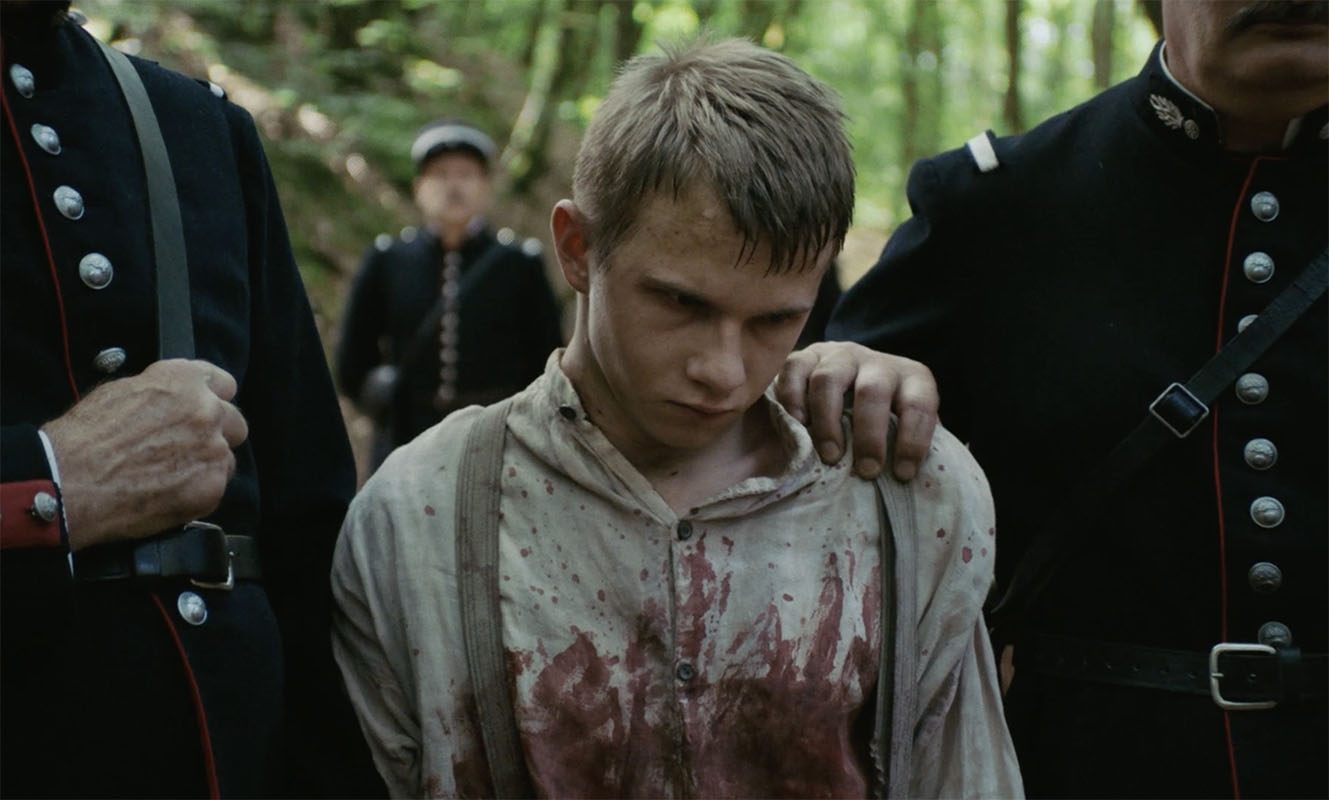
Another very consistent element in the film is the way Bruno’s relationship with institutions is filmed: psychiatrists, priests, gendarmes. The church scenes, for example, or the first sequence where he turns himself in to the gendarmes, are shot from a high angle. And yet it isn’t the church’s or the gendarmes’ gaze that is cast on Bruno.
I find the same consistency in the directions of light, for example in that shot at the beginning of the film where he turns himself in to the gendarmes after the murder, and we feel a door opening on his face: Bruno comes from a bluish, natural, nocturnal world, and he is lit by very yellow artificial light.
M.C. It’s true that in this sequence the off-screen space takes on a very strong dimension, since we never shot the reverse on the gendarmes, who remain entirely off-screen.
V.L. There’s a look into the camera in that shot. Sometimes I find that immodest, but in this case the choice was obvious. We had done takes where Bruno looked elsewhere, not into the lens, and it was false, it didn’t work. And it’s true that we’re not in the gendarmes’ place, we’re in the door’s place… we’re in a space between him and the institutions, and the film sits exactly there.
It’s funny, because we didn’t conceptualize that shot at all; the framing and lighting choices were made quite spontaneously. We had also done a whole piece of work on electricity, because the film is set in 1905, at the beginning of electric lighting. We had decided that the institutional places (the prison cell, the gendarmerie) would have artificial light, whereas the farm would not. We even held a “casting” of filament bulbs. In the end, we didn’t keep all that in the edit.
As for color, the seminary and the prison share the same palettes, mostly grays; that choice came naturally, to create a link between the institutions.
To me, the film is “painterly,” but not at all in the same way as Barry Lyndon (the reference you can’t help thinking of for a period film, also because of the zoom moves that are so present in Bruno Reidal).
The aim is not to recreate a great painting by zooming in on a detail where the human being regains their place, as in Kubrick. I find the film painterly in the way its light is built: the light is often frontal. What makes the image is not marked directions of light, nor chiaroscuro, but choices of sets and costumes that create a color palette.
In the directions of light, we almost systematically have frontal light on Bruno and backlight on the characters who embody the institutions, especially in the interview sequences with the psychiatrists.
M.C. It’s true that the psychiatric interrogation room was a hard location to find, and in the one we chose, Bruno was bound to be lit frontally and the psychiatrists backlit. I was actually a bit worried about cutting the shot/reverse shots in these sequences: alternating the blown-out light behind the professors with the shots of Bruno could have been tiring for the eye, or created a certain imbalance in the professors’ exposure values. We actually spent more time on these sequences to find that balance in the grade.
V.L. Those were indeed the longest scenes to edit and to grade. We had to be able to read the psychiatrists’ faces without canceling out the backlight. Throughout the film, we tried not to have lighting or framing that was too directive, too intentional, too expressionistic. It had to stay realistic.
In the farm interiors, the light is much less frontal; the openings are to the side, and we oriented set elements, like the bed, accordingly. It’s true, though, that elsewhere the light is frontal, or else, in nature for example, I really wanted us to shoot sometimes with overhead midday light, even if it was less beautiful, because I wanted to feel a crushing “lid,” with no shadows.
In the choice of sets, the institution always looms over Bruno: in the interrogation, with that platform, for example. How conscious was that? It doesn’t feel expressionistic; Bruno isn’t crushed; there’s always a fine balance between focal length, camera height, and set.
V.L. Typically, for the examination room we did some iconographic research and chose the photo of an interrogation room with a slightly raised platform, without it being theatrical.
It lets us embody the contradiction between the line at the beginning, “Bruno, we are not judges,” and the fact that the psychiatrists sit on a platform while Bruno is shut away on a kind of island… even if the psychiatrist character feels empathy, the relationship is always very distant.
There are several scenes that are practically re-creations of period photographs, like the first zoom out on Bruno’s family. And it’s interesting, because these zooms don’t go all the way; we’re not in Kubrick, maybe also because you didn’t have the same means.
Nor are we in pompous historical cinema; it’s subtle, it’s precise, an in-between where we’re not filming extras but giving humanity to every secondary character: Bruno’s mother, his brothers and sisters, each has their own identity.
V.L. That zoom went further, and in the edit, when we went all the way, we slipped into period-reconstruction cinema, because you’d notice a detail of the set or something else, and instead of being with this little peasant describing his family to us, we entered the “beautiful period reconstruction.” When you have Kubrick’s means, you can zoom out to 12 mm and it still works; we tended to stop at 35mm. Otherwise the risk was wanting to film the crew’s conscientious work. Jean-Baptiste Alazard, the editor, was very good, because of course you know it took you four hours to prepare your beautiful shot with your extras, and you want to keep it, but in the end it doesn’t serve the story. That, I think, is what makes the film hold up in terms of reconstruction.
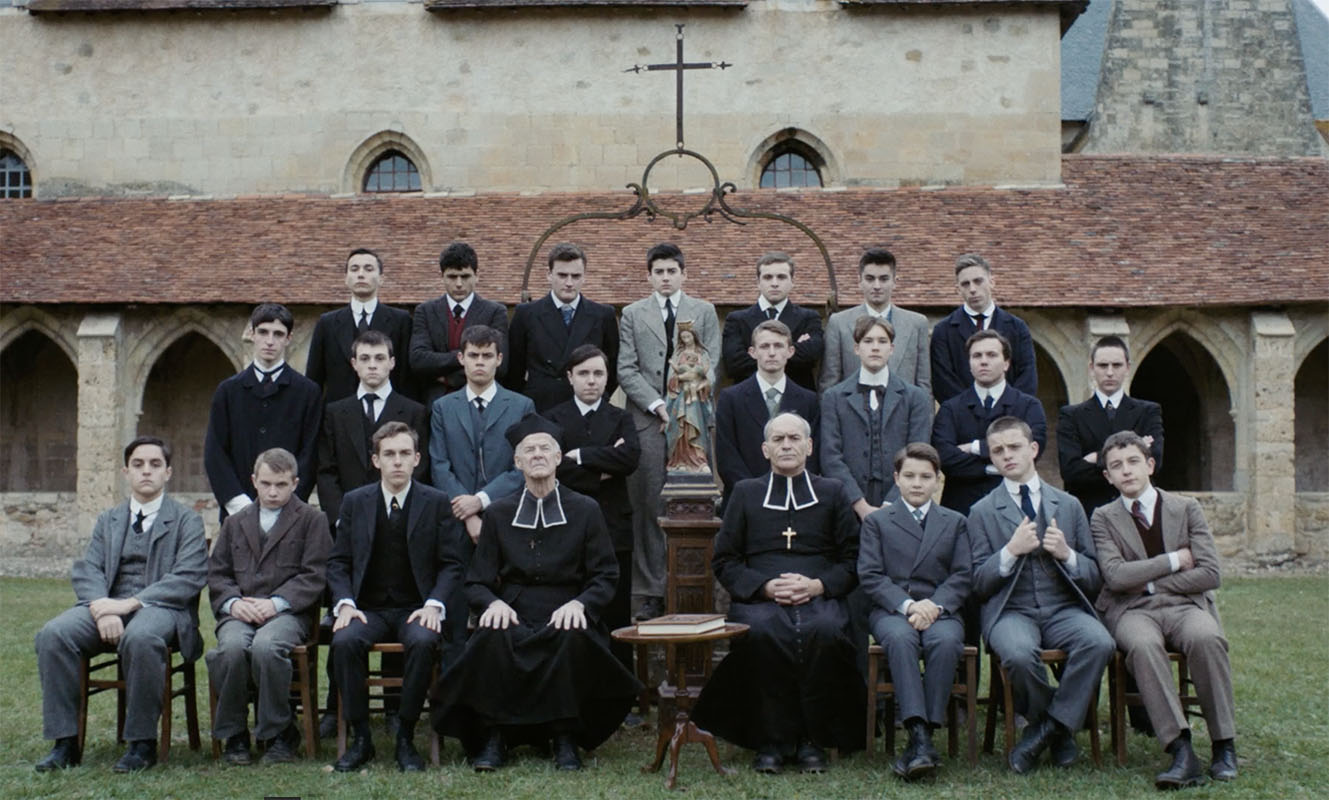
There’s a re-created photo in the seminary that is ultra-symmetrical, the group photo with the Madonna at the center of the frame…
V.L. We closely re-created a period photograph.
More generally, the art department did great work, because it stays pared down; they didn’t put in too many things just for the pleasure of filming them. They asked themselves the right questions: “What was there on a farm at that time?”
Every set prop had to have a purpose.
For me, the zoom has another function in the film: embodying the murderous impulse, which goes hand in hand with Bruno’s repressed homoerotic desire.
It is indeed a varied mix of zooms and tracking shots. For me, these movements herald Bruno’s introspection. As we zoom out, the things that surrounded Bruno in the past come into focus; there’s less blur around his face, and more and more details appear along with what the voice evokes.
V.L. Since what we show is in a way “his” film, Bruno’s account, the world we see is the world he remembers in prison.
I often had Kubrick in mind, as in the zoom-out shot at the seminary where Bruno smiles, where you can’t help thinking of Malcolm McDowell in A Clockwork Orange, or, on the contrary, other zooms where I was thinking of Nicholson in The Shining, because in a zoom move there’s an ambivalence between tension and retention: where is it going to stop?
That’s why, for me, the zoom embodies desire so well: the distance from an unattainable object of desire, Bruno’s straining toward something he can’t even put into words. There’s a lot of eroticism and murderous impulse, and the two go together.
Throughout the film, Bruno tries to distance himself from his desire to kill, but ends up succumbing to it.
V.L. I no longer remember why we chose a tracking shot rather than a zoom for certain shots, maybe because there’s more gentleness in a tracking shot, as in the shots at school where he envies his classmates.
M.C. In the school scenes there’s this desire to be in someone else’s place, so the physical sensation of the tracking shot is perceived differently, and I find it more right than a zoom at that precise moment in the film.
V.L. We weren’t dogmatic on this film; we looked at things case by case, sometimes tried both (zoom and tracking shot), and chose whichever was more right.
Bruno has more empathy for animals than for humans, and I think it’s no accident that in the scene where the pig is slaughtered, which is, after all, the first revelation of Bruno’s murderous instincts, you film a detail of the pig’s eye.
Whereas when he kills the child, the child has his back to us; he is dehumanized by Bruno’s gaze, and when Bruno looks at the corpse from the front, he realizes it’s just a lifeless body and loses all interest.
In the farm set, there’s this opening toward the forest, which I interpreted as an escape route toward nature, toward a natural world that Bruno longs for and that would be his only place of peace. Did you look for a location with that feature?
V.L. I never thought of it that way, but when we found that farm location, beyond the practical reasons (the interior and exterior of the farm were shot in the same place, and all the field-work scenes could be shot right next door, without cheating), I was very struck by that opening toward the forest, and by its potential.
For me, Bruno is a guy who is locked in: in his family, in his impulses, in society, and for me that doorway represents his only way to escape: murder, which is for him the only possible release. There’s a whole stretch where we film a zoom on him / a zoom toward the forest, and Bruno is champing at the bit, holding himself back from going toward the forest, the place of the murder. When he sharpens his knife, he’s in front of that doorway.
It’s true that at the beginning nature is the only place where he escapes the violence of the world, but that changes as the film goes on.
M.C. The forest is also the only place where Bruno isn’t shut in by walls, where the camera is more mobile.
V.L. Bruno’s cell looks like a monk’s cell, and the farm is a prison too, so the only freer moments are indeed in the forest, when he follows Blondel, for example, where we have somewhat Gus Van Sant-like Steadicam shots, more airy. That isn’t the case for the murder, which takes place in the forest and which we chose to make theatrical, notably through the choice of location, a sort of small valley surrounded by hills. In a way, the murder is a play that Bruno has had in his head for ten years, except that he botches the staging once he acts it out: he realizes it’s pathetic and that he would have been better off keeping his murder fantasies in his head.
M.C. To come back to the forest, that single day of the murder, from morning to evening, was spread out over at least ten shooting days and several different departments. It was very fragmented in terms of days and locations, and it required great attention to the natural light.
Was Bresson a reference? For the framing in particular.
M.C. I think it was unconscious, because apart from the prison, where A Man Escaped (Robert Bresson, 1956) was an unavoidable reference for shooting in the cramped space of a cell, we never really talked much about him.
V.L. He’s not at all an acknowledged reference, but he’s a filmmaker who nourished me a lot when I was young, and inevitably that stays in the way I compose a frame.
Bresson’s influence lies rather in the fact that with him, everything is always under tension, and I looked for that same tension in every shot.
Yes, that’s true, there isn’t a single “illustrative” shot in this film; each shot has an intention and an internal tension, a composition, a directing proposal; we never feel that you’re choosing an angle just for “coverage.” For example, in the interrogation, toward the end of the film, you cross the line and we feel it; we feel the scene tip over.
Nothing is left to chance in the film, and yet it isn’t overloaded; it stays sober and always right; it isn’t clinical or cold; there’s always something human in every shot, and the film keeps this wager from start to finish.
Let’s talk a bit more about technique. Was there a film vs. digital debate?
V.L. We wanted to shoot on Super 16mm, we had a quote drawn up, but it wasn’t viable for the film’s budget. Hence perhaps the choice of 1.66 and fairly deep focus, or the choice of shooting in 2K on the Alexa Mini and adding a bit of grain in the grade.
Which lenses did you shoot with?
M.C. A set of Kowa spherical primes, which sometimes produce interesting aberrations and flares when shot wide open. In the prison and the examination room, for example, it brought out interesting chromatic aberrations; because we were shooting into the backlight, we sometimes had a slight tint over the whole image.
V.L. In the end, I don’t regret Super 16, if only because we shot a lot with children, and that can require many takes. Likewise, for the interrogation, we were able to do very long takes, sometimes up to twenty or thirty takes.
M.C. We didn’t actually do that many takes. Except for what was supposed to be the last shot of the film and the film’s final sequences, which weren’t edited in.
V.L. After the scene that currently closes the film, there were five or six more sequences, a kind of epilogue that echoed the beginning, where we saw Bruno in prison and heard the psychiatrists’ diagnosis. We shot a shot of him on the prison walkway, with the camera doing a circular tracking move, a very complicated shot that we didn’t use.
But there is a circular tracking shot on the rock; I actually wondered how you shot it, since the rock seems half-suspended over the void. You no longer know where you are; you wonder whether the camera is over the void. It’s incredible; I wondered whether you shot it somewhere else, not on the rock we see in the rest of the sequence.
M.C. Well, initially Vincent had the idea of shooting a Super 8 sequence for that moment in the film, with rather frenetic editing, a bit like Jonas Mekas’s films.
V.L. The idea was that Bruno imagines his life after the murder, his journey to Africa, that he makes his own film and that we see it with very choppy editing and a low-definition image. But Michaël pushed back against that idea, and he was right: it would have changed the style of the film too suddenly. And then, while scouting, you came up with the idea of a circular tracking shot, where we film the horizon and in the end the horizon closes in on Bruno.
M.C. Indeed, that tracking shot in a way summed up the motif of the circle, of the return of the same, and of Bruno’s obsession. It was a prototype that Clément Hervouët (key grip) had found, with small rails barely thirty centimeters apart, which allowed us to lay circular track on the real rock and put the camera on a small platform with no operator on board (we were standing next to the rails).
To shoot the shot, Clément and I took turns, because the tracking move was too long and the path too uneven for me to handle the platform on my own: halfway along, Clément took over the framing and finished the shot, and it’s quite magical, you can’t feel the handover between the two operators.
It took us three hours to set up the track and many takes to get it right.
V.L. When we shot, the weather was really ugly, and we almost canceled the day because it wouldn’t match the rest of the sequence, which we had shot earlier. Then in the end we waited two hours for a break in the clouds, but the shot was super complicated: several hours to install the track, then when it came time to shoot, lots of false starts, frames everywhere, all that for a shot that turned out to be one of the most beautiful in the film.
Was there a lot of lighting equipment on the shoot, or did you mostly work from natural light?
M.C. The idea was to use natural light as much as possible, which is why, with the 1st assistant director, Maxime L’Anthoen, we arranged a schedule that would give us the best possible “right light” on each location.
We controlled the sun a lot with overheads: above the farmyard in particular, we rigged a 6×8-meter diffusion frame to control the natural light and the direct sun. For the interior scenes, we reused this frame outside, above the windows, to relight indirectly.
V.L. We also shot a lot of day-for-night, blacking out the windows, so we could work with children. Not shooting real nights allowed us to pace ourselves and not end the shoot completely exhausted.
M.C. The approach was to reinforce the directions given by the natural light. I’d say it was rather the locations, with their architectural quirks, that gave us directions of light.
V.L. In the examination room, you had rigged a big setup of frames behind the window. The idea was also that the interrogation takes place over several months and that we move more and more toward a wintry light. It had to be felt, but not too much, and yet we shot all those sequences in five days.
Sometimes in the farmyard there were reflectors everywhere, because the farm wasn’t well exposed; there are hills all around. The sun was quickly behind the hill, around 4 p.m., even though we were shooting in summer.
Were there two shooting sessions, summer and winter?
M.C. Since the film spans some fifteen years, it was important to have that variety; we did a big shooting session in summer and then two weeks in winter.
V.L. I would have liked to do three seasons, but that wasn’t possible with the budget. I would have liked a harsher winter, and an autumn. As it is, the winter isn’t cold enough for my taste: there’s no breath fogging from people’s mouths, you don’t feel that you’re all alone, lost in the middle of the Cantal in 1905.
There must be photos of the real Bruno Reidal. Were they a basis for the casting?
V.L. Yes, of course, but it was above all the doctors’ description that guided us. They say in their report that he was 1.62 m tall, that he looked very juvenile, and that he was very puny. For me it was important to stick to that description. Whereas for the psychiatrist, Lacassagne, I didn’t care about physical resemblance; we had photos of Lacassagne, but Jean-Luc Vincent doesn’t look like him at all. Because for me the real Lacassagne’s physique didn’t say anything in particular about the character. Whereas for Bruno, it matters that he is scrawny, with that drooping head, that opaque, impenetrable look.
Since we film him at three stages of his life, we had decided that the most important was age 17, but in the end I approved the 6-year-old actor before I had cast Dimitri Doré (Bruno at 17). With the casting director, we looked for coherence and continuity, trying to work as in Moonlight (Barry Jenkins, 2016), where three actors who look very different play the same character at three ages of his life. Admittedly, in Moonlight that serves the film’s purpose, since it tells the story of a character who plays several roles in his life to hide his true identity as a gay Black man, which isn’t quite the case for Bruno.
So what mattered, more than the shape of the face, was that he look ordinary, that he be small, that he have a kind of banality.
Dimitri Doré is very magnetic on screen, whereas in life he’s fairly ordinary; I found it interesting that he wasn’t someone with a disturbing face, as is the case for the actor in Angst, which is a grotesque, expressionistic film.
What I found impressive in the casting is also the supporting roles: for example among the seminarians, where there are faces that look both young and old, baby faces in which you already sense old age, in whom you can easily imagine the perverse old priest: like Blondel, who is very erotic but in whom you can glimpse the old man he will become.
M.C. Above all there is the pride, the self-assurance some of them have, which Bruno seems to lack so cruelly.
V.L. When you look at the period photos of the real Bruno Reidal’s fellow seminarians, they weren’t particularly handsome, but what interested me was everything Bruno projects onto them.
Did you have a large camera crew?
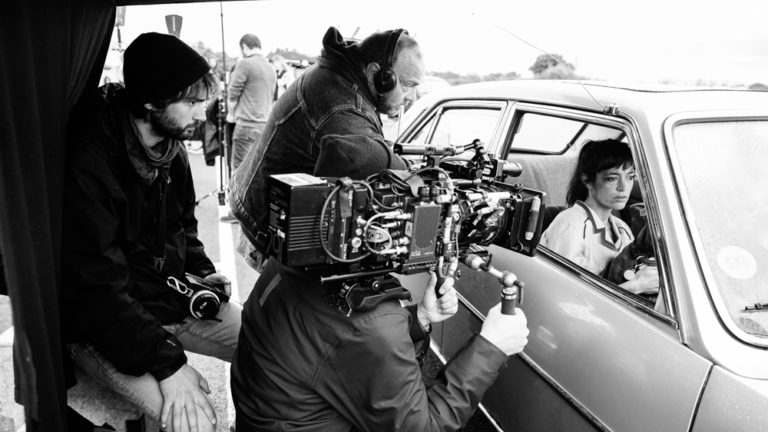
M.C. No, not really: two electricians, two grips, two assistants, plus occasional extra hands on some of the bigger locations, like the church or the prison.
V.L. We had big days with extra crew, over the 38 days. We shot a lot of days for a first film, but I prioritized having time, even if it meant fewer extras.
What camera and workflow did you shoot with?
M.C. We shot on an Alexa Mini, in Log 2K.
Did you work with LUTs? And was the grading work very elaborate?
M.C. On set, we had very simple Rec709 monitoring. In the grade, the interrogation sequences with their backlit shot/reverse shots turned out to be the toughest. Otherwise, though, the lighting was set.
V.L. We worked at La Ruche with Brice Pancot. It was hard to find something sober for those sequences: as soon as we reworked the backlight on Lacassagne too much, it became too contrasty and the skin took on a waxy complexion.
M.C. We did ten days of grading, five days on a monitor and five days in a projection room. It was fairly fast: a first pass on the whole film in three days, then more detailed work, sequence by sequence.
To come back to references, Vincent had built a thematic iconography: death, the seminary, masturbation, more or less every station of Bruno’s “way of the cross.” It was valuable upstream work that gathered visual reference material for all departments: camera, art, makeup, costumes. These images fed our work and our thinking throughout the production. Different departments could talk to one another on this common basis and get in tune.
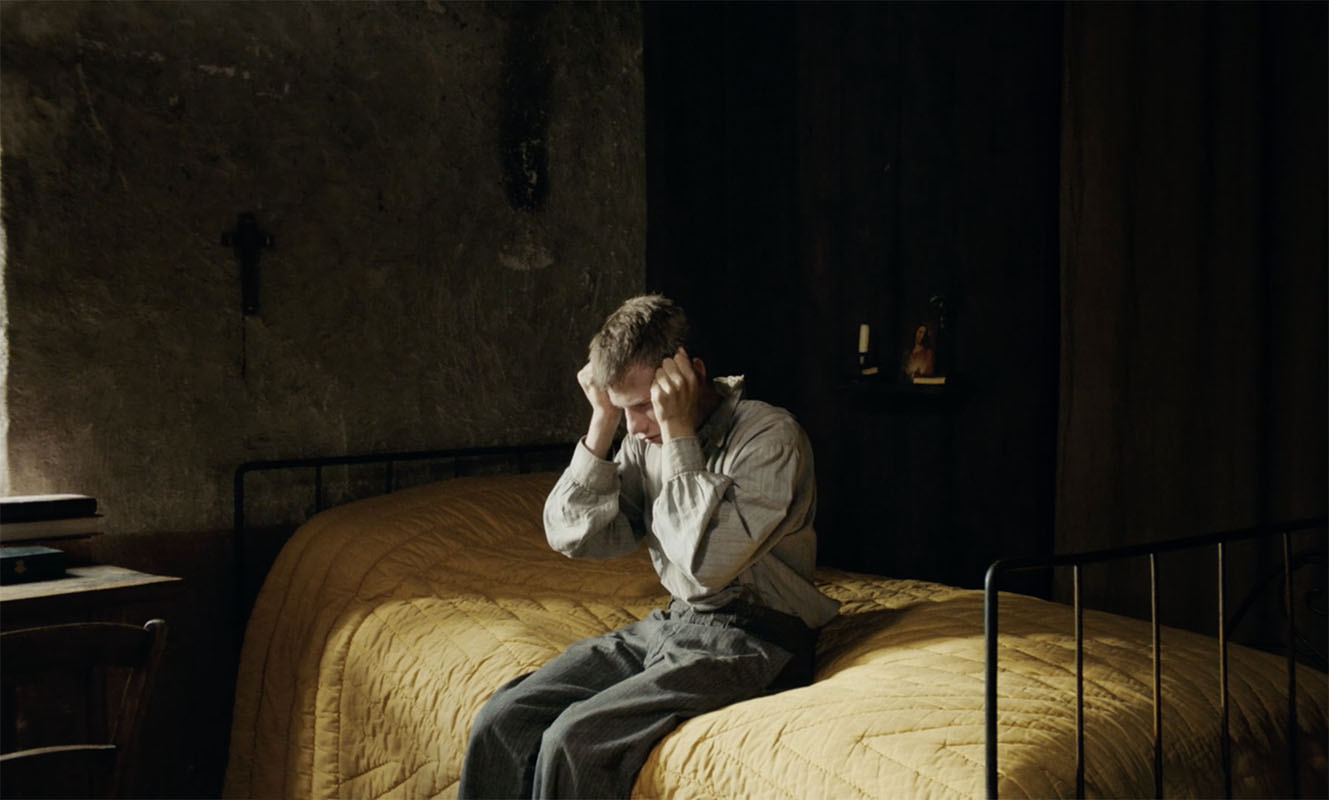
V.L. Sometimes it was very precise, but sometimes it was all jumbled; some image references concerned the sets, others the framing, but I hadn’t necessarily sorted everything, which led to some happy accidents: for example, for the farm, I had chosen a photo with a yellow bedspread that was a framing reference taken from Mes petites amoureuses (Jean Eustache, 1974), and one day Arnaud, the production designer, called me to say, “That’s it, I’ve found the perfect bedspread.” It was the same yellow bedspread as in the reference photo. At first I was a bit surprised, but in the end we kept it, we filmed it several times, and we were happy with it; people remember that yellow bedspread.
A directing question: throughout the film I thought of Michel Foucault’s Discipline and Punish (1975, Gallimard; the philosopher’s landmark work on the emergence of the prison and of the society of control in Europe), probably because it’s a book that made a strong political impression on me.
V.L. Of course, it’s one of the film’s references. The story takes place in 1905, at the beginning of criminal anthropology. For me, the main way to cite Foucault was the Panopticon (a prison with a particular, circular architectural design that allows the institution to observe and monitor inmates at all times). Only one was left in France in working condition, in Autun, in Burgundy, and we were able to shoot inside it.
We cited Foucault but also Van Gogh and his painting of prisoners walking in a circle (Prisoners Exercising, 1890, inspired by Van Gogh’s own experience of confinement at the asylum in Saint-Rémy-de-Provence). It’s a book that left its mark on me, something I read long ago, but it remains an undercurrent in the film, because Bruno Reidal is a unique case. Foucault talks about how power in modern society manages the proletariat through the control of bodies, but Bruno’s story is more singular, less emblematic, less political.
How central is the question of acting out in the film?
V.L. It isn’t the heart of the film; it’s the dramatic engine: will he act on it or not? And yet from the very beginning of the film we know he has. So the stakes don’t lie in the suspense of “will he do it or not?”; what interested me was rather: how long will he resist his impulses? And what does it do to you to resist your impulses?
For me, the unglamorous depiction of violence is one of the film’s great achievements; it’s something you rarely see in serial killer films. There’s no complacency; the film conveys to the audience the awareness that once the deed is done, the murderer finds himself facing a corpse that is a kind of lifeless, grotesque puppet.
V.L. I really like action films, violent films that I enjoy, but without wanting to moralize, there are films that depict violence in a way I can’t stand, like Titane (Julia Ducournau, 2021). I didn’t want the violence in Bruno Reidal to be gratifying or spectacular. But it remains complicated: in cinema everything is spectacular; however much you try not to make it gratifying, you still compose a beautiful frame with a decapitated body… There’s also a thrill in not wanting to thrill: how far you make it horrible and how far you make it spectacular, it’s complicated.
You can imagine what acting out means, confronting fantasy with reality: for Bruno, it’s an absolute disappointment.
Interview by Michele Gurrieri, April 2022
__
- Director: Vincent Le Port
- Screenplay: Vincent Le Port
- Based on: L’Affaire Reidal. Rapport médico-légal sur un cas de sadisme sanguinaire congénital, by Alexandre Lacassagne, André Papillon & Auguste Rousset
- Cinematography: Michaël Capron
- 1st assistant camera: Paul Morin
- 2nd assistant camera: Camille Ibanez
- Gaffer: Etienne Lesur
- Electrician: Thibault Bru
- Key grip: Clément Hervouët
- Grip: Marie Anouke Cougnon-Vilain
- Steadicam: Simon Veniel, Jake Russell
- Production design: Arnaud Lucas
- Costumes: Véronique Gély
- Sound: Marc-Olivier Brullé, Pierre Leblanc, Charlotte Butrak, Romain Ozanne
- Editing: Jean-Baptiste Alazard
- Color grading: Brice Pancot
- Special effects: Sylvain Coisne
- Producer(s): Roy Arida, Pierre-Emmanuel Urcun, Thierry Lounas
- Production: Stank, Capricci, Arte France Cinéma
- Cast: Dimitri Doré (Bruno Reidal), Jean-Luc Vincent (Lacassagne)
- Distributor: Capricci
- Release date: March 23, 2022
- Running time: 1 h 41 min
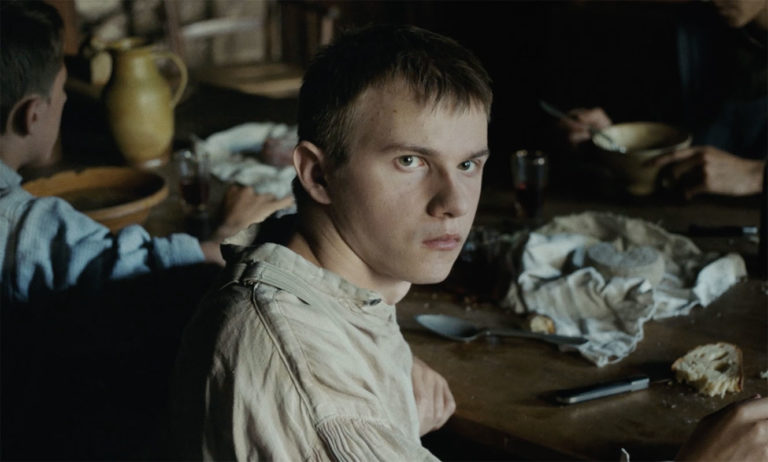
Cover image: Dimitri Doré as Bruno Reidal.