No pure black in the shadows. This is one of the intentions applied by Mathilde Gaillard on “Les Contes du Pommier”, a European co-production for which she lit the French part.
Facing Jean-Claude Rozec’s painted color scripts, Mathilde invented her own luminous grammar : backlighting hidden within the set, shadows tinted with tissue paper, a 5-centimeter magic lantern, and dedolighting with a motorized Cucoloris. A meticulous exploration of grief in saturated colors. Tales from the Apple Tree is an animated feature film that took shape through the collaboration of several writers, filmmakers, and producers. It’s a story within a story, the connecting part of which was directed in France by Jean-Claude Rozec, written by Blandine Jet, and produced by Vivement Lundi. Mathilde Gaillard lit this central segment, which features a grandfather and his grandchildren grappling with the grief of losing their grandmother in a vibrant setting. The collaboration with the filmmaker allowed them to explore perspectives and hues together.
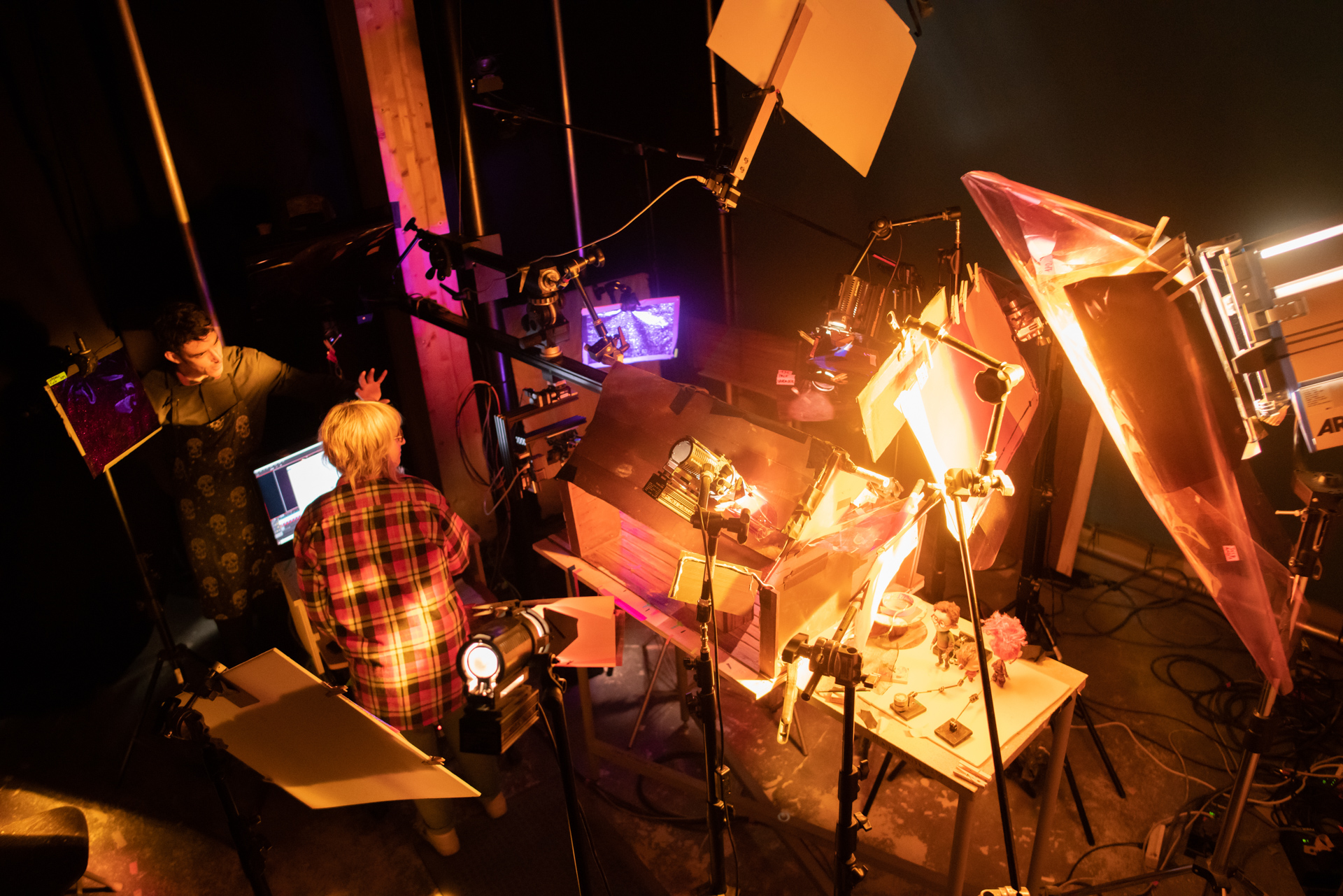
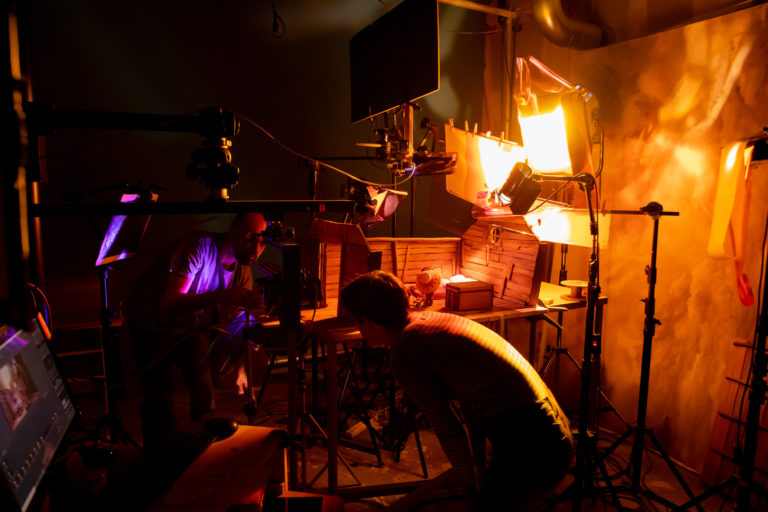
A shot being rehearsed on the set of the film Les Contes du Pommier (photo Mathilde Gaillard).
CHRONOLOGY
What was the timeline of the film, from the project proposal to preparation and filming ?
I was contacted quite late, in May 2023, for a shoot that began in September and lasted four months. The film had been in development for years, based on an adaptation of the stories by Czech author Arnošt Goldflam. Each country filmed its part almost independently, with two art directors overseeing the film’s coherence from the outset. In post-production, colorist Teo Riznar did a beautiful job seamlessly connecting the different segments of the film.
UNDERSTANDING THE PROJECT
In what form do you receive the project when you arrive on set ?
When I joined the project, Jean-Claude Rozec shared all the visual elements he had developed with me, including the color script. Jean-Claude paints and draws a lot, and he also works as a storyboard artist for other directors, which allowed for very precise discussions right from the start. When I saw the color script, I thought, ” This is amazing, it’s so beautiful .” Coming into the project with his paintings was incredibly stimulating but also quite intimidating. I kept in mind that I needed to light and visualize it in a way that was at least as interesting, taking into account that reality would present us with other possibilities and constraints. There’s one image in particular that I thought, ” This is really complicated because of the backlighting and the mix of colors .” And at the same time, I was incredibly excited. Enthusiasm and curiosity took over.
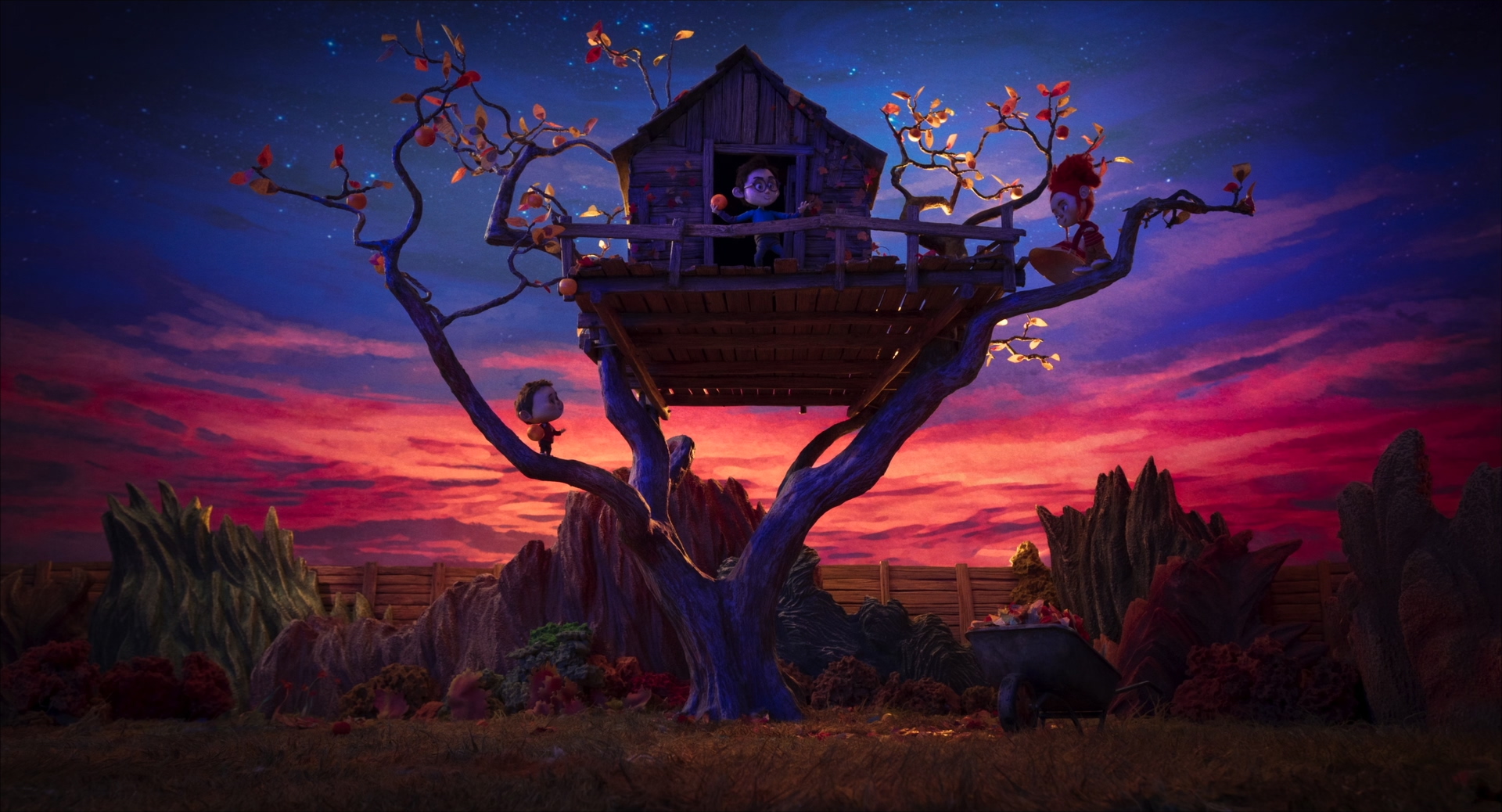
Tales from the Apple Tree, excerpt from the film.
What room for maneuver do you have in terms of image ?
I made it a point to frequently review the color script, telling myself, ” That’s the goal .” Then, on set, you’re not working with a drawing. Volume plays a significant role, as do the materials and the set design, all of which guide me toward a specific approach. Each sequence was storyboarded in black and white, and the color script provided the visual intentions for a single shot within each sequence. For all the other shots, I had to imagine and decide how the light would fall. Jean-Claude was open and curious about suggestions, as long as they aligned with the film’s aesthetic. This was particularly true regarding the rhythm of a shot or the rendering of perspectives in wide-angle lenses. The shot revealing the treehouse, for example, is a forward tracking shot with a short focal length. During filming, we accentuated it compared to the animatic, to make the perspective of the treehouse more striking.
SHOOTING IN STOP MOTION
Technically, can you guide us on what happens on a stop motion set ?
In stop-motion animation, several moments of the film are shot simultaneously with multiple cameras. It’s a balancing act because while one shot is being filmed, another is being set up for lighting, while another is being set up for scenery, or a puppet is on standby because its costume or arm has been damaged. On each set, we have the film’s animatic available for viewing. It provides guidance on framing, shot duration, and overall intention. It’s a working tool for me as much as for the animators, who glean information on acting and spatial awareness from it. I watch it every day. The animators rehearse with the puppets and establish the key positions of the action, to anticipate interaction problems or for complex animations. I’m there occasionally to adjust the lighting. It’s quite precise work (well… everything is precise, actually!). The director is also nearby to give his approval, while I remain open to suggestions or technical adjustments. Some camera movements needed a different rhythm than in the animatic because speed isn’t perceived the same way in 3D as in a 2D drawing. I often suggested lengthening and slowing down the tracking shots by a few frames to make them clearer.
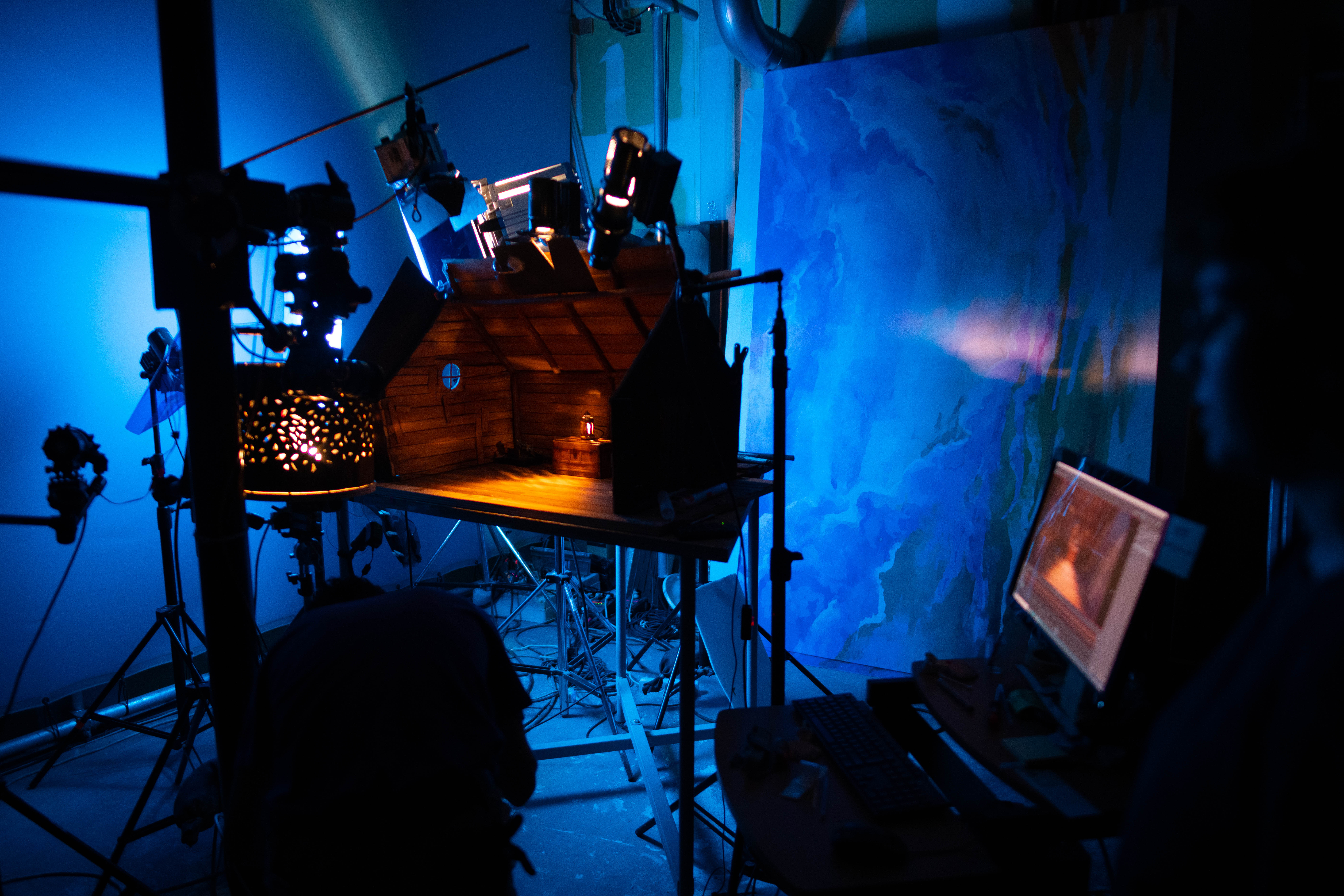
The set under the spotlights (photo: Mathilde Gaillard).
How did you choose the equipment ?
The camera was the obvious choice for me (laughs): in stop motion, you often don’t have much of a choice and you adapt to the equipment used by each studio, which has its own habits and preferred brands—for macro or for compatibility with the stop-motion software. That said, it would be a fascinating area to explore. In the industry, we work a lot with Canon cameras because of their easy compatibility with the DragonFrame animation software, but also with Nikon lenses, which have no electronic communication with the camera body, thus avoiding image glitches. For this film, I therefore worked with a Canon R camera and Nikon still photography lenses.
“We are still struggling with the uncertainty.”
We often work with a fairly small aperture. The wider you open it, the more you get a model-like effect. And while in live-action filming, we often find that beautiful, in stop motion, the blur appears at many moments when you don’t want it. On “Tales of the Apple Tree,” I used a lot of short focal lengths, which, incidentally, tended to reveal the limitations of the sets and the studio ceilings. There are some shots that were a bit cobbled together with bits of green screen, refined with ingenuity or skill in post-production. Jean-Claude was also the compositing supervisor on the project: he saw certain problems on set and considered the amount of work these backgrounds might add or not. He was the one who managed the decisions we had made together during filming in post-production.
How did you translate the intended colours?
Tinted shadows are a recurring theme in several of Jean-Claude’s films, which quickly caught my attention. There’s never a pure black. So, I tried to tint the shadows during filming. I had collected carefully selected gels, but also colored tissue paper—it was a fantastic playground. In close-ups, I placed tissue paper in shades of blue or purple, close to the skin tones. And if I couldn’t always sufficiently enhance the shadow colors during filming on larger sets, I pushed the sliders in color grading. On set, I also made many adjustments myself in DaVinci Resolve to see if it was feasible, which gave me good visibility into the colors. The film’s color palette explores shades of purple, orange, and brown, with autumn sequences and twilight scenes. The nights are very blue and highly saturated, and the spring that opens the film is also very intense.
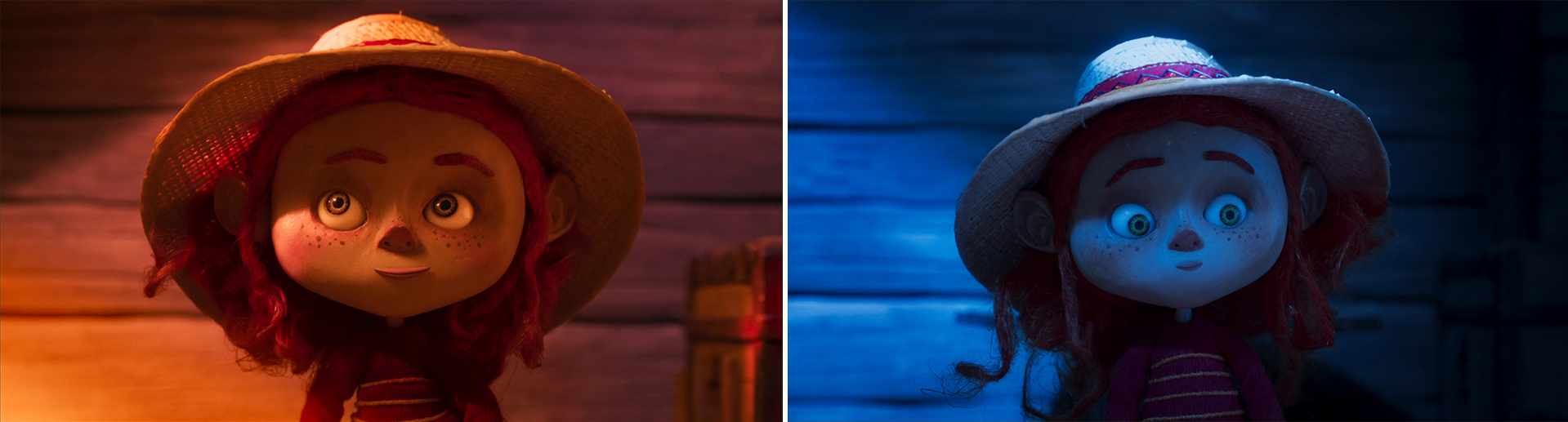
The characters were 7cm tall on average (screenshots from Les Contes du Pommier).
How did you work with the lighting on this set? On the small characters?
The entire film takes place in a garden, and the puppets are about 23cm tall (the youngest child is only 7cm). Working on such a small scale, when it will all end up on very large screens, can be a little daunting. So, we pay close attention to the dust or hair that might be clinging to a character’s face!
Getting back to the lighting, I worked extensively with Jean-Claude’s paintings to properly guide the colors and intentions. I shot many ground-level shots to establish the setting. The changing seasons are very important in this film, and each sequence marks a different time of day or year. I projected the entire film in my mind a lot to see the seasons evolving, the sun’s position, and the foliage casting shadows. We made cucoloris out of kadapak to project the leaf shapes I was interested in. I worked with Dedolight fixtures with their optical noses and gobos. There are many backlights in the film, particularly in wide shots: I had to use backlights, hidden within the set or sometimes in the frame when it came to sunsets, making sure they were erasable.
In the film’s final scene, the grandfather presents his grandchildren with a magic lantern he made. It illuminated the cabin and the children. For this sequence, it was necessary to make the lantern (which is 5 cm tall) light up, so we needed the right bulb, one that could be animated (that is, programmed by the stop-motion software used by the animator). There were also other light sources, such as a Dedolight bulb mounted on a motorized turntable surrounded by a perforated cinefoil to project shapes onto the children’s faces. I added a few Dedolights aimed at the cabin’s wooden floor, and a cooler, external light source.
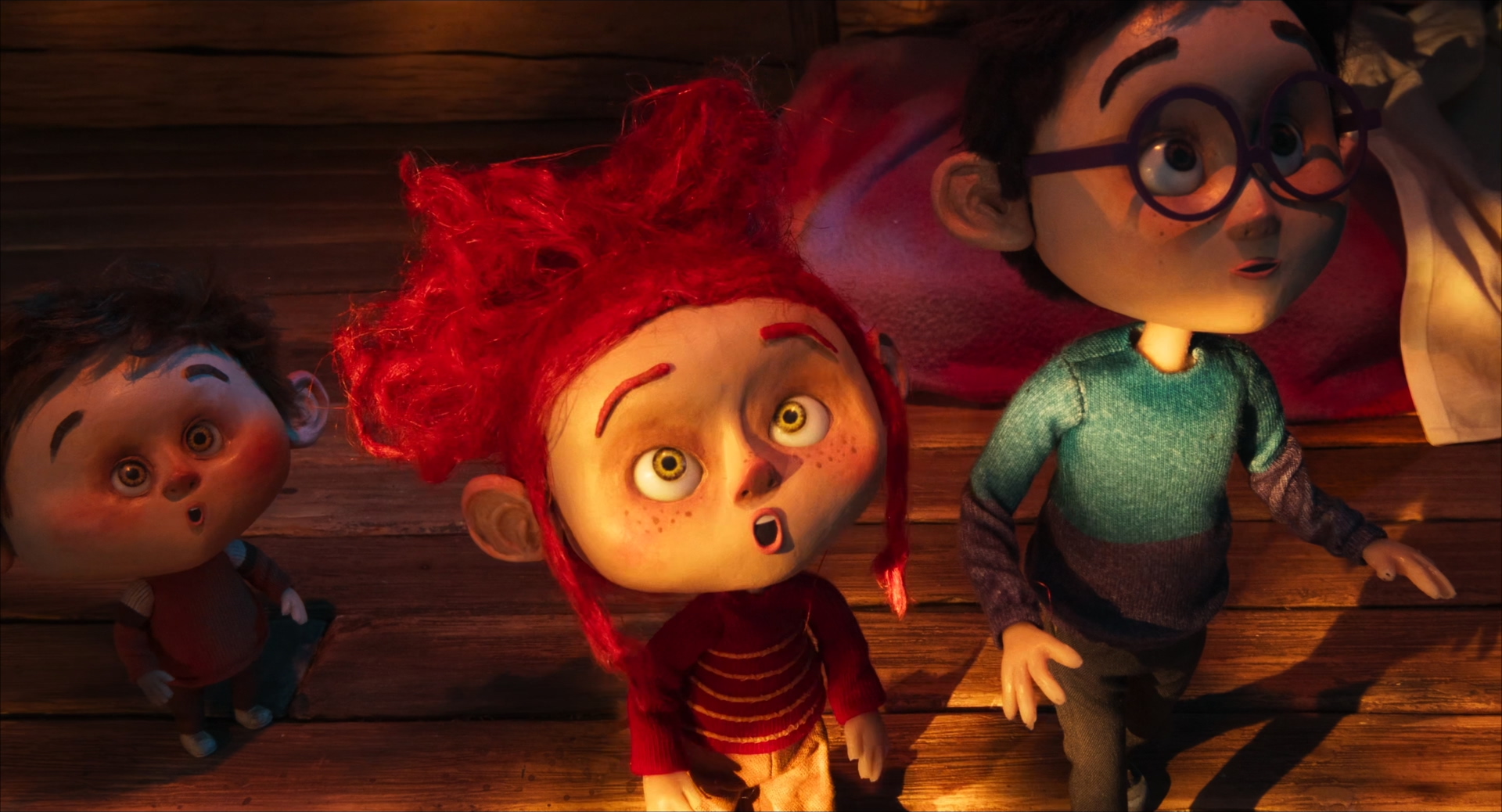
Children dazzled by the magic lantern (screenshot from Tales from the Apple Tree).
For stop motion, the camera takes photos. How do you translate your movement intentions into it?
To execute tracking shots, there’s no grip who can control the movement and speed live. I was fortunate that my camera operator, Quentin Lemouland, is incredibly versatile (he’s my gaffer/first assistant/genius handyman). He develops his own tracking shot prototypes, which he then sells. On this film, he practically custom-built the motion-controlled tracking shots. Whereas a live tracking shot is more of a sensitive physical performance, in stop motion you have to be able to break down the complex action into key points. Everything has to be “segmentable” in small increments, and thus, a tracking shot becomes full of micro-movements. It’s parameterized. So, it’s through the DragonFrame software that I configure the camera movement on the horizontal, vertical, and panoramic axes to translate the movement into a fluid, perceptible motion.
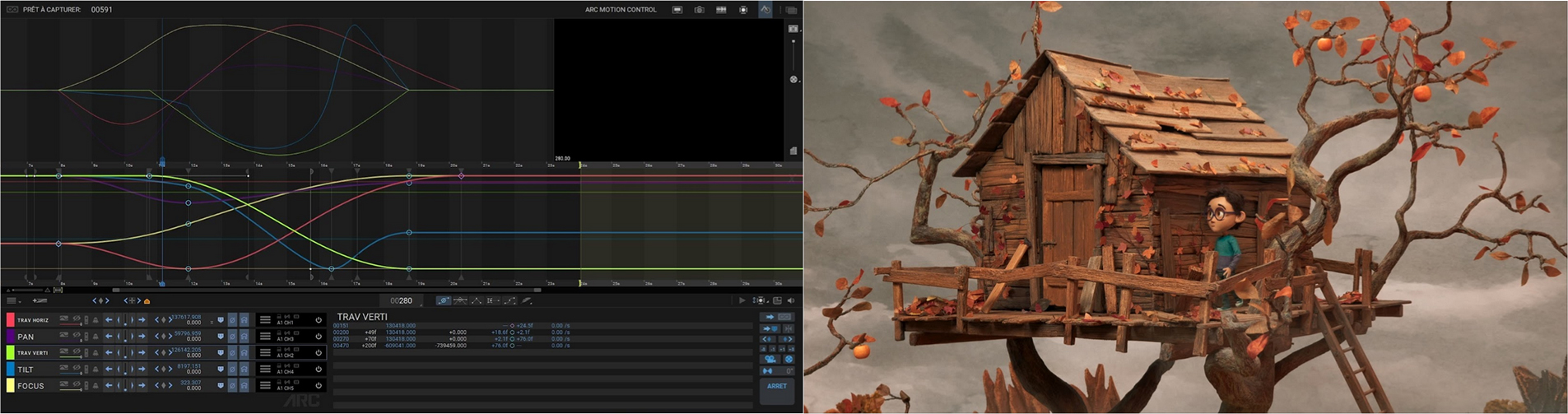
Screenshot of the animation software, in full tracking movement (DragonFrame) and the corresponding shot (Photo Mathilde Gaillard).
PERSONAL EXPERIENCE
How does pressing the shutter button differ from recording? (stop motion vs. live shooting)
In terms of feel, there’s a big difference. On a live-action shoot, you’re physically involved. There’s a physical connection that doesn’t exist in stop motion because the moment the camera starts rolling, you disappear as the director of photography. Literally: you leave the room. And then there’s an interface between yourself and reality. You often find yourself in front of the software. And at the same time, what I love about stop motion is this choreography, which is very well-prepared and polished, since when it comes time to shoot, you delegate the entire responsibility for the shot to the animators. There’s a lot of care to be taken before filming. The focal point is in a different place than in live-action, I would say.
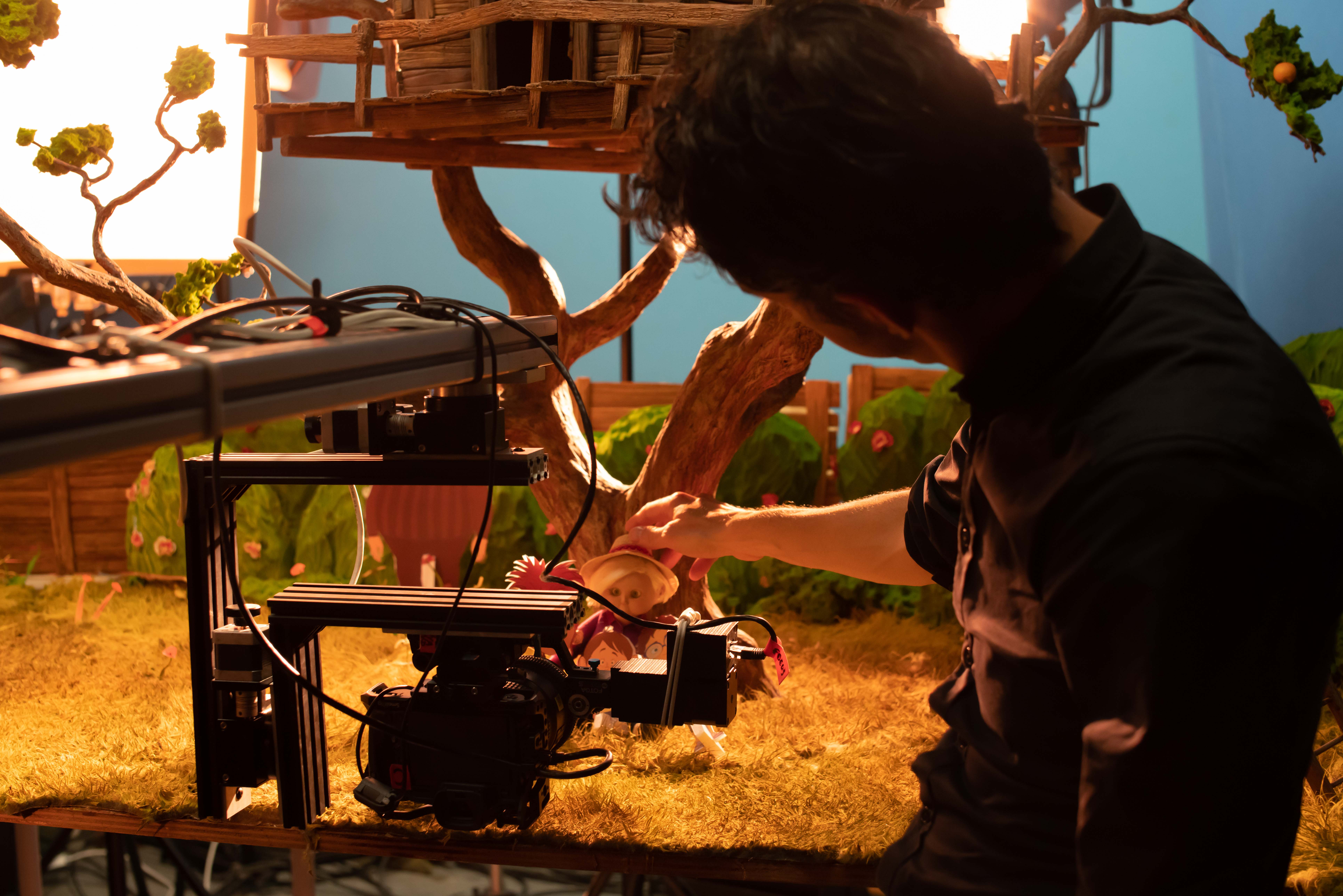
On set, in the studio (photo Mathilde Gaillard).
How has this project influenced your practice and your future directions in photography?
One of the things that struck me was the highly variable volume of the characters. One of them, Tom, had deeper-set eyes. Very often, when I used general lighting, I struggled to get the same sparkle in his eyes as in the others, which made him look frightening. It was a little challenge for both of us, because in reality, he was a very cute child! Since then, I pay even closer attention to the contours of the faces I film.
“The question of volume is omnipresent in stop motion. I also transpose it to human faces.”
Director of Photography
Mathilde Gaillard has been working as a director of photography for several years, sometimes alternating with directing. This Rennes resident had already explored stop-motion animation through photography in a Nikon short film, and much earlier, as a child playing with LEGOs with her brothers. In the fall of 2025, she contributed to some sequences of the upcoming stop-motion film by Swedish director Niki Lindroth von Bahr, entitled “The Rose”.
Tales from the Apple Tree is currently being screened at festivals: in 2025, it was presented in competition at the Berlinale as well as in the official competition at the Annecy International Animation Film Festival. It also received the Grand Prize at the Czech festival “Finale Plzeň” and the MAJA Award in the children’s film competition at FilmFest Hamburg in Germany.
The film was released in theaters on April 8, 2026.
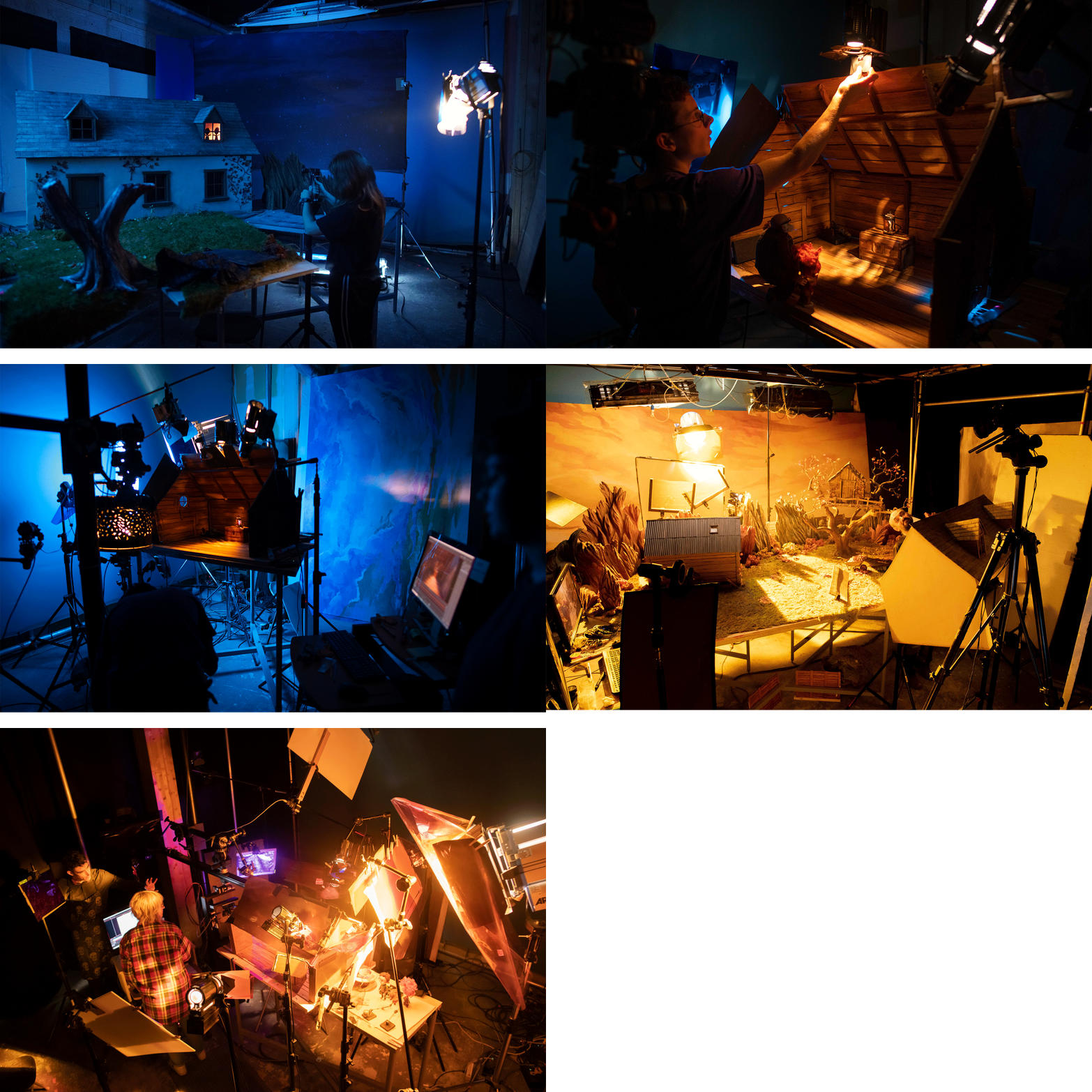
Slideshow: a few moments on the studio sets.