Seven films from different countries were featured in the short documentary selection at the 2025 Camerimage festival. One of the similarities was the absence of a common language between cinematographers and the ones they filmed—with the exception of the competition winner, No Mean City , and a visually-built film, Voices from the Abyss . The cinematographers present at the discussion agreed that this inability to understand each other allowed them greater freedom to follow the bodies and emotions of the subjects. Whether it was the Yukuna dialect, Japanese, Thai, or French, this constraint also influenced the documentary teams’ approach to filming.
LONG TAKES
Drawn from interviews with the protagonists, voiceover appears in six of the seven documentaries presented in the selection. Angello Faccini’s Lanawaru sets up in a village deep in Amazonia, following the spiritual journey of a young man who has just lost his grandfather. The film relies on striking well-composed images, playing with natural light, in the village where the small crew was based. Voiceover provides keys to the narrative. Here, the director, Angello Faccini, explains that he only got the translation after filming long sequences: “ I don’t speak Yukuna […] which is one of the ethnic groups of the Colombian Amazon region. But there’s something interesting when you don’t fully speak the language, when you don’t completely understand what they’re saying: it gives space and allows the take to be a little longer, and I don’t know, during editing, you find things that, if you had fully understood the language, wouldn’t have been so long, or you wouldn’t have had that surprise at the end .” The lack of understanding and the surprise during the translation process are common threads in the films. Here, it directly influences the rhythm.
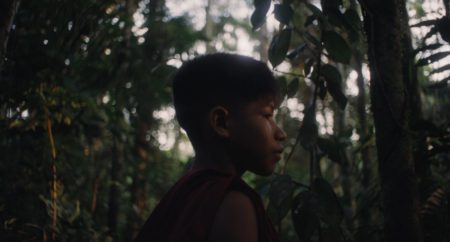
Light, dust, and water reflections where accompanied throughout the film by a voiceover taken from interviews. Lanawaru , Image: Angello Faccini
READING EMOTIONS
A Quiet Storm immerses itself for a moment in the daily life of a mother, her deaf daughter, and her krump dancer son: the director, Benjamin Nicolas, and his cinematographer, Alexandre Nour, both from advertising backgrounds where drawn to the theme of dance. In order to film this family, whom they had just met in Japan, Alexandre Nour explains how they managed the interior scenes, the core of whose conversations he didn’t understand: ” For most of these scenes, we would set up the camera, step back, and life would begin.” We waited and waited and waited, and then, maybe at some point, we’d say, “OK, let’s cut and use a longer lens, and let’s get a close-up of this person,” because you could feel in their body language that what was happening was rich. So it was a really great learning experience” . Outside of the interior scenes, one framing choice in particular became a true directorial choice: while the son is on stage, the cinematographer leaves the protagonist mid- battle , slowly pans across the immense arena to land on the mother’s face, intensely involved in her son’s performance. With this framing choice, the film’s dynamic shifts: she becomes the main character of the story. The expressions on her face are enough to convey the tension and the outcome of her son’s dance battle.
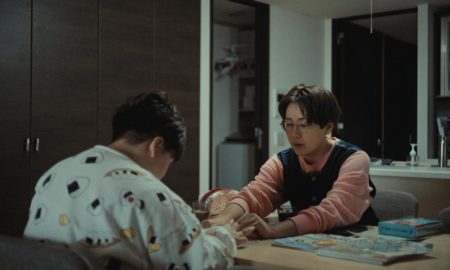
In the small apartment, there are few camera placement options, but lens changes are chosen in response to the energy of the moment / A Quiet Storm , image: Alexandre Nour Desjardins
MULTIPLYING THE POINTS OF VIEW
Two films use simultaneous multi-camera setups: Voices From The Abyss and The Believers. While the former films divers plunging from the cliffs of Acapulco, the latter films an annual ritual taking place in a Thai temple. The tradition is recounted with a desire for a collective experience. In both cases, filming a spectacular, unique event requires multiple takes of the same moment. Beyond this narrative climax, it is the voice-over interviews, superimposed on shots of bodies in action, that create a form of introspection for the protagonists during these ritualized moments. Visually, in Voices From The Abyss , Irving Serrano used thre cameras to film the divers, employing slow motion and subliminal contrasts. The black and white images lend a spiritual, even sacred, dimension to the ten dives they were allowed to film. As for the directing, Eliott Reguera Vega explains that he overlapsed these images with the divers’ voiceovers reading a poem by Bernardo Fuentes: ” [ We] wanted to give importance to their voices. Because when you go to see the show, it’s magnificent, but it’s only three seconds. You applaud, and it’s over .”
The Believers, meanwhile, captures a ritual that also takes place only once a year. To photograph this moment, Bill Kirstein, in agreement with the temple, chose to place one camera close to the participants, “more intimate“, and two further away with a very long focal length so as not to interfere with the energies unravelling. Unable to rent a Phantom camera, Kirstein opted to film with an industrial camera, a Fasteck, to capture the slow-motion sequences. Director Evan Newman explains: “ […] in the morning, there’s the mass possession. And it only lasts for a few hours or so. It erupts in a very unpredictable way. So we had to map out where to place the cameras so as not to miss the heart of the ceremony. But the intention was really to transform the camera almost into an invisible spiritual force, and to let it wander and almost listen to the testimonies and prayers that people were saying in their heads .” Watching the film, it’s impossible not to think of Jean Rouch’s seminal film “Les Maîtres Fous”, but with the added dimension of technology.
STAGING REALITY
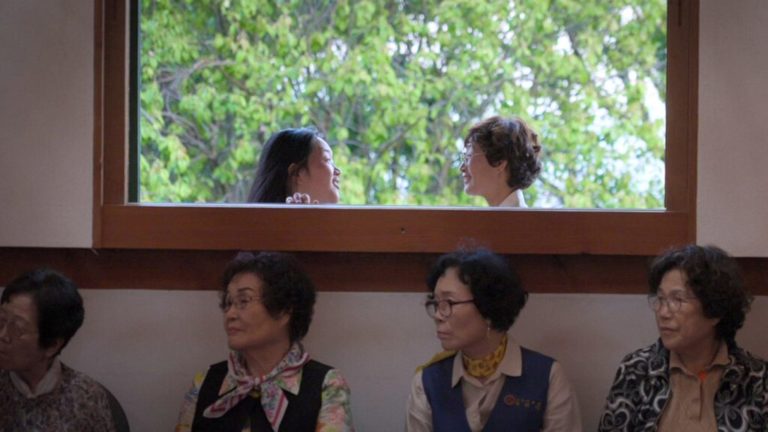
In her documentary, Welcome Home Freckles , Huiju Park films her own family reunion after many years of estrangement and the death of her grandfather. Her director of photography, Benjamin Kodboel, doesn’t speak Korean and can’t rely on the director, who is focused on her violent family reunion: “We could talk a little about the scene beforehand and how to block it out .” He explains the techniques they used with the director, particularly during the scenes where the daughter confronts her parents about their silence regarding the domestic violence she suffered: ” We only had one camera, […] so I would ask her, whenever there was an opportunity, to give me a little signal, and I would move the camera elsewhere . And we had an excellent editor who made it look like a continuous conversation .” Their close working relationship, and the ability to anticipate thanks to the director’s closeness with her subject matter, allowed the duo to approach a fictional aesthetic for this intimate documentary.
SPEAKING THE LANGUAGE OF IMAGES
The temptation to film bodies is all the stronger when language is a barrier. Plongeurs, directed by Hector Aponysus and filmed by Jaime Ackroyd, two British filmmakers, explores the coming of age of a group of young people from Marseille during their last summer together. The director explains that he met the young people via Instagram: they already had a relationship to images and cameras. The young people were able to show them where to position the camera, and even provide excerpts of their own footage. This is reflected in the movie. The images are a mix of GoPro and DVcam footage that the crew gave to the young people, framed by more scenic shots. The film also includes excerpts from television news reports announcing the (past) death of one of the young, taking all these disparate images into the social reality of the protagonists. The film’s meaning is found in the editing of the footage gathered on location with sound clips of their interviews. 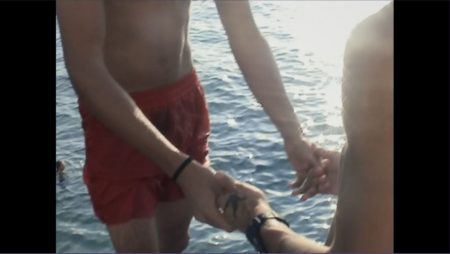 A mix of images for the film Plongeurs, sometimes coming from the hands of the protagonists. Plongeurs , photographed by Jaime Ackroyd.
CONCLUSION
The seventh documentary is No Mean City , directed by Ross McClean and photographed by Ronnie McQuillan. It is the only film shot entirely in direct cinema, without the use of voice-over. The film won the Audience Award (read Clara Pauthier’s article). Several narrative elements recur in films with distinct languages between cinematographers and protagonists: the use of voice-over over, meticulously crafted images, slow motion, and the use of multiple cameras. From a framing perspective, the documentary, without a shared language, remains a unique experience for cinematographers who can focus on bodies and emotions. A coherent choice in a film festival focused on cinematographers.
Note: We regret that none of the seven short documentaries this year were filmed by a female director of photography. Here is a selection of short documentaries photographed by women: – Car Wash , directed by Laïs Decaster, photographed by Julianna Brousse (available on the TËNK platform ) – Voyage De Documentation De Madame Anita Conti , directed by Louise Hémon, using Anita Conti’s archives ( also available on TËNK ). – The Only Girl in the Orchestra , directed by Molly O’Brien, photographed by Martina Radwan ( available on Netflix ).