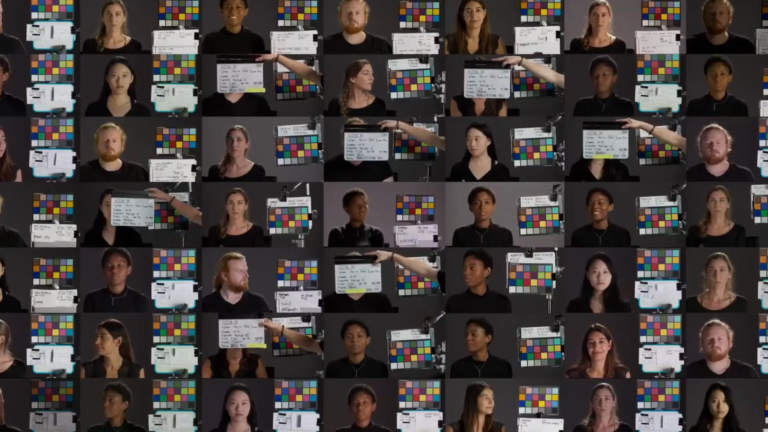
With the rapid progress of recent years, one might think that LED light sources have reached full maturity and are now capable of competing without compromise with traditional tungsten and HMI lighting. But what is the reality? The Higher Technical Commission (CST) wanted to get to the bottom of it by conducting a series of rigorous tests, with the participation of numerous industry partners.
At the heart of the protocol lies the desire to objectively compare the rendering of different light sources, based on precise scientific criteria. Among these is the Spectral Similarity Index (SSI), which measures the similarity between the spectrum of a source and that of a reference, such as tungsten. Unlike the Color Rendering Index (CRI), long used but increasingly less relevant for LEDs, the SSI allows for the detection of deviations across all wavelengths of the visible spectrum.
The results are surprising, to say the least. While some LED sources achieve excellent scores at 3200K, they struggle to impress at 5600K when it comes to simulating daylight.
Even more concerning, significant variations are observed between different models from the same manufacturer. The same is true for the Esmeralda test, which assesses metamerism—that is, a light source’s ability to accurately reproduce the colors of an object compared to a reference. Here again, not all LEDs perform well.
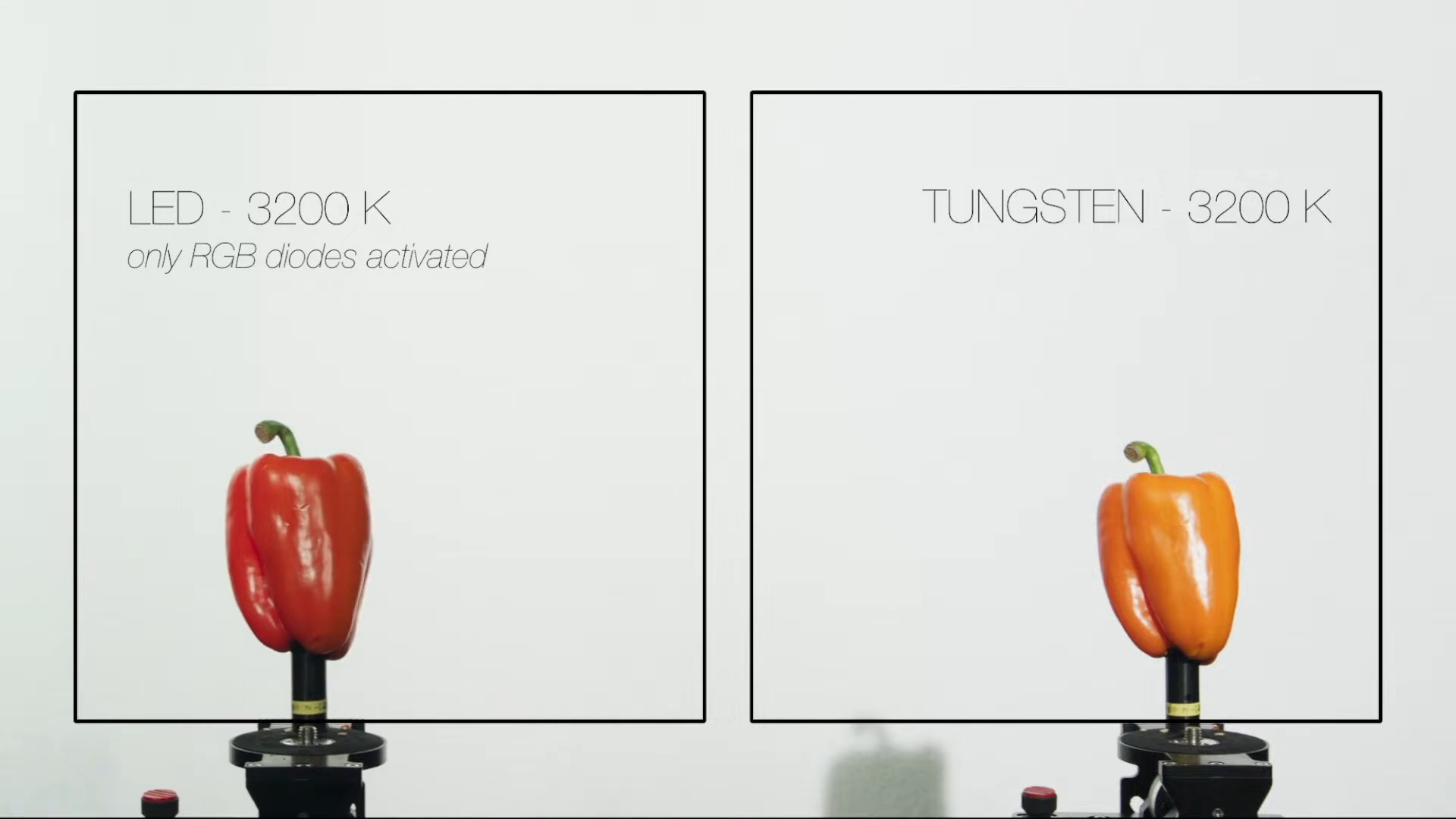
The same yellow pepper, from two different sources.
These discrepancies, however subtle they may be to the naked eye, have very real consequences for color grading. While it is technically possible to correct rendering flaws in post-production, this often translates into a much longer and more complex process, with its share of artistic compromises.
Philippe Ros, who led these tests, also noted that the cameras used—namely the Sony Venice 2, the Alexa 35, and the Red Raptor—are among the most advanced models on the market. Their wide exposure latitude and wide-gamut sensors allow them to record a maximum of colorimetric information, thus offering considerable leeway for color grading to correct variations in the rendering of LED sources. But what about more affordable cameras, like those used on many film sets? It is highly likely that their less powerful sensors would be quicker to reveal colorimetric flaws, without offering as many opportunities for correction in post-production.
Of course, these results don’t call into question the immense potential of LEDs. For several years now, this technology has offered a range of unprecedented effects and considerable flexibility on set. But they also call for a certain degree of caution. For cinematographers, the choice of a light source must, more than ever, be based on a thorough understanding of its characteristics and potential pitfalls.
This underscores the importance of tests like those conducted by the CST, whose full video report we invite you to watch. Beyond the figures, it offers valuable insights into shared experiences and avenues for improving workflows. While LEDs still face challenges, it is by combining expertise and comparing perspectives that we can help them reach their full potential.
So, should we be wary of LEDs? Probably not. But it would be unwise to trust them blindly. The CST will soon publish the complete database of these tests, which will allow for more informed choices.
Following these tests, one conclusion is clear: the LED revolution is only just beginning.
These tests were conducted by:
Philippe Ros – Director of Photography, AFC and Co-Chair of the IMAGO Technical Committee (ITC) Patrick Duroux – Director of Photography, AFC Françoise Noyon – Director of Photography Thierry Beaumel – Post-Production Consultant Jean Coudsi – Colorist François Roger – Director of Cininter Éric Chérioux – Technical Director of CST