The documentary film Bedrock was screened as a special event at the Camerimage Festival on November 17, 2025, at the Documentary Theater in Toruń, Poland. The screening concluded with a lively Q&A session with director Kinga Michalska, cinematographer Hania Linkowska, and production manager and sound engineer Janusz Dąbkiewicz.
–
An excavator bites into the earth alongside a highway under construction. A few steps away, Filip, wearing a yellow vest, scrutinizes the rubble. The ground reveals a buried memory.
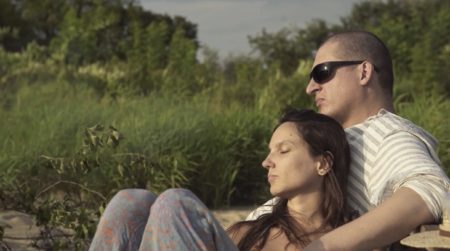
Further on, we find him with his partner on the banks of the Bug River near Treblinka, a river whose waters once carried the ashes of concentration camp victims. The heavy weight of the place’s contrasts with the contemplative shots and the dazzling summer light flooding the area.
The camera follows Filip’s hands as they touch the sand, and our imagination draws a disturbing parallel with ashes. His partner asks him, “Why is it important for you to come here?”
We understand that Filip lost many family members in the Holocaust and that he works for the Rabbinical Commission for Cemeteries, an organization dedicated to protecting Jewish burial sites on Polish soil.
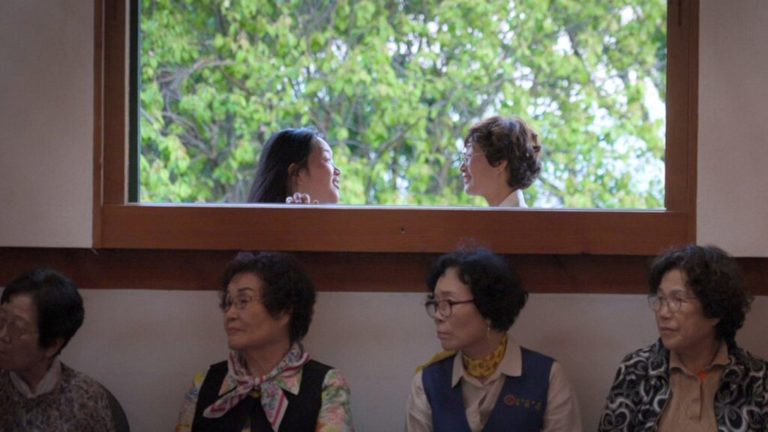
Many other sequences are interwoven. The film takes us to ten former extermination sites, introducing us to the people who live or work nearby.
It seemed essential to director Kinga Michalska to make this film to establish a painful truth: the responsibility of some of her compatriots in the genocidal murders of the Holocaust: “To say that we live on Jewish graves is not a metaphor; human remains are in our land, in our rivers, in our air.”
The title Bedrock (or Pod powierzchnią in Polish, “Beneath the Surface”) refers to this idea that the truth is there, right under our feet, in the very geology of the land.
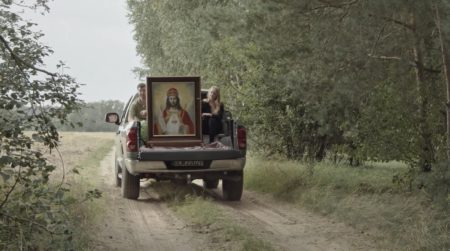
From the earliest stages of the project, Hania and Kinga chose to reject any reportage-style approach, with handheld cameras and spontaneous movements. They instead turned to beautifully composed, static shots, like paintings. This approach responded to two major intentions :
The first concerned the relationship with the viewer: faced with landscapes marked by past violences, but which today evoke nothing more than an ordinary forest, the aim was to allow a sufficiently long period of observation for the gaze to begin scrutinizing, to seek what is not immediately visible.
The second stemmed from an ethical stance: by refusing any visual dramatization and considering that camera movements could have artificially heightened the emotion, the stillness reflects the existing tension. It places the viewer within a frame from which they cannot escape, compelling them to contemplate this inhabited void.
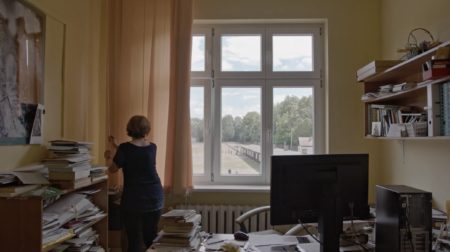
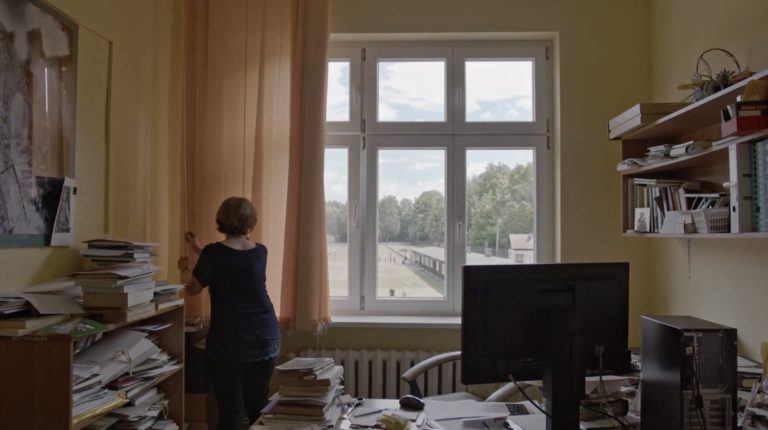
Upon entering her office, a woman delicately opens her window curtain, revealing the former Stutthof concentration camp in the background. The subtle interplay between the different planes, creating multiple layers of interpretation, deeply moved us.
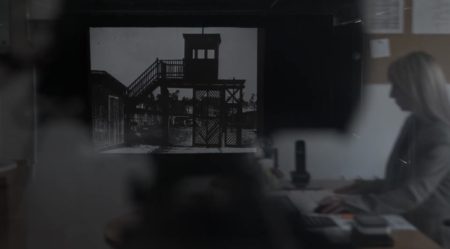
The composition combines, within a single frame, black and white archival footage in a cinema projectionist’s room and the colorful presence of a woman working in her office, analyzing administrative and historical documents found on site. Past and present coexist in the image through these contrasts and narrative layers, each unique to its protagonist.
Hania explains that she filmed with three different cameras (Blackmagic Pocket 4K, Blackmagic Pocket 6K, and Sony FX3), which had to be stitched together during color grading.
The documentary opens and closes with this same strange thermal image, which is revealed after a few seconds of observation: human silhouettes entering or leaving a location that is difficult to identify. The director reflects on these images, which she came across during the end of the film’s creation process: “I saw a certain disturbing similarity between these black and white surveillance images from the Polish-Belarusian border and archival images that we know so well from World War II. Today the new “others”, racialized migrants, are seeking refuge in our forests, following the same path once taken by the Jewish people.” These CCTV images were taken by the Polish Border Guard and then published on their official Youtube channel, offering a direct—but partial—glimpse into the reality observed at the border. They show migrants in a flight, an escape necessary for survival, complete isolation in a hostile environment chased by armed authorities.
Six years were needed to complete Bedrock, which faced numerous funding and filming requests being denied. For the director, the main challenge was maintaining a relationship of trust with the participants throughout the project. “It was also necessary to find the right tone to tell their stories, with respect to their views, and to ensure that my own directorial intentions were honest,” Kinga recalls.
Janusz Dąbkiewicz, the production manager who also served as sound engineer at the end of the project, explained how difficult it was to manage the entire legal process related to obtaining permits, especially since many participants didn’t fully grasp the role they would play in the narrative. It’s always tricky to make people unfamiliar with documentary filmmaking understand that they might only represent a small part of a much larger narrative. To avoid misunderstandings, they paid particular attention to transparency. They explained as much as possible that the film took place in many different locations and that the story brought together various journeys.
The main participants were offered to see their scenes before the film was finalized; only one person requested a minor change. No one asked to be removed from the project, and everyone welcomed the film, Kinga recalls with emotion.