Knowing and choosing lenses for projects is one of several creative choices made by cinematographers before production starts.
At this year’s Camerimage, there have been many masterclasses and seminars about lenses. It is a vast subject, and the different seminars show us that there are many aspects to consider when discussing this topic. It is an ever-evolving discussion that concerns subjective taste, trends, techniques, technology, and economics.
ATLAS LENS CO Presents: Cinematographers on Lensing Anamorphic
In this seminar, we get to listen to a panel discussion about taste, aesthetics, and anamorphic lens choices, hosted by Linus Sandgren, Oren Soffer, and Christopher Probst.
They all agree that lenses should first and foremost be chosen to fit the project. Linus Sandgren and Oren Soffer argue that anamorphic lenses with ‘flaws’ and ‘character’ (barrel distortions, lens flares, chromatic aberration, variations of optical aberrations, oval bokeh, anamorphic lens compression) all can contribute to eliciting feelings of nostalgia and an appreciation for the film as artwork, making us more receptive to the power of the stories told in those films. Sandberg goes on to mention characteristics like higher frame rate films, sharp lenses, and films that want to ‘reproduce reality’ can really make us feel more distant from the films, not more involved. Christopher Probst chimes in, arguing that the artificiality of movies becomes more evident with these factors (makeup and costumes becoming more obvious, locations feeling more ‘documentary-like’). A feeling of such ‘hyperrealism’ removes us from the feelings of film as something magical and symbolic. Sandberg does, however, mention that ‘hyperrealism’ can be useful but proposes that it would be more suited for First Person Shooter computer games, sports, and virtual reality than in cinema.
Sandgren continues to argue that most art is an abstraction from reality rather than a reproduction of it, and that anamorphic lenses contribute to this by making this reality different from what we can see with our eyes. Christopher Probst agrees, claiming that the ‘flawed’ characteristics of many anamorphic lenses trigger visual nostalgic memories in us from childhood, citing Alien and big blockbusters from the US shot in the 80s-90s.
Sandgren also notes that while he appreciates anamorphic lenses with flaws, he would never choose it by default for a project. For him, a lens choice is always taken in relation to the needs of the script and what best fits the story or project.
Christopher Probst and Oren Soffer make a point that physical haze combined with the characteristics of anamorphic lenses with character helps a lot when shooting in front of LED walls. A sharp, ‘perfect’ lens will more easily betray the artificial production style of shooting on an LED volume, in contrast to a vintage anamorphic lens that will help blend the ‘real’ set elements with the LED background.
AFC Seminar: Anamorphic Traditions & Variations moderated by Benjamin B
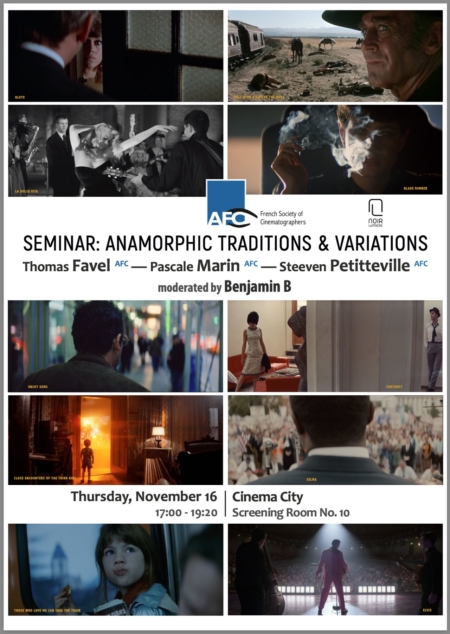
This seminar, moderated by Benjamin B, also treats anamorphic lenses, but the seminar puts anamorphic lenses into a historical context. We go through the period 1959 and up to modern times by looking at examples of films that have used anamorphic lenses, what they are achieving by using them, and how it can be seen against larger trends and traditions. The panel consists of the AFC members Marine Pascale, Thomas Favel, and Steeven Petiteville.
We start off with how “Ben-Hur” (1959) used 65mm film paired with Ultra Panavision 70 lenses to achieve an epic, ‘larger than life’ aesthetic with a 2.76:1 format. This film helped launch the American tradition with anamorphic lenses and how this format became associated with bigger blockbusters and the elusive concept of something ‘epic’.
Then we move on to a couple of European films from the same period. We look at how they use anamorphic lenses in a different way; In “Le Mépris” (1963), Jean-Luc Godard and Raoul Coutard used anamorphic in small, intimate scenes, not to convey grandeur and ‘epicness’ but rather the distance and ‘coldness’ that exists between the two characters. Placing them far apart from each other in the anamorphic format implies a feeling of alienation and solitude within the frame. This feeling of alienation is also further helped by the distortion of the characters on the edges of the anamorphic frame. “La Dolce Vita” (1960) is also used as an example of how anamorphic lenses are used to create a bigger space for the characters to move around in. These two films can be said to use anamorphic lenses more as a narrative tool and something used actively to shape how the mise-en-scène plays out within many of their shots.
“Once Upon a Time in the West” (1968) uses the anamorphic lenses and puts the American ‘epic’ aesthetics back into a European perspective. It is interesting to note that the director Sergio Leone also directed the chariot scene in Ben-Hur, so this aesthetic might have been an influence on him when achieving the look for his film. “Once Upon a Time in the West” is also known for striking extreme close-ups, something not very often utilized on anamorphic lenses at that time. The contrast between these close-ups and the wide anamorphic shots is jarring and contributes to the power of some of the sequences in the film.
We move on to more recent films and examples looking at, amongst others, “Lost Highway” (1997) and how it treats frames within frames, and “Selma” (2014) which is mixing both spherical and anamorphic lenses as a reflection of what the sequences are trying to emphasize. It shows us that nowadays it has become more common to mix and match different sets of lenses within films.
Finally, it is interesting to see how the trends of the anamorphic use in films today are often looking for ‘flaws’ and optical distortions, which would have been considered negative qualities in the past. This can also be attributed to the rise of shooting on digital in the last decade. Having cleaner and sharper images is not necessarily a quality that is desirable. It goes back to the discussion and the points raised earlier by Linus Sandberg, Oren Soffer, and Christopher Probst: unlocking visual memories from the past and creating art by rendering reality in an impressionistic way.
Leitz: Arts, Science, and Magic
A point of view from a lens designer’s perspective: Peter Karbe is the Head of the Optical Development Department at Leica in Wetzlar, Germany. He is the person responsible for developing new lenses in keeping with the famous “Leica Look”. The session was moderated by Seth Emmons, the director of communications for Leitz cine lenses.
He first takes us through the history of Leica still camera systems and moves on to the very technical parts of how lenses are constructed. We go through topics like spherical vs. aspherical glass, the way monochromatic aberrations are interpreted, how light diffraction is controlled inside a lens, and how chromatic aberration is minimized. He talks about techniques like multicoating of glass elements and/or adding more glass elements inside a lens to technically optimize its performance. We also get an insight into how floating glass elements are built into certain lenses to minimize focus breathing and to increase lens performance across the focus range. Adding more elements comes at the price of adding weight and cost of producing the lenses.
We then go through how the modulation transfer function (MTF) curve is an information-dense metric that reflects how any given lens reproduces contrast as a function of spatial frequency resolution and apparent sharpness.
He compares three different Leica cinema glass series and their sharpness as well as how their focus falloff behaves: The Hugo’s (Basically Cine-rehoused Leica M Still-lenses), Leica Summilux C (Super 35), and the new Elsie series (Full Frame).
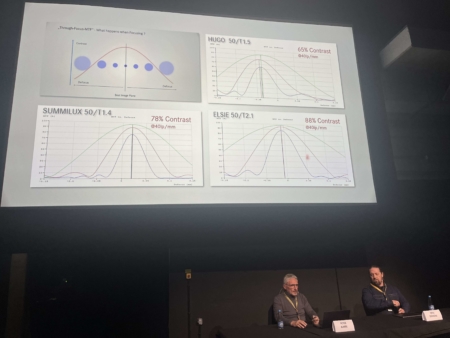
The Hugo series is lighter in weight and size because it is based on lenses intended for Photography (Leica M photography lenses). It has fewer glass elements inside, thus more focus breathing, more chromatic aberration, and the lenses with the least contrast. Since it has the least contrast, it is also the lens that will have the smoothest/less steep transitions between the out-of-focus planes in the image compared to the in-focus plane. (See MFT charts comparing the curves that represent the sharpness behavior of each lens series under)
The Leica Summilux C, introduced in 2011, was designed for film cameras. Leica wanted to achieve a high degree of sharpness and contrast in these lenses, a quality much sought after by the film industry at that point, but a feature that has been less desired after the rise in popularity of digital cameras. This also explains why the Summilux C series are sharper than the later introduced Summicron C series, which take into consideration the digital film camera trends (wanting to break the ‘harshness’ of digital sensors). The Summilux C series have a lot more glass elements inside than the Hugos, both to minimize chromatic aberration, minimize focus breathing, and increase contrast. The added contrast leads to a steeper focus falloff between the focused area and the out-of-focus areas.
The latest edition of cinema glass developed by Leica is the Elsie series. They cover full-frame sensors like the Hugo lenses, but they are, like the Leica Summiluxes, optimized to minimize focus breathing and chromatic aberration. Because of this, they have more glass elements in them, are heavier, and they have a T-stop of 2.1 wide open, whereas the Hugos are T 1.5.
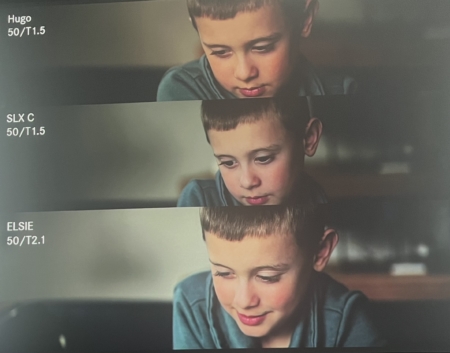
It interesting is to note that the Hugo lenses are warmer in character than the Summilux and Elsies. This has to do with the choices of glass inside and how they are coated.
P+S Technik & Otto Nemenz Seminar: Lawrence Sher, ASC about Lenses
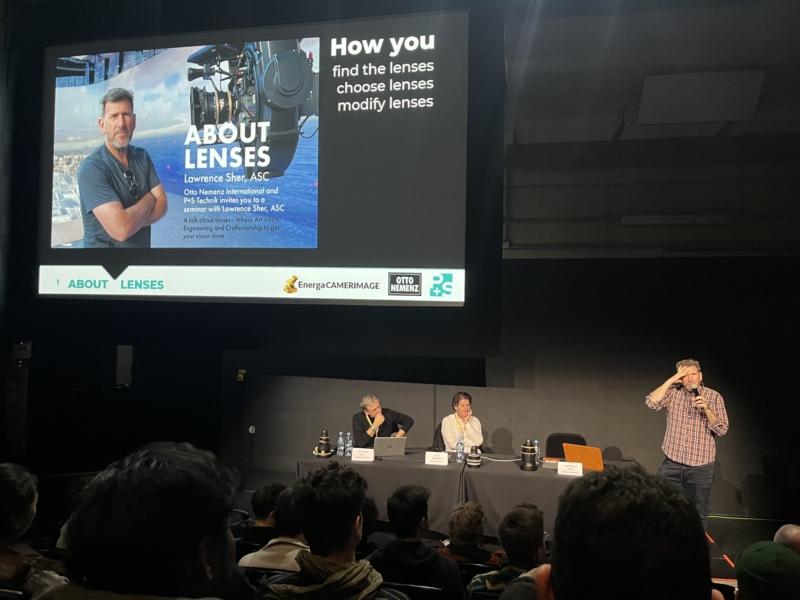
This seminar underlines the communication and collaboration in adapting lenses for specific projects. It takes form as a discussion between the creative (DOP – Lawrence Sher), the practical (Rental house Otto Nemenz – Fritz Heinzle), and the technical (P+S Technik – Gerhard Baier).
Lawrence Sher speaks firstly on some important general factors he wants to have in lenses he shoots with. These factors are: decent close focus, speed, sensor/film coverage, weight. He wanted to use Technovision lenses on the film ‘Black Adam’ (2022). These vintage anamorphic lenses presented the wanted visual characteristics and ‘flaws’ that Sher found to correspond to his needs for the project. Sher also pointed out that anamorphic lenses with character are useful when shooting sequences in an LED volume, blending foreground elements and the LED wall in a very organic way through the imperfections of the lenses.
He wanted, however, several modifications done to the original lenses, so he went to Fritz Heinzle at the rental house Otto Nemenz in California with the following requests: He wanted closer focus and that they cover full frame, and without significantly altering their weight or T-Stops. They sat down together with Gerhard Baier to figure out how to achieve this.
P+S Technik managed to alter and adapt the old Technovision lenses (2x squeeze, 3 feet close focus) to cover full-frame cameras (with a 1.5x squeeze) with a significant improvement in close-focus (1 feet 2 inches on the 75mm and 100mm, 1 feet 7 inches on the 40mm and 50mm), still within keeping the weight acceptably light and the T-stops consistent with the older series (T.2.2-2.5). They managed to do this by changing lens elements inside and re-doing and re-manufacturing mechanical parts on the lenses while still keeping their original pictorial character.
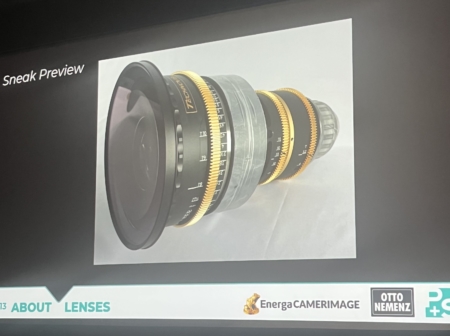
Technovision full frame anamorphic lenses with 1.5x Squeeze and impressive close focus
Finally, Lawrence Sher also mixes and matches several lenses on several of his projects; he often uses 3-4 different lens sets on his shoots, using them wherever he feels they suit his needs the best. He is a big proponent of always testing a lot of lenses for every project he undertakes.
Astera Presents: Lens Flares For Creative Use with Markus Förderer, ASC, BVK
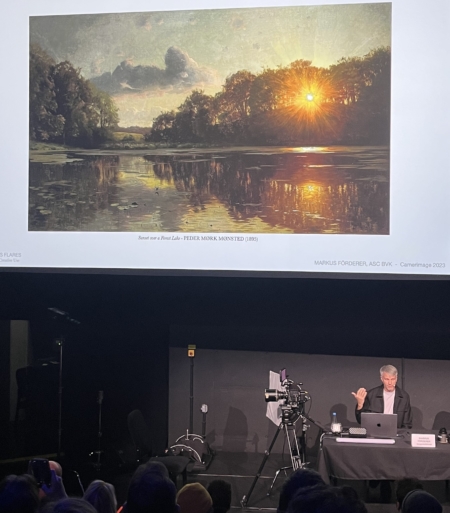
Flare characteristics represented in paintings
Markus Förderer shared his thoughts on lens flares in this seminar. The flaring of lenses is many times associated with very pronounced effects and with the horizontal ‘streaks’ that can occur when utilizing anamorphic lenses. This is certainly a part of how anamorphic lenses can behave and sometimes also simulated by cinematographers on spherical lenses, but Markus gives us examples from his work that showcases more subtle uses for lens flares. One of the examples is a scene in “Independence Day: Resurgence” (2016), where the characters walk into the UFO for the first time. The faces of the two characters in front are in shadows, and the character in the back is using a flashlight in the scene. The characters in the front then discover something as they advance, and the character in the back hits the lens with the flashlight at this moment (carefully choreographed). This lifts the shadows in the image, thus revealing the reaction of the two characters in the front, through flaring, rather than adding additional lighting.
He continues with some practical examples at the seminar, with a model, a keylight, and a portable, battery-driven RGB Fresnel light for backlighting and flaring examples. Through movement and different positioning, he changes the lens flare-response to different light positions relative to the lens (A Hawk V-lite anamorphic). He then changes the color and saturation of the RGB Fresnel to show that the lens flares also reflect the color of the light source used for the flaring.
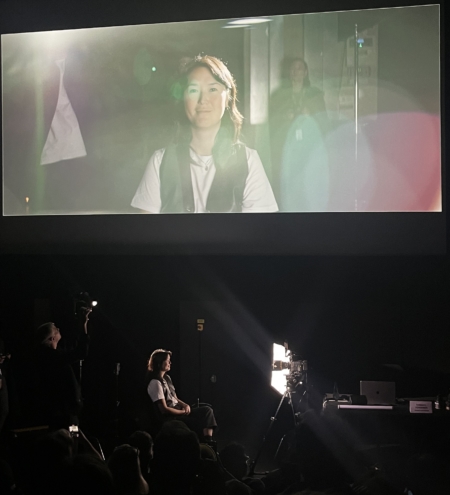
Flaring with hard backlight
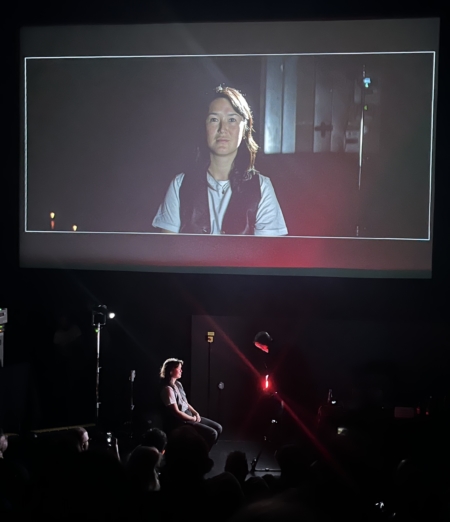
Flaring with red saturated color to create a coplight effect in the lens.
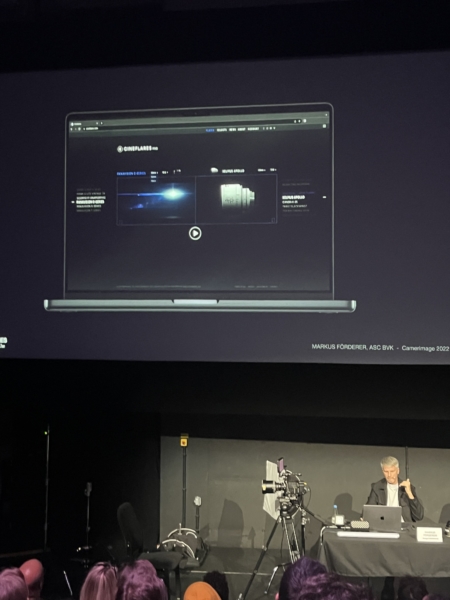
Markus also makes a point that all lenses flare differently. Through extensive testing on different lenses and lens sets, he has released a free online tool called Cineflares (signup.cineflares.com). This tool helps to compare the flaring characteristics of many different lenses and sets. You can choose between spherical and anamorphic lenses, choose your focal lengths, and at what T-stop you want to see the flaring behavior. You can choose two lenses at a time, and the videos of them will be played side by side in order to look at their similarities and differences. It looks to be an impressive tool that can be very useful for cinematographers.